Artificial intelligence is becoming a standard part of legal technology, but not every AI tool works in the same way.
Two terms are increasingly used across legal operations and contract management: AI copilots and AI agents.
They are sometimes used interchangeably, but the difference is important. A copilot primarily assists a user. An agent can go further by taking actions, coordinating steps, and completing parts of a workflow with a greater degree of autonomy.
For legal teams already evaluating a Legal AI Assistant or broader Legal AI Automation, understanding this distinction is essential. The right approach depends on the complexity of the work, the level of control required, and how much of the legal workflow the organization wants AI to manage.
What Is an AI Copilot for Legal Teams?
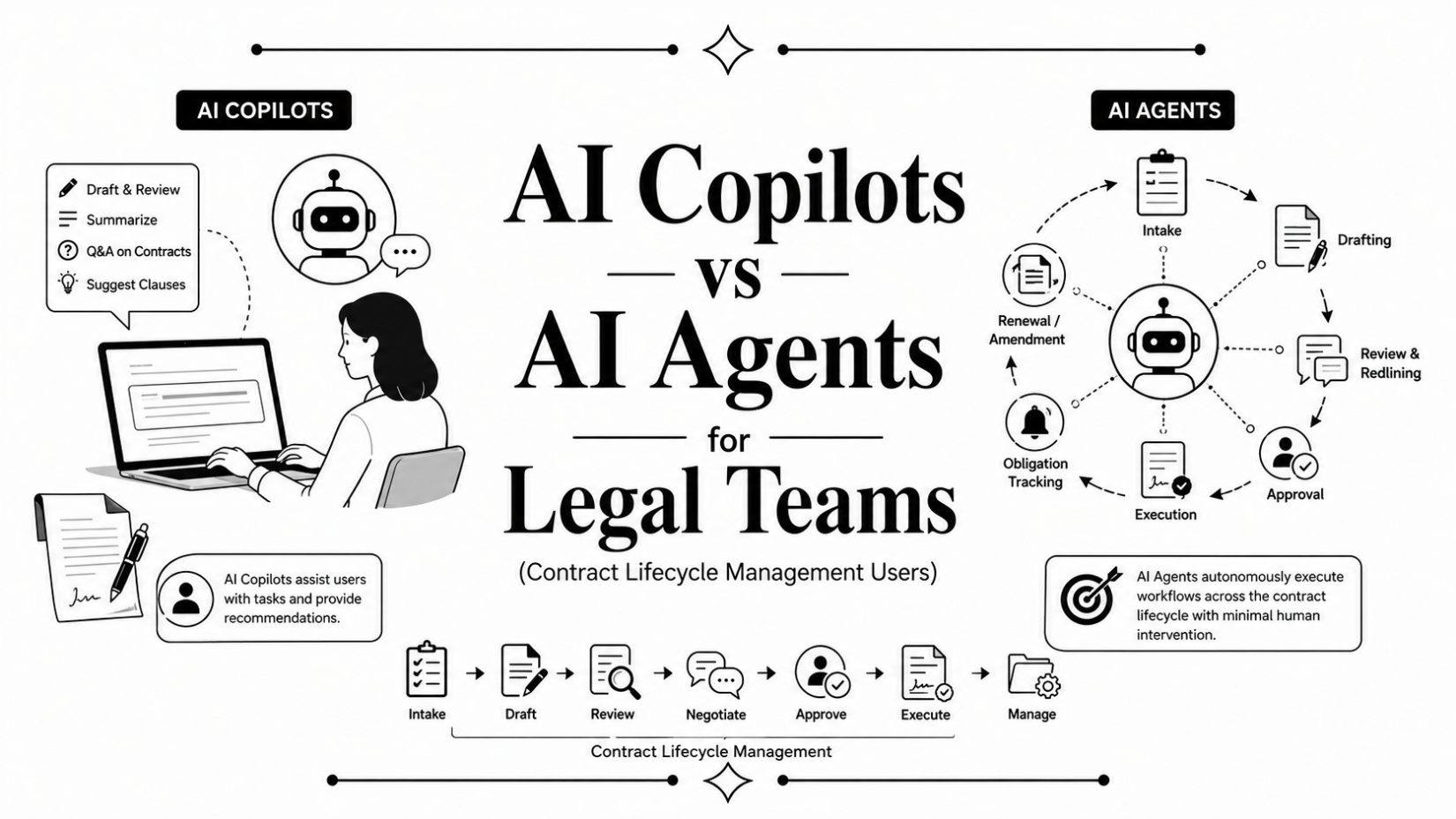
An AI copilot works alongside a legal professional. The user remains in control of the process and typically initiates each interaction. The AI analyzes information, generates suggestions, summarizes documents, drafts language, or answers questions, but a person decides what happens next.
Consider a lawyer reviewing a supplier agreement.
A legal AI copilot might:
- Summarize the contract
- Identify potentially risky clauses
- Compare provisions against a legal playbook
- Suggest alternative wording
- Explain specific contractual terms
- Draft a response to a counterparty
- Answer questions about the agreement
The lawyer reviews the output and decides whether to accept, reject, or modify the recommendation.
This type of Legal AI Assistant can significantly reduce repetitive work without fundamentally changing who controls the workflow. For many legal departments, copilots are a natural starting point because they improve productivity while preserving a familiar human-led review process.
What Are AI Agents for Legal Teams?
AI Agents for Legal Teams take the concept further. Instead of simply responding to a prompt, an AI agent can be assigned an objective and determine what actions are required to achieve it.
For example, an agent could receive a new sales contract and automatically:
- Identify the contract type.
- Extract important commercial and legal terms.
- Compare clauses against the organization’s playbook.
- Calculate a risk score.
- Route the agreement to the appropriate reviewer.
- Suggest revisions to non-standard provisions.
- Trigger additional approval if certain risk conditions are detected.
- Track the contract until the next stage of the workflow.
The significant difference is that the user does not necessarily have to initiate every individual step.
The agent operates within predefined permissions, policies, and business rules to move the process forward.
This represents a more advanced form of Legal AI Automation.
Copilot vs Agent: The Difference Is Action
The simplest way to understand the distinction is this:
A copilot helps you do the work. An agent can perform parts of the work for you. Suppose a legal team receives a customer contract containing a limitation-of-liability clause. A copilot may identify that the clause does not comply with the company’s preferred position and recommend replacement language.
An agent could identify the same issue, insert an approved fallback clause, classify the contract as requiring legal approval, assign it to the appropriate lawyer, and update the workflow automatically.
Both approaches use AI, but the level of autonomy is different.
This distinction becomes particularly important as organizations begin integrating AI with contract repositories, approval workflows, CRM systems, eSignature platforms, and other enterprise applications.
Where Legal AI Copilots Make the Most Sense
Copilots are especially useful for activities where professional judgment remains central. Contract drafting and negotiation are good examples. A lawyer may want AI assistance with identifying issues or suggesting language but may not want the system making changes or communicating externally without review.
Typical copilot use cases include:
- Drafting contractual provisions
- Summarizing agreements
- Reviewing redlines
- Comparing clauses
- Legal research assistance
- Identifying contractual risks
- Generating negotiation suggestions
- Asking questions across contract documents
The advantage is speed without losing direct human oversight.
For teams adopting AI for the first time, this model can also make implementation easier because existing processes do not need to be completely redesigned.
Where AI Agents Create Greater Value
Agents become particularly valuable when legal work involves repetitive, rules-driven processes. Consider contract intake. A legal department may receive hundreds of requests every month. Someone has to determine the contract type, identify the requester, understand the value, assess the risk, find the correct template, and route the request.
Much of this work can potentially be managed by an AI agent.
Other agent-driven workflows could include contract triage, approval routing, obligation monitoring, renewal management, repository classification, metadata extraction, and escalation of high-risk agreements. In these scenarios, AI Agents for Legal Teams can reduce operational workload rather than simply making individual tasks faster.
That is an important difference.
Saving five minutes while reviewing a document is useful. Removing several manual steps from thousands of contracts can have a much larger operational impact.
AI Agents Still Need Guardrails
Greater autonomy also creates greater responsibility. Legal teams should not think of AI agents as systems that operate without controls. The most effective agentic workflows should have clearly defined boundaries around what AI can do independently and where human approval is required.
For example, an agent might be allowed to automatically approve a standard NDA generated from an approved template but require legal review if the counterparty modifies liability, confidentiality, or governing-law provisions.
Organizations should establish controls around:
- User permissions
- Approval thresholds
- Approved templates and clauses
- Audit trails
- Escalation rules
- Data access
- Risk classifications
- Human review requirements
The objective of Legal AI Automation should not be maximum autonomy. It should be appropriate autonomy.
The Future Is Likely to Combine Both
The choice between copilots and agents does not need to be binary. Modern legal teams are likely to use both. Copilots will assist professionals with work requiring judgment, interpretation, and negotiation. Agents will increasingly coordinate repetitive processes, monitor contracts, route work, and execute predefined actions.
A lawyer reviewing a complex enterprise contract may work with a Legal AI Assistant, while multiple AI agents operate behind the scenes to classify the agreement, track approvals, update metadata, and monitor deadlines.
At Legitt AI, we believe this combination represents an important evolution in contract management.
The first generation of legal AI helped people work faster. The next generation will help legal teams redesign how work gets done.
The real opportunity with AI Agents for Legal Teams is not to remove legal professionals from the process. It is to remove repetitive coordination, administration, and low-value manual work so legal teams can focus on decisions where their experience and judgment matter most.