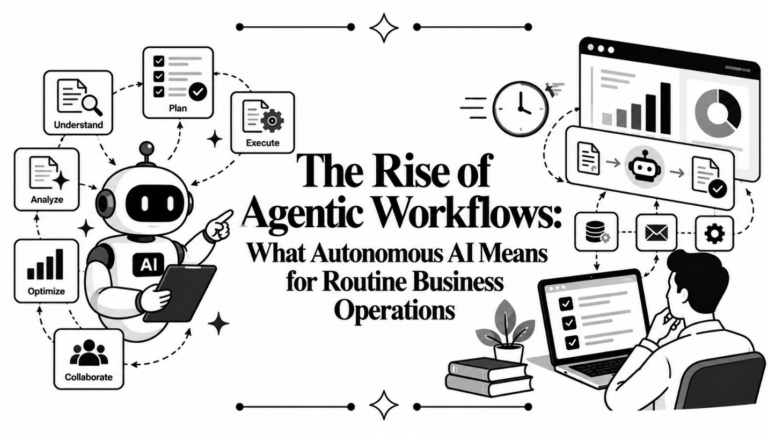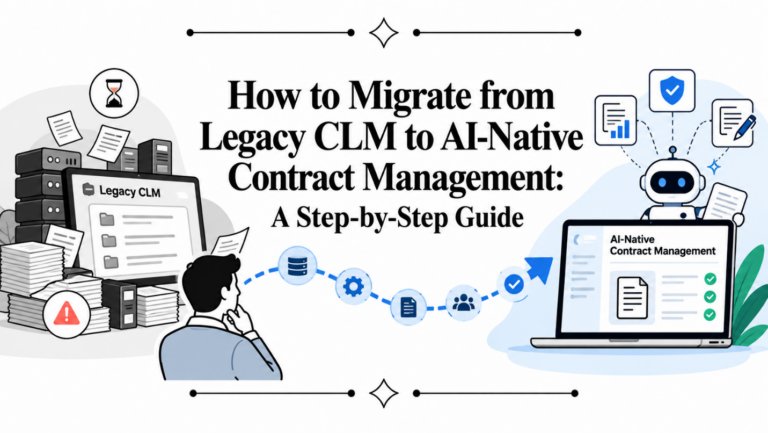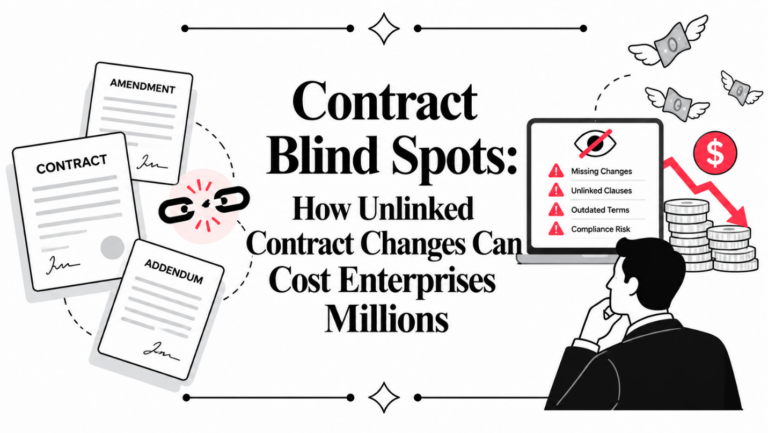

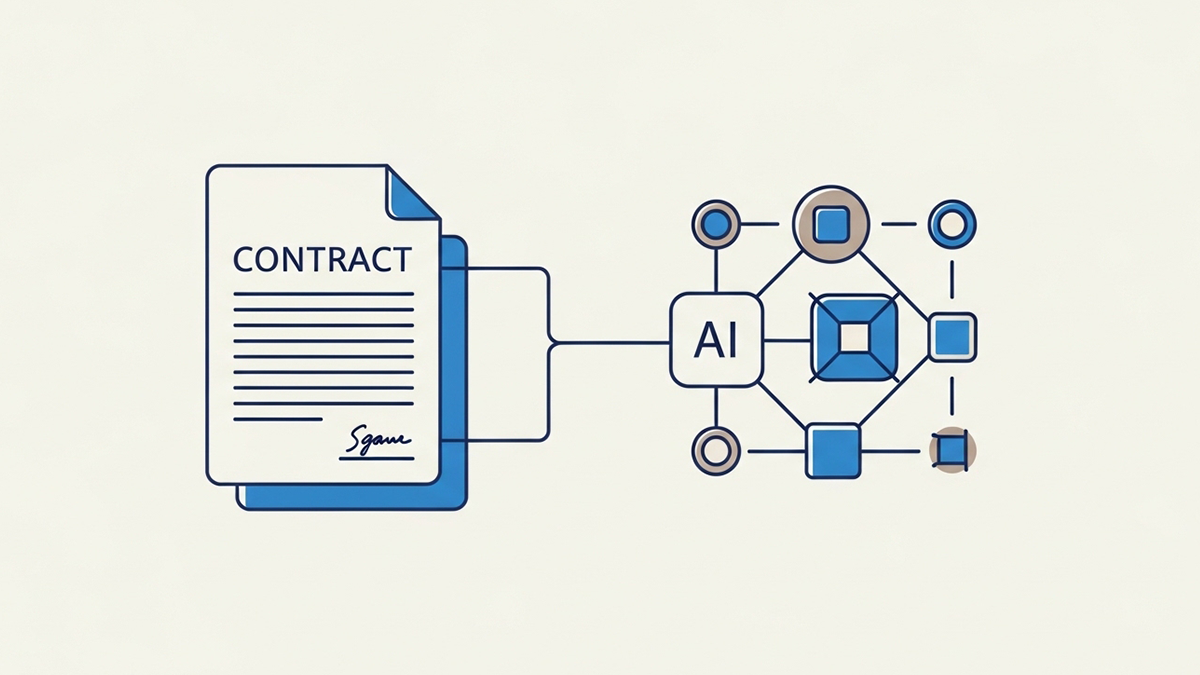
For most organizations, “modern contract management” has meant workflow automation: route a contract request, generate a draft from a template, push approvals through a queue, collect signatures, store the final PDF, and set a renewal reminder. That model was a real improvement over email chains and shared drives. But it has reached diminishing returns. In 2026, the most important shift in contract technology is moving from workflow automation to agentic contract operations-where AI agents don’t just move documents; they execute contract work end-to-end under governance.
IBM describes agentic AI as systems that can accomplish a goal with limited supervision, often using multiple coordinated agents. Oracle similarly frames agentic AI as systems capable of autonomous decision-making about how to achieve goals and then executing those decisions. Applied to contracting, that means AI agents can plan and run contracting tasks: drafting from CRM/ERP data, detecting deviations from playbooks, routing approvals only for exceptions, extracting obligations, monitoring key dates, and triggering renewal workflows.
World Commerce & Contracting (WorldCC) highlights how AI is expanding across the contract management lifecycle, including post-execution work such as obligation extraction, allocation, monitoring key dates, and tracking performance of obligations-precisely the work that agentic contract operations are built to handle continuously.
In short: workflow automation optimizes process flow; agentic contract operations optimize contract outcomes.
Why workflow automation is no longer enough
Workflow automation solved obvious problems:
- contracts moved through consistent stages
- approvals were tracked
- templates were centralized
- signatures became digital
- repositories became searchable
But even well-automated workflows still leave core business gaps:
1) Interpretation bottlenecks remain human-only
A workflow can route a contract, but it can’t reliably interpret whether a clause deviates from policy, whether a termination right creates churn risk, or whether payment triggers will delay invoicing-unless it has intelligence.
2) Post-signature value leakage persists
Most organizations manage contracts intensely before signature and weakly after signature. Obligations get missed, renewal notice windows slip, and performance commitments remain buried in PDFs. WorldCC explicitly calls out post-execution activities-obligation extraction, monitoring key dates-as key focus areas for AI in contracting.
3) Automation without intelligence hits diminishing returns
If the system only automates routing, the most expensive work still happens manually:
- reviewing redlines
- identifying risky deviations
- extracting obligations
- tracking renewals and notice periods
- creating operational tasks from contract terms
That is why the next step is not “more workflow.” It’s agentic execution.
What are agentic contract operations?
Agentic contract operations is an operating model where AI agents coordinate to run contract lifecycle work with:
- goal-driven planning (e.g., “get to signature within policy”)
- tool use (templates, clause libraries, eSignature, CRM/ERP integrations)
- verification (check deviations, validate required clauses, confirm data integrity)
- escalation (route only when policy triggers fire)
- continuous monitoring (obligations, renewals, compliance deadlines)
Sirion describes agentic AI in contract management as going beyond chatbots into end-to-end orchestration. Icertis frames agentic workflows as AI systems designed to achieve business goals autonomously-under structured processes.
In practice, agentic contract operations usually involve multiple specialized agents, such as:
- Intake Agent: validates inputs, selects contract type and risk tier
- Drafting Agent: assembles a first draft from templates and data
- Review Agent: detects deviations, flags risk, suggests fallback clauses
- Approval Agent: routes exceptions, chases approvals, enforces playbooks
- Obligation Agent: extracts obligations, assigns owners, creates tasks
- Renewal Agent: tracks renewals, notice windows, triggers playbooks
This is not “automation with AI sprinkled in.” It is an orchestrated agent system built to execute contracting as an operational function.
Workflow automation vs agentic operations: the real differences
1) From stage-based to outcome-based contracting
Workflow automation says: “Move contract from step A to step B.”
Agentic operations say: “Achieve the outcome: compliant contract executed, obligations tracked, renewals controlled.”
2) From always-human review to exception-based review
Workflow automation often routes everything similarly.
Agentic operations route based on deviations, risk thresholds, and confidence.
3) From static storage to living contract performance
Workflow automation ends at signature for many teams.
Agentic operations treat signature as the start of performance management: obligations, deadlines, renewals.
4) From repository search to contract intelligence
Workflow automation repositories help you find documents.
Agentic operations generate portfolio intelligence: renewal exposure, obligation backlogs, deviation trends.
How agentic operations transform each lifecycle stage
Stage 1: Intake and request (reduce friction before drafting)
In workflow automation, intake is often email + form + manual clarification.
In agentic operations, an Intake Agent:
- classifies request type (NDA, MSA, SOW, vendor agreement)
- checks required inputs (pricing schedules, DPA requirements, jurisdiction)
- identifies missing fields and requests them automatically
- selects the right template and routing pathway
Outcome: fewer stalled requests and shorter time-to-first-draft.
Stage 2: Drafting (contracts assembled from live enterprise data)
Drafting is often the largest cycle-time bottleneck. Agentic drafting:
- pulls CRM/ERP terms (counterparty, pricing, dates, region)
- selects clause variants based on policy and geography
- generates the first draft with consistent formatting and definitions
Outcome: faster quote-to-contract and vendor onboarding cycles with fewer errors.
Stage 3: Review and negotiation (playbooks become enforceable)
Playbooks often exist but are not operationalized. A Review Agent:
- compares redlines against standard language
- flags deviations in liability, termination, data, payment, SLA terms
- proposes fallback clauses consistent with policy
- summarizes changes in business terms (not just legal terms)
Outcome: fewer negotiation cycles and faster escalation when needed.
Stage 4: Approvals (risk-aware exception routing)
In workflow automation, approvals are queues.
In agentic operations, approvals are triggered by exceptions:
- within threshold → auto-approve or fast-track
- outside threshold → route to legal/finance/security depending on deviation
- missing clause → block progression until fixed
Outcome: fewer approval loops and less legal overload.
Stage 5: Post-signature (continuous contract tracking becomes real)
This is the biggest shift. WorldCC highlights AI’s role in:
- obligation extraction and allocation
- monitoring key dates
- tracking performance of obligations
An Obligation Agent can:
- extract obligations/milestones
- assign owners and deadlines
- create tasks and reminders
- escalate overdue items
Outcome: fewer missed obligations, fewer surprises, stronger delivery quality.
Stage 6: Renewals and expansion (renewal risk becomes manageable)
A Renewal Agent tracks:
- renewal dates
- auto-renew language
- notice windows
- renewal pricing mechanics
Then triggers playbooks early (90/60/30 days).
Outcome: improved retention and fewer “we missed the notice window” failures.
The governance layer: what makes agentic safe
Agentic contract operations are powerful, but they must be governed. The governance layer is what separates “automation” from “risk.”
A production-grade agentic framework requires:
- Policy rules and playbooks: what’s allowed vs must escalate
- Confidence thresholds: when the agent can act vs must ask
- Audit trails: every change, every decision, every escalation reason
- Role-based permissions: what each agent can do
- Human-in-the-loop checkpoints: for high-risk clauses or low-confidence outputs
- Fallback procedures: when data is missing or integrations fail
Icertis’ framing of agentic workflows as goal-driven systems underscores why governance is essential-autonomy without guardrails is not enterprise-ready.
The business outcomes: why companies are adopting agentic operations
Organizations shift to agentic contract operations to drive outcomes that workflow automation can’t consistently deliver:
- Shorter contract cycle times (time-to-first-draft, review loops, approvals)
- Lower legal workload on routine contracts (exception-based review)
- Improved obligation completion (tracked tasks with owners)
- Better renewal capture (notice windows surfaced early)
- Fewer disputes (contract truth visible and actionable)
- Portfolio-level contract analytics (renewal exposure, deviations, risk concentration)
This is the difference between managing contract flow and managing contract performance.
Where Legitt AI fits: lifecycle automation + intelligence + tracking
Legitt AI positions itself as an AI-native contract lifecycle management platform focused on drafting, review, management, signing, and tracking-aligned with the move from workflow to intelligence-driven operations. You can review the platform’s framing at https://www.legittai.com.
For the lifecycle workflow and automation positioning (which maps cleanly to intake → draft → review → execute → track), see https://legittai.com/contract-management-software.
In the agentic operations context, the relevance is straightforward: agentic contract operations require a platform that can both manage lifecycle steps and operationalize post-signature tracking. Systems that stop at signatures can’t fully support the “operations” part of agentic contracting.
Implementation path: how to move from workflow automation to agentic operations
If you already have workflow automation, don’t rip it out. Layer agents where they create immediate ROI.
Step 1: Start with one workflow bottleneck
- quote-to-contract acceleration
- vendor onboarding
- renewal tracking
- obligation extraction
Step 2: Encode playbooks and thresholds
Define what’s “auto” vs “escalate”:
- liability cap thresholds
- termination rights flags
- mandatory clauses by region
- data/security requirements
Step 3: Deploy 2–3 agents first
- Drafting Agent
- Review/Deviation Agent
- Obligation/Renewal Agent
Step 4: Integrate into existing systems
- CRM/ERP
- eSignature
- tasking and alerts (email, Slack, ticketing)
Step 5: Measure and iterate
Track:
- time-to-first-draft
- approval latency
- number of escalations
- missed renewals/notice windows
- obligation completion rates
Then tighten playbooks and thresholds based on real outcomes.
Bottom line
Workflow automation improved contracting by moving documents through consistent stages. Agentic contract operations improve contracting by executing contract work end-to-end, converting contract language into tasks, alerts, and decisions-especially after signature where most organizations still lose value.
In 2026, the move from workflow automation to agentic contract operations is the next major evolution in contract lifecycle management.
Agentic contract operations are contract workflows executed by AI agents that can plan, act, verify, and escalate under governance. IBM describes agentic AI as achieving goals with limited supervision, often via multiple coordinated agents. In contracting, agents draft, review, route approvals, track obligations, and manage renewals.
Workflow automation routes documents through stages, but it usually doesn’t interpret contract meaning deeply or manage post-signature performance. Agentic operations are outcome-driven: they detect deviations, enforce playbooks, and continuously track obligations and renewals. The difference is “move the contract” vs “run the contract.”
No. A chatbot answers questions and summarizes content. Agentic AI executes tasks end-to-end and orchestrates workflows. Sirion explicitly positions agentic AI as beyond a smarter chatbot and closer to an orchestrator.
Because that’s where contracts impact real business outcomes: obligations, milestones, renewals, notice windows, and compliance deadlines. WorldCC highlights AI’s role in obligation extraction and monitoring key dates after execution. Agentic systems keep contracts “alive” after signature.
You need playbooks, thresholds, role-based permissions, audit logs, human escalation checkpoints, and confidence thresholds. Without governance, autonomy increases risk. Icertis’ framing of agentic workflows emphasizes goal-driven autonomy, which requires strong guardrails in enterprise settings.
Start with high-volume, repeatable workflows: quote-to-contract, vendor onboarding, renewal monitoring, and obligation extraction. These have immediate ROI because they reduce cycle time and prevent missed obligations. Expand later into negotiation support and portfolio analytics.
Legitt AI positions itself around AI-native contract lifecycle management with drafting, review, management, signing, and tracking-capabilities that align with the move toward intelligence-driven operations. You can start with the Legitt AI website at https://www.legittai.com.
Track time-to-first-draft, approval latency, number of deviations escalated, missed renewals/notice windows, obligation completion rates, and dispute volumes. These metrics tie contract operations to revenue, risk, and execution outcomes. They’re stronger than “number of contracts stored,” which is a legacy metric.
Yes. Most organizations layer agentic capabilities onto existing CLM foundations rather than replacing everything. Agents can draft from templates, review deviations, and push tasks into your existing workflow and task systems. This is usually the fastest adoption path.
One reference point is the lifecycle positioning on the Legitt AI website at https://legittai.com/contract-management-software. Use it as a template for mapping agent roles across intake, drafting, review, execution, and tracking.
One reference point is the lifecycle positioning on the Legitt AI website at https://legittai.com/contract-management-software. Use it as a template for mapping agent roles across intake, drafting, review, execution, and tracking.