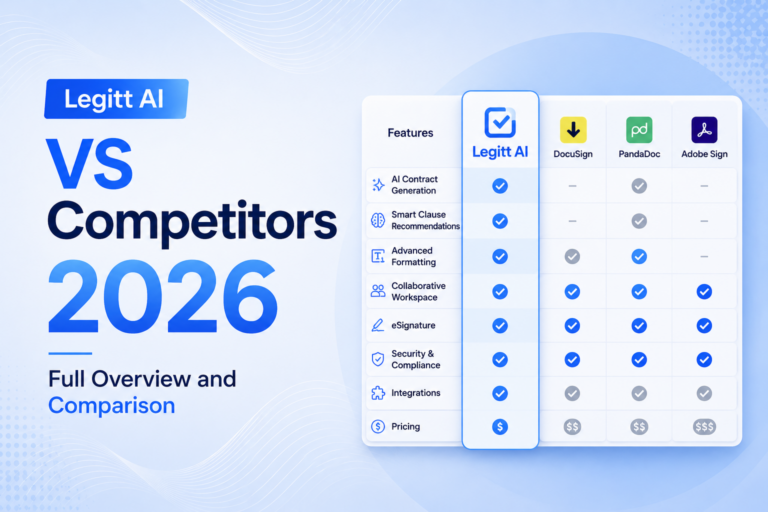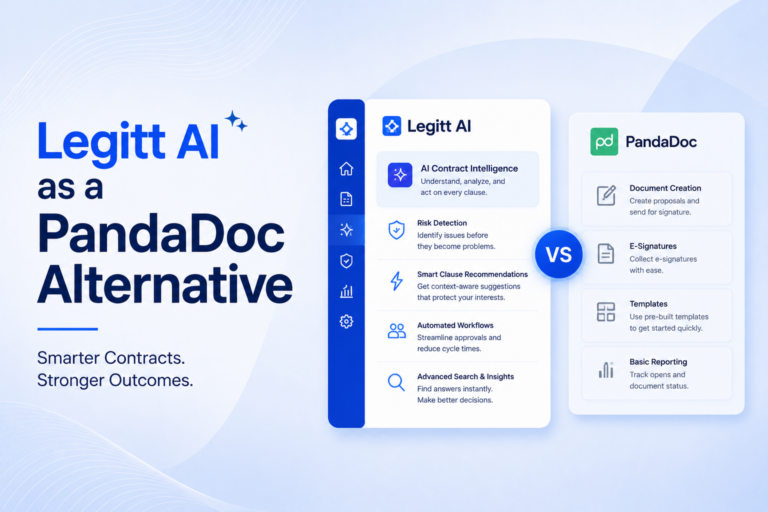

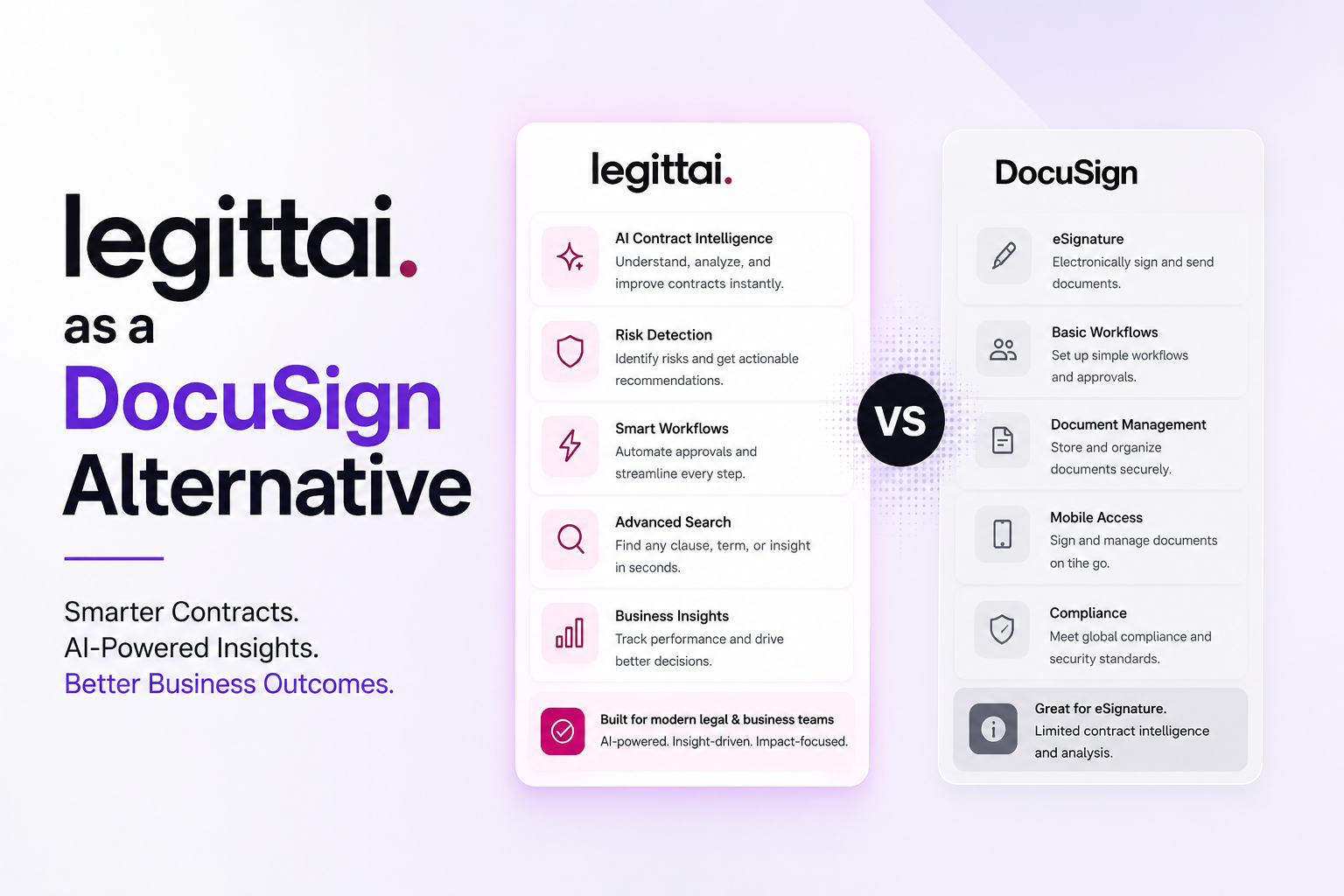
If your organization uses DocuSign primarily for eSignature, you already know the value: faster signing, audit trails, multi-party routing, templates, and compliance-oriented controls. DocuSign’s eSignature features emphasize tamper-evident storage and audit trails designed to support secure retention of signed documents.
But many teams in 2026 are looking for something more than “get it signed.”
They want an eSignature tool that also helps them run contract operations: automate routing, reduce missing fields and signature errors, and keep contracts operational after signature through tracking, alerts, and lifecycle visibility. That shift is driving demand for DocuSign alternatives that combine eSignature with AI-native contract intelligence.
This is where Legitt AI is positioned differently. Legitt AI markets an “eSignature Agent” that handles signing workflows (routing, reminders, sequencing, real-time tracking) and claims browser-based signing with no account required for clients. It also frames its eSignature offering as “more than signatures,” including AI-driven checks for missing fields and incomplete signatures before sending.
The result is a simple business proposition: if you’re evaluating a DocuSign alternative, you’re not only comparing signature capture-you’re comparing end-to-end agreement execution.
Why companies search for a DocuSign alternative
Organizations typically begin evaluating DocuSign alternatives for one (or more) of these reasons:
- Total cost and packaging complexity
Many teams start with eSignature and later add CLM. DocuSign itself positions eSignature and CLM as an end-to-end agreement stack that can expand as a company grows. Some organizations prefer a more unified bundle from day one. - Need for faster contract cycles, not just faster signatures
The signature step is only one part of the agreement lifecycle. Deal friction often happens earlier (drafting, review, approvals) and later (obligations, renewals). - Post-signature visibility and contract tracking
A signed PDF is not operational intelligence. Teams want obligation tracking, renewal alerts, and searchable contract intelligence without manual data entry. - Workflow simplicity for business users
The best DocuSign alternative is usually the one business teams actually adopt: fewer clicks, fewer handoffs, less “legal-only” friction.
DocuSign: what it’s excellent at
Before comparing alternatives, be precise about DocuSign’s strengths.
Secure signing experience and auditability
DocuSign emphasizes audit trails, chain-of-custody style evidence, and tamper-evident storage/retention capabilities-important in regulated environments.
Mature eSignature feature set
DocuSign’s eSignature feature pages highlight enterprise-grade signing workflows, retention options, and transaction integrity.
Expandability into CLM
DocuSign offers CLM as a separate product line, positioned around generating documents, negotiation/collaboration, workflow/signing, search/reporting, and integrations.
If your requirement is strictly “best-in-class eSignature with enterprise trust posture,” DocuSign remains a standard choice.
So when we talk about Legitt AI as a DocuSign alternative, the real question becomes:
Do you want eSignature as a standalone step, or do you want eSignature as part of an AI-native contract operations layer?
 Hi, What do you want to Draft?

Click to upload or drag & drop
pdf, docx up to 5 MB
Click to upload or drag & drop
pdf, docx up to 5 MB
Legitt AI as a DocuSign alternative: the positioning difference
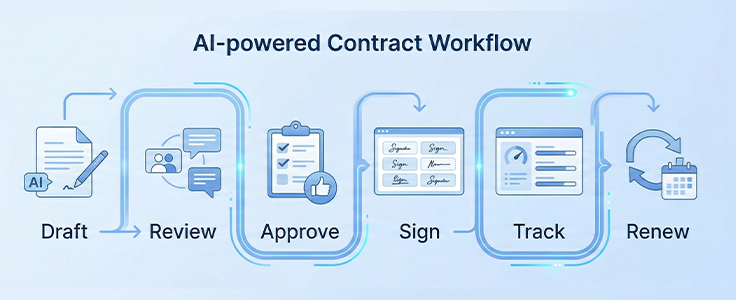
Legitt AI positions eSignature as part of a broader AI-native contract workflow-draft, review, sign, and then track what was agreed. It markets an “eSignature Agent” that handles signing workflow logistics (routing, reminders, sequencing, real-time tracking) and states that signers can sign in-browser without creating an account.
It also markets AI-driven pre-send checks to detect missing fields, incomplete signatures, and contract risks before sending.
That matters because many signing problems aren’t “signature problems”-they’re process problems:
- the wrong signer was added
- fields were missed
- the contract was sent before internal checks
- the signing workflow didn’t match approval reality
An AI-assisted eSignature workflow is positioned to reduce those avoidable loops.
What you should compare: DocuSign alternative checklist
If you’re evaluating Legitt AI as a DocuSign alternative, compare across these buckets:
1) Core eSignature capabilities
- Multi-party signing and routing
- Signing order/sequencing
- Reminders and notifications
- Templates
- Audit trails and evidence files
- Secure storage and retention
DocuSign’s feature set here is widely documented. Legitt’s eSignature pages position routing, reminders, sequencing, and tracking through the eSignature Agent.
2) Pre-send intelligence
This is where many DocuSign alternatives differentiate:
- detect missing fields before sending
- detect incomplete signer setups
- identify obvious issues earlier (reducing rework)
Legitt AI explicitly claims missing field and incomplete signature detection before sending.
3) Contract intelligence beyond signing
This is the big strategic difference. After signature, can the system:
- extract key terms
- track obligations and milestones
- monitor renewal and notice windows
- enable portfolio analytics (what’s renewing, what’s risky, what’s overdue)
DocuSign can address this through CLM, positioned as end-to-end contract management beyond eSignature. Legitt AI positions itself as an AI-native CLM platform with eSignature as one module, plus analysis and lifecycle workflows.
4) User adoption and workflow simplicity
Adoption is often the hidden ROI. The best contract tool is the one sales, procurement, and finance actually use without constant legal intervention.
Legitt AI markets “clients sign in their browser with no account required,” which is aimed at reducing signer friction.
5) Pricing model and packaging
DocuSign and Legitt have different packaging approaches; pricing will vary by region and plan, so it’s best treated as a direct vendor conversation rather than a generic claim.
The practical use case: when Legitt AI is a strong DocuSign alternative
Legitt AI tends to be most compelling as a DocuSign alternative in these scenarios:
Scenario A: You want eSignature plus AI-native contract workflows
If your pain is not just “sign faster,” but “close deals faster,” you likely need:
- faster draft generation
- faster review/redline handling
- faster approvals and routing
- faster signature
- better post-signature tracking
Legitt AI’s platform messaging includes contract generation and broader contract lifecycle tooling alongside eSignature.
Scenario B: You want post-signature tracking, not just document storage
DocuSign eSignature excels at signing and evidence. But businesses increasingly want lifecycle visibility after signature-obligations, milestones, renewals-without manual spreadsheet work.
Legitt positions “tracking” as part of its signing workflow and overall contract management story.
Scenario C: You want a unified experience for business teams
If your sales/procurement teams struggle with tool sprawl, a unified “draft + review + sign + track” platform can improve adoption and reduce handoffs.
Where to start if you’re evaluating Legitt AI as a DocuSign alternative
Start with the two simplest evaluation paths:
- Compare the signing workflow end-to-end
Can you: upload → place fields → route → remind → sign → track status → store with audit trail?
Legitt’s eSignature product page positions this as AI-assisted and workflow-managed.
- Validate the “beyond signing” value
After signature, can you quickly identify obligations, renewal dates, and key commercial terms across your repository?
That’s where the “contract intelligence layer” becomes the differentiator between a pure eSignature tool and a platform that treats signing as one step in contract operations.
If you want to review the product positioning directly, start at the Legitt AI website: https://www.legittai.com.
For the signing module details, review Legitt AI’s electronic signature page: https://legittai.com/electronic-signature/.
Bottom line
DocuSign is a mature, enterprise-grade eSignature standard with strong auditability and a broader CLM suite available as your needs expand.
Legitt AI presents a different “DocuSign alternative” story: an AI-native approach where eSignature is integrated into a broader contract intelligence and execution workflow, including AI-powered pre-send checks (missing fields/incomplete signatures) and workflow-managed routing and tracking.
If your goal is faster signatures, DocuSign is already excellent.
If your goal is faster agreements end-to-end-from draft to signature to post-signature tracking-Legitt AI is positioned as a credible DocuSign alternative worth evaluating.