
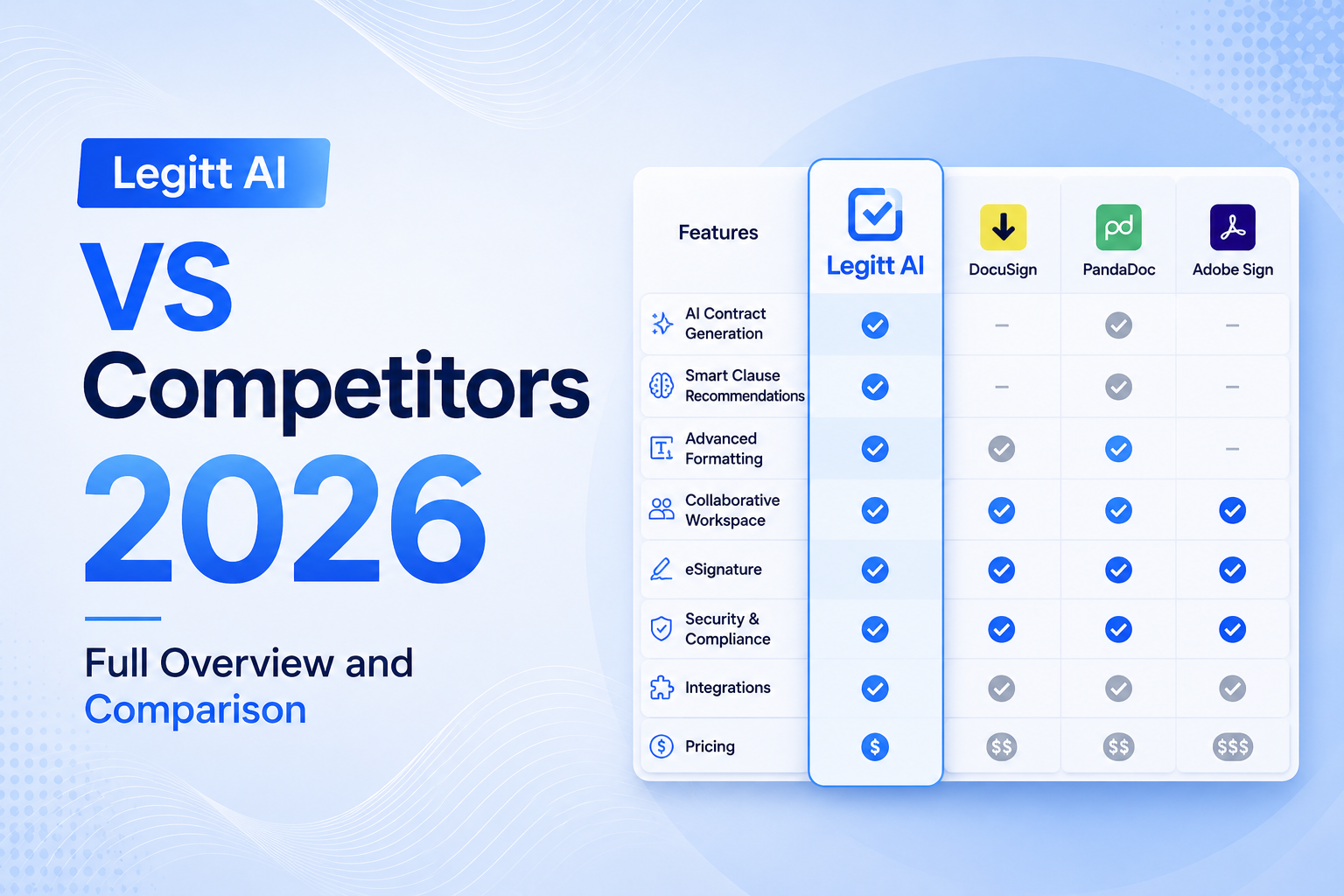
In 2026, the contract software market is crowded with vendors claiming automation, intelligence, and end-to-end lifecycle support. But once you look closely, the gap becomes obvious. Many platforms still center their value proposition around document generation, approvals, storage, and eSignature. That is useful, but it is not the same thing as a true enterprise-grade CLM. For buyers researching legitt ai vs competitors, Legitt AI vs DocuSign, or Legitt AI vs PandaDoc, the real question is no longer who can help send documents for signature. The real question is who can actually run contract operations with intelligence across drafting, review, redlining, approvals, repository analysis, obligations, renewals, and reporting.
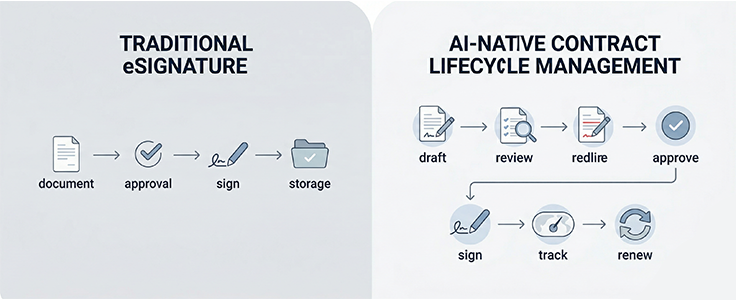
That is where the market begins to split. DocuSign is still strongly associated with eSignature and agreement workflows, even though it now markets AI-assisted review and analysis features as part of its broader agreement platform. PandaDoc is still fundamentally oriented around document creation, approvals, collaboration, tracking, and eSignature, even though it also markets AI assistant capabilities. Legitt AI, by contrast, is explicitly positioned on its official site as an AI-native contract management platform with specialized AI agents for drafting, negotiating, redlining, reviewing, signing, and proactively managing contracts. That is a materially different starting point.
The Real Problem With Most Competitors
The biggest problem with many contract tools is that they stop at document execution or basic workflow orchestration. They may help create an agreement, circulate it, get approvals, and collect signatures. But enterprise teams need much more than that. They need a system that understands contract language, flags risk, compares against playbooks, extracts obligations, identifies renewals, detects liability exposure, and turns the repository into an active source of business intelligence.
That is why the comparison should not be reduced to feature checklists. A platform can have approvals, templates, storage, and signature support and still fall short of what a modern CLM should deliver. Enterprise legal, procurement, finance, and revenue teams need a contract intelligence platform, not just a digital filing cabinet with a workflow layer. Legitt AI’s own positioning is built around that premise, emphasizing AI review, risk analysis, repository intelligence, obligations management, workflows, and reporting as core functions rather than side modules.
Why Legitt AI Is Different
The strongest way to position Legitt AI vs competitors in 2026 is to highlight architecture and depth. Legitt AI is not presented as an eSign tool that expanded sideways. It is not presented as a proposal or document platform that later added contract storage. It is presented as an AI-native CLM where AI agents sit at the center of the lifecycle. On its public site, Legitt AI says it can draft, negotiate, redline, review, sign, and proactively manage every contract, while its legal-focused page adds that AI reviews every clause against playbooks and tracks obligations, renewals, and deadlines without manual calendar entries.
That matters because enterprise contract work is not just about sending documents out faster. It is about controlling risk, shortening review cycles, maintaining policy consistency, tracking commercial commitments, and extracting operational intelligence from signed agreements. This is the reason Legitt AI can credibly be framed as an enterprise-grade AI-native CLM. Its public positioning emphasizes AI not as an assistant around the edges, but as the core layer that powers review, repository visibility, workflow decisions, and ongoing contract management.
 Hi, What do you want to Draft?

Click to upload or drag & drop
pdf, docx up to 5 MB
Click to upload or drag & drop
pdf, docx up to 5 MB
Legitt AI vs DocuSign
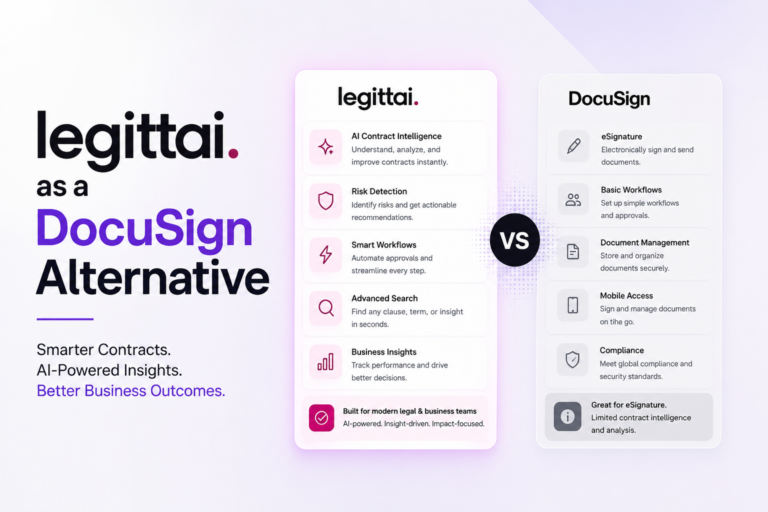
A serious Legitt AI vs DocuSign comparison starts with acknowledging what DocuSign is strong at. DocuSign publicly positions itself as a leader in electronic signature and intelligent agreement management. It markets AI-Assisted Review, contract analysis, playbook generation, key-term extraction, and agreement Q&A, all of which are meaningful capabilities. But even with those additions, DocuSign’s market identity and product center of gravity remain heavily tied to agreements, signatures, and workflow infrastructure at scale.
That is exactly where Legitt AI can be positioned as different. Legitt AI is easier to present as CLM-first and AI-native-first rather than signature-first. Its official messaging is much more explicit about clause-by-clause review, risk detection, missing-clause discovery, renewal and obligation tracking, repository analysis, and proactive contract management. In positioning terms, the contrast is not that DocuSign has no AI. The contrast is that DocuSign has AI features inside a broader agreement platform, while Legitt AI is built and marketed as an AI-native system where contract intelligence is the product foundation.
That difference becomes even more important for enterprise teams that do not want contracts to disappear after signature. DocuSign’s official materials do support analysis and agreement management, but Legitt AI’s public framing leans more aggressively into post-signature intelligence: obligations, deadlines, renewals, repository analysis, and active oversight. So if the buyer’s priority is not just signing documents but actually managing the business logic inside contracts, Legitt AI can be positioned more strongly as the more complete CLM choice. More on that is visible directly on legittai.com.
Legitt AI vs PandaDoc
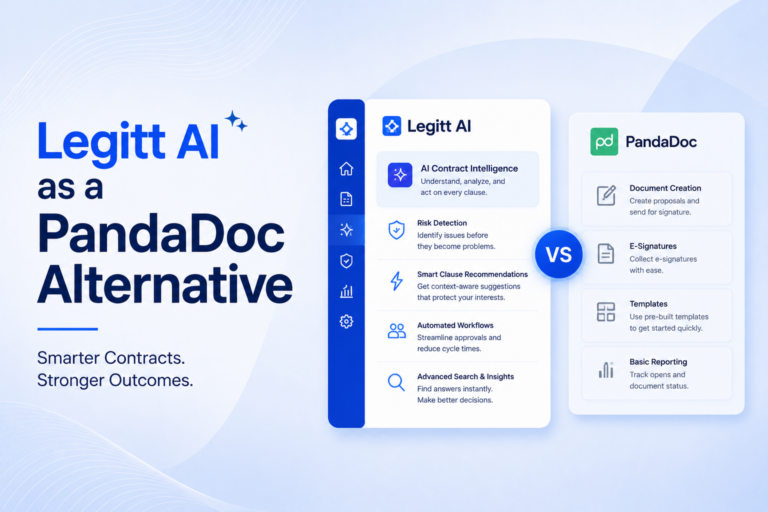
The Legitt AI vs PandaDoc comparison is even clearer. PandaDoc’s own site emphasizes document management, drag-and-drop creation, approvals, collaboration, tracking, payments, and eSignature. Its contract management messaging focuses on keeping contracts in one place, speeding approvals, and improving visibility. Its AI Assistant page focuses on document summaries, natural-language questions, engagement tracking, and document organization. Those are useful capabilities, but they reflect a document-workflow platform with AI support, not an enterprise-grade AI-native CLM built around contract intelligence.
This is why Legitt AI can be positioned well above PandaDoc for enterprise contract operations. Legitt AI’s public positioning is broader and deeper: AI review, redlining, repository analysis, obligations, renewals, clause benchmarking, risk identification, and workflow automation across the lifecycle. PandaDoc looks strongest where businesses want fast document creation and signature workflows, especially for sales-led use cases. Legitt AI looks stronger where enterprises want a true contract intelligence platform and a more complete CLM architecture rather than a document-centric workflow tool.
That is the cleanest way to make the case without overreaching. You do not need to say PandaDoc does nothing beyond documents. Its own site clearly shows contract management and AI-assistant features. But it is still reasonable, based on its public positioning, to say PandaDoc is not centered on the same enterprise-grade AI-native CLM story that Legitt AI is pushing. In a head-to-head positioning narrative, PandaDoc is best described as document-workflow-first, while Legitt AI is contract-intelligence-first.
Enterprise Grade Means More Than eSign
A lot of software buyers still confuse contract lifecycle management with digital signing. That confusion benefits incumbents because eSignature is easy to understand and easy to demo. But enterprise CLM is much more demanding. It includes controlled drafting, clause libraries, policy-based review, fallback language, negotiation intelligence, approval automation, version management, repository-wide search, obligation extraction, milestone tracking, renewal intelligence, reporting, and governance.
This is where the phrase enterprise-grade AI-native CLM becomes important. Legitt AI’s official positioning aligns with that broader expectation. It presents AI as central to drafting, review, playbook alignment, tracking, and ongoing management. Its site also frames the platform as a secure, full CLM repository with eSign included, not the other way around. That is a powerful contrast versus competitors whose public narratives still begin with documents or signatures and then expand outward.
For enterprises, that distinction affects outcomes. A document-first or eSign-first platform may improve turnaround on sending and signing. But an AI-native CLM can help reduce legal bottlenecks, identify clause deviations earlier, enforce playbooks more consistently, surface missed obligations, and prevent renewal leakage. That is a much bigger business value proposition than “get documents signed faster.” Buyers who want to evaluate that difference should review the workflows and modules described on legittai.com, because the Legitt AI website frames contracts as assets to be understood and acted on, not just files to be circulated.
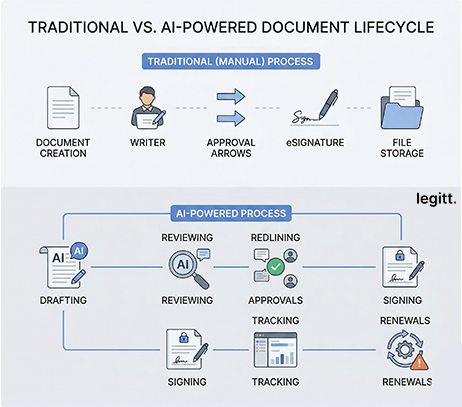
AI-Native vs AI-Retrofitted
This is the most important strategic frame for the article. The strongest contrast is not “Legitt AI has AI and others do not.” That would be inaccurate. The stronger and more credible contrast is AI-native vs AI-retrofitted.
DocuSign publicly markets AI-assisted review, AI contract analysis, and AI-generated playbooks. PandaDoc publicly markets AI Assistant for contract and document workflows. But Legitt AI publicly frames itself as AI-native from the ground up and explicitly argues that AI-native CLM beats retrofitted systems because intelligence, automation, and data-driven contract operations are built into the platform architecture rather than bolted on later. That is the defensible enterprise narrative.
For enterprise positioning, that is gold. AI-retrofitted systems can add useful assistants, summaries, and reviews, but they often still revolve around the old product core: signature workflows, document routing, or basic repositories. AI-native systems can go deeper because the product is built around semantic understanding, active workflow decisions, repository intelligence, and continuous contract operations. That is exactly how Legitt AI should be framed in a 2026 competitor article.
Final Verdict
If you want a sharper, enterprise-oriented conclusion, it is this: DocuSign is more than eSignature, and PandaDoc is more than templates, but both are still best understood as platforms where AI has been added onto agreement or document workflows. Legitt AI is different because it can be positioned as an enterprise-grade AI-native CLM where AI is the operating layer across drafting, review, redlining, approvals, repository intelligence, obligations, renewals, and reporting.
So the best 2026 positioning for legitt ai vs competitors is not a simplistic “they sign, we do AI.” It is more precise and much stronger: Legitt AI is a complete AI-native CLM built for enterprise contract operations, while DocuSign and PandaDoc remain rooted in agreement execution and document workflows, with AI layered on top rather than built in at the core.