Contracts sit at the center of almost every important business relationship. They define how companies sell, buy, partner, hire, license technology, manage suppliers, and protect themselves from risk. Yet despite their importance, contract processes in many organizations are still surprisingly manual.
Teams rely on email to exchange drafts. Approvals happen through disconnected conversations. Key terms are tracked in spreadsheets. Executed agreements are stored in shared folders, and important obligations are often rediscovered only when something goes wrong.
That model becomes increasingly difficult to manage as a business grows.
This is why AI Contract Management is quickly becoming an important part of modern legal and commercial operations. Artificial intelligence is not simply making contract drafting faster. It is changing how businesses create, review, negotiate, approve, execute, analyze, and manage contracts throughout their lifecycle.
Here are some of the most significant ways AI is transforming contract management.
- Contract Drafting Is Becoming Faster and More Structured
Drafting has traditionally involved selecting an old contract, modifying an existing template, or asking legal to create a new document.
AI can make this process much more structured.
Modern AI Contract Software can help users generate agreements based on approved templates, clause libraries, and business requirements. Instead of starting with a blank document, users can provide essential information such as the contract type, counterparty, commercial terms, contract value, jurisdiction, and important milestones.
AI can then assist in generating a first draft based on those inputs.
This is particularly useful for frequently used agreements such as NDAs, sales agreements, vendor contracts, statements of work, service agreements, and amendments. The objective is not simply faster drafting. It is also greater consistency.
When organizations use approved language as the foundation for contract creation, they reduce the risk of employees copying outdated clauses from old agreements or creating unnecessary variations in contractual terms.
- Contract Review Can Focus on Exceptions Instead of Everything
Contract review is another area where AI is having a significant impact. A legal professional reviewing a lengthy agreement may need to examine dozens of clauses to identify only a few that materially differ from the organization’s preferred position.
AI Contract Management can help automate this first layer of analysis.
AI can compare contractual language against approved clauses, legal playbooks, or predefined risk positions and identify potential deviations.
For example, it may highlight issues involving:
- Limitation of liability
- Indemnification
- Termination rights
- Intellectual property
- Data protection
- Payment terms
- Governing law
- Confidentiality
Instead of manually locating every issue, the reviewer can begin with a structured view of potential risks and deviations.
This allows legal teams to spend more time exercising judgment and less time performing repetitive document comparison.
- Contract Workflows Are Becoming Intelligent
Traditional Contract Lifecycle Management platforms helped organizations move away from spreadsheets and email by introducing structured workflows.
AI is making those workflows more intelligent. Contracts can be routed based on characteristics such as value, geography, contract type, business unit, counterparty, or risk level.
A standard agreement with approved language may move through an accelerated workflow. A high-value contract containing unusual liability provisions may automatically require additional legal, finance, security, or management approval.
This creates a more dynamic contracting process. Instead of every agreement following the same sequence of reviews, workflows can respond to the actual characteristics of the contract.
For growing companies, this can reduce unnecessary approvals while ensuring higher-risk agreements receive the appropriate level of scrutiny.
- Negotiation Is Becoming More Data-Driven
Negotiation has historically depended heavily on individual experience and institutional knowledge.
Experienced legal professionals may know which clauses are commonly negotiated, what fallback positions have been accepted in the past, and where the organization is willing to compromise.
The challenge is making that knowledge available consistently across the organization. Intelligent Contract Management can help capture and operationalize this information. AI can analyze redlines, compare counterparty language against preferred positions, recommend alternative clauses, and identify where negotiated terms differ from internal standards.
Over time, organizations can also analyze negotiation patterns. For example, they may discover that a particular liability clause is modified in most customer contracts or that a specific fallback position is consistently accepted.
That insight can be used to improve templates, playbooks, and negotiation strategies.
- Contract Repositories Are Becoming Sources of Intelligence
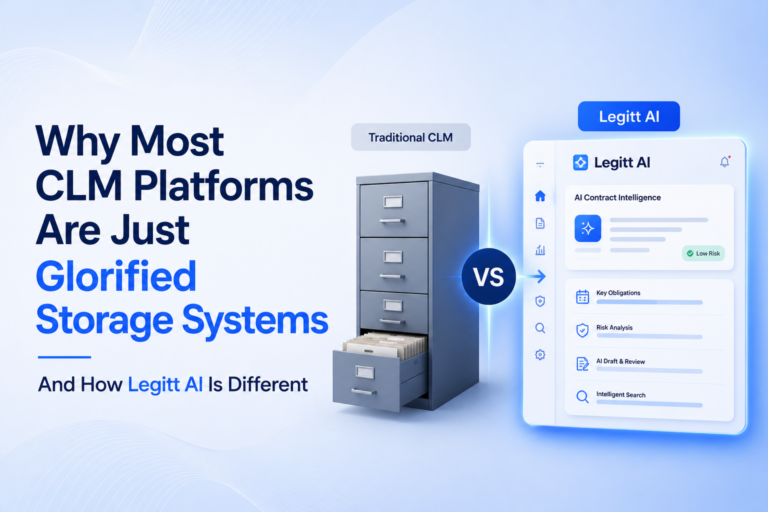
For many businesses, the contract repository has historically been little more than a digital filing cabinet.
Contracts are stored after execution, but accessing the information inside them still requires someone to open and read the document.
AI changes this considerably.
AI Legal Software can analyze executed contracts and extract structured information such as:
- Effective dates
- Expiration dates
- Renewal provisions
- Contract values
- Payment terms
- Notice periods
- Obligations
- Liability provisions
- Service levels
- Termination rights
This information can then be made searchable across the contract portfolio.
Instead of asking, “Where is the agreement?”, teams can begin asking questions such as:
“Which contracts expire in the next 90 days?”
“Which customer agreements contain unlimited liability?”
“What obligations are due this month?”
“Which suppliers have automatic renewal provisions?”
This is where contract management begins moving from document management toward contract intelligence.
- Post-Signature Management Is Becoming Proactive
One of the biggest weaknesses in traditional contract processes occurs after signature. Businesses often spend considerable time negotiating agreements but much less time monitoring whether the terms of those agreements are actually being followed. AI can help identify and monitor contractual obligations, renewals, milestones, notice periods, pricing changes, and service commitments. Alerts can be generated before important dates are reached.
This helps organizations avoid situations where a contract renews unintentionally, a termination window is missed, a price escalation is not implemented, or an obligation is forgotten.
Effective contract management therefore becomes a continuous process rather than something that ends when the agreement is signed.
- Business Teams Can Interact With Contracts More Naturally
Perhaps one of the most significant developments in AI Contract Management is the ability to interact with contract information conversationally. Instead of navigating through multiple dashboards or manually searching documents, users can ask natural-language questions about their contracts.
Sales might ask about customer obligations. Procurement may ask which supplier contracts expire during the next quarter. Finance may want to identify agreements with specific payment terms. This makes contractual information accessible to a much broader group of users.
The contract repository is no longer useful only to legal teams. It becomes an intelligence layer that can support decision-making across the organization.
From Contract Lifecycle Management to Contract Intelligence
The evolution of Contract Lifecycle Management is ultimately about more than automation. Traditional CLM systems focused primarily on managing documents and workflows. AI is expanding that role by enabling businesses to understand the content, risk, obligations, and commercial value contained within those documents.
The most effective approach combines structured workflows with AI-powered drafting, review, negotiation, analysis, and post-signature management.
At Legitt AI, we see this shift as the next stage of contract management: moving from systems that simply store and process contracts to platforms that help organizations understand and act on them.
For modern businesses, contracts contain too much valuable information to remain static documents.
With AI, they can become an active source of legal, operational, and commercial intelligence.