
For years, businesses have been told that Contract Lifecycle Management software would transform how contracts are created, negotiated, approved, signed, tracked, and renewed. In theory, that promise sounds compelling. A modern CLM should reduce delays, improve compliance, streamline collaboration, and give teams real visibility into contractual risk and revenue impact.
But in practice, many CLM platforms fall short.
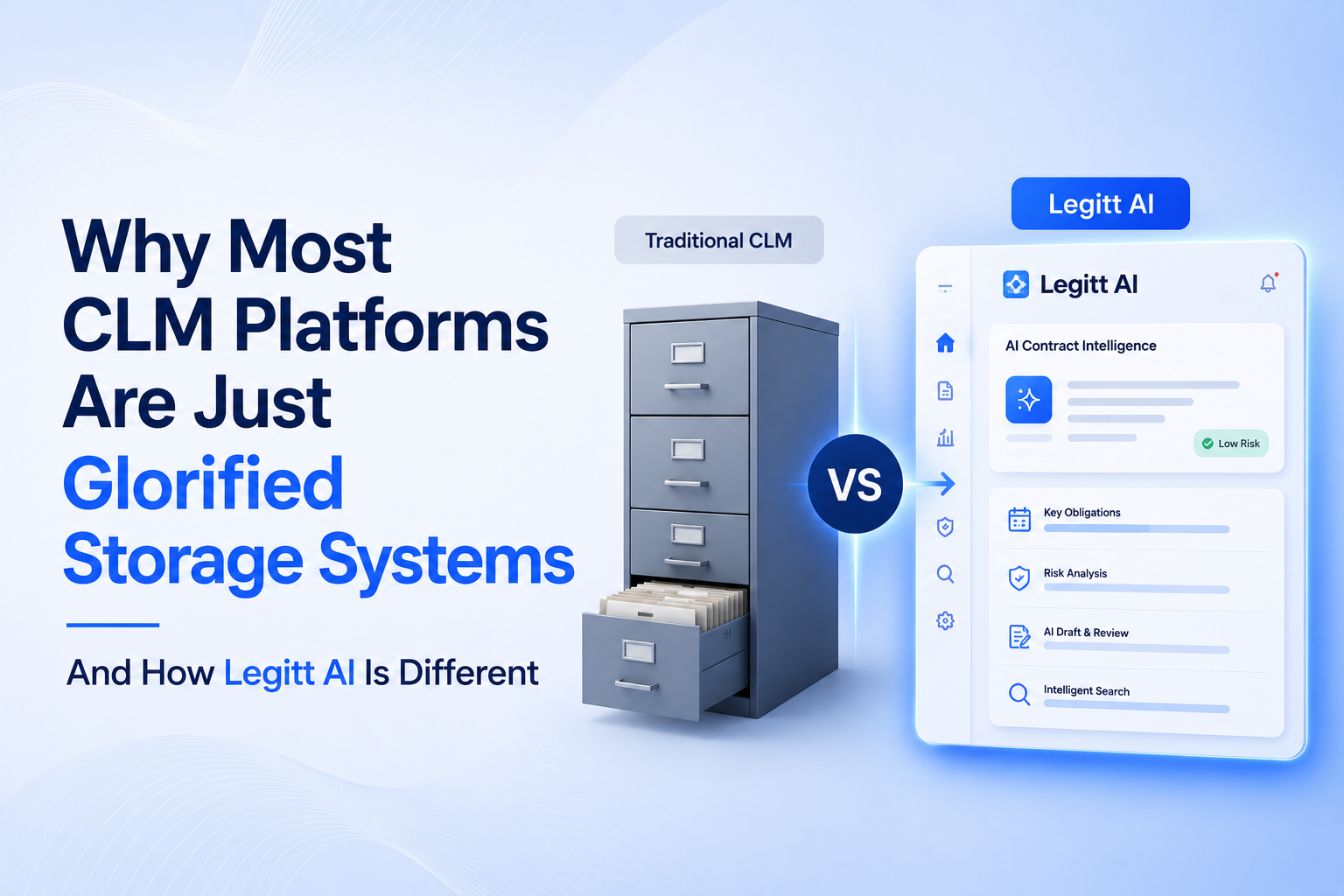
Instead of becoming a true operational layer for contracts, they end up acting like digital filing cabinets with workflow wrappers. They store agreements. They make documents searchable. They may offer basic approval chains, templating, or dashboards. But once the contract is signed, and often even during review, the system adds far less intelligence than buyers expected. That is why many legal, procurement, sales, and finance teams quietly realize that their CLM is not really managing the contract lifecycle. It is just storing contracts in a more organized way.
This gap between promise and reality is creating a major shift in the market. Businesses no longer want static repositories. They want a contract intelligence platform. They want real-time insight into obligations, clause risk, renewals, approvals, revenue leakage, vendor exposure, and negotiation bottlenecks. They want contract workflow automation that actually reduces manual work instead of simply documenting it. And increasingly, they want AI-native systems built for action, not just storage.
That is where the difference becomes clear.
The Core Problem With Traditional CLM Platforms
Most legacy CLM platforms were designed in an earlier software era. Their architecture and philosophy were built around document management, workflow configuration, and system-of-record functionality. That made sense at the time. Organizations needed a central place to keep contracts, route approvals, and avoid losing agreements in inboxes or shared drives.
But contracts are not just files. They are living business instruments. They contain revenue commitments, payment terms, obligations, performance requirements, pricing structures, liability exposure, renewal clauses, escalation triggers, compliance duties, and strategic risk. A system that merely stores those contracts without activating the intelligence inside them is missing the real value.
This is where traditional CLM platforms often disappoint:
- They centralize documents, but do not truly understand them.
- They support workflow steps, but do not optimize decisions.
- They archive contract data, but do not turn it into business intelligence.
- They provide dashboards, but not deep operational insight.
- They help teams find contracts, but not fully act on what those contracts mean.
The result is a strange contradiction. Companies invest in a CLM expecting transformation, but still rely on manual legal review, spreadsheet trackers, inbox follow-ups, Slack reminders, and human memory to manage core contract obligations.
That is not contract lifecycle transformation. That is organized storage.
Why Storage Alone Is No Longer Enough
The market has evolved. Businesses are moving faster, contract volumes are increasing, deal cycles are under pressure, and legal teams are expected to support growth without scaling headcount in the same proportion. That means a basic repository is no longer enough.
A modern contract system must answer operational questions such as:
- Which contracts are up for renewal in the next 90 days?
- Where are the biggest deviations from fallback clauses?
- Which vendor contracts expose us to uncapped liability?
- Which sales contracts contain non-standard discounting?
- Where are approvals getting stuck?
- Which obligations are due this month?
- What revenue is at risk due to missed billing milestones or renewals?
- Which contract types create the longest cycle times?
Most legacy CLM platforms struggle here because their underlying model is document-centric, not intelligence-centric. They were built to hold contracts, not continuously reason over them.
That is why the next generation is not just another CLM. It is a contract intelligence platform that understands documents, extracts meaning, drives decisions, and powers downstream actions.
The Illusion of Workflow in Many CLM Systems
A major selling point in the CLM market has always been workflow. Buyers hear phrases like streamlined approvals, automated routing, and digital contract processes. On paper, that sounds like real contract workflow automation.
But many implementations reveal a different reality.
In a large number of CLM platforms, workflows are rigid, template-heavy, and admin-dependent. Simple changes require configuration effort. Exception handling is messy. Cross-functional collaboration remains fragmented. Teams still fall back to email or chat because the system cannot adapt naturally to real business context.
In other words, the workflow exists, but it does not feel intelligent. It often just digitizes bureaucracy.
True contract workflow automation should do more than move a document from point A to point B. It should understand contract type, commercial value, clause risk, deviation level, business priority, and stakeholder role. It should know when to escalate, when to auto-approve, when to recommend fallback language, and when to trigger post-signature tracking.
That is a very different standard from a static workflow builder.
What Buyers Actually Need Today
The market increasingly wants four things from modern contract technology.
First, it wants speed. Teams need faster drafting, review, redlining, approvals, and execution.
Second, it wants intelligence. Users want systems that can surface clause issues, summarize risk, identify obligations, and explain what matters.
Third, it wants actionability. Insight without next-step execution is only partially useful. Teams want the platform to help route, redline, track, notify, and monitor.
Fourth, it wants end-to-end visibility. Contracts should not disappear into storage after signature. Their value continues across compliance, revenue, procurement, renewal, and performance management.
This is why the phrase contract intelligence platform matters so much. It represents a shift away from passive record-keeping and toward active contract operations.
Why Many CLM Platforms Still Feel Like Repositories
Even when a product markets itself as advanced CLM, the user experience often reveals a storage-first mindset. You upload or generate a contract. It moves through review. It gets signed. Then it sits in the repository.
Maybe someone later searches for it. Maybe metadata was extracted. Maybe a dashboard shows counts by status. But the contract itself is still largely treated as a file, not as a source of living intelligence.
This repository-first approach creates three major weaknesses.
1. Poor post-signature activation
After signature, contracts should drive alerts, obligations, milestones, renewals, billing events, and operational accountability. Many CLM platforms do this only partially, or through heavy manual setup.
2. Limited business interpretation
A repository can tell you where a contract is stored. A true contract intelligence platform should tell you what the contract means for revenue, risk, spend, compliance, and execution.
3. Weak AI-native capability
Many older systems have added AI features later, often as overlays. That can improve extraction or summarization, but it does not always change the underlying architecture. The result is AI around the contract, not AI deeply embedded into contract operations.
How Legitt AI Is Different
Legitt AI CLM takes a fundamentally different approach because it is not designed merely as a storage layer with workflow screens on top. It is built around AI-native contract operations. That difference matters.
Instead of treating the contract as a document to be filed, Legitt AI treats it as a structured source of business intelligence and action. The platform is designed to support drafting, review, redlining, approvals, signature, repository analysis, obligation tracking, renewal visibility, and ongoing analytics in a more connected way.
This is where Legitt AI CLM starts to stand apart from traditional CLM platforms.
A contract is not valuable only because it can be retrieved later. It is valuable because it contains decisions, risks, commitments, and triggers that the business must understand and act on. Legitt AI is built for that deeper layer.
For organizations evaluating modern contract technology, this is the crucial distinction between document storage and contract intelligence.
Legitt AI as a Contract Intelligence Platform
A true contract intelligence platform should perform across the full lifecycle, not just around repository management. It should help before signature, during negotiation, and after execution.
That means capabilities such as:
- AI-assisted drafting
- AI contract review and risk identification
- redlining support
- clause comparison against templates and playbooks
- approval routing
- signature workflows
- metadata extraction
- obligation and milestone tracking
- renewal monitoring
- repository-wide analytics
- reporting on risk, cycle time, and contract performance
This is where Legitt AI CLM aligns with how businesses actually operate. Legal does not work in isolation. Sales needs faster review. Procurement needs better control. Finance needs visibility into revenue and payment terms. Leadership needs insight into cycle time, exposure, and leakage. A strong contract intelligence platform must support all of that.
At legittai.com, the value proposition is not framed as simple storage. It is about making contracts operational, intelligent, and actionable.
Why Contract Workflow Automation Needs Intelligence
Many software buyers underestimate how important intelligent workflow really is. They assume workflow means a few status changes, notifications, and approver assignments. But contract operations are far more nuanced.
Good contract workflow automation should dynamically adapt based on:
- contract type
- deal value
- risk score
- clause deviations
- customer or vendor category
- regulatory sensitivity
- renewal importance
- business function involved
For example, a low-risk NDA should not move through the same process as a high-value enterprise MSA with custom data security terms and aggressive liability language. Yet many CLM platforms still treat workflow in a one-size-fits-all way.
This is where AI-native systems can outperform static architectures. They can bring context into workflow, helping teams move faster on routine matters while escalating the right exceptions. That is the real promise of contract workflow automation.
The Shift From CLM to Contract Operations
The future category may not even be defined narrowly as CLM.
More buyers are beginning to think in terms of contract operations, contract intelligence, and AI-enabled execution. That is because the problem is not just storing a lifecycle. The problem is managing everything the lifecycle produces.
A signed contract creates downstream responsibilities:
- invoice triggers
- service obligations
- renewal reminders
- pricing governance
- vendor performance monitoring
- compliance checkpoints
- milestone tracking
- internal accountability
Most traditional CLM platforms are not strong enough in these operational layers. They remain closest to repository and workflow orchestration. That is useful, but it is incomplete.
A platform like Legitt AI CLM is better aligned to where the market is going: toward intelligent, connected, always-on contract management rather than passive storage and static routing.
Why This Difference Matters Commercially
This is not just a product positioning issue. It directly affects business outcomes.
When companies rely on glorified storage systems, they often experience:
- slow contract turnaround
- manual follow-ups
- missed renewals
- poor obligation tracking
- hidden risk exposure
- inconsistent clause control
- weak portfolio visibility
- revenue leakage
- fragmented collaboration
When they adopt a stronger contract intelligence platform, they can improve deal velocity, reduce legal bottlenecks, strengthen governance, and gain clearer visibility into contract performance.
That is why the conversation is shifting from “Which CLM has the best repository?” to “Which platform can help us actually run contract operations better?”
This is also why Legitt AI is increasingly relevant in the market. It reflects a more modern understanding of what businesses need from contract software. More details can be explored at legittai.com, especially for teams looking beyond traditional CLM platforms and toward AI-native contract execution.
Final Thoughts
Many CLM platforms succeeded in solving an earlier generation of problems. They helped companies centralize contracts, build digital approval paths, and improve document access. That was valuable. But today’s businesses need more than digital storage plus workflow configuration.
They need a contract intelligence platform that understands agreements, drives decisions, automates follow-through, and creates continuous operational visibility. They need contract workflow automation that is contextual, adaptive, and intelligent. They need contract systems that help the business move, not just archive what already happened.
That is the fundamental difference. Traditional CLM often stops at storage.
Legitt AI CLM is built for intelligence, action, and end-to-end contract operations. And as the market matures, that difference will matter more and more.