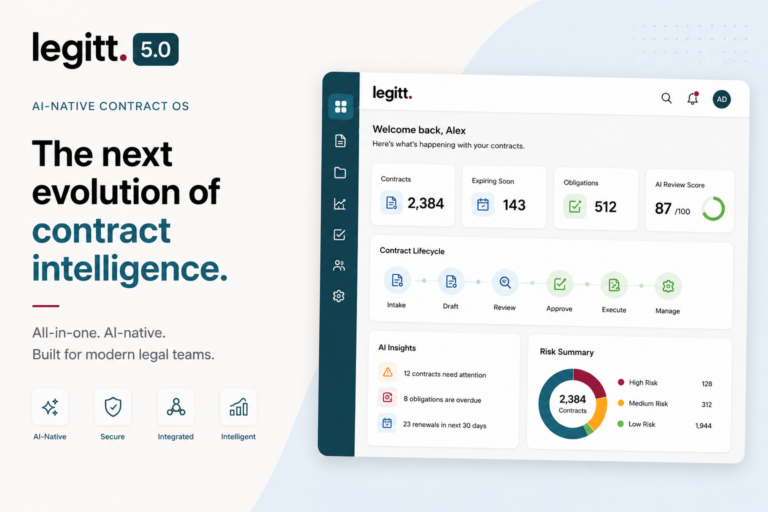

Over the last decade, Contract Lifecycle Management (CLM) has emerged as a critical enterprise software category. It digitized what was previously manual – contract drafting, approvals, signatures, storage, and retrieval.
That transformation was necessary. But it is no longer sufficient.
As we worked with organizations ranging from high-growth startups to global enterprises, one pattern became increasingly clear: despite significant investment in CLM, most companies still struggle to operationalize contracts as strategic business assets.
Contracts remain stored, but underutilized. Signed, but not fully governed. Accessible, but not truly actionable.
This is the fundamental limitation of traditional CLM.
It manages contract workflows well, but it does not fully operationalize contract intelligence.
That realization shaped our thinking over the last two years and ultimately led to the development of
Our conclusion was straightforward: The future is not CLM. The future is Contract Operating Systems.
The Structural Limitation of Traditional CLM
Most CLM platforms were architected around document lifecycle orchestration.
Their primary value proposition centered on enabling organizations to:
- Standardize templates
- Route approvals
- Maintain version control
- Execute eSignatures
- Archive agreements
These capabilities remain important, but they address only a portion of the broader enterprise problem.
A contract does far more than define legal obligations. It governs business operations.
Every commercial agreement contains embedded operational intelligence related to:
- Revenue recognition
- Pricing enforcement
- Vendor obligations
- Service commitments
- Renewal economics
- Regulatory compliance
- Risk allocation
- Cash flow timing
In other words, contracts are not merely legal records.
They are among the most important operational control systems inside an enterprise. Yet most organizations continue to manage them as static documents. This creates persistent inefficiencies. Legal teams become bottlenecks for repetitive reviews. Sales teams experience slower deal cycles.
- Procurement teams miss obligation signals.
- Finance teams struggle to validate invoices against contractual commitments.
- Leadership lacks visibility into contractual exposure and commercial leakage.
The result is not simply administrative inefficiency. It is measurable business loss.
Contracts Are Becoming Enterprise Data Infrastructure
We believe contract technology has evolved through four distinct phases.
Phase 1: Document Storage
Contracts existed in shared drives, email attachments, and folders. Search was manual. Governance was weak.
Phase 2: Lifecycle Management
CLM introduced process control. Approvals, workflows, signatures, and repository management improved operational discipline. This marked a major step forward.
Phase 3: AI-Augmented CLM
AI began improving productivity through:
- Summarization
- OCR
- Metadata extraction
- Clause identification
- Basic contract review
These capabilities reduced manual effort.
However, in most cases AI remained an add-on rather than a foundational architectural layer.
Phase 4: Contract Operating Systems
This is the category shift now underway. In this model, contracts are treated as structured, intelligent, continuously active business infrastructure. They are no longer static records.
They become systems capable of driving:
- Decision support
- Workflow orchestration
- Risk intelligence
- Financial control
- Compliance governance
- Operational automation
This is the category Legitt AI 5.0 is built for.
What Is a Contract Operating System?
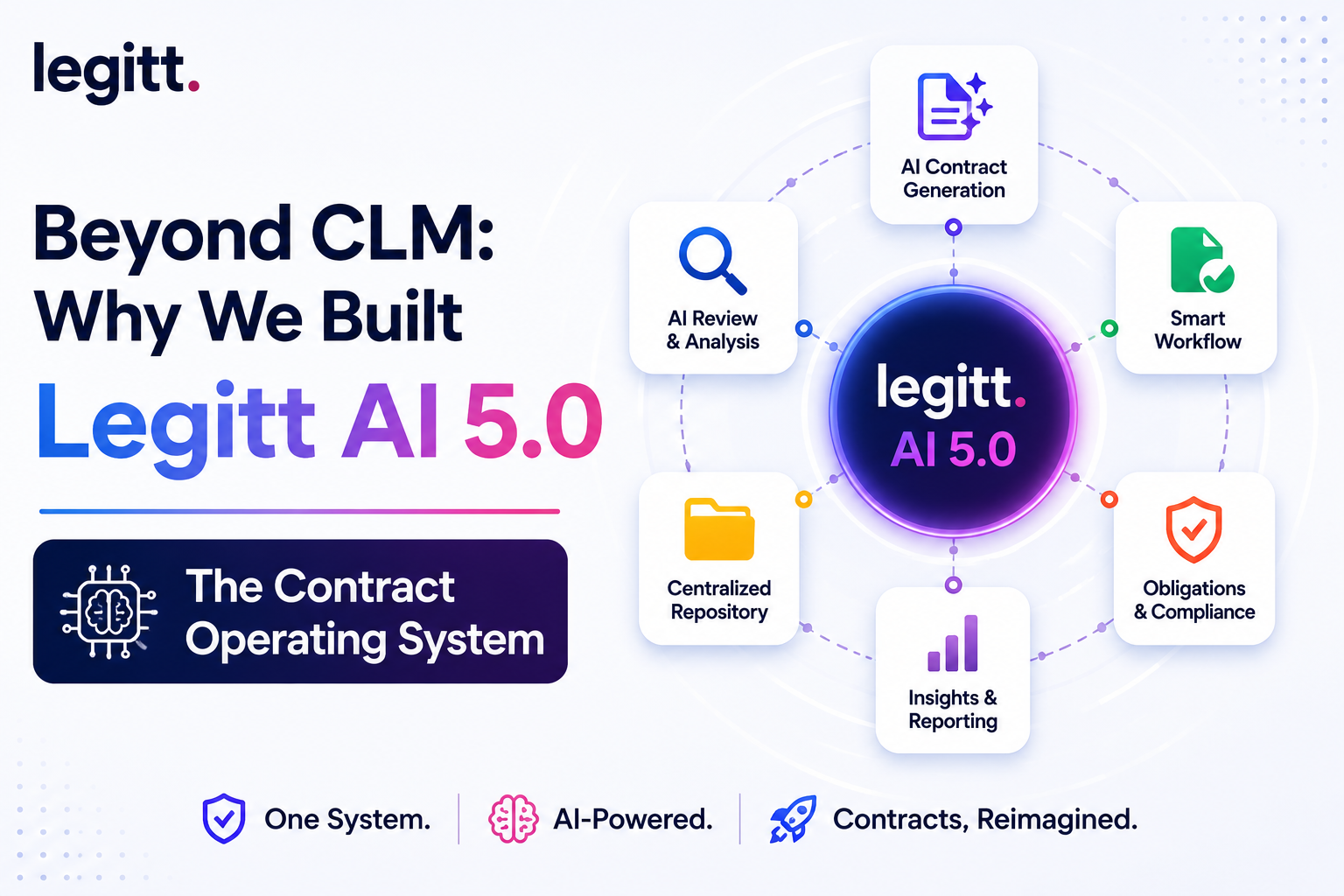
A Contract Operating System extends far beyond lifecycle management. Conceptually, it functions much like an enterprise operating system. It coordinates multiple layers of intelligence and execution.
- Contract Layer: The foundational layer containing every agreement, clause, amendment, obligation, milestone, and metadata field.
- Intelligence Layer: AI models capable of understanding legal language, commercial context, deviations, and risk.
- Agent Layer: Autonomous AI agents that monitor, reason, and act on contract events.
- Workflow Layer: Approvals, escalations, obligations, renewals, exceptions, and governance processes.
- Business Layer: Integration with revenue systems, procurement workflows, ERP, CRM, finance, and reporting infrastructure.
The key distinction is important. A CLM manages the lifecycle of a document. A Contract Operating System operationalizes the intelligence inside that document. That is a fundamentally different category.
Why We Built Legitt AI 5.0
At Legitt AI, we increasingly saw that customers were not asking for “better document management.”
They were asking much deeper questions:
- Which contracts expose us to unusual risk?
- Where are renewals likely to create pricing pressure?
- Are invoices aligned with contractual commitments?
- Which vendor agreements carry hidden liability?
- Which obligations are nearing breach?
- Where is revenue leakage occurring?
Traditional CLM platforms were not designed to answer these questions in real time. We built Legitt AI 5.0 to solve exactly this problem. This release represents our largest architectural evolution since inception. It is built around four foundational pillars.
- Industry Intelligence
Contracting is highly contextual.
Generic AI performs reasonably well for basic extraction but struggles with domain-specific nuance.
A healthcare agreement behaves differently from:
- SaaS contracts
- Procurement agreements
- Manufacturing supply contracts
- Pharma partnerships
- Financial services documentation
Legitt AI 5.0 introduces industry-specific intelligence through:
- Vertical playbooks
- Clause libraries
- Risk models
- Workflow templates
- Domain-specific dashboards
This significantly improves both deployment speed and AI accuracy.
- Agentic Contract Intelligence
Most enterprise software today describes AI as a chatbot interface. We believe that definition is too narrow. The real opportunity lies in agentic AI.
With Legitt AI 5.0, Lana evolves from an AI assistant into an AI execution layer.
Lana can now:
- Draft contracts
- Review deviations
- Suggest redlines
- Explain risk exposure
- Monitor obligations
- Recommend renewals
- Support negotiations
- Surface operational insights
More importantly, specialized agents now operate independently.
Examples include:
Review Agent: Continuously identifies contractual deviations and risk.
Renewal Agent: Tracks upcoming renewals and recommends optimal actions.
Obligation Agent: Monitors milestone completion and contractual commitments.
Revenue Agent: Validates invoice compliance against contract terms.
This changes AI’s role materially. We move from AI as assistance to AI as execution infrastructure.
- Contract-to-Revenue Intelligence
One of the most important innovations in Legitt AI 5.0 is the Invoice Repository Analyzer. This addresses a major blind spot across enterprises.
Very few organizations systematically validate invoices against underlying contract terms. That creates significant leakage.
Pricing deviations, billing inconsistencies, missed milestones, and discount misapplication often remain undetected.
Legitt AI 5.0 compares invoices against:
- Pricing schedules
- Billing frequency
- Milestone dependencies
- Discount terms
- Payment obligations
- Commercial conditions
AI can identify:
- Overbilling
- Underbilling
- Revenue leakage
- Payment delays
- Commercial non-compliance
This transforms contracts into active financial governance instruments. For finance leaders, this is especially significant. Contracts should not merely support billing. They should govern it.
- Governance by Design
AI adoption in enterprise contracting must be accompanied by strong governance. Automation without control introduces risk. Legitt AI 5.0 therefore strengthens enterprise-grade governance across the platform.
Capabilities include:
- No-code workflow orchestration
- Conditional approvals
- Multi-stage escalations
- Role-based permissions
- Audit trails
- Signing certificates
- Approval evidence
- Version controls
- Tamper detection
This ensures organizations can scale AI safely and responsibly.
Governance cannot be an afterthought. It must be architectural.
The Strategic Shift: From Workflow to Intelligence
The most important shift in enterprise software is not automation alone. It is the transition from workflow systems to intelligence systems. Historically, software answered:
What happened?
Modern AI-native platforms answer:
What is happening? Why? What should happen next?
That distinction is critical. Contracts should no longer disappear after signature. Post-signature intelligence is where strategic value compounds.
Organizations need continuous visibility into:
- Obligation performance
- Renewal economics
- Commercial risk
- Vendor exposure
- Financial leakage
- Operational compliance
This is where the next decade of contract technology will be defined.
Beyond Legal Technology
We do not view contract technology as a niche legal software category anymore. It is becoming enterprise infrastructure.
Contracts influence every major function:
- Legal
- Sales
- Procurement
- Finance
- Revenue Operations
- Compliance
- Leadership
This is why the future market leader in contract technology will not simply be the best CLM vendor.
It will be the platform that becomes the enterprise operating layer for contractual intelligence.
That is the category we are building.
The Future Is Not CLM
We believe the next generation of contract platforms must do more than store, route, and sign documents.
They must be capable of:
- Understanding
- Reasoning
- Acting
- Governing
- Optimizing
That is the promise of Contract Operating Systems.
Legitt AI 5.0 represents a major step toward that future. This is not merely a product release. It reflects our conviction about where the category is headed. The future of contracts is not static documentation. It is intelligence-driven execution.
And we are excited to help build that future.
Welcome to Legitt AI 5.0. Welcome to the Contract Operating System.