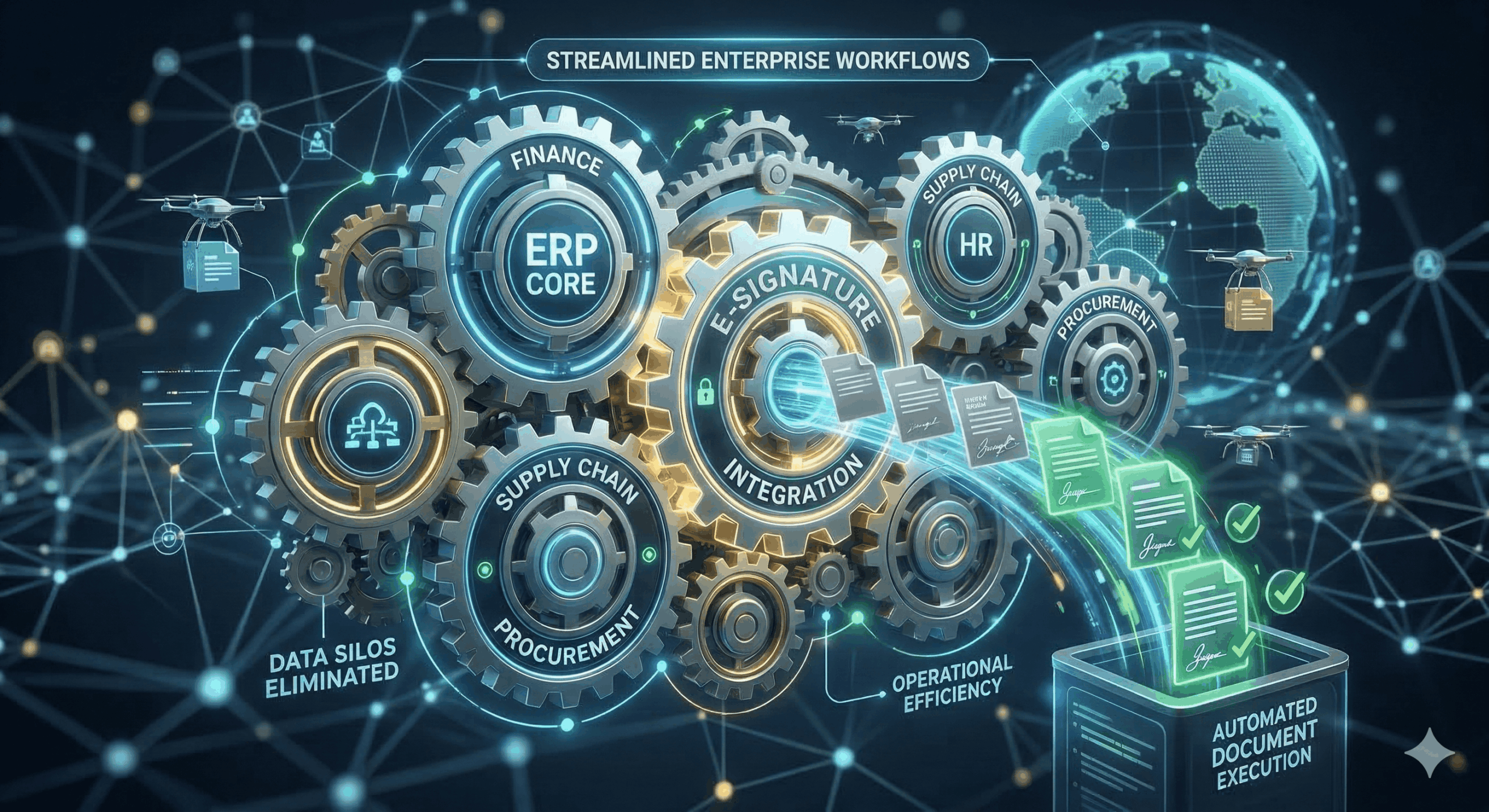
Enterprise resource planning systems have become the operational backbone of modern organizations, consolidating data across finance, supply chain, human resources, and procurement. Yet most ERP implementations still rely on disconnected e-signature tools, creating workflow friction and data silos. As businesses prioritize operational efficiency and digital transformation, the integration of e-signature capabilities directly into ERP platforms is emerging as a critical competitive advantage. This convergence eliminates manual handoffs, reduces document processing time, and ensures seamless audit trails across the entire enterprise. Organizations that embed e-signature functionality into their ERP workflows are discovering significant improvements in process efficiency, compliance documentation, and employee productivity. This shift represents a fundamental evolution in how enterprises manage document execution at scale.
Why ERP-Integrated E-Signatures Matter Now
Traditional enterprise workflows involve multiple disconnected systems. A purchase order originates in the ERP system, is exported to an e-signature platform for approval, then manually re-imported back into the ERP for processing. This fragmentation creates several problems: data inconsistencies, delayed approvals, lost audit trails, and increased operational overhead.
Modern organizations are demanding better integration. CFOs want purchase orders signed and recorded in the ERP without manual intervention. HR leaders need employment agreements executed and automatically filed in employee records. Procurement teams require vendor contracts signed and linked to supplier master data. These requirements are driving demand for e-signature solutions that integrate natively with ERP platforms rather than operating as standalone tools.
The business case is compelling. Organizations implementing integrated e-signature workflows report 50-70% reduction in document processing time, improved compliance documentation, and significant cost savings through automation. The integration also enables real-time visibility into approval status and eliminates the need for manual document management.
The Enterprise Workflow Transformation
Traditional ERP workflows require multiple system transitions. A procurement manager creates a purchase order in SAP or Oracle, exports it, uploads it to an e-signature platform, waits for approvals, downloads the signed document, and manually re-imports it into the ERP. This process introduces delays, errors, and compliance gaps.
Integrated e-signature workflows eliminate these handoffs. When a purchase order reaches the approval threshold in the ERP, the system automatically generates a signing request through the integrated e-signature engine. Approvers receives notifications within their existing workflow, signed directly from the ERP interface or via email link, and the signed document is automatically recorded in the ERP with full audit trail. The entire process is transparent, auditable, and requires no manual intervention.
Key benefits include:
– Elimination of system-to-system data transfers
– Real-time approval status visibility within the ERP
– Automatic document archival with cryptographic proof
– Seamless audit trail integration for compliance reporting
– Reduced approval cycle time by 60-80%
– Improved data accuracy and reduced rework
Stop letting disconnected systems slow down your revenue.
Experience how seamless document execution should feel. LegittAI provides the API-first architecture and native integrations required to eliminate manual handoffs and secure your audit trails.
 Hi, What do you want to Draft?

Click to upload or drag & drop
pdf, docx up to 5 MB
Click to upload or drag & drop
pdf, docx up to 5 MB
Integration Patterns and Architecture
ERP-integrated e-signature solutions follow several architectural patterns. API-first integration allows e-signature platforms to connect with ERP systems through standardized interfaces, enabling real-time data synchronization and workflow orchestration. Pre-built connectors for major ERP platforms like SAP, Oracle, NetSuite, and Microsoft Dynamics accelerate implementation and reduce customization costs.
The most effective implementations use event-driven architecture. When a document reaches a defined approval threshold in the ERP, an event is triggered that initiates an e-signature workflow. Upon completion, the signed document is automatically recorded in the ERP with metadata linking it to the originating transaction. This approach maintains data integrity and ensures compliance documentation is always current.
Organizations should prioritize e-signature providers that offer:
– Native connectors for their specific ERP platform
– REST APIs for custom integration scenarios
– Webhook support for real-time event notification
– Batch processing capabilities for high-volume signing
– Template management integrated with ERP document types
Industry-Specific Use Cases
Financial Services: Banks and financial institutions use ERP-integrated e-signatures for loan approvals, credit decisions, and regulatory documentation. Loan officers can approve credit applications directly from the ERP, with signed documents automatically filed in customer records and compliance systems.
Manufacturing and Supply Chain: Manufacturers integrate e-signatures with procurement workflows to sign purchase orders, supplier agreements, and quality certifications. This integration ensures all procurement documents are signed, dated, and linked to purchase orders without manual intervention.
Healthcare: Healthcare organizations use integrated e-signatures for physician credentialing, insurance agreements, and patient consent forms. Integration with ERP systems ensures all documentation is automatically filed in the appropriate records and compliance systems.
Retail and Consumer Goods: Retailers use ERP-integrated e-signatures for vendor agreements, promotional contracts, and supply chain documentation. Integration enables rapid contract execution and ensures all agreements are properly documented and archived.
What This Means for Enterprise Leaders
Enterprise leaders evaluating e-signature solutions should prioritize integration capabilities as a primary selection criterion. The best implementations don’t simply add e-signature as a bolt-on feature; they fundamentally redesign workflows to eliminate manual handoffs and create seamless document execution.
Key evaluation criteria include:
– Native integration with your specific ERP platform
– API-first architecture for custom integration scenarios
– Real-time workflow orchestration and event notification
– Batch processing for high-volume signing scenarios
– Compliance and audit trail capabilities
– Vendor roadmap for emerging ERP platforms
– Implementation timeline and resource requirements
Organizations should also consider the broader digital transformation strategy. ERP-integrated e-signatures are often the first step toward comprehensive workflow automation, robotic process automation, and AI-powered document processing. Selecting a platform with a clear roadmap for these capabilities ensures long-term value and reduces future rip-and-replace costs.
The Competitive Advantage of Operational Efficiency
In competitive markets, operational efficiency is a significant differentiator. Organizations that can execute contracts 70% faster than competitors gain advantages in speed to market, customer satisfaction, and cost management. ERP-integrated e-signatures enable this efficiency at scale.
Companies that delay integration are leaving significant value on the table. Every day a purchase order waits for approval, every week a contract sits unsigned, represents lost productivity and delayed revenue recognition. The technology is mature, integration patterns are well-established, and the ROI is clear. The question is no longer whether to integrate e-signatures with ERP systems, but how quickly to implement them across all critical workflows.
Conclusion
E-signature integration with ERP systems represents a fundamental shift in how enterprises manage document execution and approval workflows. The combination of operational pressure, technology maturity, and clear ROI has made integrated e-signatures essential for modern organizations. Enterprises that implement ERP-integrated e-signature workflows effectively will enjoy faster approvals, improved compliance, reduced operational costs, and enhanced competitive positioning.
As you evaluate your organization’s digital transformation strategy, consider how integrated e-signature solutions can streamline your enterprise workflows. Modern e-signature platforms like Legitt offer purpose-built integration capabilities designed for enterprise environments, with API-first architecture, compliance features, and seamless ERP connectivity. Explore how electronic signature solutions can transform your approval workflows and accelerate your operational efficiency.
Read our complete guide on Contract Lifecycle Management.
FAQs
What is ERP e-signature integration?
It is the process of embedding electronic signature capabilities directly into an Enterprise Resource Planning (ERP) system so that documents can be generated, sent, signed, and automatically stored without leaving the ERP environment.
Why shouldn't we just use a standalone e-signature tool?
Standalone tools create data silos. They require manual exporting, uploading, downloading, and re-importing of documents, which introduces human error, delays, and breaks the digital audit trail.
What are the main benefits of integrating e-signatures with an ERP?
The primary benefits include a 60-80% reduction in document turnaround time, elimination of manual data entry, guaranteed compliance through centralized audit trails, and significantly lower operational costs.
Does integrating e-signatures really reduce turnaround time?
Yes. By automating the handoffs between document creation, approval routing, and final storage, organizations typically see signature cycles drop from days or weeks down to hours or minutes.
Can we trigger e-signatures based on specific ERP events?
Absolutely. Using event-driven architecture and webhooks, you can set rules—such as automatically sending an NDA when a new vendor is added to the ERP master data.
Do we need a massive developer team to set this up?
Not necessarily. While custom API integrations require some development, modern platforms offer comprehensive documentation, webhooks, and sometimes zero-code connectors that significantly reduce implementation time.
How are signed documents routed back into the ERP?
Once all parties have signed, the e-signature platform uses webhooks to notify the ERP. The final cryptographically sealed PDF and its metadata are automatically pushed back and attached to the originating ERP record.
How is the audit trail maintained across two systems?
The e-signature engine captures the IP addresses, timestamps, and authentication methods. This complete forensic audit trail is appended to the final document and synced directly into the ERP's secure database.
Can we restrict who can initiate a signing workflow within the ERP?
Yes. The integration respects your existing ERP role-based access controls (RBAC). Only users with the correct ERP permissions can trigger contract generation or signature requests.
Are external signers (like vendors or new hires) required to create an account?
No. External parties receive a secure email link, allowing them to review and sign the document on any device without needing to download software or create a new account.