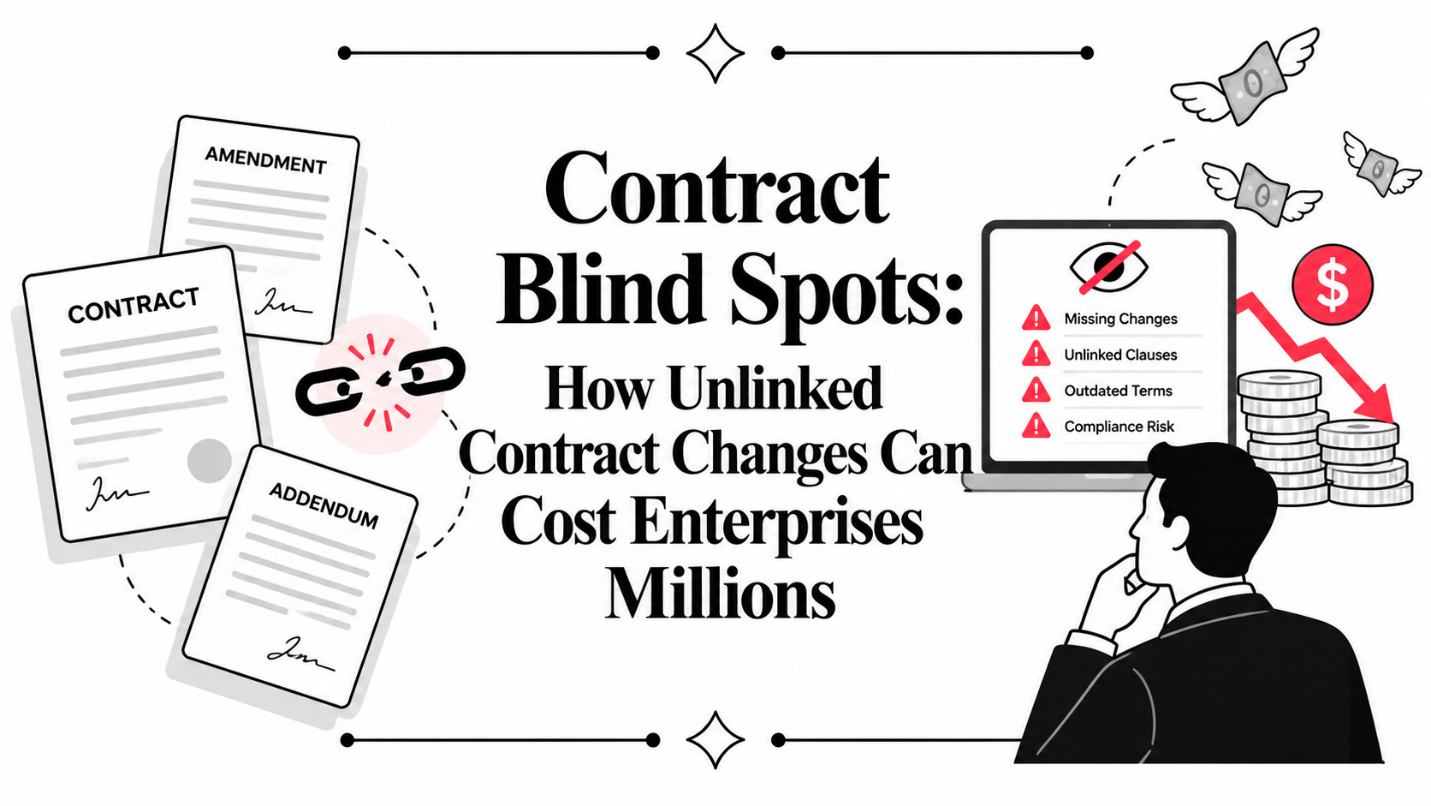
Most companies assume they know what their contracts say. The problem is that they often know what the original contract says. That is not always the same thing.
Over time, commercial relationships evolve. Pricing changes. Scope expands. Service levels are revised. Renewal terms are renegotiated. Liability positions are updated. New products get added. Old obligations are removed.
These changes usually happen through contract amendments, addenda, side letters, statements of work or even email-based approvals. And this is where one of the most expensive contract management problems begins.
If those changes are not properly linked to the original agreement, the organization can end up operating from the wrong version of the commercial relationship. At enterprise scale, that is not a small documentation issue.
It can become a revenue, compliance, legal and operational risk worth millions. The Real Problem Is Not Missing Contracts Most enterprises have contract repositories.
They have shared drives, CLM platforms, document management systems or internal portals where agreements are stored.
The bigger problem is that documents often exist without the proper relationship between them. Imagine a master services agreement signed in 2022.
Then:
- Pricing was amended in 2023
- Service levels changed in 2024
- The termination notice period changed in 2025
- A data processing addendum was signed later
- Two new statements of work were added
If those documents are stored independently, a user searching for the “contract” may only find one piece of the relationship. That creates what I call a contract blind spot.
The company technically has the documents, but it does not have a reliable view of the current contractual position.
-
Revenue Can Be Calculated on the Wrong Terms
This is probably the easiest risk to understand. Suppose the original agreement states that the customer pays $1 million annually. Six months later, the parties sign an amendment increasing the contract value to $1.3 million.
If the amendment is not connected to the original agreement, finance or account management teams may continue working from the old commercial terms. The opposite can also happen.
A discount may have been negotiated, but invoicing continues based on the original price. Both situations create problems.
One results in lost revenue. The other may result in customer disputes, credits or damaged relationships.
Effective contract change management means that the latest commercial position should always be visible without forcing employees to manually reconstruct years of documents.
-
Renewal Dates Can Become Dangerous
Renewal and termination provisions are frequently modified after the original agreement is signed. For example, an initial three-year agreement may later be extended for another two years. Or an amendment may change the required termination notice from 30 days to 90 days.
If the amendment is not linked correctly, the organization may rely on the wrong date. That can mean missing a termination window and becoming locked into an unwanted supplier contract for another year.
For a major enterprise technology agreement, that single mistake could cost hundreds of thousands-or millions-of dollars.
This is why contract amendments should never be treated as standalone documents. They alter the legal and commercial meaning of the underlying agreement.
-
Liability Exposure Can Change Without Anyone Realizing It
Commercial teams tend to focus on pricing and scope. Legal teams often care just as much about liability. Suppose an original agreement contains a liability cap equal to twelve months of fees.
During a later negotiation, the customer requests an exception for cybersecurity incidents and the company agrees.
That amendment materially changes the risk profile of the contract. If legal, finance or risk teams later review only the original agreement, they may incorrectly assume that the company’s exposure is capped.
This becomes especially serious during litigation, insurance reviews, financing events or acquisitions. The real contractual position exists across the entire agreement hierarchy, not inside one PDF.
-
Operational Teams May Follow Outdated Obligations
Contracts are increasingly operational documents. They define service levels, implementation milestones, delivery dates, support commitments, reporting requirements and security obligations.
Those provisions frequently change. A service-level amendment may increase an uptime commitment from 99.5% to 99.9%. A new statement of work may introduce additional implementation responsibilities. A side letter may create special reporting obligations for a strategic customer. If operational teams are working from older versions, the company may breach commitments it does not even realize exist.
The failure is not necessarily caused by negligence. The information simply never reached the people responsible for acting on it. This is where contract lifecycle management needs to go beyond document storage. Contract information has to become usable operational data.
-
Acquisitions Magnify the Problem
Unlinked contract changes become particularly dangerous during mergers and acquisitions. During due diligence, teams may be reviewing thousands of contracts in a limited period. If agreements, amendments and addenda are not connected, reviewers can reach the wrong conclusions about revenue, customer retention, liability or contractual obligations.
For example, an acquiring company might believe a major customer contract runs for another three years. A separate, unlinked amendment may actually give the customer a termination-for-convenience right with 60 days’ notice.
That is a fundamentally different asset. The contract repository may contain both documents. But if the relationship between them is invisible, the risk remains invisible too. What Good Contract Change Management Should Look Like
The solution is not simply better file naming. Enterprises need a structured way to maintain contractual relationships. Every amendment, addendum, statement of work and related agreement should be linked to its parent contract.
More importantly, the system should understand how those documents change the current contractual position. For example, if an amendment replaces a payment clause, users should not have to read the original contract and three amendments to determine the current payment terms.
The platform should present the effective position. This is one of the most promising applications of AI in contract lifecycle management.
AI can identify related contracts, establish parent-child relationships, detect changes between documents and surface the latest contractual terms.
Instead of searching through five PDFs, a user should be able to ask:
“What is the current termination notice period for this customer?”
And receive an answer based on the complete contract hierarchy.
The Cost of Contract Blind Spots
The risks of unlinked contract changes are not theoretical.
They can lead to:
- Underbilling and lost revenue
- Overpayments to suppliers
- Missed renewal or termination windows
- Unrecognized liability exposure
- Compliance failures
- Customer disputes
- Incorrect due diligence conclusions
For large organizations managing tens of thousands of agreements, even a small percentage of incorrectly understood contracts can create significant financial exposure. The issue is ultimately very simple. A contract is rarely one document. It is a relationship that changes over time.
If your contract lifecycle management system cannot connect those changes and show the current legal and commercial position, then having all the documents in one repository is not enough.
The goal should not be to know where every contract is. The goal should be to know exactly what every contract means today.
Frequently Asked Questions
- What are contract amendments?
Contract amendments are documents that modify specific terms of an existing agreement. They may change pricing, scope, obligations, dates, liability provisions or other contractual terms while leaving the rest of the original agreement in place.
- Why should amendments be linked to the original contract?
Because an amendment changes the meaning of the original agreement. Without linking the documents, users may rely on outdated terms and misunderstand the current contractual position.
- What is contract change management?
Contract change management is the process of tracking, controlling and recording changes made to contracts throughout their lifecycle, including amendments, addenda, renewals and related documents.
- What are the risks of unlinked contract changes?
The risks include lost revenue, incorrect invoicing, missed renewals, legal exposure, operational breaches, compliance issues and inaccurate reporting.
- How does contract lifecycle management help?
A strong contract lifecycle management platform can centralize contracts, connect related documents, manage approvals, track changes and provide visibility into the latest contractual position.
- Can AI identify related contracts and amendments?
Yes. AI can help classify documents, identify common parties and contract references, detect amendments and establish relationships between related agreements.
- What is a parent-child contract relationship?
A parent-child relationship links a primary agreement, such as a Master Services Agreement, with related documents such as amendments, addenda, Statements of Work or renewal agreements.
- Can an amendment override the original contract?
Yes. If properly executed, an amendment can replace or modify specific provisions of the original agreement. The remaining provisions generally continue to apply unless the amendment states otherwise.
- Which departments are affected by poor contract change management?
Legal, finance, sales, procurement, operations, compliance and account management can all be affected because each team relies on different contractual information.
- What should enterprises do first to fix unlinked contract changes?
Start by identifying related documents across the repository, establishing parent-child relationships and validating the most commercially important contracts. From there, organizations can implement structured contract change management processes and use AI to automate much of the analysis.