
Let’s start with something nobody likes to admit.
Most organizations have no real idea what’s inside their contract portfolio. They know the volume – maybe 80 vendor agreements, 200 customer contracts, a handful of employment arrangements. But the actual content? The specific clauses, the risk positions, the auto-renewal dates buried on page eleven? That stuff lives in documents that nobody has opened in months.
This is not negligence. It’s math. Reading a complex services agreement carefully takes two to three hours. Doing that across fifty contracts is a hundred-plus hours of work. Nobody has that kind of bandwidth sitting around, which means the portfolio stays unread, and risk stays invisible.
What follows is a practical guide to changing that – using Legitt AI’s Repo Analyzer to run a bulk analysis on your contract portfolio, pull out what actually matters, and build something your whole team can use going forward.
First, Understand Why This Problem Keeps Getting Worse
Ten years ago, a growing company might have had twenty or thirty contracts to manage. Today, a mid-sized business easily has ten times that – and the number keeps growing every year as the vendor stack expands, customer relationships formalize, and compliance requirements multiply.
Manual review never scaled to match. So teams made compromises. Review the big contracts carefully. Spot-check the smaller ones. File everything and hope the important stuff surfaces when it needs to.
The problem is it often doesn’t surface until something goes wrong. An auto-renewal triggers on a vendor relationship the team was planning to exit. A liability cap that was never flagged becomes relevant in a dispute. A compliance obligation that was buried in exhibit C goes untracked through an audit.
The contracts contain the answers. The problem is nobody can read fast enough to find them.
Bulk contract analysis is the practical fix. Not a workaround – an actual solution.
Before You Upload Anything – Two Things to Get Right
A bulk analysis is only as useful as the questions you bring to it. Spending five minutes on preparation before you upload makes the output significantly more actionable.
Get Your Contracts in One Place
Pull together whatever you want to analyze – PDF, scanned documents, Word files, all of it. The system handles mixed formats without any conversion on your end. If your contracts are spread across shared drives, email attachments, and filing cabinets, consolidate them into a folder first. That’s the only prep work required.
Write Down Three Questions You Want Answered
This sounds simple but it matters. Before you run the analysis, write down the three things you most want to know about your portfolio. Which contracts are expiring soon? Where is our liability exposure highest? Which vendor agreements have terms we’ve never actually negotiated?
Once the analysis runs, you’ll have a searchable knowledge base that can answer almost anything. Having your key questions written down means you actually go find the answers rather than browsing the output without direction.
The Six Steps – From Upload to Insight
Step 1: Upload the Batch
Open Repo Analyzer, drag in your contracts, and let the system take over. It processes digital PDFs directly and runs OCR on scanned documents to extract clean text. Everything happens simultaneously across the batch – the system is not reading your contracts one at a time.
If you’ve got a large portfolio, break it into logical groups. Vendor contracts together. Customer agreements together. Employment contracts separately. Not because the system can’t handle the volume, but because grouped output is easier to work with afterward.
Step 2: Watch the AI Pull Key Details From Every Contract
Once text is extracted, GPT-4o goes through every document and pulls out the fundamentals – contract type, the parties involved, start date, end date, and total value. It does this across every contract in the batch at the same time.
What comes out of this stage is a structured data layer across your whole portfolio. Every contract, regardless of how it was originally formatted, now has a standardized set of attributes. This is what makes comparison and search possible at scale.
Step 3: Read the Risk Scores – Clause by Clause
This is the part that takes the longest to do manually and the shortest time to do with Repo Analyzer.
Every clause in every contract gets extracted individually and scored – high, medium, or low risk – against standard legal templates. The system looks for specific things: indemnification gaps, liability caps that are unusually low, missing termination rights, payment conditions outside standard ranges, IP ownership language that needs attention, and confidentiality clauses that don’t hold up.
High-risk flags need legal review. Medium-risk flags are worth a second look before the next renewal. Low-risk flags are informational. The scoring is consistent across every document in the batch – which is something that manual review, done by multiple reviewers over days or weeks, almost never achieves.
One analyst reviewed 60 vendor contracts over three weeks. The same portfolio ran through Repo Analyzer in under two hours – with clause-level risk flags on every agreement.
Step 4: Look at How Your Contracts Relate to Each Other
This step surprises teams who have never had visibility into their portfolio structure before.
Repo Analyzer maps parent-child relationships across documents automatically. Amendments get linked to master agreements. Statements of work get connected to the MSA they sit under. Side letters get matched to the primary contract they modify.
The reason this matters: an amendment that changes a key payment term in the master agreement is invisible if you’re only looking at contracts as individual files. Once relationships are mapped, the full structure of your portfolio becomes clear – and so do the dependencies you didn’t know existed.
Step 5: Get the Report by Email
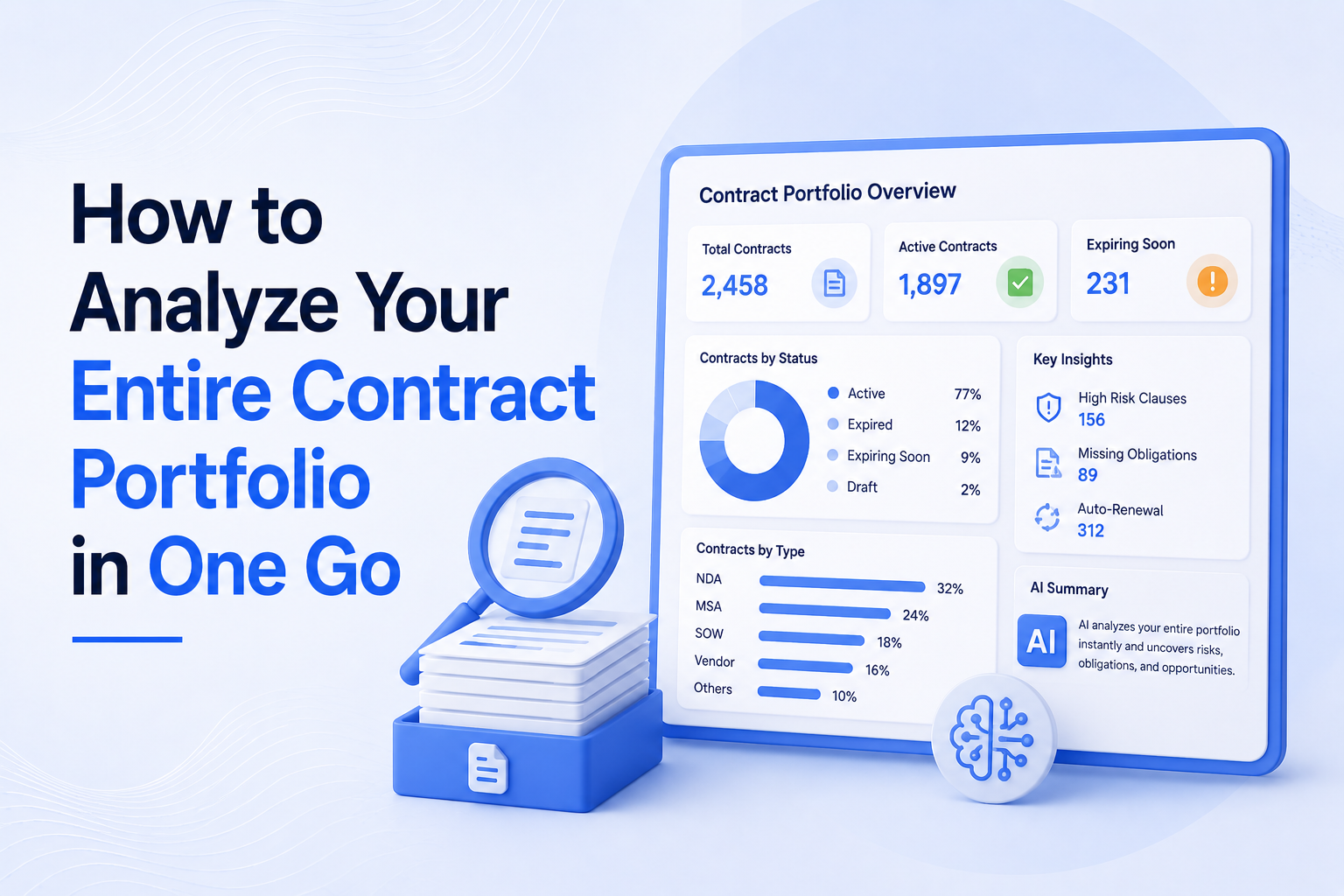
When the analysis finishes, a structured Excel workbook lands in your inbox. It includes document-level risk scores across the batch, extracted key terms for every contract, a clause summary with risk flags called out, payment term data organized for easy comparison, and charts that give you a portfolio-level view of where the risk is concentrated.
This is the report that goes to leadership. Or to the board before an audit. Or to the procurement team before renewal season starts. It’s formatted, sourced, and ready to share without any additional work on your end.
Step 6: Start Asking Questions
After the analysis, the portfolio stays live as a searchable knowledge base. Anyone on the team can ask questions in plain English and get answers with source references.
This is where the everyday value lives. A few examples of what teams actually ask after running a batch analysis:
- Which contracts auto-renew before the end of Q3?
- What’s the average payment term across our top vendor agreements?
- Which agreements give the other party audit rights over our operations?
- Do any of our contracts include non-compete or exclusivity clauses?
- Which contracts have limitation of liability below a million dollars?
Every answer comes with a reference to the specific contract and clause it was drawn from. Not a summary – a sourced response that anyone can verify.
What to Actually Do With the Output
Running the analysis is the easy part. Here’s how to make sure the results turn into action.
Start With the High-Risk Flags
Pull the contracts with the most high-risk clause flags and build a short list for legal review. Ten to fifteen contracts is a manageable starting point. Schedule time with legal to work through them before the next renewal cycle or before any of them come up in a negotiation.
Build a Renewal Calendar From the Expiry Data
Take the extracted expiry dates and build a forward-looking calendar. Anything expiring in the next 90 days needs attention now. Auto-renewal clauses in particular – most require notice 30 to 60 days before the renewal date, so waiting until the deadline is already too late.
Share the Report With the Right People
The Excel report is built to be split up. Finance gets the payment terms page. Compliance gets the obligation and flag summary. Procurement gets the vendor overview. Legal gets the full clause detail. One analysis, four different audiences, zero additional formatting work.
Keep Querying – Don’t Treat It as a One-Time Thing
The knowledge base does not expire after the analysis. As new contracts get added to the platform, the repository grows. Teams that build the habit of checking the knowledge base before they negotiate, before they renew, and before they sign stop being caught off guard by what’s already in their agreements.
Which Teams Get the Most Out of This
Bulk contract analysis is useful for any team that manages contracts in volume. But a few groups see especially fast returns.
Legal Teams Running Compliance Audits
Reviews that used to take weeks get done in hours. The team stops being a bottleneck for contract questions because the answers are already accessible to the people asking them.
Procurement Teams Heading Into Renewal Season
Every vendor agreement gets reviewed systematically instead of on a contract-by-contract basis as deadlines approach. Auto-renewals get caught early. Terms get compared across vendors before anyone sits down to negotiate.
Finance Teams Tracking Obligations
Payment terms, financial milestones, and expiry dates across the full portfolio become visible in one place. Revenue leakage from missed billing triggers or unclaimed credits surfaces before the quarter closes.
M&A Teams Doing Due Diligence
Contract due diligence – historically one of the slowest parts of any deal process – becomes something that can be completed in a day or two instead of a week or two. Risk assessment is consistent, documented, and presentable. The deal team walks into negotiations knowing exactly what they’re acquiring.
Try It on Your Own Portfolio
The contracts sitting in your organization right now contain terms your team hasn’t read, risks nobody has formally assessed, and dates that may or may not be on anyone’s radar. That’s not unusual – it’s just what happens when portfolio volume outpaces review capacity.
Repo Analyzer is available now as part of Legitt AI’s platform. Expanded industry-specific bulk analysis capabilities are also shipping as part of Legitt AI 5.0 on June 30, 2025.
You can book a demo to see it run on a real contract batch, or start free and upload your first batch today – no credit card needed.
Explore Repo Analyzer – https://legittai.com/repo-analyzer