A standard non disclosure agreement looks simple. In most companies, it's treated like routine paperwork. That's a mistake.
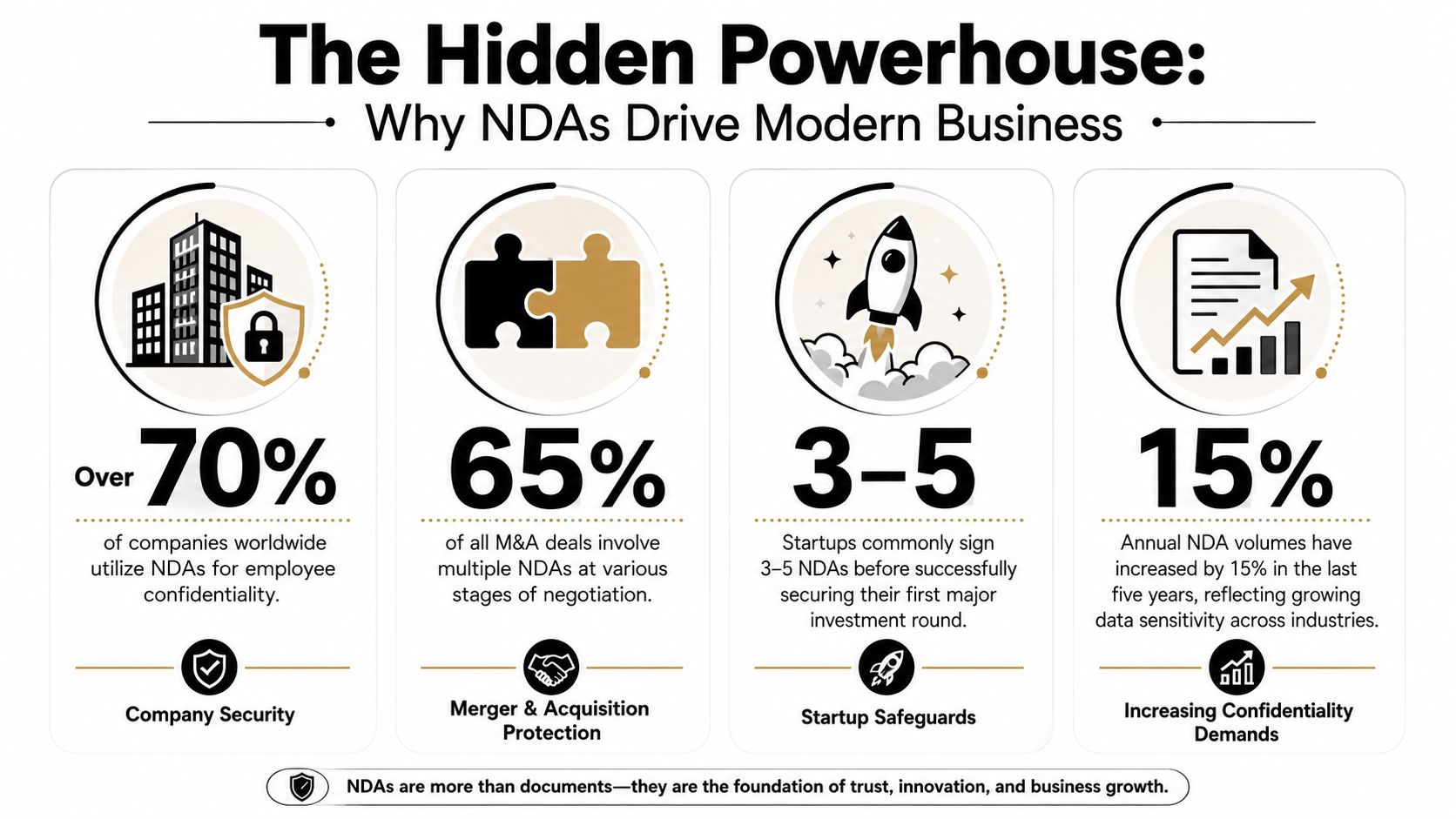
Researchers estimate that between 33% and 57% of U.S. workers are currently constrained by an NDA, with the rate in computer and mathematical jobs reaching 73%, according to the Federation of American Scientists analysis of NDA prevalence. That changes how business leaders should think about these documents. NDAs aren't edge-case legal tools. They sit inside hiring, vendor onboarding, partnerships, product evaluations, fundraising conversations, and M&A preparation.
A standard NDA is often the first contract a company sends out and one of the most frequently signed documents in its contract workflow. That makes it both a legal control and an operational test. If your NDA process is slow, vague, inconsistent, or hard to track, those same problems usually show up across the rest of your contract lifecycle management process too.
Why Every Business Leader Needs to Understand NDAs
The business issue isn't whether your company uses NDAs. It almost certainly does. The core issue is whether your teams understand what they're signing, sending, and storing.
A standard non disclosure agreement is usually a short contract that lets one or both parties share sensitive information under defined restrictions. In plain language, it answers four business questions:
- What information is protected
- Who can use it
- How long the duty lasts
- What happens if someone misuses it
That sounds straightforward. In practice, confusion starts fast. Sales teams want speed. Procurement wants consistency. Founders want flexibility. Legal wants enforceability. Those goals can work together, but only if the NDA process is designed well.
Why routine contracts create outsized risk
Most business leaders assume NDAs are low-risk because they're common. Common doesn't mean harmless. A weak NDA can fail when you need it most. A bloated NDA can delay a deal for no good reason. A missing repository record can leave your team unable to answer a basic question like, “Did we already sign with this vendor?”
Practical rule: If a contract is high volume, it deserves a better workflow, not less attention.
NDAs also shape first impressions. When your team sends an outdated template with vague language, it signals poor legal hygiene. When your team can issue a clean, role-appropriate NDA through an approval workflow and eSignature path, it signals operational maturity.
What business leaders should care about
For non-lawyers, the point isn't mastering legal doctrine. It's understanding where NDA decisions affect business speed and exposure.
| Business team | What they need from an NDA process |
|---|---|
| Legal | Consistent language, enforceability, version control |
| Sales | Fast turnaround, minimal negotiation drag |
| Procurement | Vendor-ready templates, approval rules, searchable records |
| Operations | Clear ownership, repository visibility, renewal awareness |
| Leadership | Lower risk, cleaner compliance, better productivity |
A standard NDA should be easy to issue, easy to review, and easy to find later. That's where legal theory meets business efficiency.
Unilateral vs Mutual NDAs The Critical First Choice
The first decision is basic but often mishandled. Is the NDA unilateral or mutual?
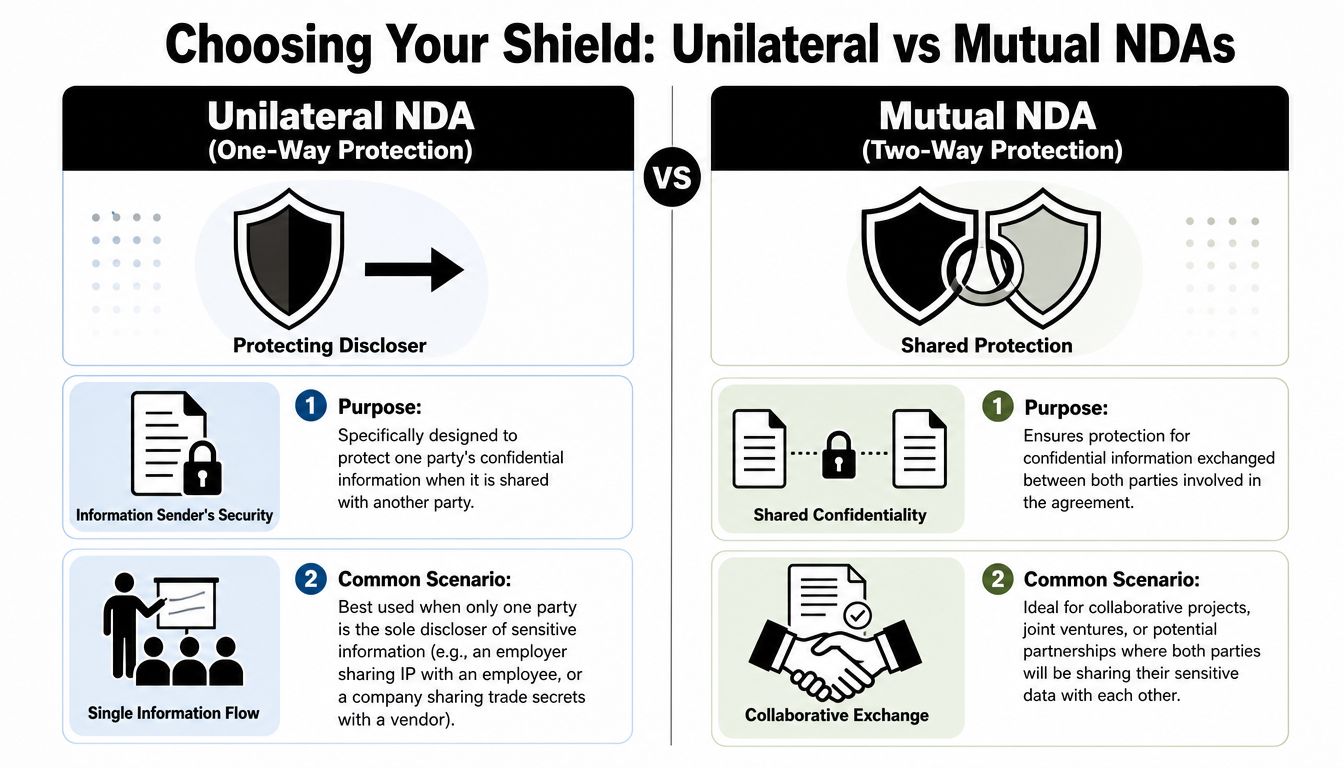
A unilateral NDA protects information flowing primarily from one side. A mutual NDA protects confidential information exchanged by both sides. Teams often grab whichever template is closest, but that shortcut creates friction. Send a one-way NDA when both sides plan to share product, pricing, roadmap, or technical information, and the other party will almost always push back.
When a unilateral NDA makes sense
Use a unilateral NDA when one party is mostly disclosing and the other is mostly receiving.
Common examples include:
- Employee access to IP: A company shares internal product plans, code, customer lists, or financial information with an employee or contractor.
- Vendor evaluation: A company gives a service provider access to internal requirements, systems details, or business processes.
- Investor screening with limited disclosure: A founder shares selected business information before a broader diligence process starts.
In these cases, one-way protection is cleaner. It avoids pretending the exchange is balanced when it isn't.
When a mutual NDA is the better fit
Use a mutual NDA when both sides expect meaningful two-way disclosure. Partnership talks are a classic example. So are joint product evaluations, technical integrations, and strategic sourcing discussions where each party shares architecture, pricing assumptions, internal processes, or roadmaps.
The practical difference is negotiation posture. In a mutual NDA, both sides care about definitions, exclusions, residual knowledge language, security obligations, and duration because both sides carry risk.
The wrong NDA type doesn't just slow legal review. It tells the counterparty your process isn't aligned with the deal.
A simple decision framework
Ask these questions before you send a template:
- Who is disclosing sensitive information first?
- Will the other side also disclose information of business value?
- Is this a limited evaluation or a collaborative relationship?
- Will your team need to defend why one side gets broader protection than the other?
If only one party is sharing meaningful confidential material, unilateral usually works. If both sides are exchanging material they'd want protected, mutual is the safer default.
Teams creating these templates internally often benefit from operational guidance on how to create an NDA between a contract worker, especially when contractor access, IP ownership, and data handling obligations overlap.
Anatomy of a Standard Non Disclosure Agreement
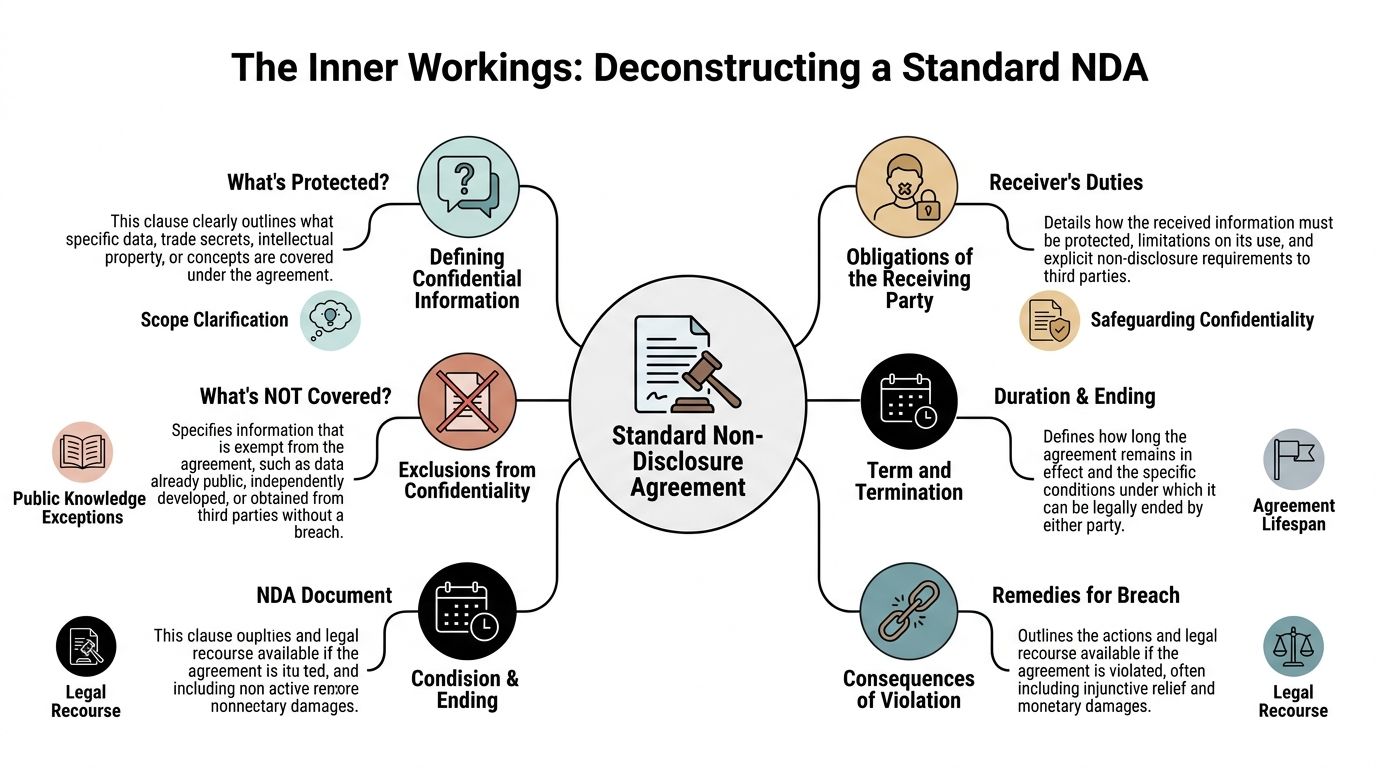
A standard NDA isn't long, but every clause carries weight. Business leaders don't need to draft from scratch. They do need to know what each part is doing and where hidden risk sits.
Defining confidential information
This is the clause often skimmed and the one that causes some of the biggest problems. If the definition is too narrow, important information falls outside protection. If it's too vague, enforceability gets weaker.
Organizations relying on generic standard NDAs with vague definitions of confidential information face a 40% higher risk of non-enforceability in contested disputes, and courts in the EU and UK are increasingly invalidating indefinite confidentiality clauses for non-trade-secret data, according to this analysis of NDA meaning and enforceability issues.
Bad drafting often sounds broad but empty. Phrases like “all sensitive data” may feel protective, yet they can leave too much room for argument. Better drafting ties confidentiality to identifiable categories such as product specifications, technical documentation, pricing, source code, customer data, business plans, or other non-public materials disclosed for a defined purpose.
Receiver obligations and permitted use
This clause tells the receiving party what they can and can't do.
A solid provision usually addresses:
- Use restriction: The recipient may use the information only for the agreed purpose, such as evaluating a vendor, partnership, or transaction.
- Access control: The recipient may share the information only with employees, advisers, or contractors who need it and are bound by confidentiality duties.
- Protection standard: The recipient must protect the information with reasonable care, often aligned with the care used for its own confidential information.
This part matters operationally because business misuse isn't always a public leak. It may be internal over-sharing, improper reuse in another project, or storage in the wrong system.
Exclusions that keep the NDA realistic
Every workable NDA needs exclusions. Without them, the agreement becomes detached from reality.
Typical exclusions cover information that is:
| Exclusion category | Why it matters |
|---|---|
| Already public | A party shouldn't owe confidentiality on public information |
| Already known lawfully | The NDA shouldn't rewrite prior knowledge |
| Independently developed | Teams can still build their own ideas without contamination claims |
| Received from a third party lawfully | Protection shouldn't extend beyond legitimate rights |
These exclusions are where many business misunderstandings get resolved. A well-drafted exclusion clause reduces pointless disputes later.
Duration, return, destruction, and remedies
Duration is not just a blank where someone types “three years” or “forever.” It should match the type of information and the jurisdiction. Trade secrets may justify longer protection. Ordinary business information often won't.
Post-termination obligations also matter. The NDA should state whether the recipient must return or destroy confidential information, whether archival copies are allowed for legal compliance, and what happens to backups.
For non-lawyers reviewing these terms, it helps to understand how confidentiality clauses work across the broader contract stack. The same drafting discipline used in NDAs often carries into master services agreements, employment contracts, and data-sharing terms.
A standard NDA should be specific enough to enforce, narrow enough to defend, and simple enough for the business to use without constant legal rescue.
Enforceability Jurisdiction and Common Red Flags
An NDA that looks polished on paper may still perform badly in a dispute. Enforceability turns on reasonableness, clarity, and the law that applies to the agreement.
The biggest business mistake is assuming the form is the protection. It isn't. Courts evaluate scope, duration, obligations, carve-outs, and local legal standards. That means the same template can produce different outcomes depending on where the dispute lands.
Why jurisdiction changes the answer
The governing law clause tells you which legal system interprets the contract. The forum clause tells you where disputes get handled. Business leaders often treat those as boilerplate. They aren't.
A broad confidentiality clause may survive in one place and get narrowed in another. The same goes for non-compete-adjacent language, employee-related restrictions, and perpetual obligations for ordinary business information. Recent case law in the EU and UK shows a 35% increase in challenges to perpetual NDAs in settlement agreements, reflecting more scrutiny of duration clauses that standard templates often mishandle, according to the Canadian Bar Association tip sheet on NDAs.
If your business operates across states or countries, jurisdiction-aware drafting isn't optional. It's a control.
Teams that negotiate cross-border or multi-state paper should pay close attention to jurisdiction clauses, because a short governing-law sentence can shape the entire risk profile of the NDA.
Red flags to catch before signing
Counterparty paper often introduces risk in subtle ways. Legal teams see this regularly, but business teams can learn to spot the obvious warning signs.
Watch for:
- One-sided obligations: Your side must protect everything indefinitely, while the other side carries lighter duties.
- Undefined confidential information: The clause is broad in tone but thin in substance.
- No useful exclusions: Public, independently developed, or previously known information isn't carved out cleanly.
- Overbroad purpose restrictions: The language blocks normal internal evaluation or legitimate adviser access.
- Problematic return and destruction duties: The clause ignores legal retention needs, system backups, or compliance copies.
- Embedded indemnity language: Some NDAs sneak in liability allocation terms that don't belong in a lightweight confidentiality agreement.
A practical review lens for business teams
Use this short checklist before escalating every issue to legal:
- Is the business purpose stated clearly?
- Can our team realistically comply with the handling rules?
- Does the duration fit the type of information?
- Are the obligations balanced if the NDA is mutual?
- Does the governing law align with where we operate?
If your team can't explain an NDA in plain language, the document probably needs revision before signature.
Modernizing NDA Workflows with AI and CLM
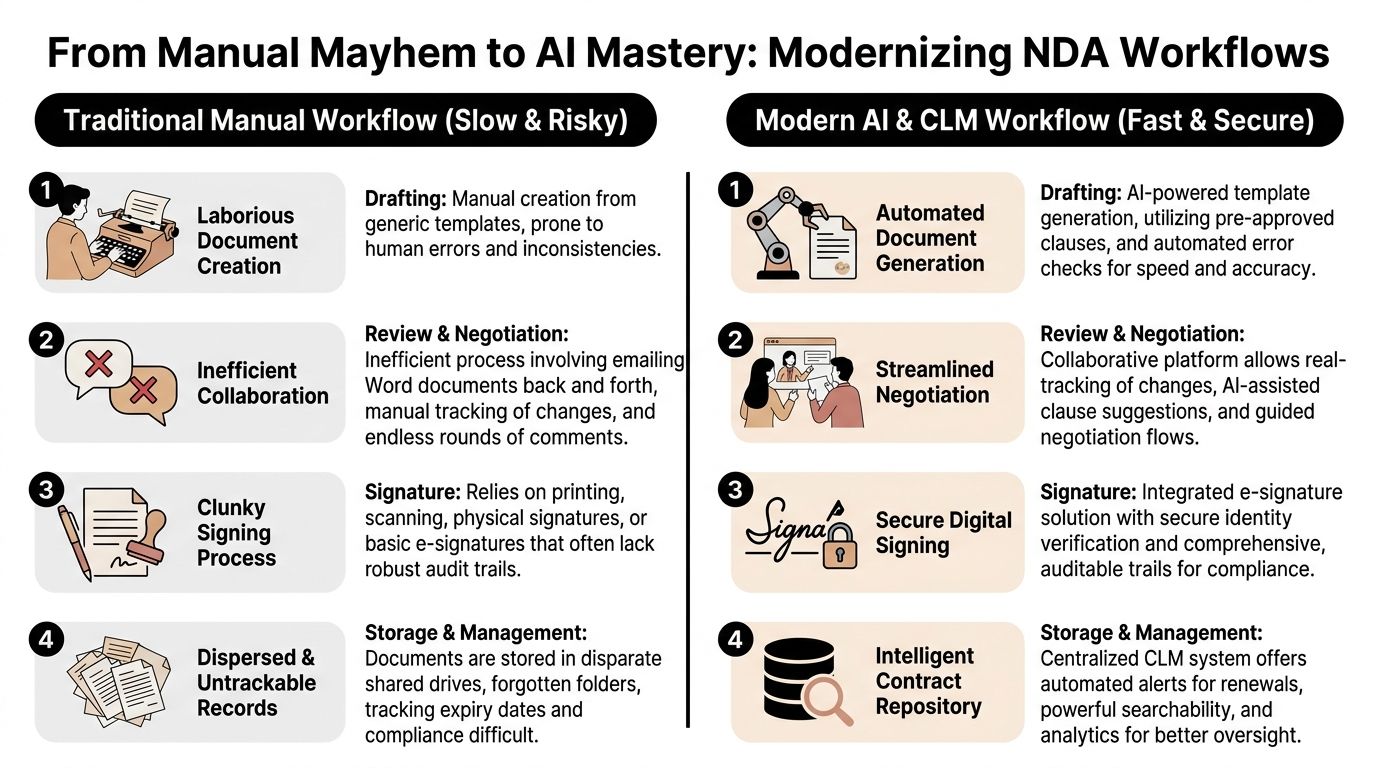
Most NDA problems aren't caused by legal doctrine. They're caused by process. Someone downloads an old Word file, edits party names manually, emails it around for approval, sends a PDF, chases signatures, and saves the final copy in a folder no one can find six months later.
That workflow breaks at scale.
Standard NDAs average 12 days to sign, and 85% are executed on the disclosing party's paper, according to Ironclad's overview of NDA contracting patterns. For a document often considered routine, that timeline shows how much drag still lives in intake, review, and execution.
What a modern NDA workflow looks like
A strong CLM process turns NDA handling into a managed system rather than an inbox exercise.
Typical workflow steps include:
- Intake through a form: The requester selects unilateral or mutual, transaction type, jurisdiction, and business owner.
- Template-based drafting: The platform assembles the right clause set from pre-approved language.
- Rule-based approvals: Low-risk NDAs move quickly. Non-standard terms route to legal or procurement.
- AI contract review: Third-party paper gets compared against fallback language and playbook rules.
- Integrated eSignature: Signatures happen inside the workflow, with auditability and status tracking.
- Central repository storage: Executed versions, redlines, metadata, and obligations stay searchable in one place.
This isn't just about speed. It's about reducing inconsistency. If ten sales reps use ten slightly different NDA templates, legal loses control over risk posture and reporting.
Where AI helps the most
Among organizations using AI in contract lifecycle management, common applications include metadata extraction at 44%, clause extraction at 39%, and contract analytics and automation at 38%, according to Aavenir's contract management statistics roundup. Those use cases fit NDAs well because NDAs are repetitive, structured, and full of fields that matter later.
In practice, AI can help teams:
| Workflow stage | AI contribution |
|---|---|
| Intake | Suggest the right NDA type based on business context |
| Review | Flag unusual confidentiality definitions, duration issues, or missing exclusions |
| Negotiation | Compare redlines against playbook positions |
| Execution | Extract dates, parties, and obligations automatically |
| Post-signature | Track expiration, destruction duties, and renewal triggers |
Procurement teams are already leaning into this model. 80% of procurement leaders report using AI for contracts and consider it highly impactful, especially for compliance monitoring, expiration tracking, renewals, and summarizing contractual relationships, according to this PR Newswire summary of procurement AI adoption.
Choosing technology that supports business reality
The right tool should support drafting, review, approval workflows, eSignature, repository management, renewals, obligations tracking, and contract intelligence in one operating model. It should also fit how your teams already work across CRM, email, procurement, and legal operations.
Some companies also pair CLM with broader AI workflow optimisation initiatives so intake, approvals, and downstream handoffs don't stop at the legal team. That matters because NDA friction often starts before legal sees the request and continues after signature when records need to be tracked.
One example in this category is AI in contract lifecycle management, where platforms such as Legitt AI support AI-powered drafting, review, redlining, eSignatures, centralized repository management, and obligation tracking inside a single enterprise contract workflow.
The operational goal isn't to make NDAs impressive. It's to make them controlled, fast, and searchable.
Building Your NDA Management Playbook
A good NDA process doesn't depend on one lawyer answering the same questions all day. It runs on templates, rules, ownership, and systems.
What legal ops should put in place
Start with a practical foundation:
- Template library: Maintain approved unilateral and mutual NDA templates, plus jurisdiction-specific variants where needed.
- Clause playbook: Define fallback language for confidentiality scope, exclusions, duration, governing law, and return or destruction obligations.
- Approval matrix: Route low-risk standard NDAs automatically and escalate only the exceptions.
- Repository discipline: Store executed agreements with searchable metadata, sign dates, owners, and expiry terms.
For smaller teams building structure from scratch, guidance on how to build a contract library as a small business owner can help turn scattered files into a usable contract system.
How sales and procurement should use the playbook
Sales teams should treat NDAs as deal accelerators, not opening hurdles. Send them only when the exchange of non-public information justifies it. Use the right template the first time. Avoid negotiating side issues that belong in the main commercial agreement.
Procurement teams should standardize vendor onboarding NDAs with intake questions that capture business purpose, system access, and data sensitivity. If a supplier sends its own paper, the team should know which red flags require legal review and which positions are already pre-approved.
The operating principle
The standard non disclosure agreement is often the simplest contract in the stack. That's exactly why it should be operationally clean. High-volume contracts reveal whether your legal operations model can support growth.
Build the workflow once. Put contract automation, AI contract review, eSignature, contract intelligence, and repository controls around it. Then let the business move faster with fewer avoidable risks.
If your team wants to turn NDAs from scattered documents into a managed contract workflow, Legitt AI is one option to evaluate. It supports drafting, review, approval workflows, eSignatures, repository management, renewals, obligation tracking, and contract intelligence in a single workspace for legal, procurement, sales, and operations teams.