
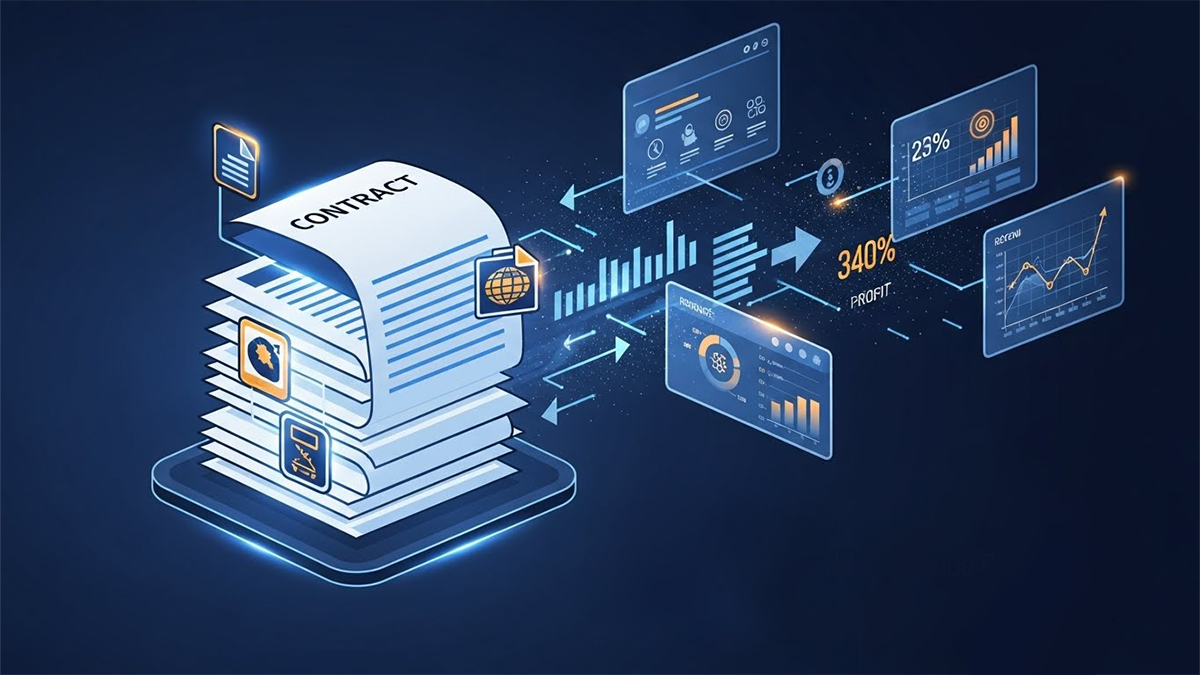
For most organizations, contracts are treated as legal safeguards, not as living revenue instruments. Once signed, they are filed away in shared drives or CLM systems and only revisited for disputes or renewals. Yet those same documents contain rich information about pricing levers, escalation clauses, cross-sell rights, usage tiers, and commercial commitments that directly influence growth and profitability. The problem is not that the opportunities are missing. It is that they are invisible at scale.
AI changes that equation. By turning unstructured contract text into structured, actionable data, AI can help finance, sales, and customer success teams systematically uncover revenue that is already encoded in agreements but never fully realized. AI-native platforms, such as Legitt AI, are specifically designed to treat contracts as a revenue data source rather than just legal archives.
1. Why do revenue opportunities get “lost” inside contracts?
Most companies manage revenue through CRM and billing systems, not through contracts themselves. When deals are closed, key commercial terms are entered manually into CRM fields, often at a high level: price, term, discount, and renewal date. The more nuanced elements remain buried in the contract: indexation clauses, volume thresholds, overage rates, minimum commitments, and rights to expand into additional services.
Over time, several problems arise:
- Details are captured inconsistently or not at all
- Changes made in amendments and side letters are not reflected in core systems
- Contractual rights (such as annual price uplifts) are forgotten
- Customer success and account teams have incomplete visibility into what they can legitimately propose
This gap between what the contract allows and what systems track leads directly to missed revenue, unmanaged risk, and reactive commercial behavior. AI helps close that gap by reading and structuring the full richness of contractual terms at scale.
2. How can AI turn contracts into a structured revenue dataset?
Contracts are written in natural language. AI models specialized in legal and commercial text can parse these documents, identify clauses, and extract relevant data points. For revenue, that includes fees, tiers, discounts, uplifts, rebates, minimums, usage metrics, and conditions for additional services or geographies.
Once extracted, AI can:
- Normalize different ways of expressing similar concepts, such as “3 percent annual uplift” or “price to be increased annually by CPI plus one percent”
- Link main agreements with amendments, schedules, and order forms so you see the full commercial picture per customer
- Produce a structured dataset that aligns contract fields with CRM, billing, and data warehouse schemas
This means you can query contracts like a revenue database. For example, you can ask, “Which customers have minimum spend commitments that are currently under-utilized?” or “Where do we have uplift clauses that have never been applied?”
3. In what ways can AI reveal upsell and cross-sell opportunities?
Many contracts quietly grant rights to sell additional modules, regions, or services under pre-agreed terms. For instance, a master services agreement might include a pre-negotiated price list, volume tiers, or a framework for adding new business units. Sales teams often overlook these options because they sit in dense attachments rather than in CRM notes.
AI helps by:
- Identifying clauses that describe optional services, future phases, or modular expansions
- Tagging customers who have rights to additional offerings but have not yet adopted them
- Highlighting geographies or business units named in the contract but not yet activated commercially
- Creating signals for account managers, such as “Customer has a pre-agreed rate card for Service X not yet used”
An AI-native platform like Legitt AI (www.legittai.com) can push these insights into CRM views or account planning dashboards. This allows sales and customer success teams to prioritize conversations that are grounded in existing contractual rights, which reduces friction and speeds up upsell cycles.
4. How can AI uncover missed price uplifts and discount optimizations?
Price uplift and indexation clauses are classic sources of hidden revenue. Contracts may specify annual percentage increases, CPI-based adjustments, or tiered discounts that change with volume. When these mechanisms are not systematically tracked, organizations leave money on the table year after year.
AI can:
- Extract all clauses related to price changes, indexation, and discount structures
- Calculate when and how much prices should have increased based on the contract language
- Compare expected contracted prices with actual billed prices from billing systems
- Flag accounts where uplifts were never applied or where discounts are out of line with the agreed thresholds
These insights allow finance and revenue operations teams to run targeted programs: implementing rightful uplifts, renegotiating excessive discounts, or updating billing configurations. Over a large contract base, this can recover significant revenue without changing core business models or signing new deals.
5. How does AI help detect under-billing and over-delivery against contractual entitlements?
Contract entitlements define what the customer is actually paying for: number of users, transactions, locations, support levels, data volumes, or service bundles. In practice, usage often drifts beyond those boundaries and billing does not fully keep up. Conversely, customers sometimes pay for entitlements they are not using, which presents a different kind of commercial opportunity.
By connecting contract data with operational and usage data, AI can:
- Match entitlements in contracts with real usage metrics
- Flag under-billing situations where consumption exceeds contracted levels without corresponding charges
- Identify “white space” where customers are far below their entitlements and might be primed for either down-sell prevention or proactive value realization
- Support true-up and reconciliation processes ahead of renewals
Legitt AI and similar platforms treat this contract-to-usage mapping as a continuous process, not just an annual audit. This gives revenue and customer success teams an always-on picture of where value delivered and value captured are out of sync.
6. How can AI support renewals, expansions, and churn reduction using contract intelligence?
Renewals are a critical moment to align price, value, and risk. Yet many renewal motions rely heavily on CRM timelines and gut feel, with only high-level awareness of underlying contractual rights. AI-powered contract analysis enriches renewal playbooks with detailed context.
For each renewing customer, AI can provide:
- A concise summary of key commercial terms, obligations, and rights
- A list of applicable uplifts or indexation events
- Historical deviations or concessions that should be reconsidered
- A map of potential expansions, cross-sells, and service add-ons embedded in the contract
This enables more strategic renewal conversations. Instead of generic “do you want to renew?” interactions, account teams can discuss concrete options aligned with the contract, such as packaging underutilized entitlements, adjusting discounts, or phasing in additional services already contemplated. AI-generated briefings from platforms like Legitt AI (www.legittai.com) can sit directly in the renewal workflow to make this a standard practice.
7. What does it take to operationalize AI-driven revenue insights from contracts?
Uncovering hidden revenue in contracts is not just a data science exercise. It requires operational integration and governance. To move from one-off analyses to a systematic revenue practice, organizations should:
- Define a clear extraction schema that maps contract terms to revenue-relevant fields
- Integrate contract intelligence with CRM, billing, and data platforms so insights show up where teams work
- Establish ownership between legal, finance, and revenue operations for interpreting and acting on AI findings
- Set rules for customer communication, prioritization, and fairness, especially when applying previously unused price uplifts or correcting under-billing
- Maintain a feedback loop so that new learnings from deals and portfolio behavior improve both templates and AI models
AI-native systems like Legitt AI are designed to support this full lifecycle: ingestion, extraction, analytics, and operationalization. When done well, the contract repository evolves from a passive archive into a core revenue engine.
Read our complete guide on Contract Lifecycle Management.
FAQs
What types of hidden revenue does AI typically uncover first?
AI often finds low-hanging fruit in three areas: missed annual price uplifts, under-billed over-usage, and under-utilized minimum commitments. It may also reveal discount structures that persist long after promotional periods or volume thresholds that no longer make sense. As the analysis matures, AI can surface more subtle opportunities, such as expansion rights into additional services or territories. These findings can quickly translate into measurable revenue once linked to billing and account planning.
Do we need a perfect CLM system before using AI for revenue analysis?
A modern CLM helps, but it is not a prerequisite. AI can work directly off contract documents stored in shared drives, data rooms, or simple repositories, as long as they are accessible and reasonably readable. Over time, integrating AI with a CLM or central repository improves maintainability. However, many organizations start with a focused project on key contracts and then use the results to justify broader CLM and AI investments.
How accurate is AI when extracting commercial terms like fees and discounts?
Accuracy is typically high for well-structured contracts, especially when templates are consistent. AI models are good at recognizing numeric fields, currency amounts, and common commercial patterns. Challenges arise when pricing is highly bespoke, scattered across multiple annexes, or mixed with narrative descriptions. Best practice is to validate a sample, calibrate extraction rules, and route low-confidence items for manual review. Over time, correction feedback makes the system more accurate for your specific contracts.
Can AI handle complex pricing models, such as tiered or usage-based pricing?
Yes, AI can recognize and structure tiered tables, usage thresholds, and overage rates, although the complexity of the model will affect how much human interpretation is still needed. AI can at least identify where such mechanisms exist and extract the core parameters. Those parameters can then be compared to billing or usage systems to check whether the logic has been implemented correctly. For very complex models, a hybrid approach is common, where AI does the heavy lifting and specialists verify the interpretation.
How do we ensure that applying missed uplifts or correcting under-billing does not damage customer relationships?
Customer communication strategy is crucial. AI should be used to understand the contractual facts, not to indiscriminately push through increases. Many organizations use AI findings as inputs into thoughtful discussions, perhaps phasing adjustments over time or offering additional value alongside price corrections. Transparency is important: explaining that adjustments are based on long-standing contractual terms can help. In some cases, identifying under-billing early allows you to negotiate a fair compromise rather than discovering issues during a dispute.
Is this approach suitable only for large enterprises with thousands of contracts?
While large enterprises realize very significant value due to scale, mid-sized companies can also benefit. Even a few hundred contracts with recurring revenue can hide meaningful missed uplifts, entitlement gaps, and expansion rights. AI helps lean teams handle this analysis without hiring large manual review squads. The economics are often attractive even at modest scale, especially if your business model is subscription or usage-based.
How does AI-based contract revenue analysis interact with finance, sales, and legal teams?
Each function plays a role. Legal ensures that interpretations respect the contract intent and that communication is appropriate. Finance and revenue operations own the linkage to billing, forecasting, and revenue recognition. Sales and customer success use insights to guide account strategy and conversations. AI provides a common factual layer, so these teams are no longer debating what the contract says, but how best to act on it.
What about data privacy and security when processing contracts with AI?
Contracts contain sensitive commercial, personal, and occasionally regulatory data. Any AI solution must meet strict enterprise security standards, such as encryption, access controls, and detailed audit trails. You should understand where data is stored, who can access it, and whether it is used to train shared models. Vendors like Legitt AI design their platforms specifically for handling contractual data securely and in compliance with relevant privacy and industry regulations.
How quickly can we expect to see financial impact from AI-driven contract insights?
For targeted initiatives, organizations often begin seeing tangible results within a few months. For example, identifying and applying previously missed uplifts for the upcoming renewal cohort can generate immediate incremental revenue. Longer-term benefits arise from improving templates, negotiation playbooks, and system configurations based on patterns uncovered by AI. Over time, the cumulative effect of sustained optimization can be substantial.
How does an AI-native platform like Legitt AI differ from using generic analytics tools on contract data?
Generic analytics tools require you to manually structure data first, which is exactly the hard part. An AI-native platform treats unstructured contracts as the starting point, using language models to extract and normalize commercial terms automatically. It then connects those terms with CRM, billing, and operational systems and provides workflows tailored to legal and revenue teams. This end-to-end approach, rather than just a reporting layer, is what turns contract insight into realized revenue opportunities.