
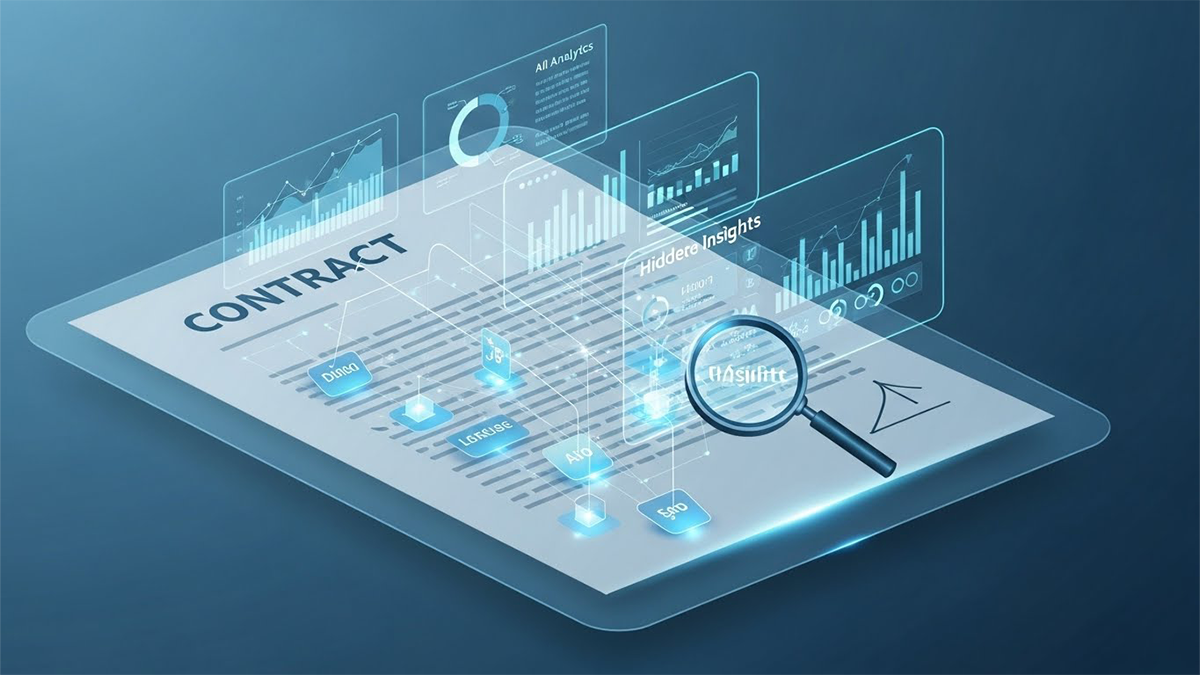
Most organizations are sitting on a contract repository that is far richer than their dashboards and reports suggest. Inside those documents are patterns about risk, revenue, customer behavior, supplier leverage, operational commitments, and compliance posture that rarely make it into day to day decisions. Even strong legal and commercial teams cannot read, remember, and connect thousands of pages across hundreds or thousands of contracts.
AI changes that. By converting unstructured contracts into structured, queryable data, AI can surface insights that humans would either miss, notice too late, or only discover during a dispute. Instead of using contracts only when something goes wrong, you can turn them into an always on intelligence layer. AI native platforms such as Legitt AI (www.legittai.com) are built exactly for this shift.
1. Why do so many critical contract insights stay invisible?
Contracting is still largely document centric. Teams focus on drafting, redlining, and signing, then move on to the next deal. Once executed, contracts are mostly filed away in shared drives, CLM systems, or email archives. At best, a few key fields are manually keyed into CRM or ERP, usually limited to start date, end date, and high level pricing.
Several structural problems follow:
- Most clauses are never captured as data, so they cannot be searched or analyzed at scale
- Deviations from standard positions are tracked inconsistently, if at all
- Amendments and side letters fragment the picture further
- Different teams maintain their own spreadsheets and trackers that rarely reconcile
With this setup, single contract insights might be visible to the lawyer who negotiated them, but portfolio level insights are practically invisible. AI provides the missing translation layer between verbose legal language and compact, actionable business signals.
2. How does AI turn unstructured contracts into an insight engine?
AI starts by reading contracts the way a human would, but does so at digital speed and scale. Using natural language processing, it identifies clauses, classifies them, and extracts key fields such as parties, terms, payment obligations, limitations of liability, SLAs, data protection commitments, and more. It then normalizes these into a consistent schema across the portfolio.
The process typically includes:
- Recognizing clause types and mapping them to standard categories
- Extracting values and conditions, not just headings, such as notice periods or liability caps
- Linking related documents, for example master agreements, orders, and amendments
- Assigning risk or relevance scores based on internal playbooks
Once this layer is in place, contracts are no longer just files. They become a structured dataset that can be queried, filtered, visualized, and correlated with financial and operational data. Platforms like Legitt AI treat this contract data layer as the foundation for all downstream insights and workflows.
3. What kinds of insights can AI surface that humans typically overlook?
Humans tend to look at contracts in a transactional way: what needs to be agreed, signed, or fixed right now. AI helps you step back and see patterns that only emerge when you look across many documents at once. Some examples of often missed insights include:
- Systematic deviations from the clause library in certain regions, segments, or sales teams
- Clusters of contracts with unusually broad indemnities or uncapped liability
- Slow creeping changes in standard positions over time, which shift your risk posture without an explicit decision
- Hidden change of control restrictions or assignment limits that could complicate a future transaction
- Inconsistent definitions of critical terms like confidential information, service levels, or data categories
Individually, these issues might seem small. In aggregate, they determine how exposed or protected your organization really is. AI surfaces these patterns so legal, risk, and leadership teams can address them proactively rather than reactively.
4. How can AI reveal patterns and trends across an entire contract portfolio?
When thousands of contracts are structured as data, AI can group them into meaningful cohorts and run analyses that would be impossible by hand. You can examine clauses and terms not only as text, but as distributions, trends, and outliers.
For example, AI can:
- Show how liability caps vary by deal size, product line, or geography
- Identify which customers or vendors are most often linked to non standard terms
- Track the evolution of a particular clause, such as data processing, across successive template versions
- Highlight which contracts share the same unusual risk feature, for instance a very short termination notice period
This turns qualitative legal information into quantitative insight. It helps general counsel, CFOs, CROs, and boards understand where the portfolio is aligned with policy and where legacy or ad hoc decisions have created concentrations of risk or opportunity. Legitt AI and similar platforms provide portfolio views that make these patterns visible in minutes rather than months.
5. In what ways does AI support risk, compliance, and governance insights?
Risk and compliance teams often need to answer questions that span the entire contract base. Which agreements include specific regulatory clauses, such as data residency, sanctions, or anti bribery provisions. Where do contracts conflict with updated policies or new laws. Without AI, answering these questions can mean weeks of manual review or rough approximations.
AI helps by:
- Tagging clauses that relate to regulatory topics across all contracts
- Comparing each clause to current policy and flagging outdated or non compliant variants
- Mapping where specific risk positions apply, for example which customers have audit rights or broad termination for convenience
- Supporting scenario analysis, such as assessing the impact of a new regulatory requirement on existing deals
These insights allow compliance teams to plan remediation programs based on facts instead of guesswork. For instance, if you change your standard data processing clause, AI can tell you exactly which contracts still contain the old one. A solution like Legitt AI (www.legittai.com) is built to make this type of governance query routine rather than exceptional.
6. How can AI connect contract insights to revenue and operations?
Contracts are not only about risk. They also encode how revenue is earned and how services are delivered. When AI links contract terms with CRM, billing, and operational systems, new classes of insight emerge that go beyond legal analysis.
Examples include:
- Identifying accounts where contractual price uplifts, indexation, or volume based charges have not been fully applied
- Mapping service level commitments to actual performance data to spot chronic underperformance or overdelivery
- Highlighting customers with pre negotiated rights to additional services or geographies that have not been activated
- Surfacing entitlements that are misaligned with usage, leading to revenue leakage or underused value
These are insights that legal teams alone rarely derive, because they require connecting contract data with operational metrics. AI can be the bridge, ensuring that what was agreed is visible to sales, customer success, operations, and finance in a form they can act on. This is one of the key strengths of AI native contract platforms such as Legitt AI.
7. What is required to trust and operationalize AI contract insights?
Insight without trust will not change decisions. To make AI insights part of real workflows, organizations need confidence in the underlying extraction, classification, and analytics. That confidence is built through careful design and governance rather than blind adoption.
Key elements include:
- Clear extraction schemas aligned with your clause library and playbooks
- Validation of AI outputs against human review samples, especially for high risk topics
- Confidence thresholds and flags, so lower certainty insights are routed for manual confirmation
- Audit trails that record how insights were generated and which data points they depended on
- Collaboration between legal, operations, and data teams to interpret and refine insights
When these practices are in place, AI moves from a one off experiment to a dependable part of how you manage contracts. Over time, feedback from users and outcomes from decisions help the system become even more accurate and relevant.
8. How should you get started using AI to uncover hidden contract insights?
You do not need to start by analyzing every contract in the organization. A focused, high value use case is usually more effective as a starting point. For example, you might begin with customer contracts in a particular region or product line, targeting specific questions like renewal risk, data protection posture, or liability exposure.
 Hi, What do you want to Draft?

Click to upload or drag & drop
pdf, docx up to 5 MB
Click to upload or drag & drop
pdf, docx up to 5 MB
A practical path often looks like this:
- Select a defined contract subset and a short list of insight questions you want AI to answer
- Ingest and normalize those contracts into an AI driven platform such as Legitt AI
- Configure extraction for the most relevant clauses and fields
- Validate results, refine models, and build simple dashboards for stakeholders
- Use early insights to drive one or two concrete actions, such as a remediation program or a targeted revenue initiative
- Expand scope gradually to more contracts, more insight types, and deeper integrations with other systems
By moving step by step, you build both technical capability and organizational trust. The end result is a contract function that does not only generate documents, but continuously surfaces insights you would otherwise miss.
Read our complete guide on Contract Lifecycle Management.
FAQs
What types of insights are most commonly missed without AI?
Organizations frequently miss cross contract patterns rather than single clause issues. These include clusters of agreements with similar non standard risks, consistently unused price uplift rights, and recurring deviations from the clause library in particular regions or business units. It is also common to overlook cumulative exposure to certain governing laws or jurisdictions. AI is strong at revealing these portfolio level patterns that do not show up when you review contracts in isolation.
Can AI really understand nuanced differences between clauses, or does it only match keywords?
Modern AI models analyze clauses semantically, not just by matching keywords. They can distinguish between similar looking provisions that have different risk impacts, for example a liability cap that excludes certain categories of damage versus a cap that is truly comprehensive. AI can also recognize when different words are used to express the same concept. That said, final interpretation of nuance still belongs with human experts, especially in complex or novel scenarios.
How accurate are AI generated insights, and how do we verify them?
Accuracy depends on document quality, template consistency, and the maturity of your AI configuration. Good practice is to set up a validation loop where a sample of AI outputs is checked by experienced reviewers. Discrepancies are used to refine extraction rules or models. Confidence scoring also helps: high confidence insights can flow directly into dashboards, while medium or low confidence items are flagged for manual confirmation before they are used in critical decisions.
Does AI only work well if all our contracts use the same templates?
Standardized templates help, but they are not a strict requirement. AI is designed to cope with variation and can learn to recognize similar concepts across different drafting styles. In fact, one of the early benefits of applying AI is discovering how many unapproved or legacy variants exist in your portfolio. Over time, those insights can support standardization efforts. Even in highly bespoke environments, AI still adds value by clustering similar clauses and surfacing outliers.
How does AI handle older scanned contracts or documents with poor formatting?
Scanned contracts require optical character recognition before AI can analyze them. High quality scans usually convert well, but older or low resolution documents can introduce noise. AI platforms often include OCR and provide confidence scores for both text recognition and extraction so you can see where quality may be an issue. For critical contracts that score poorly, you might choose to re scan or prioritize manual review. AI helps you focus human effort where it is most needed.
Can AI insights be used directly in board reports and regulatory conversations?
Yes, provided they are generated under a robust governance framework. When AI is configured with clear schemas, validated regularly, and backed by audit trails, its outputs can support board level risk discussions, internal audit work, and regulatory responses. It is important to document methodologies and limitations so stakeholders understand what AI has done and what still required human judgment. In many cases, AI brings greater transparency than the manual sampling and anecdotal methods it replaces.
How do contract insights from AI connect with our existing BI and data platforms?
Contract insights become much more powerful when joined with other datasets. AI platforms can export structured contract data into data warehouses and BI tools, or integrate directly with CRM and ERP systems. This allows you to correlate legal positions with revenue, margin, churn, or operational incidents. For example, you can analyze whether certain liability or SLA positions correlate with higher dispute rates. These connections move contracts from a siloed legal resource to an integral part of enterprise analytics.
What role do legal teams play once AI is generating insights at scale?
Legal teams shift from being primary manual reviewers to being designers, stewards, and interpreters of contract intelligence. They define which clauses and concepts matter, calibrate risk thresholds, and oversee validation. They also use AI insights to refine templates, playbooks, and negotiation strategies. Rather than spending most of their time looking for information, lawyers can focus on what that information means for risk, strategy, and governance.
Is AI driven contract insight only relevant for large enterprises with huge portfolios?
Large enterprises clearly gain significant benefits because of the scale involved, but mid sized organizations also see strong returns. Even a few hundred recurring revenue contracts or key supplier agreements can hide important patterns in pricing, risk allocation, and obligations. AI helps lean teams extract and use those insights without adding heavy headcount. The threshold at which this becomes valuable is often much lower than many organizations assume.
How does an AI native platform like Legitt AI differ from using a generic AI tool on contracts?
Generic AI tools can answer isolated questions or summarize individual documents, but they do not usually provide an end to end framework for contract data, playbooks, and portfolio analytics. An AI native platform like Legitt AI is built specifically for contracts. It provides structured extraction, clause libraries, risk scoring, integrations, and dashboards tailored to legal and commercial workflows. That means the insights are not just interesting, but reliable, repeatable, and embedded in how your organization negotiates, manages, and leverages its contracts.