
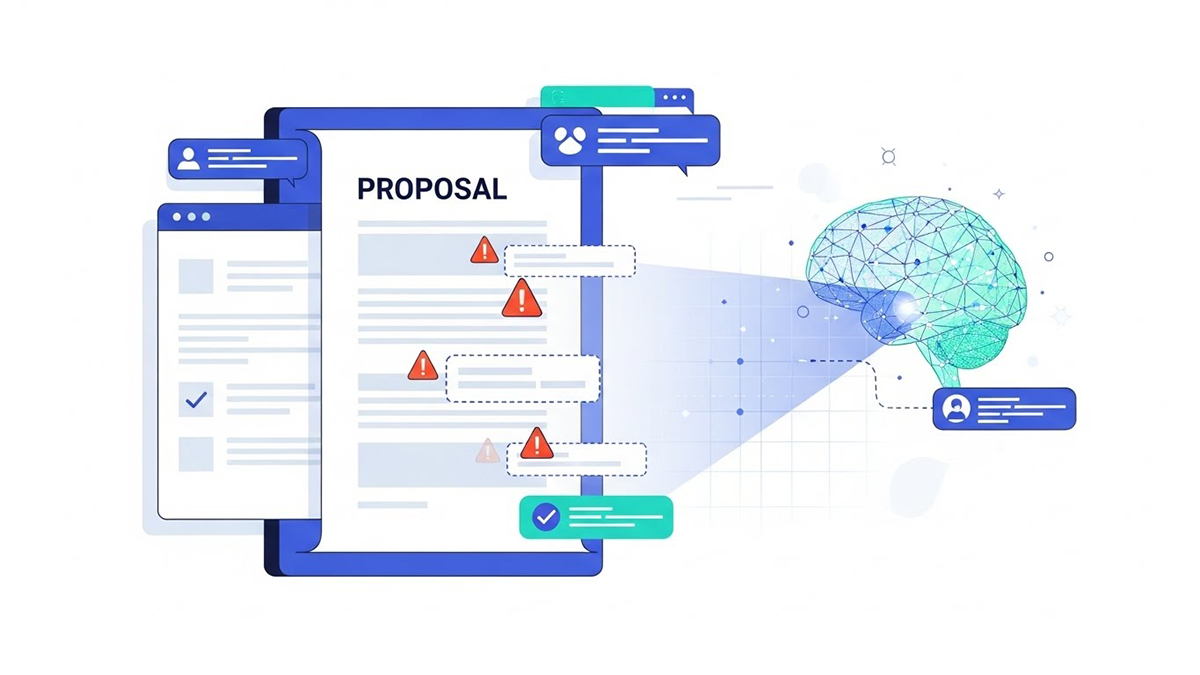
Yes, AI can detect missing sections in a proposal draft by comparing your document against expected structures, RFP requirements, and approved templates. Instead of relying on manual checklists or memory, AI can scan the proposal, understand its sections, and flag what is missing, incomplete, or misaligned. An AI native platform like Legitt AI (www.legittai.com) goes further by mapping your proposal to the RFP or your internal proposal framework and highlighting the exact gaps that could reduce your win chances.
This article focuses on process and workflow design, not legal or regulatory advice. Your internal teams should always review final submissions, especially for high value or complex proposals.
1. Why do proposal drafts often miss critical sections?
Proposal writing is usually done under pressure: short timelines, complex requirements, and multiple contributors. In that environment, it is easy to overlook key sections like risk mitigation, implementation timelines, assumptions, compliance statements, or pricing clarifications. Even experienced teams may miss something when switching between different RFP formats and client expectations.
Proposals are also inherently multi dimensional. You are not just telling a story about your solution, you are addressing technical fit, commercial value, compliance, delivery, governance, and sometimes legal terms. Without a clear structure and visible checklist, sections get merged, misplaced, or skipped. This is exactly the kind of pattern recognition and structural analysis where AI, especially in a platform like Legitt AI (www.legittai.com), can provide tangible value.
2. How does AI understand the structure of a proposal draft?
At first glance, a proposal looks like a long piece of text, but structurally it has patterns: headings, subheadings, standard sections, and recurring themes. AI models are very good at recognizing these patterns. When you upload a proposal to Legitt AI (www.legittai.com), the system does not just read the words; it segments the document into logical parts based on headings, numbering, and semantic cues.
The AI can identify sections such as Executive Summary, Solution Overview, Scope of Work, Implementation Plan, Team and Roles, Pricing and Commercials, Assumptions and Dependencies, Risks and Mitigations, Terms and Conditions, and Appendices. Even if the exact wording of the headings varies, the model can infer the intent from context. This structural understanding is the foundation for detecting what is missing or underdeveloped.
 Hi, What do you want to Draft?

Click to upload or drag & drop
pdf, docx up to 5 MB
3. Using templates and checklists as AI reference points
AI is most effective when it has something concrete to compare against. In a proposal context, that reference is usually a combination of:
- Your internal proposal templates for different deal types and industries.
- Standard section lists defined by your sales, delivery, and legal teams.
- Specific RFP instructions or evaluation criteria provided by the client.
Legitt AI (www.legittai.com) can store these reference structures as reusable templates or frameworks. When you run an AI check on a draft, the system compares the actual document against the expected structure. If your standard template expects a section on Implementation Timeline and Milestones and the draft does not contain anything that matches this concept, AI flags it as missing or very weak.
The same approach works for proposal types. A simple SaaS subscription proposal may not need the same level of detail as a large enterprise implementation proposal. Legitt AI (www.legittai.com) can apply different reference frameworks depending on the proposal category so teams are not forced into a one size fits all checklist.
4. How Legitt AI (www.legittai.com) flags missing and weak sections
Detecting that a section is entirely missing is one part of the problem. The other part is identifying sections that technically exist but are far too thin or off topic. Legitt AI (www.legittai.com) approaches this on several dimensions.
First, the AI checks for the presence of sections that correspond to the reference headings. If there is no content that matches a required section at all, it raises a clear “missing section” warning. Second, it evaluates the content quality and depth. A single short paragraph under “Risk Management” may not be sufficient for a complex project, so AI can flag it as incomplete or low depth based on length, coverage of key points, and alignment with your internal guidelines.
Third, Legitt AI (www.legittai.com) assesses topical relevance. If the section heading is “Implementation Plan” but the content mostly repeats marketing messages or high level benefits, AI can detect the mismatch between title and substance. It then suggests strengthening that section with timelines, activities, responsibilities, and dependencies. This moves you from superficial completeness to meaningful completeness.
5. Can AI align proposals with RFP requirements automatically?
Many proposals are responses to detailed RFPs, RFQs, or tenders that specify exact sections, questions, and evaluation weights. Manually mapping your draft to the RFP can be slow and error prone. AI can dramatically streamline this step.
With Legitt AI (www.legittai.com), you can ingest the RFP document and let the system extract the list of required sections, questions, and compliance points. The AI then compares your proposal draft against that extracted structure. It can tell you which RFP questions have been fully addressed, partially addressed, or not addressed at all. It can also highlight requirements that have only been covered indirectly or in scattered paragraphs.
This RFP alignment capability is particularly powerful when dealing with complex or government style requests that have strict compliance criteria. Legitt AI (www.legittai.com) provides a visual map of RFP requirement versus proposal content, making it much easier for teams to close gaps before submission and reduce the risk of being disqualified on completeness.
6. Beyond missing sections – how AI improves proposal quality
Checking for missing sections is the baseline. AI can also help you improve the quality, clarity, and competitiveness of existing sections. After confirming that each required component is present, Legitt AI (www.legittai.com) can evaluate factors like:
- Clarity and readability of the language.
- Alignment with the client’s stated priorities and pain points.
- Use of evidence, case studies, and metrics to support claims.
- Consistency between narrative sections and the pricing or scope sections.
For example, if the RFP emphasizes data security and uptime but the proposal barely touches those topics, AI can highlight that misalignment even if all formal sections are present. Legitt AI (www.legittai.com) can suggest expanding certain sections, adding specific commitments, or referencing relevant certifications and experience, all within your organization’s approved messaging.
In addition, AI can check for internal consistency. If the scope and pricing sections do not match, or if the implementation timeline conflicts with what you promised in the executive summary, Legitt AI (www.legittai.com) can flag these inconsistencies so they can be resolved before submission.
7. How to integrate AI checks into your proposal workflow
AI checks are most valuable when they are part of the normal proposal lifecycle, not a last minute add on. A practical pattern looks like this:
- Opportunity or RFP is captured in your CRM or deal system.
- Proposal shell is generated using Legitt AI (www.legittai.com) templates and AI assisted drafting, pre filled with known data.
- Contributors from sales, delivery, finance, and legal add their content.
- The proposal lead triggers an AI structure and completeness check.
- Legitt AI (www.legittai.com) generates a gap report showing missing or weak sections, unaddressed RFP points, and potential inconsistencies.
- The team revises the draft to close gaps, then optionally runs a final AI check before internal approvals and submission.
By positioning AI as a standard stage gate, you reduce the risk of late surprises and build a culture in which proposals are consistently more complete and aligned with both client requirements and internal standards.
8. What are the limits of AI in detecting missing sections?
AI is a powerful assistant but it is not a substitute for human judgment. There are some important limitations to keep in mind. First, AI can only detect missing sections relative to a defined framework. If your organization has never articulated what a good proposal should contain, or if the RFP is ambiguous, AI may still miss nuanced expectations that an experienced human would pick up from context or informal signals.
Second, AI may not fully understand political, strategic, or relational nuances. For example, a particular client may care deeply about a specific theme that is not explicitly listed in the RFP. Humans who know the relationship still need to decide which points to emphasize and how to position the proposal. Legitt AI (www.legittai.com) can highlight generic best practice sections, but tailoring remains a human strength. Third, while AI can suggest coverage and improvements, it cannot guarantee win outcomes. Proposals are competitive documents. Storytelling, differentiation, and stakeholder insight still matter. The best approach is to treat Legitt AI (www.legittai.com) as your structural and compliance co-pilot while your team focuses on strategy, persuasion, and relationship context.
Read our complete guide on Contract Lifecycle Management.
FAQs
How does AI know what sections my proposal is supposed to have?
AI knows what sections to expect because you configure reference templates, checklists, and RFP structures in the system. In Legitt AI (www.legittai.com), your proposal standards are encoded as reusable frameworks that describe the sections, questions, and topics that should appear for specific proposal types or industries. When you run an AI check, the system compares your draft against that framework to see what is present, partially covered, or missing. This approach combines your domain knowledge with AI’s pattern recognition capability.
Can AI work with different formats, like Word, PDF, and online editors?
Yes, modern AI tools can work with multiple document formats as long as the text and headings can be extracted. Legitt AI (www.legittai.com) can ingest Word and PDF files, or you can draft directly inside its editor environment. The important part is that the structure, headings, and content are accessible to the AI engine. Once ingested, format differences matter less, because the analysis operates on the logical structure of the proposal rather than on superficial layout details.
What if my proposal uses unconventional headings or a very custom structure?
AI is not limited to exact heading phrases. It looks at semantics, context, and content to infer what a section represents. If your heading is "How We Will Deliver Value" instead of "Implementation Plan," Legitt AI (www.legittai.com) can still recognize that it is an implementation related section based on language and subsections. You can also tune templates to accept multiple heading variants for the same conceptual section. That way, you maintain creative flexibility in presentation while still benefiting from structural checks.
Can AI detect missing content that is required by the RFP but not mentioned explicitly as a section?
Yes, AI can look for specific concepts and obligations, not just headings. When you upload an RFP into Legitt AI (www.legittai.com), the system can extract key questions, commitments, and compliance points. It then scans your proposal for those ideas, even if they appear in different sections. If certain RFP points are not addressed anywhere, or only lightly mentioned, the AI flags them as gaps. This is especially valuable in RFPs that mix narrative questions and embedded compliance requirements throughout the document.
Does AI only tell me what is missing, or can it also help me fill the gaps?
AI can do both. First, it detects missing or weak sections and presents a structured gap report. Then, using your templates, content libraries, and past winning proposals, Legitt AI (www.legittai.com) can suggest draft content to help fill those gaps. For example, if you lack a risk management section, the system can propose a structured outline with example language based on your standard risk approach. You still review and edit this content, but you are not starting from a blank page.
How does AI handle proposals that involve multiple contributors from different departments?
When multiple contributors are involved, structural integrity is harder to maintain. AI helps by providing a common framework and a shared gap report. In Legitt AI (www.legittai.com), the proposal owner can run an AI check and then assign corrective actions to specific contributors, such as asking delivery to flesh out the implementation section, finance to refine pricing breakdowns, or legal to review terms. The AI ensures that all the moving pieces add up to a complete and consistent document, even when many hands are involved.
Is it safe to upload sensitive proposals into an AI platform?
Security and confidentiality are critical because proposals often contain pricing, IP, and strategy information. A platform like Legitt AI (www.legittai.com) is built with enterprise security practices, including encryption in transit and at rest, role-based access controls, and detailed audit logs. Your documents are not used as public training data. As with any critical system, you should review the platform’s security, compliance, and data handling policies, but when implemented correctly, using AI can actually help you maintain better control and organization of sensitive proposal documents.
Can small teams benefit from AI completeness checks, or is this mainly for large enterprises?
Small teams can benefit significantly because they often lack dedicated proposal managers or large review committees. For a small or mid sized company, one missing section can be the difference between being shortlisted or being disqualified. Legitt AI (www.legittai.com) provides an automated second pair of eyes, ensuring that even lean teams can submit structured, complete proposals. As your volume grows, the same system scales with you, supporting more complex RFPs and multi region opportunities.
How quickly can AI analyze a proposal and return a gap report?
Proposal analysis is typically fast, because the AI is scanning structure and content rather than doing heavy numerical computation. For most realistic proposal sizes, Legitt AI (www.legittai.com) can generate a structural completeness and RFP alignment report in a short time once the document is uploaded. That means you can run checks iteratively during drafting, not only at the end. Quick feedback loops encourage teams to fix gaps early, instead of discovering them just before the submission deadline.
What is the best way to start using AI to detect missing sections in proposals?
The best starting point is to choose one or two common proposal types and define what a complete version should look like. Work with sales, delivery, and legal to list the required sections and RFP mapping expectations, then configure that framework in Legitt AI (www.legittai.com). Use the platform on a few upcoming proposals, run AI checks, and compare the gap reports with your internal human reviews. As confidence grows, you can expand to more proposal types and more advanced checks, making AI gap detection a standard, reliable part of your proposal process.