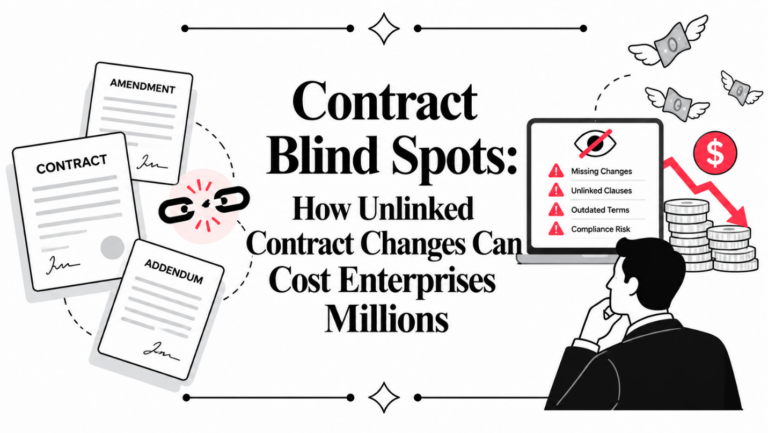

You're likely staring at a stack of vendor replies that should be easy to compare, but aren't. One supplier priced by unit, another bundled shipping, a third ignored payment terms, and now the team is stuck rebuilding the whole exercise in spreadsheets. A template for request for quote solves that problem only when it does more than collect bids, it has to force clean, comparable responses and then feed those responses into contract and approval workflows without rekeying.
What an RFQ Is and When to Use One
A procurement team sends out an RFQ that leaves too much room for interpretation, then gets three quotes back that cannot be compared. One supplier prices the product, another adds shipping, and a third sends a service package instead of a quotation. The template set the team up for extra work.
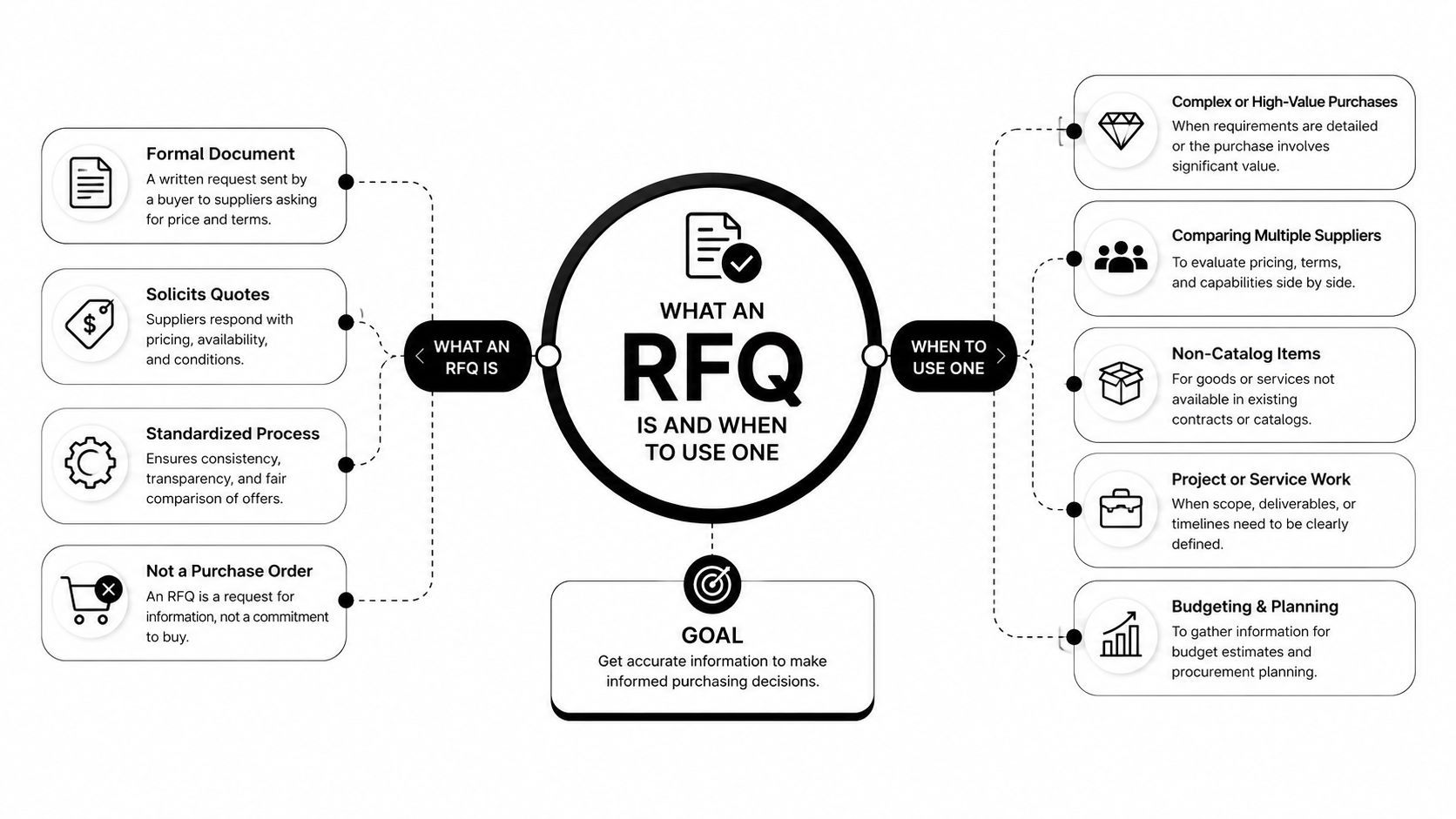
An RFQ, or request for quotation, is a structured solicitation for price bids against a defined specification. Buyers use it once the requirement is already clear and the main decision is commercial comparison, not solution design. A strong RFQ makes vendors answer the same fields, so the buyer can compare offers like for like and defend the evaluation if anyone asks why one bid won. For a practical overview of how RFQs differ from proposal-led buying, see request for proposal vs request for quotation. Salesforce's RFQ guidance also notes that teams often send RFQs to at least 3 suppliers, and 5 for larger spends, so the buyer has a real comparison set rather than a single price point. Timing matters as well. Standard RFQs are commonly given 5–7 business days, while more complex or customized requests often need 10–14 business days so vendors can price them without guessing. Salesforce RFQ guide
When an RFQ fits
Use an RFQ when the spec is known, the buyer cares about price and commercial terms, and multiple qualified vendors can quote against the same scope. It works well for repeat buys, catalog items, standardized services, and purchases where the buyer already knows the exact deliverable.
Practical rule: If the buyer still needs vendors to define the solution, it is probably an RFI or RFP.
That distinction matters because RFQs, RFIs, and RFPs are often mixed up in internal conversations, then the team wonders why the responses are impossible to evaluate. A clean RFQ is narrower than a proposal process, but it still has to be specific enough to support downstream contract drafting and approval routing.
Required Sections and Fields in an RFQ Template
The fastest way to weaken an RFQ is to let each buyer invent their own structure. Vendors can handle variation, but they can't compare a half-formatted quote, a free-text email, and a pricing table with missing units in the same process. A strong template for request for quote makes the buyer's priorities explicit and the vendor's response reusable.
Start with identification and scope
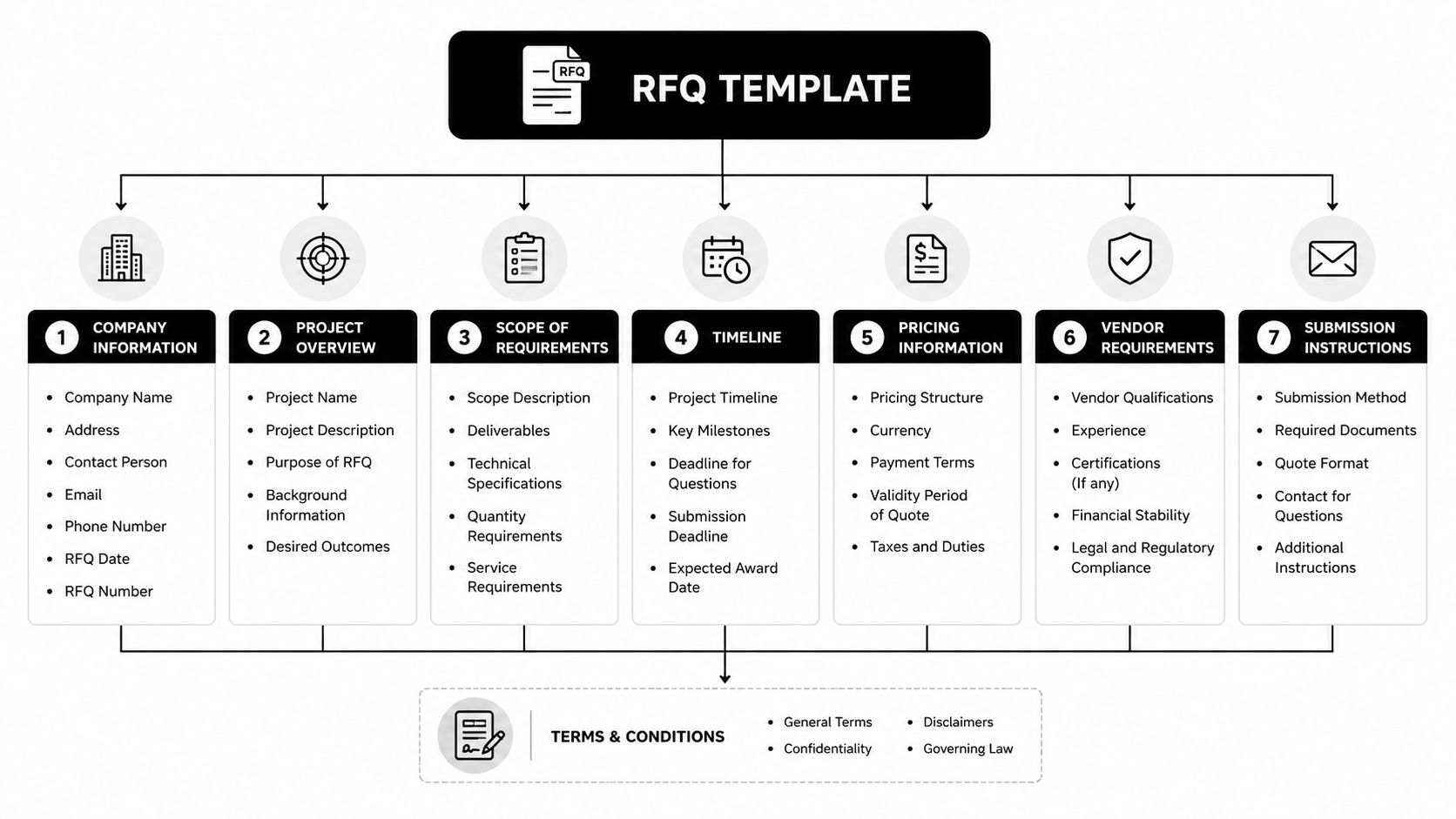
Begin with an RFQ number, issue date, vendor contact details, and a short project overview. These fields sound administrative, but they prevent confusion when multiple quote rounds or amendments are circulating. Smartsheet's RFQ structure also includes a submission response deadline, vendor details, project overview, specifications, delivery requirements, submission instructions, evaluation criteria, terms and conditions, and vendor qualifications, which is exactly the kind of scaffolding that keeps the process auditable. Smartsheet RFQ templates
Lock the commercial comparison points
The most important section is the pricing table. It has to standardize the fields vendors complete, usually including unit price, quantity, extended total, shipping, taxes, lead time, and payment terms. If the pricing table changes from vendor to vendor, the buyer loses apples-to-apples comparability, which is the entire point of the RFQ.
A good template also includes delivery requirements, submission instructions, and evaluation criteria. Those fields tell vendors how to answer, by what date, and what the buyer will score. A single communication channel is worth keeping in the template too, because clarification questions should be shared consistently across bidders. Responsive's RFQ guidance is blunt on this point, standardized specs and a standardized pricing table are what keep manual reconciliation from taking over the buying process. RFQ template examples
What usually gets missed: the template isn't just a form, it's a control point for pricing logic, deadline discipline, and supplier fairness.
The internal pages and legacy templates used across public procurement have long reflected the same pattern, issue date, due date, delivery expectations, and vendor contact details. That consistency is why the RFQ has lasted as a formal procurement instrument rather than a loose email request. If your team uses contract lifecycle management or AI contract review, those fields become the handoff data that drive approval routing, repository storage, and draft contract generation. For a related pricing-structure reference, see standardizing pricing for estimates, proposals, and quotations.
Ready-to-Use Template You Can Copy
Some teams only need a short email RFQ. Others need a full document that legal, procurement, and finance can route through approval. The structure below works for both. Trim the explanatory text for email use, or keep the full version when the buying decision needs a clean audit trail and a contract handoff.
A useful place to start if you're also building proposal or commercial templates is find business proposal templates, because the same discipline, clear scope, consistent pricing fields, and consistent terms, carries across most commercial documents. If your organization uses a CLM platform, this structure also maps cleanly into repository storage, redlines, and eSignature workflows. For teams standardizing commercial documents, see Legitt AI industry contract templates.
Template for Request for Quote
Subject: RFQ for [Project or Product Name]
RFQ Number: [RFQ-###]
Issue Date: [Date]
Response Deadline: [Date and time]
Primary Contact: [Name, title, email, phone]
1. Project Overview
[Brief description of the goods or services requested, business context, and intended outcome.]
2. Specifications
[List exact product or service requirements, dimensions, standards, scope boundaries, or deliverables.]
3. Quantities and Units
[State quantities, units of measure, and any tiered volume expectations.]
4. Delivery Requirements
[State delivery location, delivery window, shipping responsibilities, and any Incoterms guidance.]
5. Pricing Table
[Vendor to complete unit price, total price, shipping, taxes, discounts, bulk pricing, lead times, and payment terms.]
6. Submission Instructions
[State file format, naming rules, attachment size limits, single contact channel, and whether questions must be submitted by email or form.]
7. Evaluation Criteria
[State how responses will be reviewed, including price, compliance, delivery timing, warranty, service levels, or other priorities.]
8. Terms and Conditions
[Attach or link standard terms, quote validity expectations, confidentiality requirements, and any mandatory legal or compliance language.]
9. Vendor Qualifications
[State certifications, references, experience, insurance, geographic coverage, or other minimum requirements.]
10. Signature or Acknowledgment
[Name, title, date, and acceptance of RFQ terms.]
For one-page email RFQs, keep the first pass tight and move technical detail into attachments or follow-up fields. That helps preserve response rates when the buyer already knows the key requirements. If the RFQ later turns into a contract, the structured fields here should flow directly into drafting, approval, and signature rather than being retyped from a PDF.
Real-World Examples for Common Scenarios
The cleanest RFQ template on paper can still fail if it doesn't fit the buying situation. The fields that matter for a SaaS purchase are not the same ones that matter for office supplies or professional services. A good procurement lead edits the template deliberately instead of rewriting the whole thing from scratch.
| Field Changes Across Three Common RFQ Scenarios | SaaS Purchase | Office Supplies | Professional Services |
|---|---|---|---|
| Pricing structure | Seat-based pricing, implementation fees, renewal terms | Unit pricing, bulk pricing, substitution costs | Rate card, milestone pricing, change-request pricing |
| Commercial controls | Security questionnaire, quote validity, renewal timing | Delivery window, stock availability, substitution policy | Acceptance criteria, milestone sign-off, invoicing schedule |
| Operational detail | Support tiers, onboarding scope, data handling | Delivery locations, pack sizes, restock cadence | Deliverables, project roles, timeline assumptions |
| Vendor response focus | Compliance, scalability, contract terms | Availability, consistency, fulfillment terms | Method, staffing, deliverable quality |
For a one-time SaaS purchase, the template should push vendors to answer on seat-based pricing, security, renewal language, and implementation assumptions. A vague SaaS RFQ often produces clean sticker prices but useless commercial comparisons because one vendor includes onboarding, another excludes it, and nobody defines support. That's where approval routing and contract review matter, because legal needs the same renewal, warranty, and termination language in the same place every time.
For recurring office supplies, the buying logic shifts. The RFQ should focus on volume tiers, delivery windows, stock consistency, and substitution policies. The vendor's ability to meet replenishment expectations matters as much as unit price, especially when the same items are ordered repeatedly.
For custom professional services, rate cards, milestones, and acceptance criteria do the heavy lifting. Vendors should know exactly what success looks like, who signs off, and how change requests will be handled. If those details are missing, the buyer ends up negotiating scope during execution instead of comparing quotes up front.
Strong vendor responses are specific. They answer the pricing table cleanly, mirror the requested units, and flag exceptions in the same place the buyer asked for them.
That kind of response is easier to compare, easier to approve, and much easier to convert into a contract workflow without rework.
Common Mistakes That Weaken Vendor Responses
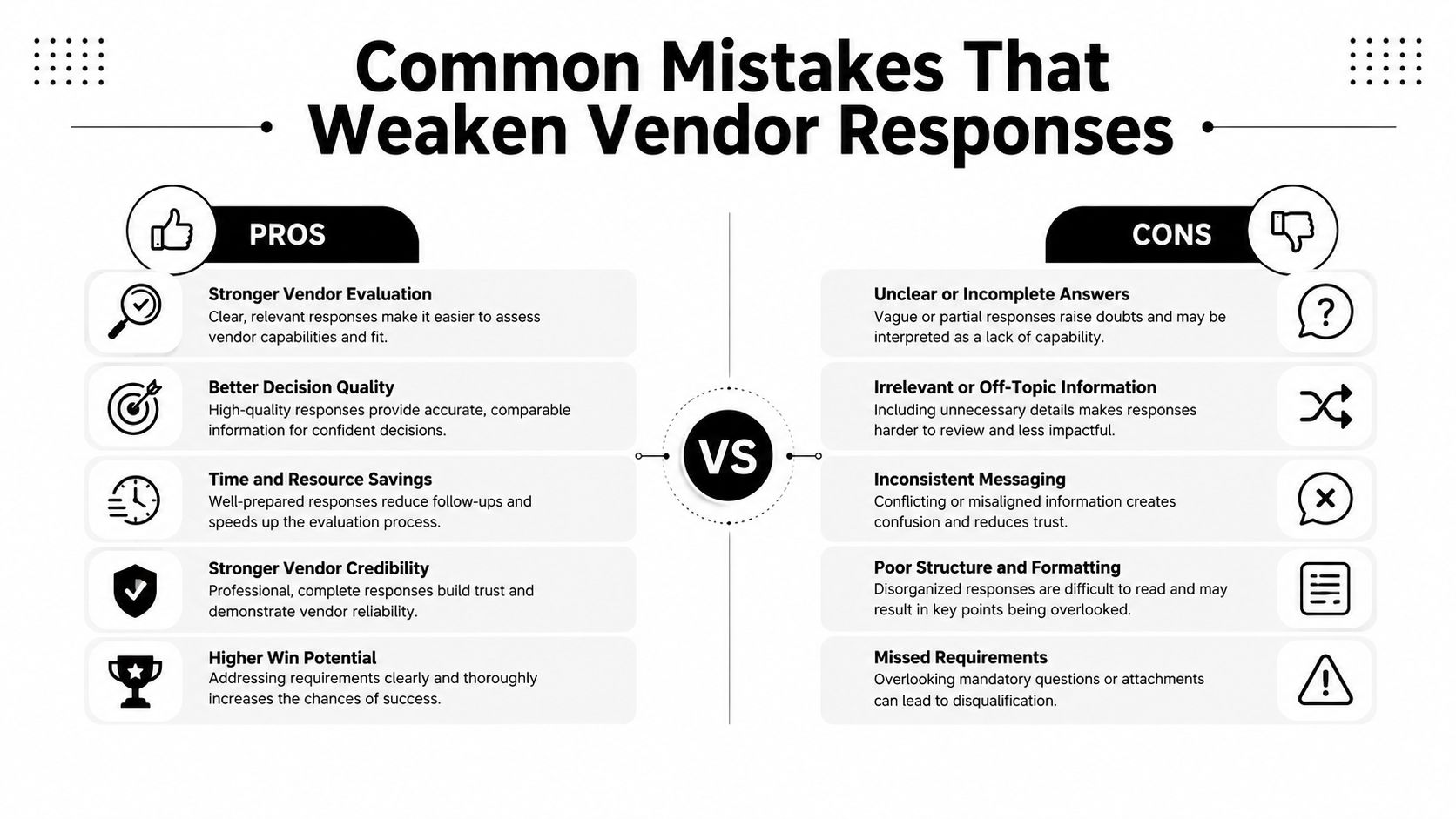
Most weak RFQ responses aren't caused by bad vendors. They come from templates that force too much too soon, obscure the core commercial rules, or leave too much room for interpretation. The precision-versus-participation tradeoff is the one most template guides skip. More detail can improve comparability, but a rigid RFQ can also shrink the bidder pool, especially if smaller or alternative suppliers feel boxed out before they start.
The mistakes that create noise
A few failures show up again and again:
- Too many fields on the first pass. One B2B RFQ-form benchmark notes that completion rates drop measurably beyond 8 fields, so the practical move is to keep only essential identifiers in the opening form and push the rest into structured follow-up fields or attachments. RFQ form benchmark
- Vague specifications. Vendors can't price “roughly this” with confidence, and they'll either pad the number or refuse to bid.
- Missing evaluation criteria. If buyers don't say what matters, vendors guess, and they often guess wrong.
- Buried deadlines. A deadline that's hidden in a footer or buried in an attachment gets missed, then the process turns into cleanup.
- Over-rigid requirements. When a template over-specifies every field, smaller suppliers often stay out, even when they could have competed well on price or service.
A public-sector template set from GSA shows how much of RFQ guidance is procedural, scope, pricing method, due date, instructions, but not strategic. That's useful, but it also leaves the buyer to decide how much detail is enough. GSA RFQ samples and tips
How to fix the template
If the first version is getting weak responses, strip the opening form down to essentials. Put the rest in attachments, follow-up fields, or a second-step intake. That keeps the vendor experience manageable without sacrificing pricing discipline.
A practical example from operations teams is to separate quote collection from technical qualification. SafetyCulture's newer RFQ template guidance reflects that shift toward forms, email flows, FAQ sections, and structured submission instructions rather than static documents. The gap is that many teams still don't connect those fields to later automation, so the quote arrives but doesn't feed directly into approval, routing, or contract handoff. Request for quotation template guidance
For teams that need faster outbound coordination, a simple outbound workflow can also help. If sales or sourcing teams are building vendor shortlists and need cleaner initial outreach, Hire SDRs is a practical reference point for handling structured outreach at scale. For proposal-style drafting errors that also hurt RFQs, see common mistakes in proposal writing.
Evaluating Responses and Moving to a Contract
The RFQ is not finished when the quotes arrive. The hard part starts when procurement, legal, and finance have to turn those responses into a decision that can survive review, then into a contract that keeps the commercial detail intact. If pricing sits in a PDF and approvals live in email, teams rekey data, lose context, and invite avoidable errors.
Score against the same criteria every time
Use the evaluation criteria already published in the RFQ. That keeps the review defensible and avoids the quiet changes that make vendors question the process. Clarification questions should go through one channel, and every answer should be shared with every bidder so no one gets an unfair advantage.
Good evaluation discipline is boring on purpose. Same scoring sheet, same deadline, same clarification process, same approval path.
That discipline gets easier when quote data starts in a structured format. In tools like Legitt AI, teams can take approved quote data, generate a draft contract, run redlines and approval workflows, and store the executed agreement alongside the original RFQ for auditability. That matters for AI contract management, contract intelligence, and CLM software because the system can track what was requested, what was accepted, and what still needs approval rather than relying on scattered attachments and inbox history.
Shortlist, negotiate, and hand off cleanly
Once the scores are in, shortlist the vendor that fits the pre-defined criteria best, not just the lowest number. Then negotiate the exceptions that matter most, such as delivery, payment terms, warranty language, or service levels. If the deal is going ahead, the RFQ should hand off cleanly into the contract lifecycle process, with the vendor's quote, clarifications, and final terms attached to the record.
A structured response window still matters here. Standard RFQs commonly need 5–7 business days, while more complex requests need 10–14 business days so vendors can respond cleanly and buyers can evaluate without scrambling.
For teams comparing vendor management workflows, vendor management best practices is a useful reference, because the RFQ handoff is only one point in a longer supplier relationship. For proposal-style drafting and approval work that also needs controlled handoff, government proposal software is a relevant comparison point.
Best Practices Checklist and Frequently Asked Questions
A reliable RFQ process is less about perfect wording and more about repeatable control. If the template is clean, the pricing table is standardized, and the handoff into contract management is structured, vendor responses become easier to compare and easier to approve.
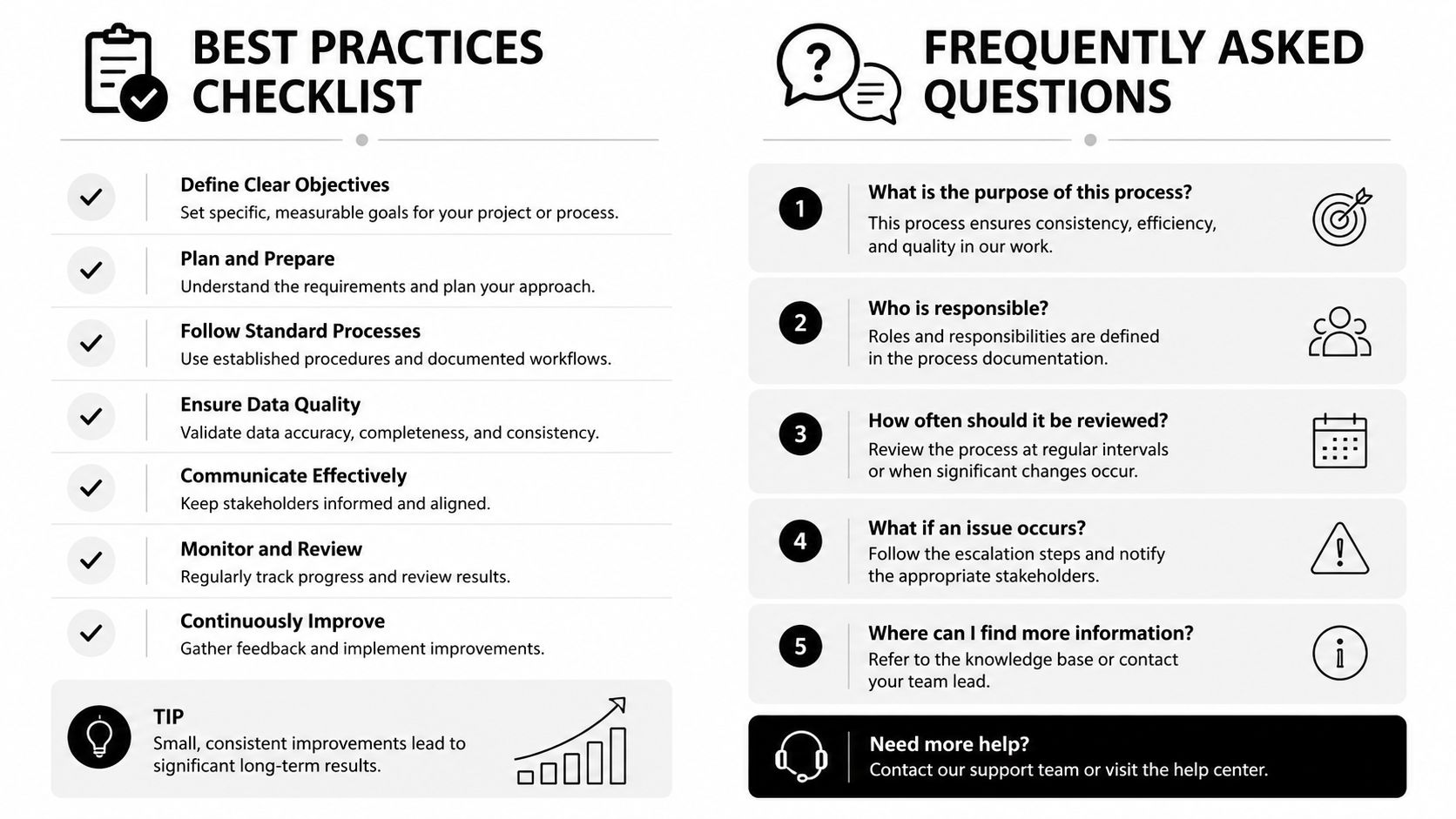
RFQ best practices checklist
- Use a fixed scope. Make the requirement clear enough that vendors quote the same thing.
- Standardize the pricing table. Keep units, totals, shipping, taxes, and payment terms in one format.
- Publish evaluation criteria early. Vendors write better responses when they know what matters.
- Keep the first pass lean. Collect only the fields you need to start the comparison.
- Set a realistic deadline. Give vendors enough time to answer without compressing their internal approvals.
- Share clarifications with everyone. One channel keeps the process fair.
- Store the result in a contract system. That's where quote data becomes approvals, redlines, eSignature, and repository history.
Frequently asked questions
How is an RFQ different from an RFP?
An RFQ compares price against a known specification. An RFP asks vendors to propose the solution itself, so methodology and approach matter more.
What if there's only one supplier?
That's usually a sole-source situation, not a competitive RFQ. The team should document the reason and move through the right internal approval path.
Can the resulting contract be signed electronically?
Yes, if your legal and procurement policies allow eSignature. That usually makes the handoff from quote to executed agreement much faster.
How do you keep RFQ data structured for analytics?
Use the same fields every time, keep pricing in standardized columns, and store the accepted quote with the contract record so procurement can review trends later.
Legitt AI helps teams turn structured quote data into draft contracts, approvals, and signed agreements without losing the original RFQ context. If you're trying to tighten vendor comparisons, reduce rekeying, and keep procurement and legal aligned, visit Legitt AI to see how RFQ data can move cleanly into contract lifecycle workflows.