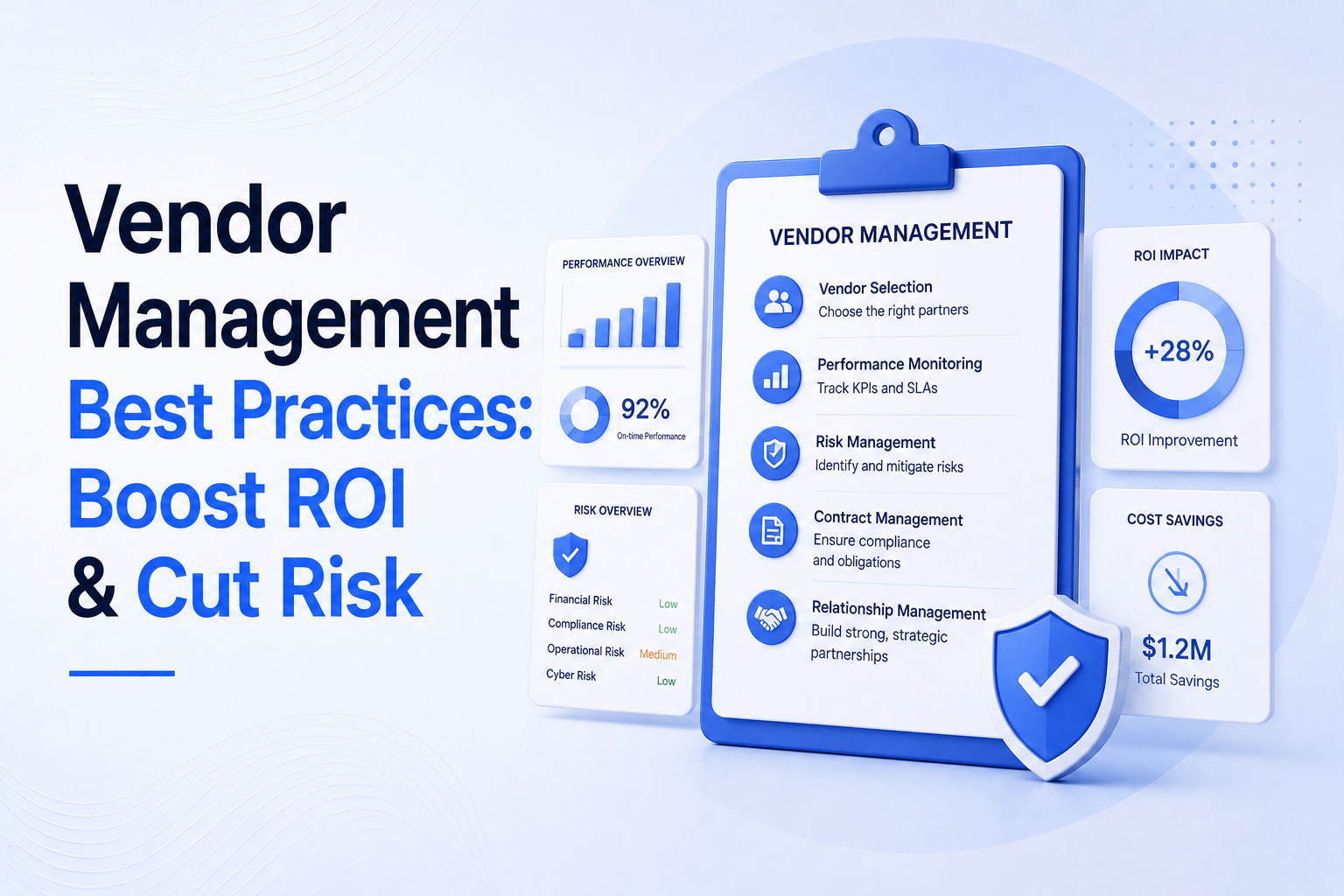
Vendor management used to sit in a corner of procurement. That model no longer works. Once vendors touch customer data, core systems, revenue operations, regulated workflows, or business continuity, vendor management becomes a legal, finance, security, and operations issue.
The shift is visible in the technology market itself. A vendor management systems forecast values the market at USD 11.51 billion in 2026, with projected growth to USD 23.16 billion by 2033 at a 10.5% CAGR. That matters because it reflects how organizations now treat vendor oversight as a data and automation problem, not just a relationship-management task.
The strongest vendor management best practices follow the same pattern. Teams centralize contracts and vendor records, define clear risk tiers, track meaningful KPIs, and automate the dates and approvals that usually get missed. The payoff isn’t only lower risk. It also means fewer contract surprises, stronger renewal position, faster internal approvals, and cleaner audit trails.
What follows is a practical list of vendor management best practices that Legal, Procurement, Sales, Finance, and Operations teams can run. Each one is implementable with disciplined process design and, where it makes sense, a modern CLM platform such as Legitt AI.
1. Vendor Risk Assessment and Classification
Most vendor programs fail at the first step. They treat all vendors like they deserve the same level of review. That creates two problems at once. High-risk vendors don’t get enough scrutiny, and low-risk vendors get trapped in slow approvals that waste everyone’s time.
Start by classifying vendors based on business criticality, data access, regulatory exposure, operational dependency, and financial resilience. A cloud hosting provider, payment processor, or data-handling service shouldn’t go through the same path as an office supply vendor.

Build tiers that change the workflow
Risk classification has to drive action, not just produce a label in a spreadsheet.
- High-risk vendors: Require deeper security review, stronger contractual controls, executive approval, and tighter monitoring.
- Medium-risk vendors: Need standard diligence, contract review, and scheduled check-ins.
- Low-risk vendors: Should move through simplified intake and template-based contracting.
A financial services team might require baseline evidence of controls such as SOC 2 Type II or ISO 27001 for certain technology vendors. A healthcare organization may route every data-handling vendor through privacy review before signature. A manufacturer may score supply vendors based on continuity risk and dependency on single-source components.
Practical rule: If your risk tier doesn’t change contract language, approvers, or monitoring cadence, it isn’t a real classification model.
Legitt AI can support this by extracting risk-sensitive clauses from third-party paper, flagging deviations early, and storing completed assessments in a searchable repository. That helps legal and procurement teams catch issues before negotiations drag on.
2. Standardized Contract Templates and Playbooks
If every vendor agreement starts from a blank page, your contracting process is already too expensive. Standardized templates are one of the most effective vendor management best practices because they reduce avoidable negotiation, keep fallback language consistent, and make review faster for business teams.
Templates should reflect vendor type and engagement model. Your SaaS vendor paper shouldn’t look like your staffing agreement, and your data-processing addendum shouldn’t be improvised in the middle of a security review.
What good standardization actually looks like
A practical template library usually includes:
- Core agreement forms: MSA, SOW, order form, NDA, and procurement terms.
- Risk-specific add-ons: Security exhibits, data processing terms, insurance requirements, and audit rights.
- Negotiation playbooks: Approved fallback positions for liability, indemnity, SLA remedies, privacy, and termination.
Best practice guidance also recommends vendor scorecards with roughly 5 to 10 key metrics covering quality, delivery, service, and innovation. The same discipline applies to templates. Keep the clause set tight and intentional. Too many optional provisions create inconsistency instead of control.
Teams using a CLM platform can operationalize this instead of storing templates in disconnected folders. With Legitt AI’s AI contract drafting agent, legal and procurement teams can generate first drafts from approved language and customize them for specific vendor scenarios. If you’re also tightening supplier controls, this external guide to supply chain risk mitigation is a useful operational companion.
Standardization doesn’t mean rigidity. It means your team starts from approved positions instead of renegotiating policy every time.
3. Vendor Performance Metrics and SLA Management
Vendor issues rarely start with a dramatic failure. They show up as small misses. A support queue slips past response time, invoices stop matching rate cards, or delivery dates move often enough that the business builds workarounds. Teams that manage vendors well measure those patterns early and tie them to contract decisions.
A useful scorecard does more than report activity. It gives Legal, Procurement, Sales or Operations, and Finance a shared basis for action. Procurement needs service and pricing discipline. Legal needs clear links between performance terms and remedies. The business owner needs proof that the vendor is meeting operational expectations. Finance needs visibility into credits, overbilling, and whether the contract still supports the business case.
The strongest programs keep the metric set tight. Track only the KPIs that support a decision to renew, remediate, or replace. Good examples include on-time delivery, defect rate, SLA attainment, invoice accuracy, incident response time, and service credit usage. If a metric will not change governance, it does not belong on the scorecard.
Implementation works best when each KPI is tied to the contract record and reviewed against the current contract version, not a spreadsheet that has drifted from the signed terms. Legitt AI can extract SLA language, map obligations to owners, and store scorecards alongside the agreement. Teams using a contract repository analyzer for vendor metadata and clause visibility can also flag where the negotiated SLA differs from the standard playbook, which matters when service failures trigger credits, cure periods, or termination rights.
A simple operating model usually includes:
- One owner per metric: The function closest to the outcome should validate it. Procurement should not be the only team judging service quality.
- One review cadence by vendor tier: Critical vendors may need monthly reviews. Lower-risk vendors may only need quarterly or semiannual checks.
- One escalation path: Define what happens after an SLA miss, including corrective action plans, service credits, executive review, or replacement planning.
- One financial check: Finance should confirm whether billing matches contracted rates, earned credits, and approved change orders.
Trade-offs matter here. A detailed scorecard creates discipline, but too many inputs turn vendor reviews into admin work. I have seen teams track twenty metrics and act on none of them. Five to eight well-defined measures, tied to contract remedies and business outcomes, usually produce better decisions.
External practitioner guidance on vendor management tools and operating models also points to a single source of truth for contracts, compliance records, KPIs, and communications. That matters because SLA management breaks down when the contract says one thing, the business owner reports another, and Finance pays invoices without seeing open disputes.
The goal is simple. Measure what the contract promises, review exceptions quickly, and make vendor decisions with evidence instead of anecdotes.
4. Centralized Contract Repository and Metadata Management
Scattered contracts create silent risk. Legal has one version, procurement has another, finance has a PDF in email, and no one knows which amendment changed the renewal term. That isn’t a storage problem. It’s a governance problem.
Modern vendor programs are moving toward centralized, data-driven governance, with vendor agreements and master data consolidated into a single repository that serves as a single source of truth for spend, delivery performance, and risk indicators, as described in current vendor management guidance.

Metadata matters more than storage
A shared drive full of PDFs isn’t a repository if nobody can query it properly. Every vendor contract should carry searchable metadata such as vendor name, business owner, category, jurisdiction, renewal model, data sensitivity, governing law, and notice periods.
That structure gives different teams what they need:
- Legal: Clause visibility, amendment history, and audit trail
- Procurement: Term comparison, renewal advantage, and supplier rationalization
- Finance: Payment commitments, auto-renewal exposure, and budgeting visibility
- Security and compliance: Data access terms, certifications, and obligation tracking
I’ve seen teams think they had control because contracts were “saved somewhere.” They didn’t. Control starts when you can answer a question across the portfolio in minutes, not after a week of chasing files.
Legitt AI’s repository analyzer agent is relevant here because it can centralize executed documents, extract metadata, and surface portfolio-level issues that are hard to identify manually.
5. Vendor Relationship Management and Strategic Partnerships
Strategic vendor management starts with a clear decision: which suppliers warrant executive attention, cross-functional reviews, and long-term planning. Everything else should follow a lighter operating model. Teams waste time when they treat low-impact vendors like strategic partners, and they create avoidable risk when they fail to give critical vendors enough structure.
The vendors that merit this level of focus usually support revenue, customer delivery, regulated workflows, or infrastructure that is expensive to replace. For those relationships, Procurement cannot run the process alone. Legal needs visibility into contractual change and dispute patterns. Finance needs a view of cost trajectory, credits, and budget exposure. Sales or business owners need to confirm the vendor still supports customer commitments and growth plans.
Use business reviews to make decisions
A quarterly or biannual business review should produce actions, owners, and deadlines. If it turns into a status meeting, the relationship is drifting.
The most useful reviews cover four areas:
- Service and delivery performance: Trends in uptime, response times, defect rates, and unresolved issues
- Commercial fit: Whether pricing, volume commitments, and service scope still match current usage
- Risk movement: Changes in the vendor’s financial condition, security posture, compliance status, or subcontracting model
- Roadmap alignment: Upcoming business changes, product dependencies, and contract amendments needed before they become urgent
I have seen this work best when one person owns the vendor relationship, but the review itself stays cross-functional. That structure avoids the common failure mode where Procurement tracks cost, Legal tracks paper, Operations tracks incidents, and nobody connects the dots early enough to act.
Strong strategic partnerships are disciplined, not informal. Good vendors will usually welcome that structure because it gives them clearer priorities, faster decisions, and fewer surprises during renewal or expansion discussions.
Legitt AI can support that operating model by linking review history, contract versions, obligations, and renewal milestones in one record. That gives Legal, Procurement, Finance, and business stakeholders a shared view of the relationship, which matters when ownership changes or a negotiation reopens months after the last review.
6. Automated Obligation and Renewal Tracking
Manual contract calendars work until they don’t. Then a notice deadline is missed, an unwanted auto-renewal triggers, or a vendor falls out of compliance because no one tracked a certification requirement.
This is one of the easiest places to justify automation. Contracts contain dates, milestones, reporting duties, audit windows, pricing review rights, insurance obligations, and termination notice mechanics. Spreadsheets won’t manage that well at scale.
Track obligations the way the business actually works
The strongest approach is tiered. High-impact deadlines need proactive alerting and assigned owners. Lower-risk obligations can sit in periodic review queues.
That usually means setting reminders for:
- Renewals and non-renewal notices
- Price review windows
- Insurance and compliance document expirations
- SLA review dates
- Termination assistance or transition obligations
A global IT team managing infrastructure agreements may want long lead times before renewal because replacement planning is complex. Finance may need earlier notice where multi-year commitments affect budgeting. Legal may need to review notice language before anyone sends a non-renewal letter.
Legitt AI can automate obligation extraction and renewal alerts, then route notifications to Slack or connected systems so procurement, legal, and finance all work from the same trigger. That reduces the classic problem where everyone assumes someone else is watching the date.
7. Contract Compliance Monitoring and Regulatory Alignment
A signed contract isn’t proof of compliance. It’s only the starting point. Vendor terms still need to match applicable regulation, internal policy, and the actual service model in production.
This matters most where contracts touch personal data, regulated records, financial controls, sector-specific rules, or operational resilience requirements. A clause library helps, but real compliance comes from ongoing monitoring and exception handling.
Build review paths for deviations
High-risk agreements should follow a structured review path whenever the paper departs from approved policy. That means legal and compliance can focus on real deviations instead of reading every contract with the same intensity.
Practical controls often include:
- Mapped clause requirements: Required positions for privacy, audit rights, security commitments, and subcontracting
- Deviation analysis: Clear escalation when vendor paper removes or weakens mandatory protections
- Evidence retention: Searchable records of approvals, exceptions, and updated versions
A healthcare organization may review business associate terms differently from a marketing services agreement. A financial institution may apply stricter language around auditability, data handling, and operational resilience for core vendors than for noncritical service providers.
Legitt AI fits naturally here because it can flag missing or nonstandard clauses, route high-deviation contracts for additional review, and preserve evidence in the repository for audit or internal control testing.
8. Vendor Consolidation and Strategic Sourcing
Too many vendor portfolios become accidental. Different teams buy overlapping tools, local departments keep legacy providers, and nobody compares terms across all vendors. The result is complexity, duplicate spend, fragmented data, and weaker negotiating power.
Vendor consolidation fixes some of that, but it isn’t always the right move. Fewer vendors can improve control, but it can also increase concentration risk if you overcommit to one provider without contingency planning.
Consolidate where standardization helps
The best consolidation opportunities usually sit in categories where services are comparable and switching costs are manageable. Think commodity software, staffing support, commodity supplies, or fragmented professional services categories.
Look for patterns such as:
- Duplicate tools with similar functionality
- Different pricing for similar scopes
- Multiple contract forms for the same category
- Underused vendors kept out of habit
A centralized repository pays off. When legal and procurement can search for pricing mechanics, renewal structures, service levels, and termination rights across the portfolio, consolidation decisions get much sharper.
I’ve seen organizations chase consolidation only on price and regret it later. The better question is whether consolidation improves control, service consistency, and internal efficiency without creating a single point of failure.
Legitt AI can help by making vendor contracts searchable at scale, extracting key commercial terms, and supporting cleaner transition documentation when business shifts from one provider to another.
9. Collaborative Negotiation and Redline Management
Poor negotiation process creates slow deals and bad records. People email versions around, approvals happen in side conversations, and nobody remembers why a risky fallback was accepted six months later.
Good redline management is a discipline. It keeps negotiation transparent, ties edits back to approved policy, and preserves institutional memory so the next deal doesn’t start from zero.
Keep the rationale, not just the markup
Version control matters, but its primary value comes from documenting why material changes were accepted or rejected. That’s especially important for recurring vendors or common contract types where patterns emerge over time.
A disciplined negotiation process should include:
- A standard fallback playbook: So legal and procurement don’t debate settled issues every time
- Structured approvals: Business, security, privacy, finance, and legal sign off on the issues that belong to them
- Clause comparison: To identify how far the final deal moved from your paper
Microsoft and other large in-house teams have long relied on collaborative redlining and version control for complex vendor negotiations. The practical takeaway is simple. The faster path isn’t fewer reviews. It’s cleaner roles and a shared record.
If your team can’t explain why a liability cap changed, your negotiation process is weaker than it looks.
Legitt AI supports this with built-in redlines, comments, comparison tools, and approval workflows that let internal teams review changes without losing the contract history.
10. Vendor Data Security and Third-Party Risk Management
Security review can’t sit outside vendor management. If a vendor stores, processes, transmits, or can access sensitive data, contract review and security review need to move together.
That means evaluating the vendor’s controls, but it also means checking whether the contract requires the protections your team assumes are in place. Many organizations discover too late that a vendor promised strong controls in a questionnaire but accepted weak breach, audit, or subcontracting language in the contract.

Security terms need ongoing oversight
A practical third-party security process usually combines diligence, contracting, and monitoring.
- Before signature: Review questionnaires, certifications, architecture summaries, and incident history where appropriate.
- In the contract: Require clear data handling, breach notification, confidentiality, subprocessors, return or deletion, and cooperation terms.
- After signature: Track expiring compliance documents, reassess critical vendors, and review incidents quickly.
For privacy-heavy engagements, teams often attach a dedicated data processing agreement template instead of burying all privacy terms in the main MSA. Healthcare buyers may also align technical validation with specialist services such as Affordable Pentesting’s HIPAA services when evaluating security posture in sensitive environments.
Recent guidance also points to an underserved problem: the long tail of lower-value vendors. Organizations are being pushed toward centralized data, automated alerts, and continuous risk monitoring for broad vendor populations, but the operating model for triaging that long tail still requires judgment in practice, as noted in current commentary on vendor management mistakes and prioritization.
10-Point Vendor Management Best Practices Comparison
| Practice | Implementation Complexity 🔄 | Resource Requirements ⚡ | Expected Outcomes 📊 | Ideal Use Cases 💡 | Key Advantages ⭐ |
|---|---|---|---|---|---|
| Vendor Risk Assessment and Classification | High, extensive initial assessments and continuous updates | Risk/finance/legal expertise; assessment tools; data feeds | Tiered risk view; prioritized oversight and mitigation | Regulated industries; critical supply chains | Identifies issues pre-contract; focuses resources on highest risk |
| Standardized Contract Templates and Playbooks | Medium‑High, build and governance overhead | Legal drafting, template library, version control | Faster drafting; consistent, compliant contracts | High‑volume contracting; multi‑jurisdiction deals | Reduces drafting time; enforces company policies |
| Vendor Performance Metrics and SLA Management | Medium, define metrics and monitoring processes | Monitoring dashboards; data integrations; ops support | Objective performance scores; early issue detection | Outsourced services; SLA‑driven engagements | Creates accountability; informs renegotiation decisions |
| Centralized Contract Repository & Metadata Management | Medium‑High, migration and metadata discipline | CLM platform; OCR/metadata tools; training | Improved discoverability; fewer missed expirations | Large contract volumes; audit/compliance needs | Single source of truth; easier audits and reporting |
| Vendor Relationship Management & Strategic Partnerships | Medium, ongoing coordination and governance | Relationship managers; executive time; CRM integration | Stronger collaboration; strategic alignment | Strategic suppliers; innovation partnerships | Better service quality; long‑term value creation |
| Automated Obligation and Renewal Tracking | Low‑Medium, setup extraction and alerts | CLM automation; accurate metadata; integrations | Fewer missed renewals; proactive renewal planning | Subscription/SaaS heavy portfolios; many renewals | Prevents unwanted auto‑renewals; reduces manual work |
| Contract Compliance Monitoring & Regulatory Alignment | High, continuous mapping to evolving rules | Compliance experts; automated checks; audit logs | Reduced regulatory risk; audit evidence | Regulated sectors; data/privacy‑sensitive contracts | Early compliance gap detection; supports audits |
| Vendor Consolidation & Strategic Sourcing | High, analysis plus change management | Spend analytics; procurement resources; transition plans | Fewer vendors; improved pricing and control | Fragmented supplier bases; cost reduction drives | Increased negotiating leverage; simplified management |
| Collaborative Negotiation & Redline Management | Medium, process adoption and tooling | Collaboration/redline tools; stakeholder training | Shorter negotiation cycles; clear change history | Complex/high‑value contracts; cross‑functional deals | Accelerates negotiations; preserves negotiation audit trail |
| Vendor Data Security & Third‑Party Risk Management | High, ongoing assessments and monitoring | Security teams; questionnaires; testing budgets | Lower breach risk; contractual security controls | Data processors; critical IT and cloud vendors | Protects data and systems; aligns with security regs |
Unify Your Vendor Management Strategy
Most organizations don’t need more vendor policy documents. They need an operating model that legal, procurement, finance, security, and business owners can follow. That’s the difference between isolated improvements and a real vendor management strategy.
The best vendor management best practices work because they connect. Risk tiering determines approval depth. Templates and playbooks reduce contract friction. A central repository gives everyone the same contract record. KPI tracking and business reviews turn performance into a renewal decision. Obligation alerts stop missed notices. Compliance monitoring and security review keep signed agreements aligned with reality.
The underlying pattern is clear. Centralization and automation are no longer optional nice-to-haves for teams with growing vendor portfolios. Current guidance consistently emphasizes a single source of truth, automated renewal and compliance alerts, periodic risk assessments, and more structured vendor oversight across the full lifecycle. That shift matters even more when organizations manage a long tail of lower-value vendors that still carry hidden legal, security, or operational exposure.
In practice, the strongest operating model looks like this:
- Procurement owns intake, commercial coordination, and supplier performance process
- Legal owns templates, fallback language, and approval guardrails
- Finance owns budget visibility, payment alignment, and renewal forecasting
- Security and compliance own control validation for sensitive vendors
- Business stakeholders own service acceptance and day-to-day vendor accountability
When those roles aren’t explicit, vendor management becomes reactive. Contracts get signed without the right review. Renewals get missed. Business teams bypass procurement. Risk assessments sit in email. None of that is a tooling issue by itself, but technology can make disciplined execution much easier.
A CLM platform can serve as the control layer that ties these workflows together. For teams trying to unify drafting, review, approvals, repository management, eSignatures, renewal tracking, and contract intelligence in one workspace, Legitt AI is one relevant option. The value isn’t in replacing judgment. It’s in making good judgment repeatable across the entire vendor lifecycle.
Strong vendor management doesn’t mean treating every supplier like a threat. It means knowing which relationships deserve speed, which need control, and which should evolve into real partnerships. Teams that get that right reduce risk, improve efficiency, and negotiate from a much stronger position.
If your team is still managing vendor contracts across email, shared drives, and spreadsheets, Legitt AI can help centralize drafting, negotiation, approvals, eSignatures, repository management, renewals, and AI-assisted contract analysis in one workflow.
Refined using Outrank app