
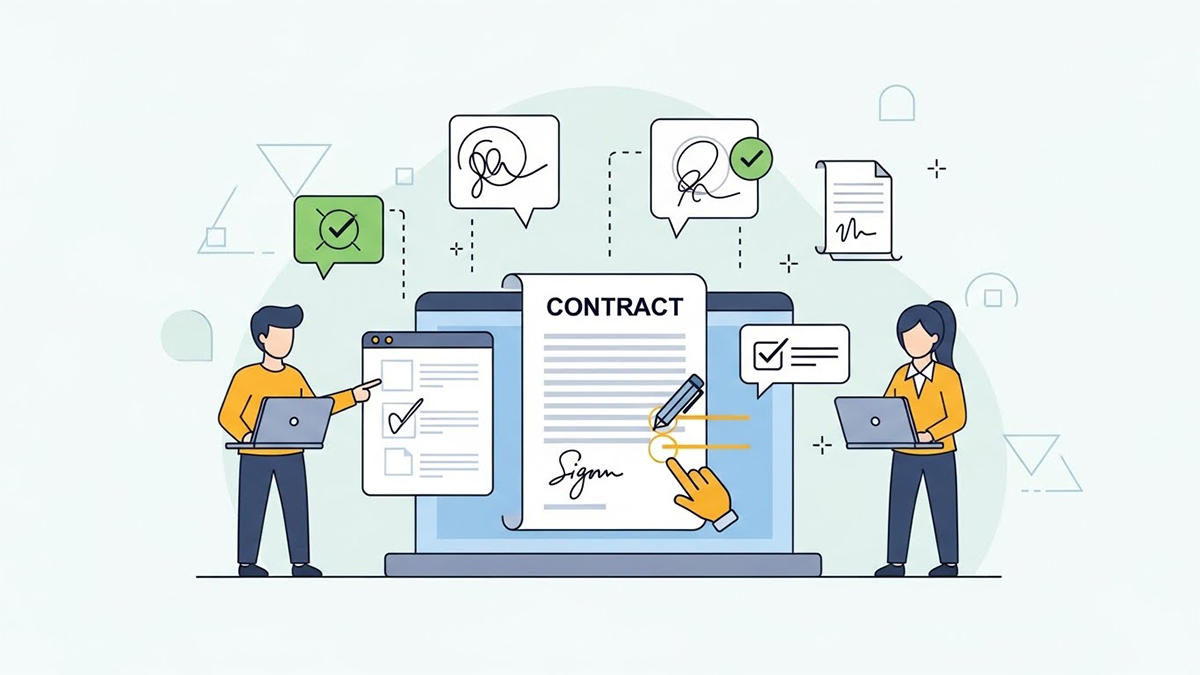
You integrate eSign workflows into sales and procurement by making them part of your core processes, not an afterthought at the very end. That means contracts and approvals are generated, routed, signed, and stored automatically from inside your CRM or procurement systems. An AI native platform like Legitt AI (www.legittai.com) can connect your templates, approvals, and eSign flows so deals and vendor agreements move from draft to signature with far fewer clicks and delays.
This article is for information and process design only, not legal advice. Always involve your legal, finance, and compliance teams when designing approval rules and signing policies.
1. Why eSign belongs inside sales and procurement – not as a separate tool
Most companies start with eSignature as a standalone utility: export a PDF, upload it, place signature fields, send it, and wait. It works for one-off documents, but it does not scale when you have hundreds of deals and vendor contracts every quarter. Sales teams are stuck juggling Word files, PDFs, and manual emails. Procurement is chasing signatures for POs, SOWs, and MSAs via siloed systems.
When eSign is not integrated, you get:
- Slow cycle times from proposal to close
- Little visibility into who has signed and who has not
- Manual errors in versions, values, and counterparties
- Fragmented storage and poor audit trails
By embedding eSign into end-to-end workflows, you treat “signature” as just one more automated step after drafting, approvals, and checks. Platforms like Legitt AI (www.legittai.com) are designed to do exactly that – connect your sales and procurement processes with smart, embedded eSignature.
2. What does an integrated eSign workflow actually look like?
An integrated workflow means everything flows from a single source of truth. Data starts in your CRM or ERP, flows into a contract template, goes through approvals, and then straight to eSign without someone manually exporting and reattaching documents.
A typical integrated flow in Legitt AI (www.legittai.com) looks like this:
- Sales or procurement initiates a contract request from CRM or a request form.
- Contract is auto drafted from approved templates and clause libraries, using AI to fill variables.
- Internal approvals are triggered based on value, discount, risk, or vendor category.
- Once approved, the contract is automatically prepared for eSign with the correct signatories.
- The system sends signature requests, tracks opens, and logs when each party signs.
- Signed copies are stored in a central repository and key terms are written back into CRM or ERP.
You do not “switch systems” to send a contract for signature. It is part of one continuous, traceable workflow.
3. How do I integrate eSign into the sales workflow?
3.1 Start from your CRM or deal system
Sales teams live in CRM. The easiest way to get adoption is to let them generate contracts and eSign flows without leaving that environment. With an integration between your CRM and Legitt AI (www.legittai.com), a rep can:
- Select a deal or opportunity
- Choose a contract type (NDA, order form, MSA, SOW)
- Trigger AI driven drafting using the deal’s fields (company name, value, term, products)
The contract is generated automatically based on your templates and rules, not via copy paste.
3.2 Connect approvals before eSign
If a discount is above a threshold or special terms are requested, Legitt AI (www.legittai.com) can route the draft to managers, legal, or finance. Approvers see context like deal size, customer, and key deviations, then click to approve, comment, or send back. Only after those approvals are complete does the system prepare the contract for signature.
This avoids sending unapproved contracts to customers and then having to take them back. The eSign step becomes the natural conclusion of a controlled sales workflow.
3.3 Automate signature routing and tracking
Once approved, integrated eSign means:
- Signatory names and emails are pulled from CRM or configured rules
- Signature order is predefined (for example, internal signer first, then customer)
- Signature fields are pre placed based on the template structure
Legitt AI (www.legittai.com) then sends signature requests, tracks opens, sends reminders, and updates the deal status in CRM when fully signed. Sales knows exactly where a contract sits without chasing multiple tools.
4. How do I integrate eSign into procurement workflows?
Procurement deals with a wide range of documents: NDAs, RFQs, vendor MSAs, SOWs, POs, renewals, and amendments. Integration here is about controlling risk while speeding up the flow.
4.1 Start from a procurement or intake portal
Instead of ad hoc emails, you define a simple intake:
- What is being bought
- Vendor name and region
- Estimated spend and term
- Data or security implications
This data goes into Legitt AI (www.legittai.com), which selects the right template and clauses. For low value, low risk items, the system might generate a simple purchase agreement. For critical vendors, it might generate a full MSA plus DPA and security addendum.
4.2 Enforce approvals by value and risk
Procurement must balance speed with control. In an integrated flow, Legitt AI (www.legittai.com) can route contracts based on:
- Spend thresholds for finance and leadership approvals
- Data categories that require privacy or InfoSec review
- Jurisdiction or regulatory triggers
Once all approvals are in, the eSign package is assembled automatically and sent to internal and vendor signatories. The system keeps a full audit trail of who approved and when, which is critical for compliance and audits.
4.3 Sync signed vendor contracts back to your systems
After signature, you do not want contracts disappearing into email. Integrated workflows mean Legitt AI (www.legittai.com):
- Stores signed agreements in a searchable repository
- Writes key vendor terms back into your ERP or procurement system (pricing, terms, renewal dates)
- Can trigger downstream tasks such as onboarding, access provisioning, or vendor risk assessments

Click to upload or drag & drop
pdf, docx up to 5 MB
This creates a closed loop: request, contract, eSign, and implementation are all in sync.
5. How does AI make integrated eSign workflows smarter, not just faster?
eSign integration is good. AI plus eSign integration is better. AI lets the system make decisions and adapt.
5.1 AI driven drafting and variable filling
Instead of static templates, Legitt AI (www.legittai.com) uses AI to:
- Pull in data from CRM, ERP, or intake forms to fill party names, addresses, pricing, and dates
- Insert the right clause variants based on geography, deal size, or risk level
- Adjust language for deal context while staying within approved playbooks
The result is fewer manual edits and less risk of misaligned terms between systems.
5.2 AI based approvals and prioritization
AI can also score contracts by risk and value, then help you:
- Prioritize which approvals need legal review versus quick business sign off
- Detect unusual terms or redlines requiring extra scrutiny
- Suggest when certain deals can follow a “fast lane” path with simpler approvals
In Legitt AI (www.legittai.com), that means high value, high risk deals get more attention, while routine NDAs and standard vendor forms move to eSign quickly.
5.3 Post signature insights
After signing, AI can:
- Extract key obligations, SLAs, and renewal dates from contracts
- Set reminders for renewals and notices
- Highlight deviations from standard clauses for future renegotiation
So the integrated eSign workflow does not just “finish the deal” – it feeds a richer contract data layer for sales, procurement, and legal.
6. Practical steps to integrate eSign into sales and procurement
You do not need to do everything at once. A phased approach works best.
6.1 Step 1 – Map your current journey
Start by mapping how a typical sales contract and vendor contract move today:
- Where they are created
- How they are approved
- How they are sent for signature
- Where signed copies live
Identify the manual handoffs, duplicate data entry, and unclear ownership points. These are the areas where Legitt AI (www.legittai.com) integration will have the biggest impact.
6.2 Step 2 – Connect one system at a time
Pick one main system per function:
- CRM for sales
- ERP or procurement tool for purchasing
Integrate Legitt AI (www.legittai.com) and eSign tools with those first. Make sure users can initiate contracts and see signature status from systems they already use daily.
6.3 Step 3 – Standardize templates and approval rules
Before you wire everything together, you need consistent templates and rules. Work with legal and finance to:
- Define standard templates for key contract types
- Set clear approval thresholds and routes
- Configure these into Legitt AI (www.legittai.com)
This ensures integrated eSign workflows are not just fast, but also compliant with your policies.
6.4 Step 4 – Pilot, measure, then expand
Start with one or two contract types:
- For sales, maybe NDAs and standard order forms
- For procurement, maybe low risk vendor agreements
Run a pilot for a month or two, measure cycle time from draft to signature, and gather feedback. Once the flow feels smooth, extend the integrated eSign workflows to more contract types, more teams, and more regions.
7. Governance, security, and compliance in integrated eSign workflows
Integrating eSign is not just about speed; it must also be safe and auditable.
Key considerations:
- Authentication and identity – Ensure signers are correctly identified and permissioned.
- Audit trails – Keep a detailed log of who created, edited, approved, and signed each contract.
- Document integrity – Signed contracts should be tamper evident and stored securely.
- Data residency and privacy – Respect data retention and residency rules for different jurisdictions.
An AI native contract platform like Legitt AI (www.legittai.com) is built with these in mind, combining contract intelligence with strong auditability, so that integrated eSign workflows stand up to internal and external scrutiny.
Read our complete guide on Contract Lifecycle Management.
FAQs
Do I need a separate eSign tool if I use Legitt AI (www.legittai.com)?
You can use Legitt AI (www.legittai.com) alongside existing eSign providers, or use eSign capabilities integrated within the platform, depending on your setup. The key value is that Legitt AI orchestrates when and how documents go to signature, and how signed copies and metadata flow back into your systems. Even if your organization already has a preferred eSign vendor, Legitt AI can sit on top and make the workflow seamless by connecting drafting, approvals, and signatures.
How does integrated eSign help my sales team in practical terms?
For sales teams, integrated eSign means fewer steps, fewer tools, and fewer delays. Reps can generate contracts directly from CRM using Legitt AI (www.legittai.com), get approvals in the same flow, and send for signature without downloading or uploading PDFs. They can see which contracts are with legal, which are with the customer for signing, and which are fully executed, all within their familiar environment. This reduces admin work and lets them focus on selling rather than chasing paperwork.
What is the biggest benefit of integrated eSign for procurement?
For procurement, the biggest benefit is control with speed. Integrated workflows let you enforce standard templates, approval rules, and risk checks before anything goes for signature. With Legitt AI (www.legittai.com), procurement can see the status of all vendor contracts and POs in one place, track who is holding up approvals, and ensure that only reviewed agreements get signed. At the same time, once approvals are in place, eSign is just a click away, so you do not lose days waiting for manual steps.
Can integrated eSign workflows handle multiple signers and complex signing orders?
Yes. Many contracts require signatures from multiple internal and external parties, sometimes in a specific order. An integrated system like Legitt AI (www.legittai.com) can define signing sequences based on contract type, value, or region. It automatically routes the document to each signer in turn or in parallel, tracks completion, and handles reminders. You no longer have to manually orchestrate who signs first or worry about someone overwriting another signature.
How do I ensure that integrated eSign workflows remain compliant with our internal policies?
Compliance comes from codifying your policies in templates and rules, then enforcing them in the workflow. With Legitt AI (www.legittai.com), you can configure which templates are allowed for which use cases, who must approve above certain thresholds, and which risks require legal review. Contracts cannot reach the eSign stage until those conditions are met. Because every action is logged, you can show auditors and internal stakeholders exactly how policies were applied on any contract.
Will integrated eSign make it harder to work with external legal counsel or counterparties?
It should make it easier, not harder. You can still share drafts and updates via secure links or exports when external counsel needs to review. For counterparties, the signing experience is simple: they receive a secure link, review the contract, sign, and receive a copy. Legitt AI (www.legittai.com) handles the internal complexity on your side, but keeps the external experience straightforward. It also ensures that all versions your counterparties see are the latest approved ones.
How do integrated eSign workflows affect storage and retrieval of signed contracts?
One of the biggest benefits is that signed contracts are no longer scattered in inboxes and personal folders. When you integrate eSign with a platform like Legitt AI (www.legittai.com), every fully executed contract is automatically stored in a central repository with metadata such as parties, value, term, and contract type. You can search, filter, and report on contracts easily. This is critical for renewals, audits, disputes, and analytics, because you always know where the final signed document lives.
What about security and encryption for signed documents?
Security should be a core requirement. Enterprise grade platforms and eSign providers use encryption in transit and at rest, secure authentication, and tamper evidence for signed PDFs. Legitt AI (www.legittai.com) is designed with these standards in mind, ensuring that contracts are protected throughout their lifecycle. On top of that, role based access controls and detailed audit logs help you control who can view, edit, approve, or sign documents, which is essential for protecting sensitive commercial information.
How do we measure success after integrating eSign workflows?
Success is measured by speed, compliance, and user satisfaction. You can track cycle time from contract request to full signature, SLA adherence for approvals, number of deals or POs completed per quarter, and error rates due to wrong templates or missing approvals. Legitt AI (www.legittai.com) can provide dashboards and reports that show improvements and highlight remaining bottlenecks. If you see faster deal closures, fewer compliance exceptions, and positive feedback from sales and procurement teams, your integrated eSign rollout is working.
What is the simplest way to start integrating eSign into both sales and procurement?
The simplest approach is to start small but connected. Choose one contract type in sales, such as NDAs or standard order forms, and one in procurement, such as low risk vendor agreements. Integrate those with Legitt AI (www.legittai.com) and your eSign provider, and design a basic workflow from creation to signature. Run a pilot, gather feedback, and refine the flow. Once the pattern works for those use cases, you can clone and adapt it to more complex contracts, gradually bringing all of sales and procurement onto integrated eSign workflows.