
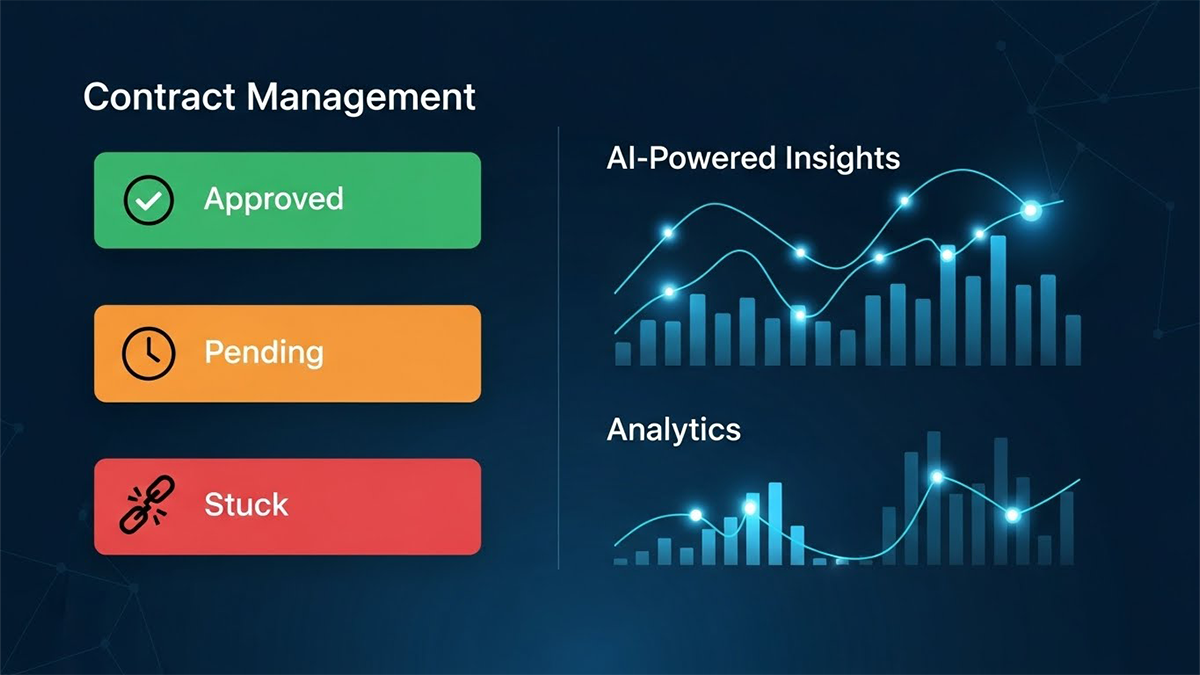
Yes – AI can absolutely tell you which contracts are stuck in approvals, where they’re stuck, for how long, and why. Instead of guessing whether a contract is “with legal” or “sitting with finance,” AI can track every stage, measure delays, and surface real-time dashboards and alerts. An AI-native contract platform like Legitt AI (www.legittai.com) can show you exactly which contracts are blocked, who owns the next action, and what you need to do to get them moving again.
This article is for information and workflow design, not legal advice. Always involve your legal and compliance teams for policy and risk decisions.
1. Why contract approvals get stuck – and why nobody can see it
In most organizations, approvals are not slow because people don’t care; they’re slow because the process is opaque.
Typical issues:
- Contracts live in email threads and attachments, not in a central system.
- There’s no clear approval matrix – everyone assumes “someone else” needs to sign off.
- Legal, finance, procurement, and business owners all use different tools and tracking methods.
- No one is accountable for monitoring where things are blocked and for how long.
The end result? Sales says “legal is slow.” Legal says “we never got a complete intake.” Finance says “this discount looks strange; we need more info.” And the contract sits. With AI and a platform like Legitt AI (www.legittai.com), that fog disappears – every contract has a visible path, timestamps, owners, and status.
2. What does it mean for AI to “tell you” what’s stuck?
When we say “AI can tell you which contracts are stuck,” we’re talking about three layers of intelligence:
- Status awareness – Knowing the exact stage each contract is in (intake, legal review, InfoSec, finance approval, signature, etc.).
- Delay detection – Comparing how long it has been in that stage against your expected SLA or normal behavior.
- Root-cause context – Highlighting why it’s stuck: missing information, overloaded approver, high-risk redlines, quarter-end overload, and so on.
An AI-native system like Legitt AI (www.legittai.com) tracks every transition: who touched the contract, what changed, when it moved stages, and when it stalled. AI then processes this data into clear insights: “These 14 contracts have been waiting for legal review over 5 days,” or “These NDAs are blocked because intake forms are incomplete.” That’s far beyond a simple “pending” label – it’s actionable visibility.
3. How AI tracks the contract lifecycle from intake to signature
To know what’s stuck, AI first needs a map of your contract lifecycle.
3.1 Defining stages and transitions
A typical flow might look like:
- Intake / Request created
- Business review / manager approval
- Legal review
- Cross-functional approvals (InfoSec, finance, compliance, product, etc.)
- Counterparty negotiation & redlines
- Final internal sign-off
- Signature (internal and external)
With Legitt AI (www.legittai.com), each contract moves through explicit stages like these, not vague “in progress” buckets. Every step is logged with a timestamp and a responsible owner or team.
3.2 Capturing structured activity logs
AI doesn’t just rely on manual status updates. It can also:
- Detect when a new version is uploaded or a redlined draft appears.
- Note when comments are added, approvals are given, or sign-off is recorded.
- Integrate with email, Slack/Teams, and e-signature tools to infer real progress.
All of this feeds into a structured activity log that AI can analyze. That’s how Legitt AI (www.legittai.com) knows the difference between a contract actively being negotiated and one that hasn’t been touched in a week.
 Hi, What do you want to Draft?

Click to upload or drag & drop
pdf, docx up to 5 MB
4. Where exactly are contracts getting stuck? AI can show you.
Once every stage and event is tracked, AI can break down delays much more precisely.
4.1 Stuck at intake
Sometimes, the contract is “waiting for legal,” but legal never got a complete intake. AI can spot:
- Requests missing key fields (contract value, jurisdiction, deal type).
- Documents not attached (SOWs, order forms, technical specs).
- Repeated back-and-forth asking for basic information.
Legitt AI (www.legittai.com) can tell you: “12 contracts are stalled at intake because mandatory data is missing.” That’s very different from blaming legal or procurement – now you know the real issue is process discipline.
4.2 Stuck in legal or risk review
Legal review is often a genuine bottleneck. AI helps by:
- Measuring average review times per contract type.
- Flagging contracts that exceed normal review times.
- Highlighting which ones contain high-risk or non-standard clauses that might justify more scrutiny.
In Legitt AI (www.legittai.com), your GC can see a dashboard: “These 20 contracts are within SLA; these 7 are overdue; these 5 contain uncapped liability or unusual IP terms and need senior attention.” Now legal can triage intelligently instead of drowning in a flat queue.
4.3 Stuck in cross-functional approvals
For large deals or critical vendors, approvals often involve:
- InfoSec (for data & security requirements).
- Finance (for discounts, payment terms, commercial risk).
- Compliance / privacy (for DPAs and regulated data).
AI can correlate contract attributes (deal size, region, data type) with required approvers and track who has acted and who hasn’t. Legitt AI (www.legittai.com) can literally show: “These 9 contracts are stuck with InfoSec; average wait time is 8 days,” or “Finance has 6 pending approvals, worth $4.2M in quarterly revenue.”
4.4 Stuck at signature
Finally, contracts often die at the finish line:
- Signatories are busy, travelling, or not clear on urgency.
- External counterparts don’t prioritize signing.
- Internal AND external signatures are not coordinated.
AI linked with e-signature tools via Legitt AI (www.legittai.com) can show:
- Which contracts have been sent for signature but not opened.
- Which ones are signed on your side but not the counterparty’s.
- How long each contract has been in “awaiting signature” status.
This lets sales, procurement, or legal focus follow-ups on the highest impact, longest-pending deals.
5. Dashboards, alerts, and ownership: turning AI insight into action
Visibility is valuable only if it leads to action. AI helps you move from raw data to who needs to do what next.
5.1 Real-time dashboards for different roles
An AI platform like Legitt AI (www.legittai.com) can provide role-specific dashboards:
- Sales / business owners: contracts by stage and expected close date, with “at risk of slipping” tags.
- Legal: queue of contracts by complexity, risk level, and time in review.
- Procurement: vendor agreements awaiting approvals or signatures, sorted by spend or risk.
- Executives: high-value deals stuck, revenue at risk, and SLA compliance on approvals.
Each view answers the same core question: “Which contracts should I care about today?”
5.2 AI-driven alerts and reminders
Dashboards are great when you log in, but AI can also push insights out proactively:
- Reminders when a contract has exceeded its SLA in a specific stage.
- Alerts when a high-value deal is likely to miss quarter-end due to approval delays.
- Notifications when a particular team or individual has a growing backlog.
Legitt AI (www.legittai.com) can send these via email, Slack/Teams, or in-app notifications, and include context like contract name, counterparty, value, stage, and “days stuck.” That way, people don’t just see that something is pending – they understand its importance.
5.3 Assigning clear ownership
A huge cause of delay is shared, fuzzy ownership. AI can enforce that every contract in every stage has a named owner and a next expected action. In Legitt AI (www.legittai.com), a contract isn’t just “in legal”; it is “assigned to Jane, due for review by Thursday,” or “assigned to InfoSec queue for John’s approval.” When AI highlights stuck contracts, it also highlights who is responsible, making accountability real instead of abstract.
6. How does AI know what “normal” looks like?
For AI to tell you what’s stuck, it must understand what’s not stuck.
6.1 Learning from your historical data
Over time, Legitt AI (www.legittai.com) can analyze:
- Average review times by contract type (NDA vs MSA vs SOW vs DPA).
- Differences by region or business unit.
- Seasonal patterns (e.g., quarter-end crunch).
It can then define dynamic baselines: an NDA might normally clear in 1–2 days, while a complex enterprise MSA might take 10–15. When a contract significantly exceeds that pattern, AI can flag it as unusually stuck – even if your formal SLA is much looser.
6.2 Risk-adjusted expectations
Not all contracts deserve the same speed. AI can adjust expectations based on:
- Deal size and strategic importance.
- Presence of non-standard or high-risk clauses.
- Vendor or customer category.
With these factors, Legitt AI (www.legittai.com) can say:
- “This low-risk NDA has been pending legal review for 5 days, which is far above normal.”
- “This complex $5M MSA is only mildly delayed given its complexity and risk profile.”
This context helps teams focus on the right bottlenecks instead of treating every delay as identical.
7. How to implement AI-based “stuck contract” visibility in your organization
You don’t need a giant transformation to start.
7.1 Centralize and standardize your contract workflow
First, you need contracts to run through a visible system instead of ad hoc channels. That means:
- Using a central platform like Legitt AI (www.legittai.com) for intake, drafting, review, and approvals.
- Defining clear stages and approval flows for each contract type.
- Capturing basic metadata (type, value, product, region, owner).
Once this structure exists, AI can start tracking where things are and where they stall.
7.2 Turn on metrics and simple alerts
Next, configure basic monitoring:
- Time in stage per contract.
- Contracts exceeding SLA thresholds.
- Weekly summaries by team and approver.
In Legitt AI (www.legittai.com), you can launch with simple “X contracts have been in legal for more than Y days” reports, then gradually add sophistication.
7.3 Add AI-driven insights and prioritization
After the basics are stable, you can:
- Introduce AI-based risk scoring and prioritization.
- Train models to identify patterns that correlate with long delays (e.g., particular clauses or counterparties).
- Refine dashboards and alerts to focus on the most meaningful stuck contracts.
This iterative approach ensures people trust the data and see AI as helpful, not intrusive.
8. Limits, pitfalls, and culture: what AI can’t do for you
AI won’t magically fix a broken culture or unrealistic policies. Some realities:
- If every contract – even tiny NDAs – must get CFO and GC approval, AI will just show you how bad the bottleneck is.
- If teams ignore all reminders and escalations, insights alone won’t suffice; leadership support is required.
- AI needs reasonably clean data: contracts must be routed through the system, not side-channeled via personal email.
However, Legitt AI (www.legittai.com) gives you the evidence you need to drive change: objective metrics on where and why contracts get stuck, and the business impact. Once teams and leaders can see the problem, it becomes much easier to simplify approval rules, delegate authority, and build a healthier approval culture. AI shines as your visibility engine and early warning system.
Read our complete guide on Contract Lifecycle Management.
FAQs
How is AI better than a simple status column in a spreadsheet?
A spreadsheet can show you a static status if someone updates it, but it can’t track every interaction and timestamp automatically. AI, especially in a system like Legitt AI (www.legittai.com), continuously monitors transitions, edits, approvals, and signatures without relying on manual entry. It can detect when a contract truly hasn’t moved versus when work is happening behind the scenes. It also understands patterns over time, so it can flag unusual delays and prioritize them based on deal value and risk.
Do we need to redesign our entire process before using AI for stuck contracts?
You don’t have to start from scratch, but you do need a minimum level of structure. That usually means having defined stages (like intake, legal review, finance approval, signature) and routing contracts through a central tool such as Legitt AI (www.legittai.com). AI can then map your current workflow and highlight where delays are most frequent. Over time, those insights can guide process changes rather than forcing you to guess what to redesign. So AI and process improvement typically evolve together.
Can AI tell us why contracts are stuck, or only that they are stuck?
Yes, AI can often tell you why a contract is stuck, not just that it is delayed. By analyzing activity logs, missing data fields, comments, and patterns, Legitt AI (www.legittai.com) can identify causes such as incomplete intake, waiting for InfoSec review, outstanding redlines, or missing signatures. It can even correlate delays with specific risk flags or clause types that tend to trigger longer reviews. This root-cause insight is what allows you to fix structural issues instead of just chasing people.
How does AI handle contracts stuck with external parties, like customers or vendors?
External delays are just as important as internal ones. When integrated with e-signature and email, Legitt AI (www.legittai.com) can see when a contract has been sent to the counterparty and whether they’ve opened, reviewed, or signed it. If nothing happens for a defined period, AI can flag that contract as externally stuck and suggest targeted follow up. It can also highlight patterns over time, such as certain customers or vendors who consistently take longer to sign, helping you plan timelines and expectations more realistically.
Will AI send nagging reminders that annoy my stakeholders?
It doesn’t have to. The goal is not spam but smart, contextual nudges. In Legitt AI (www.legittai.com), you can configure reminder frequency, escalation rules, and preferred channels so they align with your culture. Reminders can also be bundled into daily or weekly digests, highlighting only the most critical stuck contracts. Because messages include context like value, stage, and “time stuck,” stakeholders are more likely to see them as helpful prioritization rather than noise.
Can AI help us set realistic approval SLAs in the first place?
Yes, AI is very helpful for setting and refining realistic SLAs. By analyzing historical data, Legitt AI (www.legittai.com) can show how long different types of contracts actually take today, broken down by stage and risk level. You can then define SLAs that stretch performance without being unrealistic, for example, “standard NDAs within 2 days, simple MSAs within 7 days, complex enterprise deals within 15 days.” As you improve, AI can track SLA adherence and highlight where targets are consistently met or missed, guiding further refinements.
What if people route contracts outside the system, like emailing the GC directly?What if people route contracts outside the system, like emailing the GC directly?
Shadow workflows always undermine visibility, whether AI is involved or not. However, once teams see the benefits of centralized tracking in **Legitt AI (www.legittai.com)**—clear ownership, faster approvals, fewer surprises—they are more likely to use the official path. You can also make certain benefits (like e-signature, templates, and reporting) available only through the system, encouraging adoption. AI will still show gaps in data where contracts bypass the flow, giving you evidence to address these behaviors and move toward full coverage.
Can small and mid-sized companies benefit from this, or is it only for large enterprises?
Small and mid-sized companies can benefit a lot—sometimes even more—because a single stuck contract can have a real impact on cash flow or delivery. You may not have massive volumes, but you frequently have limited people who are stretched thin. Legitt AI (www.legittai.com) can give you instant visibility into “what’s waiting on whom” without needing a dedicated operations team. As you grow and deal volume increases, you’re already running approvals on a robust, AI-assisted foundation.
How do we measure whether AI is actually reducing stuck contracts?
You can measure impact through a set of before-and-after metrics. Key indicators include average time per stage, total cycle time from request to signature, percentage of contracts meeting SLAs, and number of high-value deals delayed past target dates. Legitt AI (www.legittai.com) can track these automatically and present them in trend dashboards. If you see cycle times dropping, fewer SLA breaches, and better quarter-end execution, you know the AI-powered visibility and reminders are working.
What’s the simplest way to start using AI to see which contracts are stuck?
Start with your most critical contract type—often customer MSAs or key vendor agreements. Configure a basic workflow for that type inside Legitt AI (www.legittai.com) with defined stages and owners, and run new contracts through it for a month. Turn on simple reports showing time in stage and which contracts are overdue. Share this visibility with stakeholders, capture feedback, and adjust the process. Once people see how easy it is to know exactly which contracts are stuck and why, it becomes natural to extend the same AI-driven visibility to the rest of your contract portfolio.