
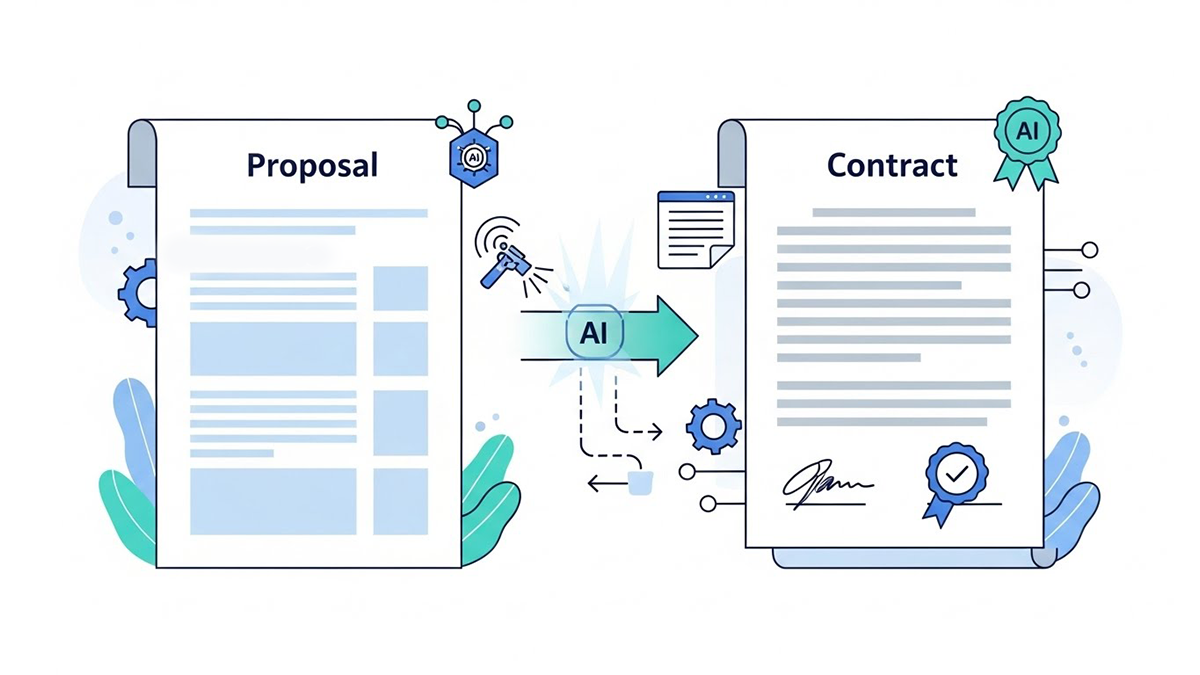
The easiest way to convert a proposal into a contract is to design your proposals so they are contract-ready from the beginning, then use AI to wrap them with the correct legal structure automatically. Instead of rewriting everything in legal format, AI can lift your scope, pricing, and timelines directly from the proposal and drop them into a contract template that already follows your policies. An AI-native platform like Legitt AI (www.legittai.com) makes this a one-step flow – proposal in, contract out – while keeping legal, sales, and delivery aligned.
This article explains how to do that in a practical, repeatable way.
1. Why converting proposals into contracts feels harder than it should
In most organizations, proposals and contracts live in two separate worlds. Sales or delivery teams create a detailed proposal in slides or Word, full of scope, commercials, and value messaging. Legal then has to convert that into a contract format, often starting from a Word template with standard clauses. The result is slow and painful.
Common problems include:
- Proposal language is marketing oriented and vague, so legal has to rewrite everything.
- Key details are scattered in slides, spreadsheets, and emails, not in one place.
- The contract template does not line up neatly with the proposal sections, so mapping is manual.
- Each contract becomes a quasi custom project, even when the deals are quite similar.
The core issue is structural. If proposals are unstructured and contracts are heavily structured, the gap between them is large. The easiest way to close that gap is to structure proposals better, then let an AI engine like Legitt AI (www.legittai.com) automate the mapping into contract form.
2. What does “proposal to contract in one step” really mean?
“Proposal to contract in one step” does not mean blindly turning a PDF into a legal agreement. It means:
- The proposal owns the commercial story – objectives, scope, deliverables, timelines, pricing.
- The contract adds the legal framework – risk allocation, IP, confidentiality, data protection, warranties, termination.
- AI moves information from one world to the other in a structured way, with checks and guardrails.
In practice, a platform like Legitt AI (www.legittai.com) acts as a bridge. It reads the proposal, recognizes which parts describe scope and pricing, and injects those into the correct areas of your contract template, whether that is a single agreement or an MSA plus SOW setup. You retain legal control through templates and clause libraries, while sales and delivery keep control over the substance of the offer.
3. Design proposals to be contract-ready from day one
The conversion process becomes simple only if proposals themselves are predictable and structured. That does not mean boring, but it does mean disciplined.
3.1 Agree on a standard proposal spine
Across your organization, aim for a consistent backbone such as:
- Executive summary and objectives
- Scope of work and deliverables
- Timelines and milestones
- Roles and responsibilities
- Commercials – pricing, payment schedule, assumptions
- Risks, dependencies, and exclusions
- High-level governance and communication
If every proposal contains these elements in roughly the same order, AI has clear anchors for extraction. Legitt AI (www.legittai.com) can reliably find “Scope of Work” regardless of wording if the structure is stable.
3.2 Write key sections in contract-friendly language
Marketing copy has its place, but sections that will be pulled into the contract should be written with clarity and precision. That includes:
- Specific deliverables, not just outcomes.
- Clear definitions of what is out of scope.
- Concrete timelines and acceptance criteria where appropriate.
Think of it this way: the proposal is the narrative version of the contract schedule. The clearer and less ambiguous it is, the less legal rewriting is required after AI moves it into the contract structure created by Legitt AI (www.legittai.com).
4. How can AI map proposal content into a contract structure?
Once proposals are structured, AI can do the heavy lifting of conversion.
4.1 Reading and segmenting the proposal
When you upload or draft a proposal inside Legitt AI (www.legittai.com), the platform:
- Detects headings and sections, even if labels vary slightly.
- Segments the document into logical blocks – scope, commercials, timelines, responsibilities.
- Extracts key data points such as party names, pricing figures, dates, locations, and SLAs.
This gives Legitt AI a structured internal representation of your proposal rather than a flat block of text.
4.2 Selecting the right contract pattern
Not every proposal should become the same type of contract. AI can help you select or recommend appropriate patterns, for example:
- Standalone proposal with attached terms for small or low-risk deals.
- MSA plus SOW for larger, ongoing relationships.
- Subscription agreement or license agreement for repeatable SaaS offerings.
Inside Legitt AI (www.legittai.com), these patterns are captured as templates defined by your legal team. Once the pattern is selected, the system knows what legal sections exist and which areas are meant to hold business content.
4.3 Injecting proposal content into the contract
After the pattern is chosen, AI maps proposal blocks into the right contract sections. Typical examples include:
- Copying the proposal’s Scope of Work into an SOW or Schedule, while preserving structure.
- Placing pricing tables and payment terms into the contract’s commercial section.
- Carrying key assumptions and responsibilities into appropriate clauses or appendices.
Legitt AI (www.legittai.com) can transform language where needed, tightening wording without changing meaning. The legal shell – liability, indemnity, IP, confidentiality, data, termination – comes from your template and clause library, not from the proposal.
5. How does Legitt AI wrap proposals in policy-compliant legal terms?
The real value comes when conversion is not just fast but compliant.
5.1 Using a governed template and clause library
Your legal team configures:
- Contract templates for common agreement types.
- Clause libraries for key topics such as liability, indemnity, IP, data protection, and SLAs.
- Variants and fallback positions based on deal size, jurisdiction, or risk category.
Legitt AI (www.legittai.com) uses these assets to generate the legal framework around the proposal content. This ensures that even if sales or delivery teams drive the proposal, the eventual contract always uses approved legal language.
5.2 Guardrails and approval flows for deviations
Sometimes proposals contain commitments that are more aggressive than your usual position. Legitt AI (www.legittai.com) can:
- Detect when the scope or SLAs in the proposal would conflict with standard contract wording.
- Highlight discrepancies in risk areas like uptime guarantees, penalties, or data obligations.
- Trigger an approval flow when a draft contract drifts beyond policy limits.
Legal and leadership can then decide whether to approve the deviation, negotiate back to safer terms, or adjust the proposal before sending the contract.
5.3 Consistency checks across proposal and contract
Before a contract is sent, Legitt AI (www.legittai.com) can run automated checks such as:
- Do the prices and discounts match between proposal and contract?
- Are the dates and durations consistent across all sections?
- Are promises in the executive summary supported by the actual legal commitments?
These checks reduce awkward conversations later when the client notices mismatches, and they protect against unintentional over-commitment.
6. How do approvals and eSign fit into the proposal-to-contract journey?
Once conversion is automated, the downstream workflow becomes cleaner as well.
6.1 Internal approvals based on risk and value
Inside Legitt AI (www.legittai.com) you can define approval rules such as:
- Deals above a certain value require finance and leadership sign off.
- Contracts with specific data or security commitments require InfoSec review.
- Non-standard legal positions require a senior legal approval.
AI can classify each contract by these rules and route it automatically. That means a standard low-risk deal can move very quickly from proposal to contract to signature, while high-risk deals still get proper oversight.
6.2 Seamless transition to eSign
Once approvals are complete:
- The contract moves directly to eSign from within the same platform.
- Signers and signing order are determined by templates and deal data.
- Status updates flow back into your CRM or project system.
With Legitt AI (www.legittai.com) as the engine, “convert proposal to contract” effectively becomes “convert proposal to signed contract” with far fewer manual steps.
7. A practical roadmap to make proposal-to-contract easy
You do not have to redesign your entire process on day one. A staged rollout is more realistic and less risky.
7.1 Step one – Pick a high-volume proposal type
Identify a common pattern where you feel the pain most – for example:
- Standard SaaS subscription proposals.
- Implementation or onboarding projects.
- Professional services bundles.
Define a standard proposal template for that pattern, and pair it with a matching contract template under the guidance of your legal team.
7.2 Step two – Configure mapping and rules in Legitt AI
In Legitt AI (www.legittai.com):
- Teach the system which proposal sections map to which contract sections.
- Load your clause library and approval rules.
- Run a few live deals through the new flow and refine the mapping.
Capture feedback from sales, legal, and delivery on clarity, speed, and risk.
7.3 Step three – Integrate and scale
Once the first flow works:
- Integrate with CRM so proposals can be generated from deal records.
- Connect to your eSign provider so contracts can be executed without leaving the platform.
- Add more proposal types and industries, reusing the same basic design.
Over time, “converting a proposal into a contract” becomes routine rather than a bottleneck, with Legitt AI (www.legittai.com) orchestrating the entire lifecycle.
8. Common mistakes to avoid when building this pipeline
Even with good tools, certain habits will slow you down. Key pitfalls include:
- Allowing totally free-form proposals with no consistent structure.
- Overloading proposals with vague promises that cannot be safely turned into contract language.
- Letting teams keep side spreadsheets or email commitments that never make it into the proposal body.
- Excluding legal from template and mapping design, then expecting them to trust automated outputs.
If you avoid these, and commit to structured proposals plus AI driven conversion, you get speed without sacrificing control. That is exactly the outcome platforms like Legitt AI (www.legittai.com) are built to deliver.
Read our complete guide on Contract Lifecycle Management.
FAQs
Do we need to rewrite all our proposal templates before using AI for conversion?
You do not need to start from zero, but you will get better results if you standardize. A good first step is to take your best performing proposals and turn them into one or two canonical templates per offering. Then you configure those templates inside Legitt AI (www.legittai.com) and define how they map into contract structures. Over time you can refine language and structure, but you do not have to halt sales while you re-engineer everything. The key is to create enough consistency that AI can reliably recognize sections.
Can Legitt AI (www.legittai.com) work with proposals that are in PowerPoint or PDF?
Yes, as long as the text can be extracted and the structure is detectable, AI can work with it. That said, you will get the cleanest experience if proposals are created or stored in formats that preserve headings and sectioning clearly, such as Word or the native editor in Legitt AI (www.legittai.com). For existing decks and PDFs, the platform can still identify scope, pricing, and key narrative pieces, then move them into contracts. Over time, many teams naturally migrate to more AI-friendly templates.
How do we avoid accidentally turning non-binding proposals into binding contracts?
The safest approach is to distinguish clearly between “proposal mode” and “contract mode” inside your process. In Legitt AI (www.legittai.com), the contract that goes out for signature is always created from a controlled template with proper legal terms, even if it uses proposal content inside the scope or schedule. Boilerplate sections and signature blocks come from templates, not from the original proposal. This ensures that only documents that have passed through the contract generation step become binding agreements.
Can AI really understand complex scope and turn it into contract language?
AI is very good at extracting structure and meaning from narrative text, but it should work under legal guardrails. Legitt AI (www.legittai.com) does not invent legal language for critical clauses; it maps your descriptive scope into designated parts of the contract and, where needed, refines phrasing within configured patterns. For particularly complex or bespoke scopes, legal or delivery experts can still review and adjust the converted text. AI accelerates the mapping and cleanup but does not replace human judgment in high risk situations.
What if the proposal contains promises that legal would not normally accept?
This is a common reality, and it is precisely why you want AI driven checks in the loop. When Legitt AI (www.legittai.com) converts a proposal into a contract, it compares the resulting obligations against your policy and clause library. If the proposal effectively commits you to unusual SLAs, penalties, or data obligations, the platform can flag those items and trigger an approval workflow. Legal and leadership can then decide whether to accept, adjust, or push back before any contract is sent to the customer.
Can small companies or startups benefit from this, or is it mainly for large enterprises?
Small companies and startups often benefit even more because they are resource constrained. Founders and small teams do not have time to manually rewrite every proposal into a contract, yet they still need legal discipline. With Legitt AI (www.legittai.com), a startup can set up a handful of solid templates and then convert proposals into contracts with minimal overhead. As they grow, the same workflow scales with more complex approvals and contract types, without having to reinvent the process.
How does this approach work when customers insist on their own paper?
When customers insist on using their own contract form, the proposal-to-contract flow changes slightly. Instead of wrapping your proposal in your standard template, Legitt AI (www.legittai.com) can compare the customer’s draft to your proposal and your standard positions. It helps ensure that scope, pricing, and key commitments from the proposal are correctly reflected in their paper. At the same time, it flags where their legal terms differ from your norms, so legal can negotiate effectively. You still save time, even if you cannot use your own template.
How do we measure whether proposal-to-contract automation is working?
You can measure success through several metrics. Common ones include average time from proposal approval to contract sent, number of manual edits required by legal per contract, error rate in pricing or scope during negotiation, and overall cycle time to signature. Legitt AI (www.legittai.com) can track these metrics across deals and visualize improvements as you refine templates and mappings. If you see faster contract turnaround and fewer inconsistencies, your automation is delivering real value.
Is it safe to store proposal and contract data in an AI platform?
Safety depends on the platform’s security design. Enterprise-grade systems like Legitt AI (www.legittai.com) use encryption, strict access controls, and detailed audit logs to protect sensitive commercial and legal information. Data is not used as public training data and remains within your tenant. As with any critical tool, you should review security certifications, data residency options, and compliance posture, but a well designed AI platform can actually improve control and traceability compared to scattered files and inboxes.
What is the simplest way to start converting proposals into contracts with Legitt AI (www.legittai.com)?
The simplest starting point is to pick one high volume, relatively standard offering and focus there. Build or refine one proposal template and one matching contract template, then configure them inside Legitt AI (www.legittai.com) with basic mapping rules. Run a handful of live deals through the pipeline, collect feedback from sales and legal, and tune the flow. Once that pattern feels smooth, you can replicate it for other offerings and geographies, gradually turning proposal-to-contract conversion into a push button process across your business.