
Every business, at some point, faces the same question.
Do you grab a ready-made contract and fill in the blanks? Or do you get one drafted specifically for your situation?
It sounds like a small decision. But the wrong choice can leave you legally exposed when it matters most. Here is everything you need to know to make the right call.
What Are Contract Templates?
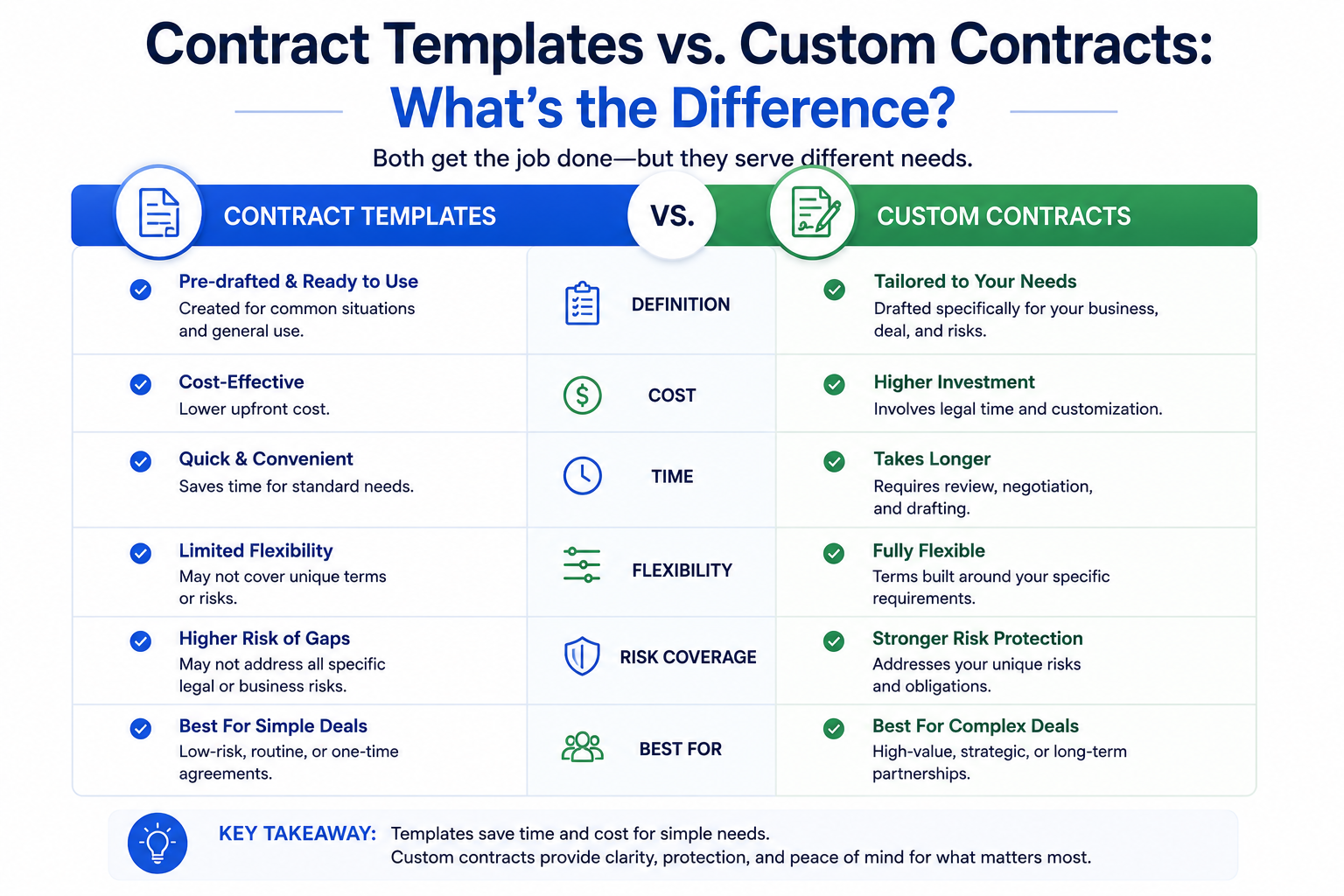
Contract templates are pre-written documents built around the most common clauses used in standard agreements. They are designed to be reused, adapted slightly, and signed quickly.
You have probably seen them used for:
- Employment agreements
- Service contracts
- NDAs (Non-Disclosure Agreements)
- Rental agreements
Templates work well when time or budget does not allow for drafting something from scratch. If you want to explore ready-to-use options, you can check out the top contract templates every remote business needs to get a sense of what a good template covers.
What Are Custom Contracts?
Custom contracts are legal agreements drafted specifically for a unique situation or transaction. They are typically created with the help of legal professionals who account for the specific needs of both parties involved.
Unlike templates, custom contracts are detailed and situation-specific. They address individual terms, edge cases, and business nuances that a generic document simply cannot cover.
Benefits of Using Contract Templates
For small businesses and startups, templates offer real, practical advantages.
They save time
Templates come pre-formatted with standard clauses and structure. You just fill in the relevant details, names, dates, payment terms, and the contract is ready. This is especially useful when you need to move quickly on a new deal or partnership.
They save money
Hiring a lawyer to draft every routine contract adds up fast. Templates handle straightforward agreements in-house, cutting down legal costs significantly.
They create consistency
When every contract follows the same format and terminology, your team knows what to expect. Confidentiality clauses, termination rights, dispute resolution, all in the same place every time. This is exactly what contract standardization is designed to achieve across growing businesses.
They include built-in compliance
Well-crafted templates incorporate standard legal provisions and industry best practices. Key clauses like indemnification language and data protection addenda are often pre-approved by legal counsel.
They scale with your business
As your business grows, so does your contract volume. Templates give you a reusable foundation that adapts to new situations without starting from zero every time.
Drawbacks of Contract Templates
Templates are not a perfect solution. Relying on them too heavily can create real risks.
Generic language may not protect you
Templates are written for broad use. If your business has specific needs around intellectual property, exclusive partnerships, or non-standard payment terms, a generic clause may leave you unprotected.
They do not account for legal differences across states
Laws vary by jurisdiction. A template that works in one state may be unenforceable in another. Non-compete clauses, data privacy requirements, and arbitration terms are all subject to state-specific rules that templates often ignore.
They lack flexibility for complex deals
Templates are built for simplicity. Multi-phase projects, equity partnerships, or long-term service contracts with performance milestones need more structure than a standard template can offer. Forcing a template to fit a complex deal often creates contradictions or unclear clauses.
They offer less negotiation leverage
Custom contracts can be strategically written to give your business stronger protections and more favorable terms. Templates are designed for balance and neutrality, which means you may leave value on the table in competitive negotiations.
Advantages of Custom Contracts
When the stakes are high, custom contracts deliver what templates simply cannot.
Every clause is built for your situation
Payment schedules, termination rights, warranties, confidentiality obligations. Each one is drafted with your specific business model and risk tolerance in mind. To understand what goes into each of these, it helps to first read up on what a contract clause actually is and why it matters in any agreement.
Legal professionals ensure accuracy
Custom contracts are typically drafted or reviewed by lawyers who understand current laws, state-specific requirements, and industry standards. This significantly reduces the risk of errors or omissions that could hurt you later.
They hold up better in court
Courts look for clarity, mutual understanding, and fairness in contract language. A custom contract, drafted with specific intent and jurisdictional compliance, is far more defensible in a legal dispute than a generic template.
They mitigate risk in sensitive agreements
Deals involving data security, equity ownership, licensing rights, or large financial commitments need detailed protections. Custom contracts give you the room to address all of these precisely, including how disputes will be resolved.
They signal professionalism
Walking into a negotiation with a custom contract tells the other party you are serious, prepared, and thorough. That often leads to more favorable terms.
Disadvantages of Custom Contracts
Custom contracts are not always the right choice. Here is where they fall short.
They cost more
Hiring a lawyer to draft or review a contract is an investment. For startups and small businesses with tight budgets, legal fees across multiple rounds of negotiation can add up quickly.
They take more time
Drafting, reviewing, and negotiating a custom contract involves multiple iterations. When you need to close a deal fast, this process can slow everything down.
They can get overly complicated
Custom contracts sometimes become dense with legal jargon that non-lawyers struggle to understand. This can create hesitation from business partners and make day-to-day contract management harder.
They are not always necessary
For simple, low-risk transactions, a fully tailored agreement may not add enough value to justify the cost. In these cases, a good template is the smarter, more practical choice. A self-service contract approach often works perfectly well for these routine situations.
So Which One Should You Use?
The honest answer is: it depends.
For routine, low-risk transactions, a well-structured template gets the job done efficiently and affordably. For complex, high-value, or sensitive agreements, a custom contract is worth every rupee of the investment.
For many businesses, the smartest approach is a hybrid. Start with a solid template and customize it with legal guidance where it matters. You get the speed of a template and the precision of a custom contract.
One area where this hybrid approach works especially well is NDAs. You can start with a standard structure and then refer to a detailed guide on how to create a Non-Disclosure Agreement to make sure every clause is airtight before you sign.
Contracts are not just paperwork. They are what protect your business, your relationships, and your reputation when things do not go as planned. Choose accordingly.
Create Professional Contracts in Minutes with Legitt AI
Whether you need a ready-to-use template or want to build something customized, Legitt AI gives you both options in one platform. Draft, customize, send for signatures, and track your contracts from start to finish.
Also read: What is a Contract Clause?