
Contract review has always been one of the most time-consuming and high-stakes tasks in legal work. A single missed clause in a commercial agreement can create liability exposure worth multiples of the contract value. A misunderstood indemnification structure can leave a company holding risk it did not intend to accept. An auto-renewal clause buried in the boilerplate can lock a company into another year of unfavorable terms.
For most of legal history, the only tool available for this work was a trained human reader – ideally a lawyer with domain expertise – reading every word of every contract and applying judgment to every clause. That approach is reliable when done well. It is also slow, expensive, inconsistent across reviewers, and completely unscalable.
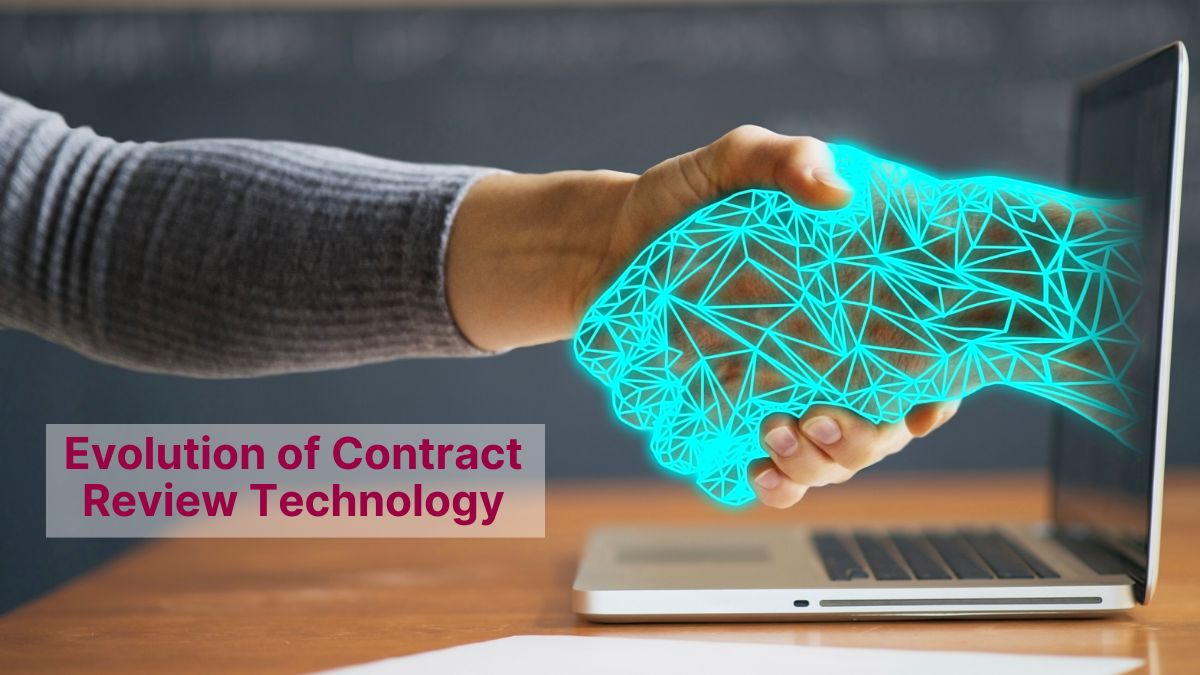
The past two decades have produced a sequence of technology interventions that have progressively changed how contract review is done. Understanding that evolution – what each stage added, what limitations it left, and where AI fits – provides the context for evaluating current AI contract review tools accurately.
Stage 1: Word Processing and Template Libraries (1980s-2000s)
The first technology intervention in contract review was not review at all – it was drafting. Word processing software replaced typewriters, making contract templates reusable and editable without retyping. Template libraries standardized clause language across an organization, so reviewers were not starting from scratch each time.
This stage improved drafting efficiency dramatically but did not meaningfully change the review process. Reviewing a contract still meant reading it – the technology had simply made it easier to produce contracts, not to evaluate them.
The primary contribution of this stage to review was consistency: when your organization’s contracts come from a shared template library, reviewers know what standard language looks like, which makes identifying deviations easier. But that benefit only applies to contracts drafted by your own organization. Reviewing a counterparty’s paper – a contract drafted on their template – still required reading every clause without the benefit of a known baseline.
Stage 2: Document Management and Search (2000s-2010s)
The second stage brought enterprise document management systems and full-text search. Contracts were stored digitally, organized by counterparty and type, and searchable by keyword.
This improved review in two ways. First, reviewers could search a contract for specific terms – finding “limitation of liability” or “indemnification” or “governing law” directly rather than reading to locate them. Second, they could search the contract repository for precedents – finding how the same clause had been handled in similar agreements previously.
These were real improvements, but they addressed speed more than accuracy. Search found clauses; it did not evaluate them. A reviewer could locate the limitation of liability clause in seconds, but whether that clause was acceptable for this deal type still required legal judgment. Search made lawyers faster. It did not make review more consistent or scalable.
Stage 3: Rule-Based Contract Analysis (2010s)
The first generation of dedicated contract analysis technology used rule-based logic – essentially sophisticated pattern matching. The system was programmed with a library of rules: “flag any clause containing ‘unlimited liability'”; “alert when ‘governing law’ references a jurisdiction other than [X]”; “highlight any indemnification clause that is broader than [standard position].”
Rule-based systems were useful and represented a genuine advance. They could screen a contract for a defined set of risk conditions faster than any human reader, and they applied the same rules consistently to every contract. For high-volume, standardized contract review – NDAs, standard vendor agreements, employment contracts – they reduced review time significantly.
But rule-based systems had fundamental limitations that became apparent at scale:
Brittleness. A rule written to flag “unlimited liability” would miss a clause that achieved the same result through different language – “all losses and damages without cap or limitation.” Legal language is endlessly varied; rules written for specific formulations miss variations that a human reader would immediately recognize as equivalent.
Maintenance overhead. As laws changed, as the organization’s risk appetite evolved, and as new contract types were added, the rule library required constant manual updating. A system that worked well for last year’s standard contracts needed significant rework when the business moved into a new jurisdiction or a new product category.
Binary output. Rule-based systems flagged or did not flag. They could not explain why something was risky in a way that helped a reviewer make a decision, suggest alternative language, or assess the overall risk profile of the agreement in context.
Despite these limitations, rule-based systems remained the standard for contract analysis through the mid-2010s, and many legacy CLM platforms still use this approach today.
For how modern AI overcomes these limitations through a fundamentally different technical approach, see how AI contract review actually works.
Stage 4: Machine Learning Contract Review (2015-2020)
The introduction of machine learning to contract review changed the underlying approach from rule-following to pattern recognition from examples.
Instead of being programmed with explicit rules, ML-based contract review systems were trained on large datasets of reviewed contracts – documents where lawyers had identified clauses, assessed risk, and made decisions. The system learned to recognize patterns across those examples: what clause structures consistently appeared in high-risk agreements, what language variations were functionally equivalent, what combinations of terms created elevated liability exposure.
This addressed the brittleness problem of rule-based systems. A trained ML model can recognize that “all losses and damages without cap or limitation” achieves the same effect as “unlimited liability” because it has seen thousands of examples of both formulations in similar contexts. It generalizes from examples rather than matching specific patterns.
ML systems also enabled more nuanced output. Rather than binary flag/no-flag, ML models could produce risk scores – a probability that a given clause represented elevated risk – and could classify clause types rather than just flagging specific terms.
The leading ML-based contract review systems of this era – Kira Systems, Luminance, Seal Software – could process contracts faster than any human team and with reasonable accuracy on the clause types they were trained on. They were adopted primarily by large law firms and enterprise legal departments with the volume to justify the implementation cost and the resources to manage training and validation.
Limitations remained. ML systems of this generation required substantial training data for each new clause type or document category. They were accurate within their training distribution but less reliable on unusual contracts or novel clause constructions. They could identify clause types but struggled with the contextual reasoning that determines whether a clause is actually problematic for a specific deal – that still required human legal judgment.
Stage 5: Large Language Model-Based Review (2020-Present)
The development of large language models (LLMs) – AI systems trained on vast corpora of text including legal documents – represented a qualitative shift in what AI could do with contract language.
LLMs do not just pattern-match to training examples. They develop a generalized understanding of language – including legal language – that enables more sophisticated capabilities:
Semantic understanding. LLMs understand what clauses mean, not just what words they contain. They can recognize that two differently worded clauses are functionally equivalent, that a clause is ambiguous in ways that create interpretation risk, or that a clause’s practical effect depends on how it interacts with another clause elsewhere in the agreement.
Contextual analysis. LLMs can assess a clause in the context of the full agreement – understanding that a limitation of liability clause has different implications when the agreement includes a broad indemnification clause in the same party’s favor.
Explanation and reasoning. Unlike rule-based systems and early ML models, LLM-based reviewers can explain why a clause is flagged – which specific language created the concern, what the practical risk is, and what alternative language would address it.
Playbook alignment. LLMs can compare contract language against a negotiation playbook – the organization’s approved positions and fallback language – and flag not just that a clause is risky but specifically how it deviates from the approved position and what the standard alternative language is.
Multi-language and multi-jurisdiction capability. LLMs trained on multilingual legal corpora can review contracts in multiple languages and apply jurisdiction-specific legal standards rather than requiring separate models for each jurisdiction.
For a detailed look at how these LLM capabilities translate into specific contract review functions, see smart contract analysis: what AI reads and flags.
Where AI Contract Review Stands Today
Current AI contract review systems combine LLM-based language understanding with structured clause libraries, playbook management, and workflow integration to deliver capabilities that no previous technology stage achieved:
- Contract review in minutes rather than days, for standard commercial agreements
- Consistent application of review standards across every contract, regardless of reviewer workload or experience level
- Clause-level risk scoring with explanation, not just binary flagging
- Playbook-aligned redline suggestions that map to the organization’s approved fallback positions
- Multi-language review without requiring separate specialized models
- Integration with CLM workflows so review outputs connect directly to approval and negotiation processes
The limitation that remains is the one that has persisted through every stage of this evolution: AI does not replace legal judgment for complex, novel, or strategically significant issues. What it does is absorb the routine, high-volume work that consumed legal team capacity – leaving that judgment available for decisions that actually require it.
For a practical guide to implementing AI contract review effectively, including common configuration mistakes and what to measure, see AI contract review best practices.
The Competitive Landscape in 2026
The AI contract review market has matured significantly. The category now includes:
Large law firm and enterprise tools: Kira (now part of Litera), Luminance, Harvey – built for high-complexity legal work with extensive training data and deep legal domain expertise.
CLM-integrated review: Ironclad, DocuSign CLM, Icertis, Legitt AI, SpotDraft – review capabilities embedded within broader contract lifecycle management platforms, so review outputs connect directly to negotiation and approval workflows.
Point solutions: Standalone AI review tools that integrate with existing CLM or document management systems for organizations that want AI review without replacing their existing infrastructure.
The practical difference for buyers is whether they want AI review as a standalone capability or as part of an integrated contract workflow. Standalone tools typically offer deeper review accuracy; integrated platforms offer better workflow connectivity and lower friction for the teams using them daily.
Summary
Contract review technology has evolved through five distinct stages – from word processing to rule-based analysis to machine learning to large language models – each addressing limitations of the previous approach while introducing new ones.
The current stage, LLM-based review integrated into contract management workflows, represents the closest to a complete solution: fast, consistent, explainable, and capable of handling the volume and variety of contracts that modern organizations manage. The remaining boundary – strategic legal judgment for complex and novel issues – is not a technology limitation so much as a definitional one. Some decisions require human expertise. The value of AI is in ensuring those decisions get the attention they deserve, rather than competing for bandwidth with routine clause review.
Related reading in this cluster:
- How AI contract review actually works technically
- AI contract review best practices and buyer checklist
- AI contract review use cases by team
- Smart contract analysis: what AI reads and flags
- How AI handles complex legal language
FAQs on Contract Review Technology
What is contract review technology, and why is it important?
Contract review technology refers to the use of software and AI algorithms to analyze and extract insights from legal contracts efficiently. It is essential because it streamlines the contract review process, saving time, reducing errors, and ensuring compliance with legal requirements.
How does AI revolutionize contract review?
AI-powered contract review tools leverage natural language processing and machine learning algorithms to analyze contracts quickly and accurately. They can identify relevant clauses, flag potential risks, and provide recommendations, significantly enhancing the efficiency and effectiveness of the review process.
What are the traditional challenges of contract review?
Traditional contract review processes are often manual, time-consuming, and prone to errors. They may struggle to keep pace with the increasing volume and complexity of contracts, leading to potential risks and resource constraints for organizations.
How does Legitt AI address these challenges?
Legitt AI offers advanced features such as advanced natural language processing, customizable workflows, real-time collaboration, compliance checks, and predictive analytics. These features streamline the contract review process, enhance accuracy, and provide valuable insights to organizations.
What are the key benefits of using Legitt AI for contract review?
Using Legitt AI for contract review offers several benefits, including increased efficiency, reduced risk, improved compliance, enhanced collaboration, and access to valuable insights and predictions.
Can Legitt AI be customized to specific organizational needs?
Yes, Legitt AI offers customizable workflows that allow organizations to tailor the contract review process to their specific requirements and preferences.
How does Legitt AI ensure compliance with legal requirements?
Legitt AI performs comprehensive compliance checks, ensuring that contracts adhere to relevant laws, regulations, and internal policies. It flags potential compliance issues and provides recommendations for addressing them.
Does Legitt AI offer real-time collaboration features?
Yes, Legitt AI facilitates real-time collaboration among team members, allowing them to communicate, share feedback, and coordinate tasks seamlessly throughout the contract review process.
Can Legitt AI provide insights and predictions for contract management?
Yes, Legitt AI analyzes historical contract data and provides valuable insights and predictions to inform decision-making and strategy development.
How does Legitt AI leverage natural language processing (NLP)?
Legitt AI's advanced NLP capabilities enable it to understand and interpret contract language with remarkable accuracy, even in complex legal documents.
What are some potential future developments for Legitt AI?
Potential future developments for Legitt AI include enhanced predictive analytics, integration with blockchain technology for enhanced security, transparency, and immutability, and further refinement of its natural language understanding capabilities.
How does Legitt AI contribute to operational efficiency?
By streamlining the contract review process, reducing errors, and providing valuable insights, Legitt AI contributes to operational efficiency, enabling organizations to save time and resources.
Can Legitt AI be integrated with other software or systems?
Yes, Legitt AI can be integrated with other software or systems, allowing for seamless data exchange and workflow automation.
Does Legitt AI offer training and support for users?
Yes, Legitt AI provides comprehensive training and support for users, ensuring that they can effectively utilize the platform and maximize its benefits.
How can organizations get started with using Legitt AI for contract review?
Organizations can get started with using Legitt AI for contract review by reaching out to the Legitt AI team for a consultation and demonstration of the platform. They can then customize the platform to their specific needs and begin using it to streamline their contract review processes effectively.