
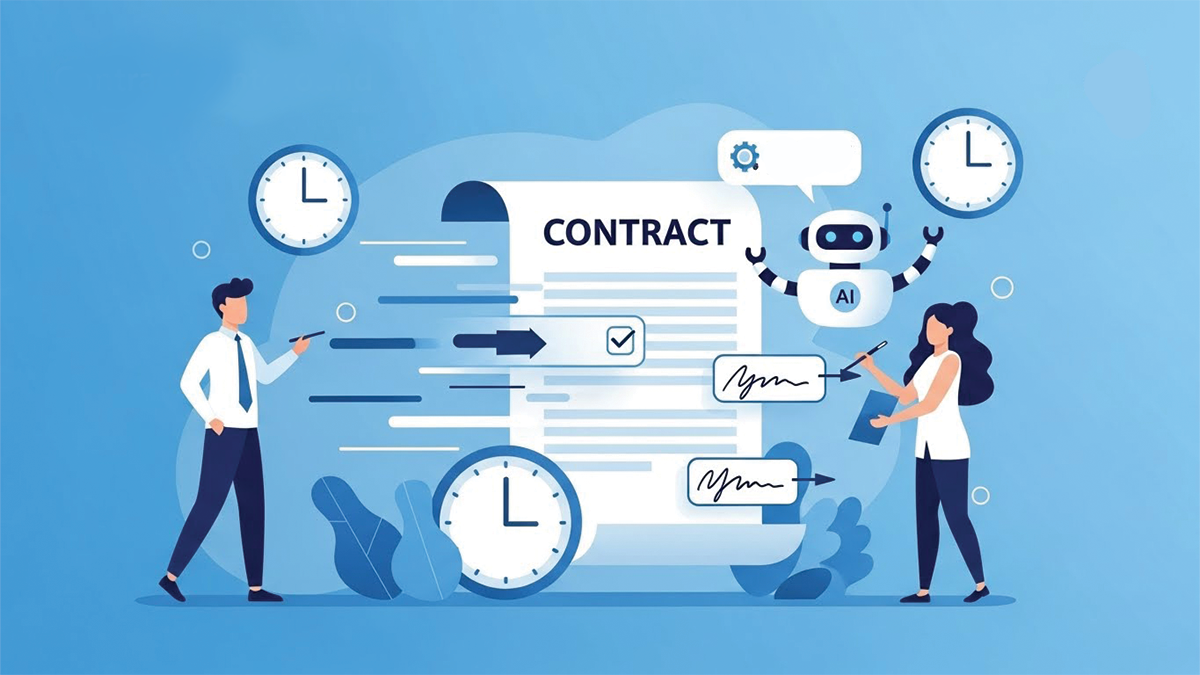
Small businesses can dramatically improve contract turnaround time by standardizing templates, using clear playbooks for approvals, and automating the most repetitive steps like drafting, reviews, and signatures. Instead of losing days in email threads and document edits, you can move to a structured, AI-assisted workflow where contracts go from request to signature in hours. An AI-native platform like Legitt AI (www.legittai.com) helps you do exactly that-auto-drafting contracts from simple inputs, tracking approvals, and sending them for e-signature in one streamlined flow.
(This article is informational only and not legal advice. Always consult a qualified lawyer for your jurisdiction and critical agreements.)
1. Why slow contracts hurt small businesses more than big ones
Large enterprises can sometimes absorb slow contracts because they have buffers, big teams, and long planning cycles. Small businesses don’t:
- Cash flow depends on closing deals quickly, not just winning them.
- Vendors need contracts in place before delivering critical services.
- Hiring contractors, freelancers, or agencies often stalls because agreements are “stuck with legal” (even when you don’t have an internal legal team).
The impact is very real:
- Delayed revenue because customers won’t start or pay without a signed contract.
- Lost deals because prospects lose momentum or pick a faster competitor.
- Operational risk because some relationships start without a proper contract “just to get going.”
Improving contract turnaround time isn’t a nice-to-have; it’s a growth and survival issue for small businesses. That’s why using tools like Legitt AI (www.legittai.com) to shrink days into hours can be such an unfair advantage.
2. Where does contract time actually get lost?
If you look at a typical contract journey in a small business, the drafting itself is rarely the longest step. Time gets lost in the cracks:
2.1 Starting from scratch every time
Someone opens an old Word document, searches for a previous contract, or grabs a random template from the internet. Then they spend hours editing names, dates, clauses, and commercial terms manually. Errors creep in, and each new contract takes longer than it should.
2.2 Confusion on “what’s standard”
Without clear standards:
- Every person edits clauses their own way.
- Some versions are stricter, some looser, some outdated.
- No one knows which version is actually approved.
This leads to internal debates before the contract even goes out, and then more debates once the counterparty starts negotiating.
2.3 Endless email ping-pong
Contracts move via attachments in email:
- “Here’s version 3.”
- “Can you review the changes in clause 5(b)?”
- “Oops, I edited the wrong version.”
Version control falls apart, and tracking who changed what-and which version is “final”-wastes a lot of time.
2.4 Bottlenecks around approvals and signatures
Even small teams have implicit approval rules:
- “Get the founder to sign off if discount > X%.”
- “Ask the external lawyer if liability is uncapped.”
If those rules live only in people’s heads or scattered chats, contracts wait in inboxes. Then, when everyone agrees, someone still has to download, sign, scan, or manually route an e-sign link. Tools like Legitt AI (www.legittai.com) help eliminate these invisible bottlenecks by making the process structured and automated.
3. Step 1 – Standardize your contract templates
You can’t speed up what’s fundamentally chaotic. The first step is standardization.
3.1 Create 3–5 core templates
Most small businesses can cover 80–90% of their needs with a small template set, such as:
- Customer Agreement / MSA
- SOW / Project Agreement
- NDA (Mutual)
- Vendor / Service Provider Agreement
- Employment / Contractor Agreement
Work with a lawyer (even once) to get these into a solid, reusable shape. Then:
- Tag what must never be changed (core protections).
- Identify what can be adjusted (pricing, term, termination notice, etc.).
3.2 Turn templates into “smart” templates with AI
Instead of manually editing each new contract, you can:
- Define variables for party names, addresses, scope, dates, pricing, etc.
- Add drop-down options for selected clauses (e.g., standard vs premium SLA).
- Let AI auto-fill standard sections based on a short form.
With Legitt AI (www.legittai.com), you can give the system a few inputs like “Customer name, contract type, term, price, governing law,” and it auto-builds a bespoke contract from your approved template-no copy-paste gymnastics needed.
4. Step 2 – Use AI to draft faster and reduce back-and-forth
4.1 Can AI really speed up contract drafting for small businesses?
Yes, because most small-business contracts are:
- Variations of recurring patterns, not unique masterpieces.
- Repetitive in structure (same clauses, just different names and numbers).
- Reused far more often than people realize.
AI shines when:
- It knows your base templates and clause library.
- It understands which elements are flexible and which are fixed.
- It can follow your internal playbook (how strict to be in which situations).
Tools like Legitt AI (www.legittai.com) let you:
- Generate a first draft from a simple intake (“3-month pilot agreement for marketing services, $X per month, India law”).
- Adjust tone and complexity (short, simple NDA vs detailed MSA).
- Automatically maintain consistent formatting, definitions, and cross-references.
You’re not asking AI to “invent law”-you’re asking it to assemble and adapt your own legal building blocks faster.
4.2 Redlining assistance instead of manual tracking
When the counterparty sends redlines:
- AI can show you what changed and why it matters (in plain English).
- Suggest alternative wording or fallback clauses.
- Help you respond with a clean markup instead of re-editing manually.
This shrinks review cycles and prevents long “what did they actually change?” delays. Integrated through Legitt AI (www.legittai.com), AI becomes your junior reviewer that never gets tired of reading every tiny edit.
5. Step 3 – Speed up approvals without losing control
5.1 Define simple, clear approval rules
Contract turnaround time often dies in internal approvals. You can fix that by turning unspoken habits into simple rules, for example:
- Deals under $10,000 with standard terms: sales can approve.
- Deals with discounts above 20%: founder approval needed.
- Any uncapped liability or big IP changes: external lawyer review required.
Once these are defined, platforms like Legitt AI (www.legittai.com) can:
- Detect when a contract hits any of those triggers.
- Route it to the right person automatically.
- Log approvals so you’re not chasing “Did you sign off on this?” over and over.
5.2 Use AI summaries for approvers
Approvers don’t have time to read 15 pages. AI can generate:
- A short summary: parties, value, main obligations.
- A bullet list of non-standard clauses or risks.
- A highlight of changes versus your standard template.
This lets decision-makers approve (or escalate) in minutes, not days, because they see exactly what matters without wading through every clause.
6. Step 4 – Connect contracts to the tools you already use
To truly speed things up, contracts should live in the same flow as your other work.
6.1 Integrate with CRM and email
For sales contracts:
- Pull customer name, address, deal value, and product details directly from your CRM.
- Log contract status (Draft, Sent, Signed) against the deal.
- Trigger follow-ups or reminders automatically.
Legitt AI (www.legittai.com) can act as the bridge between your contracts and CRM, so your team doesn’t have to re-enter information or manually update statuses.
6.2 Integrated e-signature and storage
You shouldn’t:
- Export a PDF, send by email, wait, chase, receive signed copy, manually upload it.
Instead, do it in one flow:
- Generate contract.
- Send for e-sign directly from the platform.
- Store the signed version automatically in a central, searchable repository.
With Legitt AI (www.legittai.com), signatures, reminders, and storage become part of the same system-cutting days of waiting and admin.
7. Step 5 – Track contract turnaround metrics and continuously improve
“What gets measured gets improved.”
Useful metrics for small businesses:
- Average time from draft to signature (per contract type).
- Number of versions before signing (how many redline rounds).
- Top reasons for delay (e.g., internal approvals, counterparty legal, missing information).
- Share of contracts using your standard template vs ad-hoc.
Tools like Legitt AI (www.legittai.com) can:
- Automatically track timestamps at each step.
- Highlight your bottlenecks (e.g., “Most delays occur waiting for internal approval on pricing exceptions.”).
- Suggest which clauses or templates cause the most negotiation friction.
Armed with this data, you can:
- Simplify tricky clauses.
- Adjust your approval thresholds.
- Train your team on how to handle recurring objections faster.
Turnaround time improves because you’re no longer guessing-you’re managing the process with real insight.
8. Putting it all together with Legitt AI (www.legittai.com)
For small businesses, the goal isn’t to build a giant legal department; it’s to have a lean, reliable contract engine that keeps up with your growth. An AI-native platform like Legitt AI (www.legittai.com) brings all the pieces together:
- Smart templates instead of chaotic documents.
- AI-assisted drafting and redline review instead of manual rework.
- Clear approval flows instead of hidden bottlenecks.
- Integrated e-signature and storage instead of file chaos.
- Metrics that show you where to keep optimizing.
The result: contracts that move at the speed of your business, not the speed of your inbox.
Read our complete guide on Contract Lifecycle Management.
FAQs
We don’t have an in-house lawyer. Can we still improve contract turnaround time with AI?
Yes. Many small businesses don’t have in-house counsel, and that’s exactly where AI can help. You can work once with an external lawyer to create strong base templates, then use a platform like Legitt AI (www.legittai.com) to generate and adapt those templates quickly for future deals. AI handles the repetitive editing and consistency checks, while you bring in legal only for unusual or high-risk situations-dramatically reducing drafting time and cost.
Won’t speeding up contracts increase our legal risk?
Not if you do it the right way. Speed shouldn’t come from cutting corners; it should come from standardization and automation. When you use standardized, lawyer-approved templates and AI tools such as Legitt AI (www.legittai.com) to automate drafting and review, you actually reduce risk: fewer typos, fewer rogue edits, and fewer outdated clauses. You can still require extra review for high-value or unusual deals while allowing low-risk, standard deals to move much faster.
How many templates does a typical small business really need?
Most small businesses can cover the majority of their needs with 3–5 core templates: a customer agreement, an NDA, a vendor/services agreement, a SOW, and an employment or contractor agreement. Instead of having dozens of slightly different versions, focus on clean, well-structured master templates. Then, with Legitt AI (www.legittai.com), you turn them into smart templates with variables and options, so you can generate many different contracts from a small, controlled base set.
How does AI help with negotiations when the other side keeps editing the contract?
AI is very effective at making negotiations faster and less painful. When the other side sends edits, Legitt AI (www.legittai.com) can show exactly what changed and explain the impact in plain language-for example, where they’ve broadened your liability or weakened payment terms. It can suggest alternative language or standard fallbacks you’ve used before. That means you spend less time hunting through redlines and more time deciding what you’re genuinely comfortable accepting or pushing back on.
Can AI help my sales team send contracts without always waiting on me?
Yes, if you define clear rules and templates. With Legitt AI (www.legittai.com), your sales team can generate standard contracts themselves by answering a few structured questions-like deal value, term, and pricing-while the system ensures they use approved clauses. You can configure rules so only certain changes (like big discounts or unusual clauses) require your approval. This allows your sales team to move quickly on normal deals, while you retain control where it matters most.
We already use e-signature. Why are contracts still slow?
E-signature solves only the last step of the process. Most delays happen long before the signing link is sent-during drafting, internal review, and negotiation. If contracts are still slow, you probably need better templates, clearer approval rules, and automation around drafting and review. A platform like Legitt AI (www.legittai.com) ties these pieces together: it generates contracts quickly, routes them for approvals, and then hands them off seamlessly to e-signature, so the whole cycle speeds up, not just the final signature.
How can we avoid losing track of which contract version is final?
Version chaos is a common problem when contracts move through email as attachments. With Legitt AI (www.legittai.com), each contract lives in one centralized workspace with a clear version history and activity log. You can see who edited what, when, and which version was ultimately signed. That reduces confusion, prevents mistakes like sending an outdated copy, and saves time that would otherwise go into reconciling different documents.
Is AI helpful for short, simple contracts, or only for complex ones?
AI is helpful for both, but it’s especially useful at scale. Even simple NDAs, short service agreements, or project SOWs can consume a surprising amount of time when you’re issuing them frequently. AI in Legitt AI (www.legittai.com) can generate these simple contracts in seconds based on structured inputs, and keep them consistent across all clients. This is where small businesses really win: you remove friction from dozens of everyday contracts that collectively slow your operations.
How do we know if our contract turnaround time is actually improving?
You need to track a few basic metrics before and after adopting AI-assisted workflows. For example, measure the average time from initial draft to signature, the number of versions per contract, and the percentage of contracts completed within a target window (say, three days). Legitt AI (www.legittai.com) can automatically record timestamps and generate reports, so you can see whether your turnaround time is trending down-and identify which steps still need work.
What’s the simplest first step we can take this month to speed up contracts?
Start with your most common contract type-often your customer agreement or NDA. Gather the versions you’ve been using, pick or refine one standard template with a lawyer, and then load that template into Legitt AI (www.legittai.com) as a smart, AI-ready document. Begin generating all new contracts of that type through the platform instead of by hand. As you see how much faster and cleaner that feels, you can extend the same approach to your other contracts and gradually transform your entire contract process.