
Every procurement team faces the same tension: vendor contracts need legal review to protect the organization, but routing every vendor agreement through legal creates a bottleneck that slows purchasing, frustrates business owners, and consumes legal capacity on work that is often routine.
The traditional resolution to this tension is a tiered review model – small purchases below a threshold get approved without legal review, larger purchases go to legal. This works until the threshold is set too high (creating risk from unreviewed agreements) or too low (routing too much volume to legal to manage).
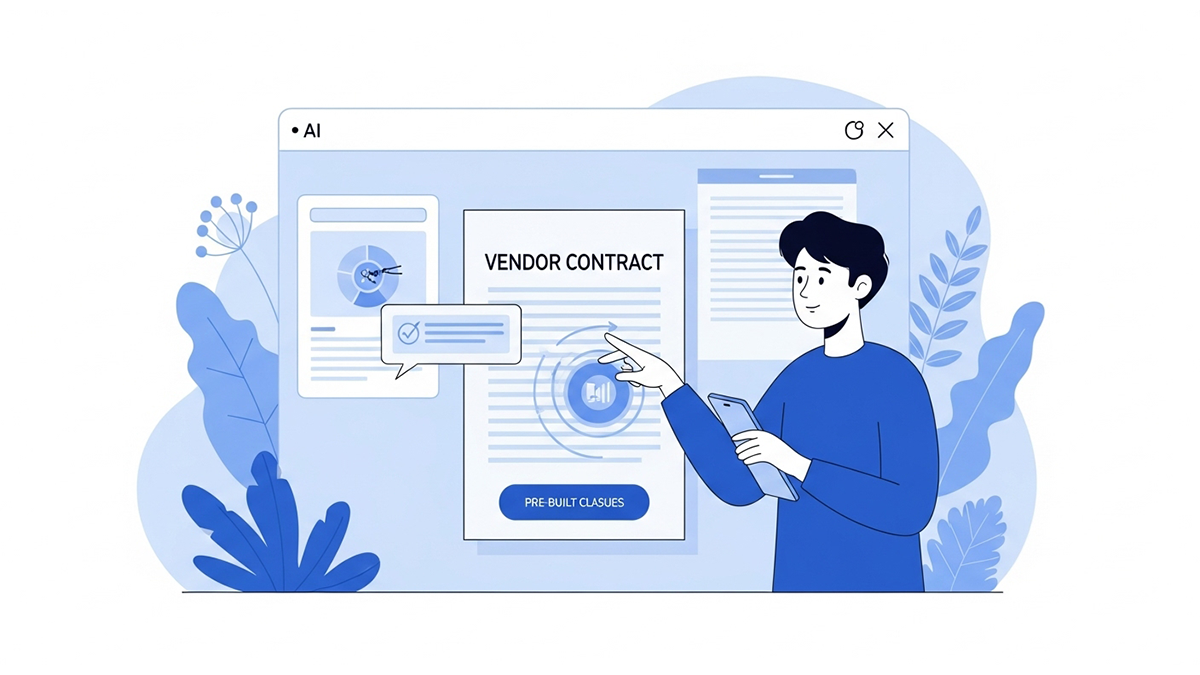
Prebuilt clause libraries offer a better resolution. By encoding the organization’s approved vendor contract positions into a reusable clause structure, procurement teams can generate vendor agreements that are already legally sound – without requiring legal to review each one individually. Legal involvement shifts from reviewing every contract to maintaining the clause library and reviewing exceptions.
This guide covers what prebuilt clause libraries are, how they work in a vendor contract context, and what the practical workflow looks like for procurement teams.
What a Prebuilt Clause Library Actually Is
A clause library is a structured collection of pre-approved contract language organized by clause type and use case. Each entry in the library contains:
- The clause type (e.g., limitation of liability, payment terms, data processing, warranty)
- The approved language for that clause in a specific context (e.g., standard vendor services, SaaS subscription, goods purchase, professional services)
- The conditions under which that language applies (e.g., contract value above/below a threshold, vendor category, jurisdiction)
- Any variants for specific situations (e.g., a more favorable version for strategic vendors, a more protective version for high-risk vendors)
The library is maintained by legal counsel and approved through whatever governance process applies to standard contract language. Once approved, procurement teams can use library clauses to generate contracts without requiring legal to re-review the same standard positions on every agreement.
The “prebuilt” aspect matters because it shifts legal effort upstream. Legal invests time once in drafting and approving clause language, rather than investing recurring time reviewing the same standard terms across hundreds of vendor agreements.
Why Vendor Contract Automation Is Different From Sales Contract Automation
Most discussion of AI contract automation focuses on outbound sales contracts – agreements where the organization is the seller and wants to accelerate deal closing. Vendor contract automation is the procurement counterpart: agreements where the organization is the buyer.
The dynamics are different in several important ways.
Volume and variety. A sales team typically works with a relatively small number of contract templates – a master services agreement, a subscription agreement, maybe a reseller agreement. A procurement team manages a much wider variety of vendor relationships: SaaS subscriptions, professional services engagements, equipment purchases, maintenance agreements, staffing contracts, consulting agreements, facilities services. Each category has different risk profiles and different standard positions.
Counterparty paper. In vendor contracting, the counterparty often provides their own contract – the vendor’s standard terms, MSA, or order form. Procurement must either review and negotiate the vendor’s paper or propose its own standard terms. Both scenarios require the organization to have clear, documented positions on key clause types.
Compliance requirements. Vendor contracts in regulated industries must include specific compliance provisions – data processing agreements for vendors handling personal data, information security requirements for technology vendors, business continuity provisions for critical suppliers. These requirements apply regardless of the vendor’s preferred contract structure.
Approval complexity. Vendor contracts often involve multiple internal approvers beyond legal: the budget owner, the business sponsor, IT security (for technology vendors), finance (for significant spend), and sometimes the executive team. Routing logic for vendor contracts is typically more complex than for sales contracts.
For how vendor contract automation connects to ERP systems where procurement workflows live, see automating vendor agreements with Oracle Fusion integration and vendor contract automation with Microsoft Dynamics.
How Prebuilt Clauses Enable Vendor Contract Automation
The automation workflow that prebuilt clause libraries enable works in four stages.
Stage 1: Contract Initiation From Procurement Data
When a purchase requisition is approved or a vendor relationship is formalized, the contract generation process begins automatically. The system reads the procurement data – vendor name, vendor category, contract value, jurisdiction, product or service type – and uses it to select the appropriate contract template and clause set.
A SaaS subscription above $50K triggers a different template than a one-time professional services engagement below $10K. A vendor in the EU triggers data processing clause requirements that a domestic vendor does not. A critical supplier above a spend threshold triggers enhanced business continuity and audit rights provisions. These selections happen automatically based on rules configured in the system – not based on a procurement coordinator manually choosing a template.
Stage 2: Automatic Clause Assembly
Once the template and clause set are selected, the system assembles the contract. Prebuilt clauses from the library are inserted into the appropriate sections of the template based on the contract category and value thresholds.
Standard positions fill automatically: payment terms of Net 30, limitation of liability capped at 12 months’ fees paid, standard confidentiality obligations, governing law in the organization’s preferred jurisdiction. Clauses that vary based on vendor category are selected from the applicable library variant: a data processing agreement for technology vendors, enhanced security requirements for vendors with access to sensitive data, warranty provisions tailored to goods versus services.
The output is a complete first draft that already reflects the organization’s approved positions – not a blank template that someone needs to fill in, but a substantive contract ready for review.
Stage 3: Automated Compliance Check
Before the contract is sent to the vendor or routed for approval, the system runs an automated compliance check against the clause library. It verifies that all required clause types are present, that all clauses meet the minimum standards for the contract category, and that no required provisions are missing.
For regulated contract categories – vendor data processing agreements, agreements involving access to customer data, agreements in regulated industries – the compliance check verifies that all mandatory regulatory provisions are included. A technology vendor contract missing a GDPR data processing agreement fails the compliance check and is flagged for legal review before proceeding.
Stage 4: Workflow Routing Based on Contract Profile
Once assembled and compliance-checked, the contract is routed for approval based on its profile. The routing logic uses the same data that drove clause selection: contract value, vendor category, risk profile, and any exception flags from the compliance check.
Standard contracts meeting all compliance criteria and falling within normal parameters route to the relevant budget owner and business sponsor for approval – legal approval is not required. Contracts with non-standard terms, above value thresholds requiring legal sign-off, or with compliance exceptions route to legal review with the specific exceptions flagged.
This tiered routing is the mechanism that resolves the tension between legal review quality and procurement speed. Standard agreements move quickly because they are already legally sound. Exceptions get appropriate scrutiny without slowing everything else down.
Building the Vendor Clause Library: What Legal Needs to Define
The clause library is only as useful as its contents. Building it requires legal to define and approve positions for each clause type across each vendor contract category. This is the highest-leverage work in the entire automation project.
Payment terms. What are the standard payment terms for each vendor category? Net 30 for services, Net 45 for goods, advance payment required for specific vendor types? What are the late payment consequences?
Limitation of liability. What is the standard cap for each contract category? Is it mutual? What categories of damages are excluded? Are there carve-outs for specific situations (data breaches, IP infringement)?
Indemnification. What does the organization require vendors to indemnify against? What is the organization’s reciprocal indemnification scope? Are there caps on indemnification obligations?
Data protection. What data processing obligations apply to vendors with access to personal data? What security standards are required? What breach notification obligations does the organization require?
Intellectual property. Who owns IP created under the vendor engagement? What license does the organization require to use vendor-created IP? What representations does the vendor make about IP ownership?
Warranty and performance. What warranties are required for goods and services? What are the remedies for warranty breach? What SLA standards apply?
Termination. What termination rights does the organization require? What notice periods? What are the consequences of termination for each party?
Governing law. What governing law applies to vendor contracts in each jurisdiction where the organization operates?
Legal does not need to define every variant in the first version of the library. Starting with the highest-volume vendor categories and the highest-impact clause types produces a working library faster than attempting comprehensive coverage from the start.
What Procurement Teams Experience After Implementation
The practical change in procurement workflow after clause library automation is significant.
Before: A procurement manager identifies a new SaaS vendor. They create a purchase requisition, which gets approved by finance. They then either accept the vendor’s standard terms (hoping they are acceptable), ask legal to review the vendor’s terms (waiting 1-2 weeks), or use a contract template they remember from a previous engagement (which may be outdated). The process is inconsistent and slow.
After: The approved purchase requisition automatically triggers contract generation. The system produces a complete vendor agreement in the organization’s standard terms within minutes, pre-populated with the vendor’s details from the procurement system. The contract goes to the vendor for signature if it falls within standard parameters, or routes to legal for review if it involves exceptions. The procurement manager sees status updates throughout without chasing anyone.
The consistency improvement is as significant as the speed improvement. Every vendor agreement in the same category is built from the same clause library – the quality of contract terms does not depend on which procurement coordinator processed the request or whether legal happened to be available.
Measuring the Impact
Key metrics for vendor contract automation with clause libraries:
- Contract generation time: How long from purchase approval to first draft contract? Should reduce from days to minutes for standard vendor categories.
- Legal review rate: What percentage of vendor contracts require legal involvement? Well-configured automation should reduce this to under 20% for high-volume standard categories.
- Contract error rate: Pricing mismatches, wrong entity names, missing required clauses. Should approach zero for AI-generated contracts.
- Cycle time by vendor category: Time from contract initiation to signed agreement. Track by category to identify where delays persist after automation.
- Exception rate: What percentage of contracts generated from the library require non-standard terms? High exception rates may indicate the library positions are too aggressive for the market.
Summary
Prebuilt clause libraries enable vendor contract automation by encoding the organization’s approved positions into reusable, AI-selectable contract language. Procurement teams can generate legally sound vendor agreements without routing every contract through legal review. Legal investment shifts from recurring review of standard positions to one-time drafting and maintenance of the library.
The practical result is faster procurement cycles, more consistent contract quality, and a legal team that spends its time on exceptions and strategic matters rather than reviewing routine vendor agreements that are already built from approved positions.
Related reading in this cluster:
- Automating vendor agreements with Oracle Fusion integration
- Vendor contract automation with Microsoft Dynamics
Related reading from other clusters:
- AI contract review best practices
- How AI automates post-signing contract obligations
- AI-powered contract management solutions: buyer’s guide
FAQs
Do pre-built clauses make our contracts rigid?
Not if you design them with preferred and fallback variants. The goal is to standardize where it’s safe and spotlight the few areas that truly need bespoke negotiation. Reviewers can always override with rationale, and the library evolves with those lessons.
How does AI know which clauses to pick for a given vendor?
It reads the intake context-category, risk tier, jurisdiction, data profile-and matches tags against the clause library. Parameters (caps, notices, SLAs) are filled from defaults or your inputs. If something is ambiguous, the system asks for clarification instead of guessing.
Can we use automation on third-party vendor paper?
Yes. The system classifies clauses, extracts key values, compares them to your playbook, and flags deviations with suggested edits. It can even propose swaps to your preferred variants and remember what this vendor accepted previously.
What about privacy and security obligations-can those be standardized?
Many can. Encode breach windows, audit rights, encryption, subprocessor rules, and residency in parameterized clauses. The system automatically escalates stricter variants when regulated data or higher exposure is detected, and it opens tasks for DPIAs or security reviews.
How do we prevent “black-box” drafting?
Insist on clause-level provenance: every paragraph shows its source, version, and rationale. Include a policy-delta summary with each draft so approvers see exactly what differs from standard and why. That transparency builds trust.
How fast can we expect results?
Most teams see immediate gains in time-to-first-draft (minutes instead of hours) once a minimal library is in place. Over the next few weeks, review time drops and deviation rates fall as the library and thresholds are tuned.
What’s the minimum we need to start?
Two vendor categories, 10–15 core clauses with one fallback each, a short intake form, and a simple playbook for caps, indemnities, privacy, and termination. You can layer on localization, third-party alignment, and procurement integrations after the pilot.
How do we measure ROI?
Track cycle time (intake → draft → sign), reviewer hours per deal, deviation rates at signature, renewal hygiene (clear notices, no surprise auto-renewals), escalations avoided, and audit prep time. Tie improvements to onboarding speed and risk reduction.
Will automation reduce legal control or increase risk?
Done right, it increases control by making standard positions the default and routing exceptions with context. Non-negotiables get stop-ship checks, and every deviation carries rationale. Counsel stays in the loop but focuses on decisions, not assembly.
Where does Legitt AI fit?
Legitt AI provides the full loop: clause libraries with variants, intake and risk-tiering, jurisdiction/localization packs, policy-aware drafting, third-party alignment, provenance, and integrations with CLM, e-sign, and procurement tools. It turns vendor drafting into a fast, explainable, and auditable workflow that scales with your business.