
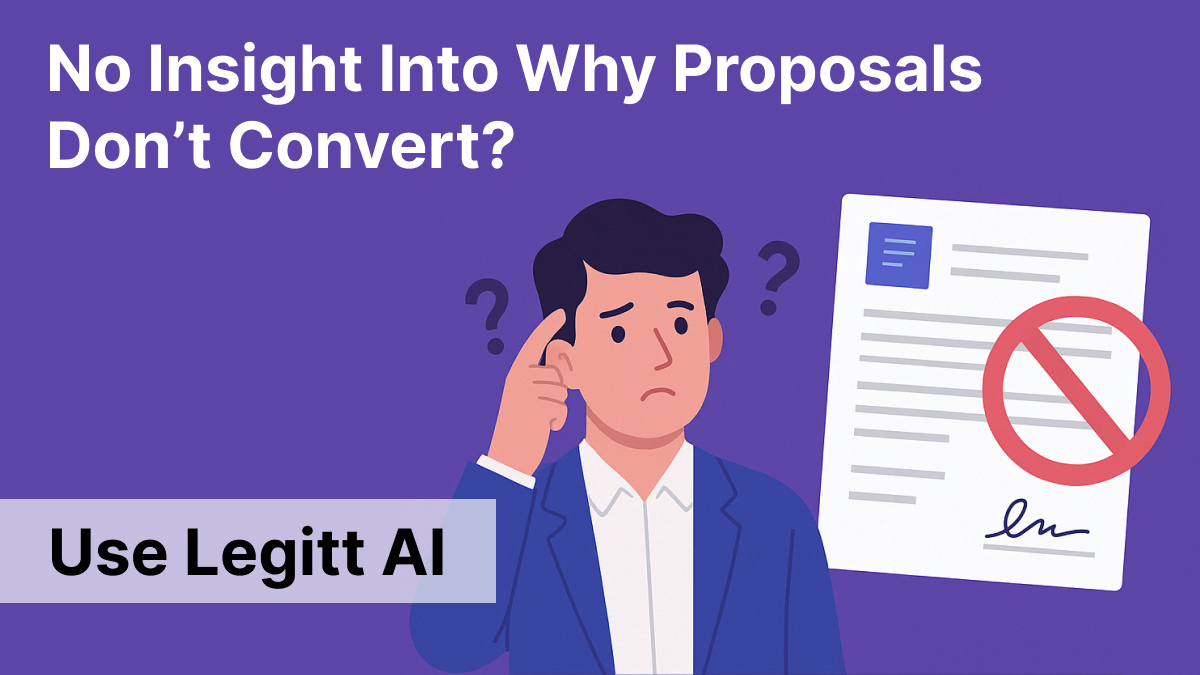
Most sales teams focus proposal improvement efforts on the wrong things. They redesign the template. They add more case studies. They refine the pricing presentation. These changes may improve how the proposal looks but they rarely improve whether it converts.
The proposals that fail to convert do not typically fail because of aesthetics or even because of content quality. They fail for more specific, diagnosable reasons that require different interventions. This guide covers the actual conversion killers in B2B proposal processes and what AI can and cannot fix about each.
The Real Reasons Proposals Fail to Convert
Reason 1: The Proposal Arrives Too Late
Deal momentum is highest immediately after a discovery call or a demo. The prospect has just articulated their problem, seen a potential solution, and is mentally engaged with the decision. A proposal that arrives within 24 hours reinforces that momentum. A proposal that arrives four days later arrives when the prospect has mentally moved on to other priorities, has had time for second thoughts, and may have heard from a competitor.
Research by Qwilr found that proposals sent within 24 hours of a discovery call close at significantly higher rates than proposals sent 3 or more days later. The content of the two proposals may be identical – timing alone explains a meaningful portion of the conversion gap.
AI-generated proposals address this directly. When proposal assembly time drops from 2-3 days to 30-60 minutes, same-day proposals become operationally feasible rather than exceptional.
For how automated generation achieves this speed, see automated proposal generation: how AI builds proposals.
Reason 2: The Proposal Does Not Reflect What the Prospect Said
A proposal that reads like a generic brochure signals to the prospect that the sales team was not listening. When the prospect mentioned during discovery that their primary concern is compliance, and the proposal leads with ROI and efficiency messaging, there is a disconnect that erodes trust.
Personalization is the intervention, but manual personalization is time-consuming enough that it only happens for strategic accounts. For most deals, reps reuse a previous proposal and change the company name.
AI personalization at scale addresses this. When discovery call notes and CRM fields capture the prospect’s stated priorities, AI proposal generation surfaces those priorities in the proposal structure – featuring relevant case studies, leading with relevant value propositions, and referencing the specific use case discussed. Every prospect gets a proposal that feels tailored, not just templated.
Reason 3: Pricing Is Unclear, Inconsistent, or Hard to Justify
Pricing confusion kills deals. A prospect who cannot understand what they are paying for, cannot reconcile the proposal pricing with what the sales rep discussed verbally, or cannot get internal budget approval because the pricing logic is opaque will stall rather than sign.
Three specific pricing problems appear consistently in non-converting proposals:
Inconsistency between verbal and written pricing. The sales rep quoted one price in conversation; the proposal shows something different because it was populated from a different source. The prospect notices and loses trust.
Missing justification for value. The price appears without adequate context for why it is the right investment. A prospect who cannot articulate the ROI case to their CFO cannot get budget approval regardless of their personal conviction.
Complexity that obscures the decision. Too many line items, too many options, too many tiers – the prospect cannot identify what to choose and defaults to inaction.
AI integration between CRM pricing and proposal generation addresses the first problem: pricing in the proposal matches what was configured in the CRM deal, eliminating the reconciliation errors that come from manual re-entry. For how AI improves pricing accuracy and insight, see proposal accuracy with AI-driven insights.
Reason 4: The Proposal Does Not Address the Buying Committee
Most B2B purchases involve multiple stakeholders: an economic buyer focused on ROI and budget, a technical evaluator focused on implementation and integration, an end user focused on usability, and often a legal or procurement stakeholder focused on risk and terms.
A proposal written for one stakeholder type fails with the others. A proposal that reads as a technical deep-dive does not give the CFO the financial justification they need. A proposal that is entirely ROI-focused does not give the technical evaluator the implementation detail they need to feel confident recommending it.
AI proposal generation can assemble different sections for different stakeholder needs within a single document, or generate different proposal variants optimized for different audiences in the same deal. The configuration rules determine what content appears for which deal context and which stakeholder profile.
Reason 5: The Proposal Creates Friction at the Approval Stage
A proposal that the prospect loves but cannot get approved internally fails as surely as one they do not love. Internal approval friction takes several forms:
Terms and conditions that legal objects to. Proposals that include aggressive standard terms – one-sided liability, problematic IP provisions, unusual payment requirements – get sent to legal for review, which adds weeks to the cycle. Proposals with reasonable, balanced terms move through without generating a legal review.
Pricing that does not map to budget categories. Finance teams approve budgets by category. A proposal that bundles everything into a single line item may not map cleanly to how budget approval works internally.
Lack of standard contract documentation. Procurement teams require specific documentation before approving vendor relationships. A proposal that arrives without a standard MSA draft, without security questionnaire responses, or without compliance certifications creates additional back-and-forth that delays the decision.
AI proposal generation addresses the terms issue by drawing from approved standard terms in the clause library – terms that have been designed to be reasonable and approvable rather than aggressively one-sided. For how proposals connect to the contract workflow, see how AI bridges sales, legal, and procurement.
Reason 6: No Clear Next Step
A proposal that presents information without a clear call to action leaves the prospect uncertain about what to do next. Should they respond with questions? Call the sales rep? Sign something? The absence of a clear next step creates inertia.
AI-generated proposals can be configured to include consistent, appropriate calls to action based on the deal stage and proposal type. A proposal to a prospect at the evaluation stage might include a request for a follow-up meeting to review the proposal together. A proposal to a late-stage prospect ready to decide might include a direct signing link or a contract draft attached.
What AI Cannot Fix About Proposal Conversion
A misdiagnosed opportunity. If the sales rep has not correctly understood the prospect’s problem, no AI-generated proposal will fix that. AI assembles content based on what the rep has captured in the CRM. If the discovery was shallow and the CRM reflects that, the proposal will reflect it too.
A competitive positioning problem. If the organization’s pricing or product is genuinely less competitive than alternatives, proposal quality will not close that gap. AI makes good proposals better; it cannot make a non-competitive offering competitive.
A trust deficit from earlier in the process. Proposals are not evaluated in isolation – they are evaluated in the context of the entire sales experience to date. A prospect who does not trust the sales rep will not be won over by a well-assembled proposal.
Poor follow-up. The best proposal in the world sits in an inbox without conversion if no one follows up. AI handles proposal creation; follow-up remains a human function.
Diagnosing Your Proposal Conversion Problem
Before implementing AI proposal generation, it is worth diagnosing which of these conversion killers is actually driving the problem in your organization. The diagnosis should be data-driven:
- Track proposal send timing against close rate – does later timing correlate with lower conversion?
- Survey prospects who did not convert – was pricing clarity a factor? Was the proposal relevant to their stated priorities?
- Audit proposals that converted versus those that did not – are there structural differences beyond the deal itself?
- Track internal approval delays – how often does legal or procurement review add to cycle time?
This diagnosis determines which interventions will have the most impact. Organizations where timing is the primary issue need faster proposal generation. Organizations where personalization is the issue need better content library configuration. Organizations where terms create friction need template revision. AI can help with all of these – but identifying the priority problem first makes the implementation more focused.
Summary
Proposal conversion fails for specific, diagnosable reasons: late delivery, generic content, pricing confusion, mismatch with the buying committee, approval friction, and unclear next steps. AI addresses several of these directly – most significantly the speed and personalization problems that manual proposal processes cannot solve at scale.
Understanding which conversion problems are most significant in your organization’s specific deal mix determines where AI investment will have the most impact.
Related reading in this cluster:
- Automated proposal generation: how AI builds proposals
- Proposal accuracy with AI-driven insights
- How AI bridges sales, legal, and procurement
Related reading from other clusters:
FAQs on Legitt AI
What makes Legitt AI different from tools like DocuSign or PandaDoc?
Legitt AI goes beyond document generation and e-signatures. It offers real-time engagement analytics, clause-level intelligence, and proposal conversion insights. While DocuSign captures signatures, Legitt AI ensures the proposal gets read, understood, and improved with each iteration.
How does Legitt AI know which parts of the proposal the client interacted with?
Legitt AI uses embedded tracking within proposals to capture interaction data - such as scroll depth, time spent on sections, and user navigation. This data is visualized for sales teams, helping them understand where interest lies or where friction occurs.
Can I customize the proposal templates in Legitt AI?
Yes. Legitt AI allows you to create custom templates or modify existing ones. You can personalize by industry, client type, or product category. The AI engine can also recommend optimizations based on historical conversion performance.
How does clause-level optimization work?
Legitt AI monitors which legal or contractual clauses get redlined, delayed, or removed frequently. It flags these clauses and suggests edits or alternatives that speed up approval. Over time, your clause library becomes smarter and more conversion-friendly.
Is Legitt AI secure and compliant with legal standards?
Absolutely. Legitt AI is built with enterprise-grade security, offering SOC2, GDPR, and ISO compliance. All proposal interactions are logged, encrypted, and stored securely, ensuring legal auditability and data privacy.
Can Legitt AI integrate with my CRM or sales tools?
Yes. Legitt AI offers integrations with leading CRMs like Salesforce, HubSpot, and Microsoft Dynamics. You can auto-fill proposal fields using CRM data, track activity in real-time, and update deal stages based on proposal interactions.
Will Legitt AI slow down my sales workflow?
Not at all. Legitt AI is designed to enhance - not disrupt - your sales process. Proposal generation becomes faster with AI assistance, while tracking and insights operate in the background without manual effort. It reduces administrative load and improves decision-making speed.
How can Legitt AI help me improve conversion rates over time?
By analyzing engagement metrics and feedback patterns, Legitt AI shows you which proposals win and why. It helps identify high-converting formats, optimal pricing structures, and clause combinations that work. This continuous feedback loop drives higher conversion rates.
Can clients interact with the proposal directly using Legitt AI?
Yes. Clients can comment, request changes, or even negotiate terms directly within the proposal document. This creates a frictionless experience and reduces the need for lengthy email chains or follow-ups
Who is Legitt AI best suited for?
Legitt AI is ideal for B2B companies that deal with complex sales cycles, detailed proposals, and legal reviews - such as SaaS providers, agencies, consultancies, legal teams, and enterprise sales orgs. It’s a game-changer for anyone who wants to close deals faster and smarter.