Small businesses don’t usually fail because they signed too many contracts. They fail because they signed weak ones, reviewed the wrong ones too late, or couldn’t find the final version when it mattered. According to the IACCM’s 2023 findings, about 75% of small business contracts contain vague or ambiguous terms that don’t clearly define roles, responsibilities, and deadlines. That is a direct path to disputes, delays, and preventable cash flow problems.
Contracts are not paperwork. They are operating controls. They define how you get paid, what you owe, when you can exit, who carries risk, and what happens when a deal goes sideways. They also shape your exposure to insurance issues, indemnity obligations, and third-party claims. If you need a plain-English primer on that overlap, review this explanation of the impact of contractual liability on insurance.
The fix isn’t more paperwork. It’s a better contract lifecycle management process. Small businesses need clear drafting, disciplined review, structured approvals, searchable storage, AI contract review, eSignature controls, and renewal tracking that doesn’t depend on someone’s inbox.
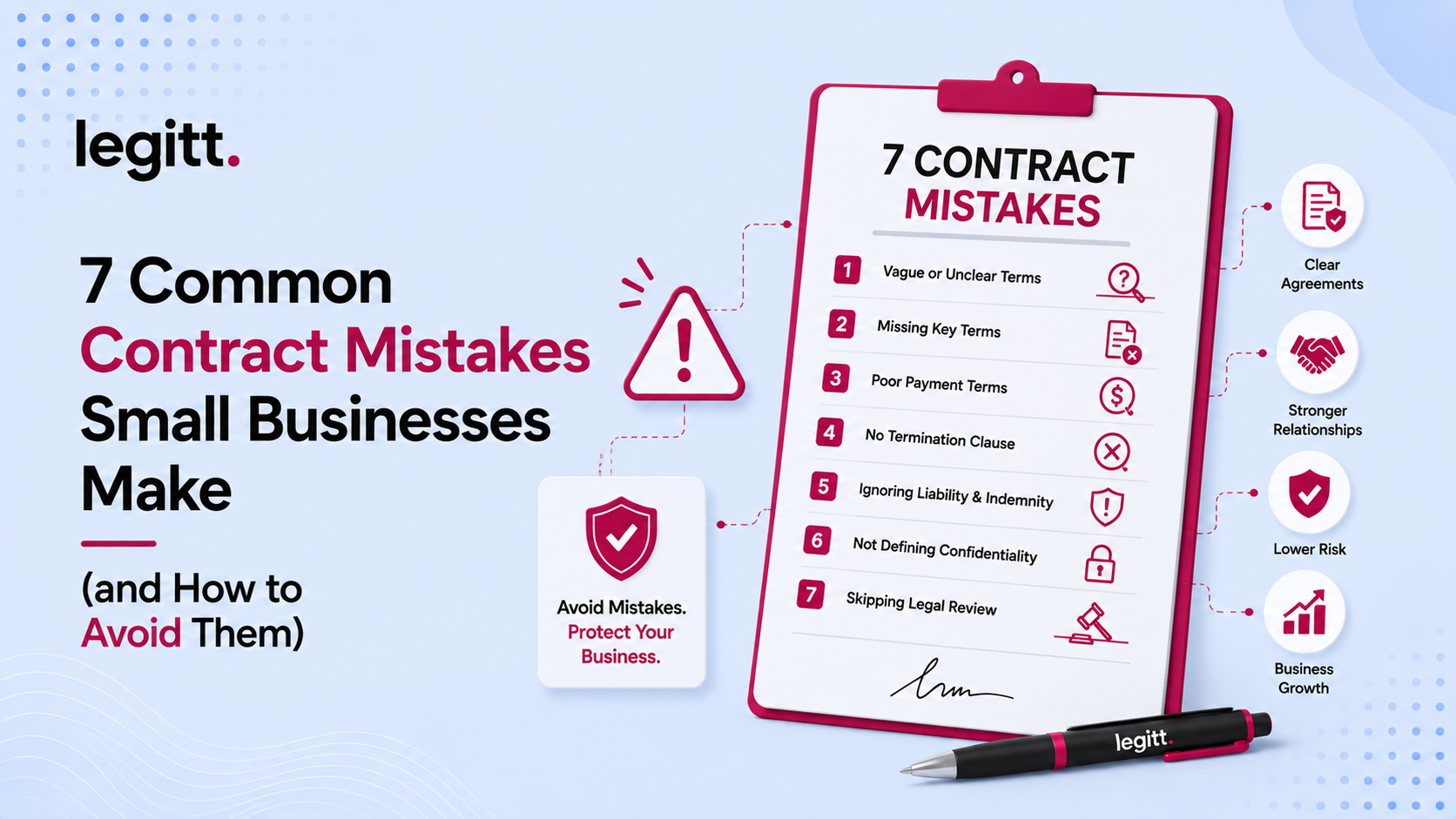
These are the 7 common contract mistakes small businesses make, and how to avoid them with a practical, modern CLM workflow.
1. Vague or Missing Terms and Conditions

Ambiguous contract language creates expensive arguments. Terms like “promptly,” “reasonable efforts,” and “as needed” sound harmless until a customer disputes an invoice, a vendor misses a deadline, or a project expands far beyond the original price.
Small businesses get hit hardest because vague wording usually hides in routine deals. A founder reuses an old template. A sales rep copies language from a prior contract. Nobody defines the payment trigger, the acceptance standard, or the exact point where extra work becomes billable. Then the business is forced to negotiate after the dispute starts, which is the worst time to fix bad drafting.
What this looks like in practice
A consulting firm agrees to “deliver marketing strategy” but never lists deliverables, presentation format, revision limits, meeting hours, or client approval deadlines. The client keeps asking for more. The consultant keeps working. Margin disappears because the contract never drew a boundary.
A services agreement says payment is due “upon completion” without defining completion. The client says the work is incomplete. The provider says it finished weeks ago. Cash gets stuck because the contract left a basic business term open to interpretation.
One rule solves a lot of this. If two reasonable people could read a clause differently, rewrite it.
Use this checklist every time you draft or review a contract:
- Define payment mechanics: State invoice dates, payment due dates, late fees, dispute windows, approved payment methods, and whether partial payment is allowed.
- Define scope in measurable terms: List deliverables, quantities, file formats, service levels, response times, revision limits, and what is excluded from the fee.
- Define deadlines and acceptance: Set milestone dates, review periods, acceptance criteria, deemed acceptance rules, and the consequence of delay.
- Define exit rights clearly: Include termination for convenience, termination for cause, cure periods, notice methods, and post-termination duties. These sample termination clause examples show the level of precision most small businesses need.
- Define ownership and risk allocation: Cover IP ownership, confidentiality, data use, indemnity, liability caps, governing law, and dispute resolution.
How to prevent vague terms with AI-powered CLM
Start with approved templates for each contract type. Sales agreements, vendor contracts, contractor agreements, and MSAs should not start from a blank page. They should start from clause libraries your team has already approved.
Then add control. An AI-powered CLM platform such as Legitt AI can generate first drafts from structured intake forms, compare language against your approved fallback clauses, flag missing terms before review, and route contracts to the right approver without relying on email memory. That saves time, but the bigger win is consistency. Your team stops improvising legal language in live deals.
If you want a stronger review process around unclear clauses, this guide on the importance of contract review in business breaks down what should be checked before signature. For drafting teams, Legitt AI also helps standardize plain-English language, reduce clause drift, and keep final terms searchable for renewals, audits, and dispute response.
Clear terms shorten negotiation, reduce write-offs, and make enforcement easier. That is real ROI.
2. Failing to Review Third-Party Contracts and Amendments
Small businesses rarely get burned by the contract they wrote. They get burned by the one they accepted.
A vendor MSA, customer procurement paper, or one-page amendment can rewrite pricing, shift indemnity, expand data rights, or lock you into an auto-renewal cycle your team never intended to accept. If inbound contracts are signed from email without a defined review gate, you are handing risk control to the other side.
The fix is simple. Treat third-party paper and amendments as controlled intake, not casual admin work. Every inbound contract should be logged, assigned an owner, reviewed against your approved positions, and approved before signature. That applies to amendments too. A short addendum can override liability caps, payment terms, or termination rights negotiated in the base agreement.
What to review before anyone signs
Start with the clauses that change cost, risk, and flexibility fast:
- Auto-renewal and termination: Confirm renewal length, notice deadlines, required notice method, and any early termination fees.
- Pricing and payment terms: Check fee increases, minimum commitments, implementation charges, pass-through costs, late fees, and refund limits.
- Risk allocation: Review indemnity, limitation of liability, warranty disclaimers, insurance obligations, and security commitments.
- Data and IP terms: Verify who can use your data, who owns work product, and whether the counterparty can reuse confidential material.
- Incorporated documents: Open every linked policy, URL, exhibit, and order form. If it is incorporated by reference, it is part of the deal.
One missed amendment is enough. A supplier sends a renewal addendum that looks administrative. Buried in paragraph three is a new 60-day notice requirement and a price increase tied to a broad cost-adjustment clause. No one flags it. The deadline passes. The business renews at a higher rate for another year.
How to prevent this with AI-powered CLM
Manual review fails when contracts arrive through scattered channels and nobody follows the same checklist. Fix the process first, then automate it.
Use an intake form to capture contract type, counterparty, contract value, effective date, renewal date, and business owner. Route every third-party contract into one system. Then run deviation analysis against your fallback language so your team sees what changed before anyone approves it.
Legitt AI helps small teams do this without building a legal department. It can identify renewal triggers, surface non-standard payment terms, flag risky clauses, and keep amendment history tied to the original agreement. It also supports approval and signatory workflows that keep contract reviews without friction across teams. For a practical explanation of why this review step matters, see the importance of contract review in business.
Process discipline matters as much as software. Your sales, procurement, finance, and operations teams should follow one review path, with clear handoffs and documented exceptions. If you need a model for documenting those handoffs, use MarTech Do’s RevOps process guide.
Review every amendment with the same discipline as the original contract. That rule prevents expensive surprises.
3. Inadequate Signature Authority and Approval Workflows
Unauthorized signatures create expensive confusion fast. The wrong person signs, the business starts performing, finance processes payments, and only later does someone realize the agreement never cleared the right approvals.
That failure is common in small companies because approvals often live in email, chat, or verbal handoffs. Sales sends a contract out to hit quarter-end. A founder replies “looks fine.” Procurement never sees the vendor paper. Finance finds a payment schedule it would have rejected after the contract is already signed.
Build a real approval path, not a loose policy
Start with a written signature authority matrix. Keep it simple, but make it enforceable. Define approval rules by contract type, dollar value, legal risk, and deviation from your standard paper. Customer MSAs, vendor agreements, employment documents, and partnership deals should not share one approval route.
Use a structure like this:
- Standard low-risk contracts: Department lead approval
- Non-standard commercial terms: Finance approval
- Changed indemnity, liability, privacy, or termination language: Legal review
- High-value or strategic agreements: Executive approval
- Final signature: Only approved signatories signing on behalf of the legal entity
The last point matters. If an owner or employee signs in a personal capacity instead of clearly signing for the company, liability questions get messy fast, as explained in this summary of common legal mistakes made by small businesses.
Workflow prevents the mistake
A policy document sitting in a folder will not stop an unauthorized signature. A gated workflow will.
Replace memory-based approvals with rule-based routing. If a contract includes a payment term outside policy, send it to finance. If it is third-party paper with edited legal terms, send it to legal. If the value crosses your approval threshold, escalate it automatically. eSignature should sit at the end of that sequence, not at the beginning.
CLM software provides small businesses with measurable ROI. Legitt AI can route contracts by value, clause deviation, or contract type, hold signature until required approvers sign off, and maintain an audit trail showing who approved what and when. That removes bottlenecks without losing control. If you want a practical model for centralized contract storage and controlled access, pair it with approval rules so the right version reaches the right signer every time.
Use one workspace for approvals, comments, and signature authority. That single change cuts side-channel approvals and gives operations, finance, and legal a clean record.
For teams formalizing the process, Legitt AI supports structured routing, approval chains, and signatory controls in one workspace. This walkthrough on approval and signatory workflows is a useful starting point. If your broader operating problem is undocumented approvals and informal handoffs, this MarTech Do’s RevOps process guide helps document ownership, exceptions, and approval stages clearly.
4. Poor Contract Organization and Lost or Inaccessible Documents

68% of small businesses with fewer than 500 employees still manage contracts through manual, paper-based, or disconnected digital workflows, according to the 2024 ACC Contract Lifecycle Management Market Report. That is how signed agreements get buried in inboxes, saved under the wrong name, or lost when an employee leaves. Once that happens, every downstream task gets harder. Billing, renewals, audits, disputes, and vendor management all slow down because nobody can confirm the controlling document.
Poor organization creates expensive, avoidable mistakes. Finance invoices against outdated payment terms. Sales renews a customer on the wrong pricing schedule. Operations misses a notice deadline because the amendment that changed it lives in someone’s email archive. The problem is not filing discipline. The problem is the lack of a real system of record.
What a broken repository costs you
Scattered storage blocks execution. Your team wastes time searching for contracts, then wastes more time checking whether the version they found is final. If the signed PDF, amendment, and order form sit in different places, people make decisions with incomplete information.
That is where modern CLM earns its keep. A central repository paired with AI extraction gives you searchable contract data, not just a pile of files. Legitt AI can pull key fields and clauses from uploaded agreements, tag them automatically, and route them into one workspace. For teams trying to reduce audit gaps and missed obligations, this guide to AI-powered compliance and risk management workflows shows the model to use.
Build a usable system of record
A contract repository needs rules, metadata, and automation.
- Store every final document in one place: Include executed contracts, amendments, SOWs, order forms, exhibits, and notices.
- Capture metadata at intake: Record counterparty, contract type, owner, effective date, renewal date, value, and governing law.
- Make clauses searchable: Index payment terms, auto-renewal language, termination rights, liability caps, and data obligations.
- Control access by role: Sales, finance, procurement, and legal should see what they need without creating duplicate copies.
- Connect business systems: Sync the repository with CRM, ERP, and accounting tools so contract data stays consistent across teams.
Use automation to enforce the process. If a signed agreement is not uploaded, tagged, and linked to the right customer or vendor record, treat it as incomplete.
Legitt AI supports searchable storage, clause extraction, and connected workflows across systems like Salesforce, HubSpot, and Microsoft Dynamics 365. If your team is still hunting through folders for signed agreements, start with a centralized repository and enforce it. This guide on centralized contract storage shows the operating model you want.
5. Inadequate Risk Assessment and Non-Compliance with Regulatory Requirements
A contract can create regulatory exposure long before a dispute starts. Small businesses miss this because they treat compliance review as a legal formality instead of an approval gate. That is a costly mistake.
The highest-risk terms are rarely hidden. They sit in plain view inside indemnities, limitation of liability clauses, data use rights, security commitments, insurance requirements, subcontracting terms, and worker classification language. If nobody checks those clauses against your actual operations, insurance coverage, and jurisdictions, you are signing risk you do not understand.
Cross-border contracts deserve extra scrutiny. AI drafting tools can speed up first drafts, but they do not know your regulatory obligations unless you set clear rules, approved playbooks, and review triggers. A polished clause can still be wrong for data transfers, local labor rules, tax treatment, or industry-specific requirements.
The real problem with AI-generated compliance language
Do not rely on generic “AI-safe” templates for international or regulated contracts. They often produce acceptable wording at a glance and bad outcomes in practice.
For example, a vendor agreement may include broad data processing rights but omit the transfer mechanism your customer requires. A contractor agreement may label someone an independent contractor while the actual working relationship points the other way under state law. An MSA may accept security obligations your team cannot meet. Those failures do not come from bad formatting. They come from weak risk review.
The business owner still owns the liability.
What to assess before approval
Build risk assessment into the review workflow and force it before signature.
- Data protection and residency: Check what data is collected, where it is stored, who can access it, and what transfer restrictions apply.
- Liability and insurance fit: Compare indemnity, limitation of liability, cyber obligations, and insurance requirements against your actual policies and risk tolerance.
- Worker classification exposure: Review scope, control, exclusivity, equipment, payment structure, and termination terms. Contract labels do not override the facts.
- Industry and geographic compliance: Confirm whether the agreement triggers state, national, or sector-specific rules for privacy, consumer protection, healthcare, financial services, or export controls.
- Operational feasibility: Remove promises your team cannot perform, especially around response times, audit rights, retention periods, and security certifications.
Worker classification needs special attention. The U.S. Department of Labor states that determining whether a worker is an employee or independent contractor depends on the economic reality of the relationship, not just the contract label. Review its guidance on employee or independent contractor classification under the Fair Labor Standards Act. The IRS makes the same point in its independent contractor or employee guidance. If your contract says “independent contractor” but your business controls the work like an employer, the clause will not save you.
Use workflow controls, not memory
Manual review breaks down fast. One person forgets to check a privacy exhibit. Another assumes insurance already approved the cap. Sales pushes the deal through because the language “looks standard.” That is how non-compliant terms get signed.
Set up a rule-based approval process instead:
- Classify the contract by type, region, and risk level at intake.
- Auto-flag clauses tied to privacy, security, international transfers, labor classification, and regulatory obligations.
- Route flagged contracts to the right reviewer, legal, HR, finance, security, or procurement, before signature.
- Require fallback language from an approved clause library.
- Store the final risk decisions and clause deviations in the repository so the next review starts with context.
AI-powered compliance and risk management workflows in Legitt AI help small businesses scan for missing compliance language, detect clause deviations, and enforce approval rules before a contract is signed. Use that kind of system if you want speed without accepting blind risk.
6. Inefficient Negotiation and Redline Processes
Version confusion kills deal speed and creates avoidable contract risk. Small businesses still push drafts through email attachments, forwarded comments, and side conversations in chat or calls. Once legal, sales, finance, and the counterparty all touch the document, the process turns into guesswork.
The problem is control. One person edits an old draft. Another approves language that never makes it into the final copy. A salesperson tells the customer “we can accept that change” on a call, but nobody updates the paper. That is how businesses sign contracts with terms they did not review.
Why manual redlining breaks down
Email is not a negotiation system. It is a delivery channel.
It does not give you one approved draft, one decision record, or one clear owner for each concession. It scatters negotiation history across inboxes, attachments, and call notes. If a dispute shows up later, your team wastes time proving which version was final and whether a change was approved.
This also slows revenue. World Commerce & Contracting reports that poor contract management processes cost businesses an average of 8.6% of contract value each year, driven by missed obligations, cycle delays, and weak control over terms during the contracting process: https://www.worldcc.com/resource/Poor-Contract-Management-Continues-To-Costs-Companies-9-Of-Their-Bottom-Line.html
Negotiation friction is a big part of that loss. Analysts at McKinsey explain that contract workflows still depend heavily on manual review, fragmented handoffs, and inconsistent clause handling in many organizations, which is exactly why AI-based review and workflow tools are getting attention: https://www.mckinsey.com/cn/our-insights/our-insights/beyond-the-hype-unlocking-value-from-the-ai-revolution
Replace scattered redlines with a controlled workflow
Set up a negotiation process that forces discipline.
- Assign one internal owner for each draft. One person controls the outbound version and consolidates feedback before anything goes back to the counterparty.
- Keep all edits in one workspace. Comments, clause changes, approvals, and fallback language should sit in the same record.
- Separate internal debate from external negotiation. Resolve pricing, liability, security, and operational positions inside your team first. Then send one clear response.
- Capture every concession in the document. If a point is agreed on by email or on a call, update the draft immediately. Verbal agreement that never reaches the contract is worthless.
- Generate a clean execution copy from the final approved version. Do not sign a file that was manually rebuilt from multiple drafts.
A modern CLM platform turns this from policy into process. Legitt AI gives small businesses a practical way to manage redlines in one place, route approvals automatically, compare clause deviations, and keep a reliable audit trail of who changed what and why. That matters because small teams do not have spare time for version cleanup or post-signature damage control.
The counterparty does not need to use your exact system. Your team still needs one controlled workflow for review, negotiation, approvals, and final execution. That is how you cut cycle time without giving away terms by accident.
7. Absence of Proactive Contract Renewal and Obligation Management
A contract can lose money long before it expires.
The risk starts right after signature. Miss one renewal notice, one price increase date, one audit obligation, or one service credit trigger, and the contract starts controlling you instead of the other way around. Small businesses feel this faster than large enterprises because the same few people are handling sales, vendor management, billing, and compliance.
What the data shows
Deloitte points to poor contract management, weak visibility into obligations, and missed termination terms as recurring drivers of value leakage and disputes in its contract lifecycle management research. Review Deloitte’s contract lifecycle management perspective here: Deloitte on contract lifecycle management.
The Association of Corporate Counsel has also documented growing CLM and legal technology adoption as legal teams push for better tracking, faster workflows, and tighter control over renewals and obligations. See the ACC legal technology resources here: ACC legal technology resources.
The takeaway is simple. If renewal and obligation tracking lives in inboxes, spreadsheets, and memory, deadlines will be missed.
Build a system that prevents misses
Set up renewal and obligation management as an operating process, not an admin task.
- Capture key terms the moment the contract is signed. Pull renewal notice periods, payment dates, deliverable milestones, reporting duties, audit rights, insurance requirements, and termination triggers into a tracked record.
- Assign one owner for each obligation. Customer success should own customer renewals. Procurement should own vendor renewals. Finance should own billing checkpoints. Compliance should own certifications, training, and audit tasks.
- Set multiple alerts, not one. Create reminders 90, 60, and 30 days before renewal or notice deadlines so the business has time to decide, negotiate, or exit.
- Tie obligations to action. A reminder without a workflow is noise. Every alert should trigger a task, owner, due date, and escalation path.
- Match billing to contract terms. Finance should invoice based on the signed schedule, milestones, and pricing rules in the contract. Default accounting habits create revenue leakage and disputes.
AI-powered CLM makes this practical for a small team. Legitt AI can extract dates and obligations from signed agreements, route reminders to the right owner, and keep renewals, invoices, and compliance tasks visible in one workflow. That is how you stop treating renewals as calendar surprises and start treating them as controlled revenue and risk decisions.
7 Contract Mistakes: Side-by-Side Risks & Remedies
| Issue | 🔄 Implementation Complexity | 💡 Resource Requirements | ⭐📊 Expected Outcomes | Ideal Use Cases | ⚡ Key Advantages |
|---|---|---|---|---|---|
| Vague or Missing Terms and Conditions | 🔄 Moderate, requires careful clause drafting and template customization | 💡 Legal review, contract templates, CLM/AI drafting (~small upfront investment) | ⭐📊 Clearer enforceability; fewer disputes; faster closings | Any SMB negotiating deliverables, payment or IP terms (SaaS, consulting) | ⚡ Reduces negotiation cycles; ⭐ lowers litigation risk; improves alignment |
| Failing to Review Third-Party Contracts and Amendments | 🔄 Moderate, process + automation for inbound reviews | 💡 Contract intake, AI deviation tools, legal gating for approvals | ⭐📊 Fewer surprise costs/auto‑renewals; earlier risk detection | Procurement, sales accepting vendor/customer standard terms | ⚡ Fast deviation detection; 📊 centralizes historical comparisons |
| Inadequate Signature Authority and Approval Workflows | 🔄 Medium–High, requires role matrices and workflow design | 💡 CLM with role-based routing, CRM integration, stakeholder time | ⭐📊 Stronger governance, audit trails, fewer unauthorized signatures | Companies with delegated signing limits or regulatory obligations | ⚡ Parallel approvals speed deals; ⭐ enforces compliance and auditability |
| Poor Contract Organization and Lost or Inaccessible Documents | 🔄 Low–Moderate, migration and metadata standardization effort | 💡 Centralized repository, indexing, AI clause extraction, migration time | ⭐📊 Faster retrieval, fewer missed renewals, better reporting | Organizations with scattered storage or missed deadlines | ⚡ Searchable repo reduces retrieval time to seconds; 📊 version control |
| Inadequate Risk Assessment and Non-Compliance with Regulatory Requirements | 🔄 High, requires rule configuration and expert input | 💡 Compliance/legal experts, AI risk scoring, clause libraries | ⭐📊 Reduced regulatory exposure; prioritized legal review of high‑risk deals | Regulated industries (healthcare, finance, data protection) | ⚡ Prioritizes scarce legal resources; ⭐ ensures compliance readiness |
| Inefficient Negotiation and Redline Processes | 🔄 Moderate, adoption of centralized collaboration workspace | 💡 Collaboration platform, change-tracking, stakeholder training | ⭐📊 Shorter negotiation cycles; clearer audit trail of changes | Deals with multiple stakeholders or frequent redlines | ⚡ Real-time redlines and handoff to eSignature; 📊 eliminates version chaos |
From Reactive Firefighting to Proactive Contract Management
Most small businesses don’t need a bigger legal department. They need a tighter contract system. The seven mistakes above come from the same root problem. Teams treat contracts as files to sign and store, instead of operational assets that need drafting controls, review discipline, approval logic, searchable storage, negotiation structure, and post-signature tracking.
That shift matters because the cost of poor contract management isn’t limited to legal disputes. It shows up in slower sales cycles, missed renewal opportunities, avoidable vendor lock-in, payment delays, compliance gaps, and insurance friction. It affects legal teams, procurement leaders, sales teams, finance, and operations in different ways, but the underlying failure is usually the same. Nobody owns the full contract lifecycle.
Modern CLM software fixes that by connecting each stage. AI-powered contract drafting helps teams start from approved language instead of generic templates. AI contract review and deviation analysis make it easier to evaluate third-party paper without relying on manual line-by-line review for every agreement. Structured approval workflows ensure the right people review the right issues before signature. eSignature with role-based routing enforces the sign-off chain. A centralized repository gives everyone one version of the truth. Contract intelligence turns static documents into searchable business data. Renewal alerts and obligation tracking keep signed agreements active instead of forgotten.
For small businesses, that isn’t overengineering. It’s basic risk control with a clear efficiency upside. When contract data flows into CRM, procurement, and accounting systems, teams stop retyping terms, missing deadlines, and arguing over which version applies. When legal ops and business teams share a single contract workspace, deals move faster without losing control.
Legitt AI fits that operating model well because it combines drafting, review, redlining, approvals, eSignature, repository management, and AI-driven contract intelligence in one platform. That matters for smaller organizations that can’t afford disconnected tools or manual handoffs between departments.
If you want to avoid the 7 common contract mistakes small businesses make, don’t patch each issue one by one. Standardize the process. Centralize the documents. Automate the workflows. Review risk before signature. Track obligations after signature. That is how contracts stop being hidden liabilities and start working as business assets.
If your team is still drafting in Word, negotiating over email, chasing approvals in chat, and storing signed PDFs across scattered folders, it’s time to upgrade the process. Legitt AI gives legal, sales, procurement, finance, and operations teams one AI-native workspace to draft, review, negotiate, e-sign, store, and track contracts end to end. Use it to standardize templates, automate approvals, analyze third-party paper, centralize your repository, and stay ahead of renewals and obligations without adding more manual work.