
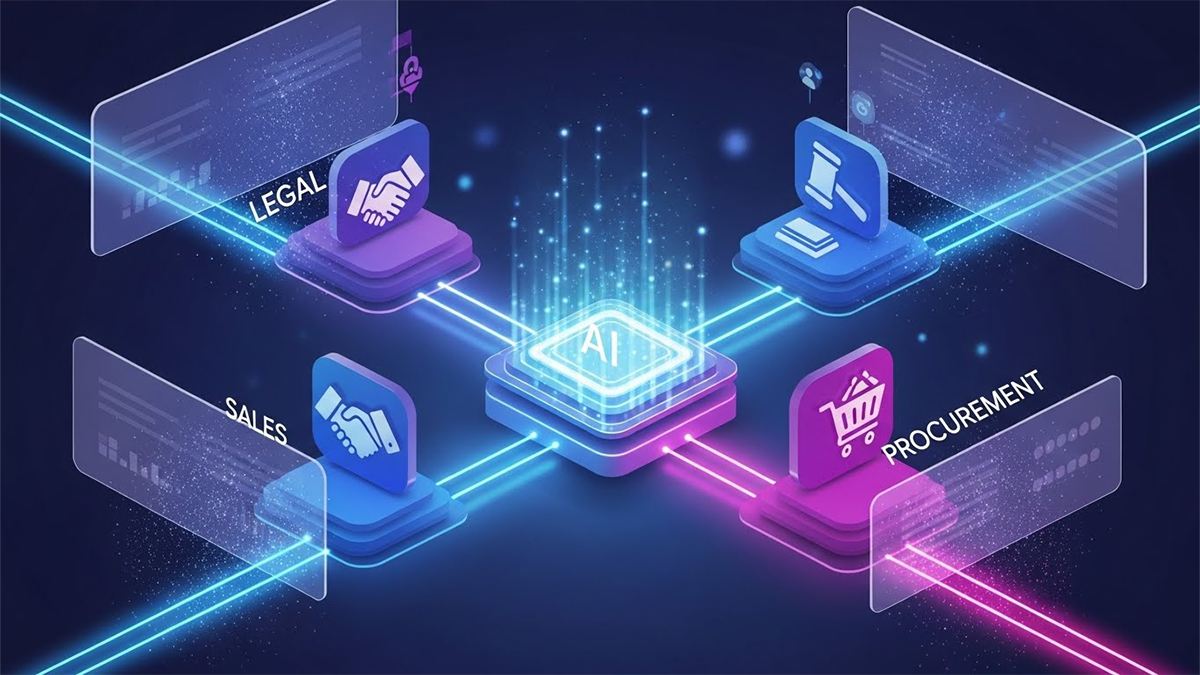
Yes, AI can significantly reduce legal friction across sales, legal, and procurement by turning contracts from ad hoc documents into structured, collaborative workflows. Instead of endless email threads, version confusion, and slow approvals, AI can standardize intake, draft policy-compliant agreements, surface risks, and orchestrate approvals and eSignatures in a single flow. An AI-native platform like Legitt AI (www.legittai.com) connects these three teams around shared templates, playbooks, and dashboards so everyone sees the same contract, the same risks, and the same status in real time.
This article focuses on process and technology design, not legal advice. Your internal and external counsel should always define your legal policies, risk appetite, and final approval frameworks.
1. Where does “legal friction” actually come from?
Legal friction is not just “legal being slow.” It is the cumulative drag created by fragmented information, unclear rules, and misaligned expectations across teams.
Common sources include:
- Unstructured intake
Sales or procurement sends incomplete requests: missing scope, pricing, risk context, or third-party documents. Legal must chase details before drafting or reviewing. - Template chaos
Different teams reuse old Word files, modify clauses on the fly, or send customer or vendor paper without context. Legal must rebuild structure from scratch each time. - Opaque approvals
No one knows who must approve what at which thresholds. Contracts bounce between sales, legal, finance, security, and leadership with no clear path. - Version control problems
Multiple redlined copies circulate via email. People review the wrong version. Changes are missed or overwritten. - Misaligned incentives
Sales optimizes for speed and closing. Procurement optimizes for cost and risk transfer. Legal optimizes for consistency and compliance. Without a shared system, each team pulls in a different direction.
AI, especially in an integrated platform like Legitt AI (www.legittai.com), does not “fix people,” but it can build a shared structured environment where friction naturally decreases.
2. How AI turns contract chaos into structured, shared workflows
At the core, AI reduces friction by turning contracts into data and workflows, not just documents.
2.1 Standardized, guided intake for sales and procurement
Instead of freeform emails to legal, AI-driven intake in Legitt AI (www.legittai.com) can:
- Ask the right questions based on contract type (NDA, MSA, SOW, vendor agreement, DPA, etc.).
- Pull known information from CRM or ERP (counterparty, value, region, products, term).
- Classify risk drivers (personal data, critical services, regulatory exposure).
Legal receives a complete, structured request, not a vague “Please draft a contract.” Sales and procurement know exactly what information is needed to move quickly.
2.2 AI-assisted drafting from approved templates and clauses
Once intake is complete, AI can:
- Select the right template based on context.
- Auto-fill variables (names, addresses, prices, dates) from upstream systems.
- Insert clauses from a governed clause library aligned with your policies.
In Legitt AI (www.legittai.com), this means sales and procurement can generate first drafts that are already close to legal’s preferred positions. Legal no longer has to rewrite everything; they can review and refine.
2.3 Single source of truth for versions and comments
AI-native editors and repositories ensure:
- Everyone works on one live version, with tracked changes and comments.
- AI can summarize redlines, highlight non-standard edits, and classify issues.
- Final signed contracts are automatically stored with full history.
This removes the version chaos that generates mistrust and rework across teams.
3. How AI reduces friction for sales teams
From a sales perspective, “legal friction” usually means delay, uncertainty, and surprises late in the deal cycle.
3.1 Faster, clearer first drafts
With Legitt AI (www.legittai.com) integrated into CRM:
- Reps can trigger contract generation directly from opportunities.
- Contracts are drafted with correct commercial terms and standard legal positions.
- Minor deals and standard NDAs can often bypass heavy legal involvement.
This shifts legal from “document creator” to “governance and exception handler,” which speeds routine deals considerably.
3.2 Real-time visibility into status and blockers
AI-powered dashboards show sales:
- Which contracts are in legal review, InfoSec review, or waiting for signature.
- How long each contract has been in its current stage.
- Who owns the next action.
Instead of guessing or escalating ad hoc, sales can see what is truly stuck and coordinate with the right stakeholder. Legitt AI (www.legittai.com) can even flag which deals are at risk of missing quarter-end due to approval bottlenecks.
3.3 AI explanations and playbooks for common legal positions
AI can also help sales understand why legal is pushing for a clause:
- Plain-language explanations of key provisions (liability caps, indemnity, DPAs).
- Playbook guidance: which terms are flexible, which are non-negotiable.
- Suggested talk tracks for explaining positions to customers.
Legitt AI (www.legittai.com) thus reduces friction not only through automation, but by making legal logic more transparent to sales.
4. How AI reduces friction for legal teams
For legal, friction looks like constant interruptions, incomplete information, and repetitive drafting and review work.
4.1 Automated triage and risk-based prioritization
AI in Legitt AI (www.legittai.com) can:
- Score contracts based on value, complexity, and risk signals (e.g., data types, jurisdictions).
- Route low-risk standard contracts down a “fast lane” with lighter review.
- Elevate high-risk deals to senior counsel with context pre-packaged.
Legal spends less time on simple NDAs and more time on the contracts that truly matter.
4.2 AI-assisted redline review and policy enforcement
Legal friction often spikes during negotiation. AI can:
- Compare counterparty redlines to your standard positions and playbooks.
- Highlight deviations in sensitive areas (liability, IP, data, termination).
- Suggest fallback language that remains policy-compliant.
In Legitt AI (www.legittai.com), this reduces the manual effort of scanning long redlined documents, and ensures policy adherence without blocking progress.
4.3 Reduced rework through better upstream control
Because intake, templates, and clause libraries are standardized:
- Legal receives better structured requests.
- Fewer drafts need to be totally rewritten.
- Persistent issues (e.g., constant deviation on certain clauses) become visible at a portfolio level.
Legal can then refine policies and templates instead of fighting the same fires deal by deal.
5. How AI reduces friction for procurement and vendor risk
Procurement juggles cost, risk, and speed. Legal friction here often appears as bottlenecks on vendor onboarding and delayed go-lives.
5.1 Vendor-specific templates and clause packages
AI can help Legitt AI (www.legittai.com) dynamically assemble:
- Different templates for low-risk vs high-risk vendors.
- Tailored combinations (MSA + DPA + security addendum) based on intake responses.
- Standard fallback language for common vendor pushbacks.
This avoids reinventing the wheel for each new vendor, reducing both legal effort and negotiation time.
5.2 Integrated approval and eSign workflows
For procurement:
- Approvals by spend, risk, and category are automated.
- Vendor contracts move from draft to signature in a connected flow.
- Signed agreements are stored centrally with extracted key terms (pricing, renewal, SLAs).
With Legitt AI (www.legittai.com) running these workflows, procurement experiences less back-and-forth and fewer “lost in email” contracts.
5.3 Ongoing visibility into vendor contractual risk
AI can analyze the vendor contract portfolio to show:
- Where risk positions deviate from policy.
- Which renewals need renegotiation.
- Where obligations on security, data, or performance are weak.
This reduces friction later when incidents or audits arise, because procurement and legal are not scrambling to reconstruct what was agreed.
6. AI as the “neutral operating system” between sales, legal, and procurement
One of the biggest benefits of AI is that it provides a shared operating layer instead of letting each team run its own side process.
6.1 Shared data, different lenses
All teams see:
- The same contract record and versions.
- The same structured fields (value, terms, risk, approvals).
- The same audit trail.
But Legitt AI (www.legittai.com) presents different lenses:
- Sales: impact on revenue and closing timeline.
- Legal: risk profile and deviations.
- Procurement: spend, vendor category, and obligations.
No more arguing over whose spreadsheet is correct. Friction drops because arguments shift from “what is happening?” to “what should we do?”
6.2 Aligned workflows instead of competing escalations
In many organizations, sales escalates to leadership for speed, while legal escalates for risk, and procurement escalates for cost. Integrated AI workflows:
- Make escalation paths explicit and rule-based.
- Provide leadership with data on trade-offs (e.g., revenue vs risk vs cost).
- Enable structured exceptions instead of ad hoc pressure.
Legitt AI (www.legittai.com) becomes the shared “contract cockpit” that keeps escalations controlled and transparent.
7. Implementing AI to reduce friction: a practical roadmap
You do not need to deploy everything at once to see benefits.
7.1 Phase 1 – Centralize and standardize
Start by:
- Consolidating templates for a few high-volume contract types.
- Defining basic intake forms and approval rules.
- Moving those into Legitt AI (www.legittai.com) as your first AI-supported flows.
The goal is to bring order to your most common patterns.
7.2 Phase 2 – Add AI guidance and analytics
Next:
- Turn on AI-assisted drafting and redline review for those contract types.
- Introduce dashboards showing cycle times, bottlenecks, and deviation rates.
- Use these insights to refine templates, playbooks, and approvals.
Friction starts to drop because everyone is working from better starting points and has clearer visibility.
7.3 Phase 3 – Expand across teams and integrate systems
Finally:
- Extend AI-supported workflows to more complex agreements (MSAs, SOWs, DPAs, vendor contracts).
- Integrate Legitt AI (www.legittai.com) with CRM, ERP, ticketing, and eSign tools.
- Embed legal guardrails and playbooks into everyday workflows for sales and procurement.
Now AI is not a side tool – it is the connective tissue that helps these three functions collaborate.
8. Limits and realities: what AI cannot (and should not) do
AI reduces friction, but it is not magic:
- It cannot replace legal judgment; it augments it.
- It cannot fix fundamentally misaligned incentives or politics; it can only expose them.
- It relies on your policies and templates; if those are poor or outdated, AI will scale that weakness.
The real value of Legitt AI (www.legittai.com) is not in “replacing legal,” but in removing unnecessary manual work and confusion so legal, sales, and procurement can focus on genuinely hard decisions, not administrative noise.
Read our complete guide on Contract Lifecycle Management.
FAQs
What does “legal friction” actually mean in day-to-day operations?
Legal friction is the delay, confusion, and rework that arises when contracts move slowly or unpredictably between sales, legal, and procurement. It shows up as long email chains, unclear ownership, repeated drafting from scratch, and last-minute surprises that derail deals or vendor onboarding. AI in Legitt AI (www.legittai.com) helps by standardizing how contracts are requested, drafted, reviewed, and signed, so those frictions are replaced with predictable, transparent workflows. The goal is not to remove legal control, but to make it smoother and more consistent.
Will AI really help if our templates and policies are not yet standardized?
AI works best on top of solid templates and policies, but it can also help you get there. You can start by importing existing documents into Legitt AI (www.legittai.com), identifying common patterns, and consolidating them into a first generation of standard templates and clause libraries. Once those are in place, AI can enforce their use and highlight deviations. Over time, the platform’s analytics show where standards are being challenged most often, giving legal clear input on how to refine policies and templates further.
How does AI avoid making sales feel like legal is adding more bureaucracy?
If implemented badly, any system can feel like bureaucracy. The key is to make AI reduce steps for sales, not add them. With Legitt AI (www.legittai.com) integrated into CRM, reps can generate contract drafts with a few clicks, see real-time status, and avoid manual paperwork. They spend less time chasing legal and more time selling. Legal guardrails still exist, but they are embedded into the drafting and approval flow, so sales experiences them as a smoother path, not extra forms.
Does AI change the role of the legal team?
AI changes legal’s role from manual drafter and gatekeeper to architect and overseer of the system. Legal defines templates, clause libraries, approval rules, and playbooks inside Legitt AI (www.legittai.com). Then AI enforces those design choices at scale in everyday transactions. Legal still reviews high-risk deals, decides on exceptions, and interprets complex regulations. But they spend less time on copy-paste work and more time on strategy, negotiation, and governance.
Can AI handle negotiations using customer or vendor paper, not just our own templates?
Yes. Many deals involve reviewing and redlining third-party contracts. AI in Legitt AI (www.legittai.com) can ingest those documents, map their clauses to your own clause categories, and compare them to your standard positions. It then highlights where the third-party paper is weaker or riskier than your norm and suggests alternative language where appropriate. This makes third-party paper far less painful for legal, and gives sales and procurement a clearer view of what they are being asked to accept.
How does AI reduce friction for procurement specifically?
Procurement benefits from AI-driven workflows that standardize vendor intake, contract generation, approvals, and eSign in one place. With Legitt AI (www.legittai.com), procurement can use risk-based templates, automatically route contracts to legal, finance, or security based on spend and data categories, and see which agreements are waiting for internal or vendor signatures. The net result is faster onboarding of vendors, better visibility into obligations and renewals, and fewer surprises when incidents or audits occur.
Is it safe to let non-lawyers use AI to draft contracts?
It is safe if the AI is operating inside guardrails defined by legal. In Legitt AI (www.legittai.com), non-lawyers work from structured intake forms and approved templates rather than free writing legal language. Sensitive sections can be locked or semi-locked, and any deviation from standard positions triggers approval. This allows business users to self-serve routine contracts while still protecting the organization’s risk posture. Legal remains in control of the underlying rules.
How quickly can we measure whether AI is actually reducing friction?
You can start measuring impact within a few weeks for a pilot scope. Key metrics include time from request to first draft, time in legal review, total cycle time to signature, and number of back-and-forth iterations per contract. Legitt AI (www.legittai.com) can track these metrics automatically and present before/after views as you roll out AI workflows. If you see shorter cycle times, fewer escalations, and less ad hoc email traffic, you are reducing legal friction in a measurable way.
Does AI help with post-signature issues, or only during drafting and approval?
AI is valuable across the entire lifecycle. After signature, Legitt AI (www.legittai.com) can extract key terms (renewal dates, pricing, SLAs, data commitments), set reminders for renewals and notices, and flag where active contracts deviate from current policy. This reduces friction later when renewals, renegotiations, or disputes arise because sales, legal, and procurement can quickly see what was agreed and how it compares to today’s standards. The same platform that reduced friction at drafting continues to prevent surprises after signing.
What is the simplest way to start using AI to reduce friction across these three teams?
The simplest path is to pick one high-volume, high-impact contract type and one shared process. For example, choose standard customer NDAs or low-to-medium value MSAs, and have sales, legal, and procurement agree on a basic template and approval flow. Implement that flow in Legitt AI (www.legittai.com), connect it to your CRM or intake system, and run a small pilot. Once all three teams see that contracts move faster with fewer misunderstandings, you can expand to more complex contracts and vendor workflows with much stronger buy-in.