
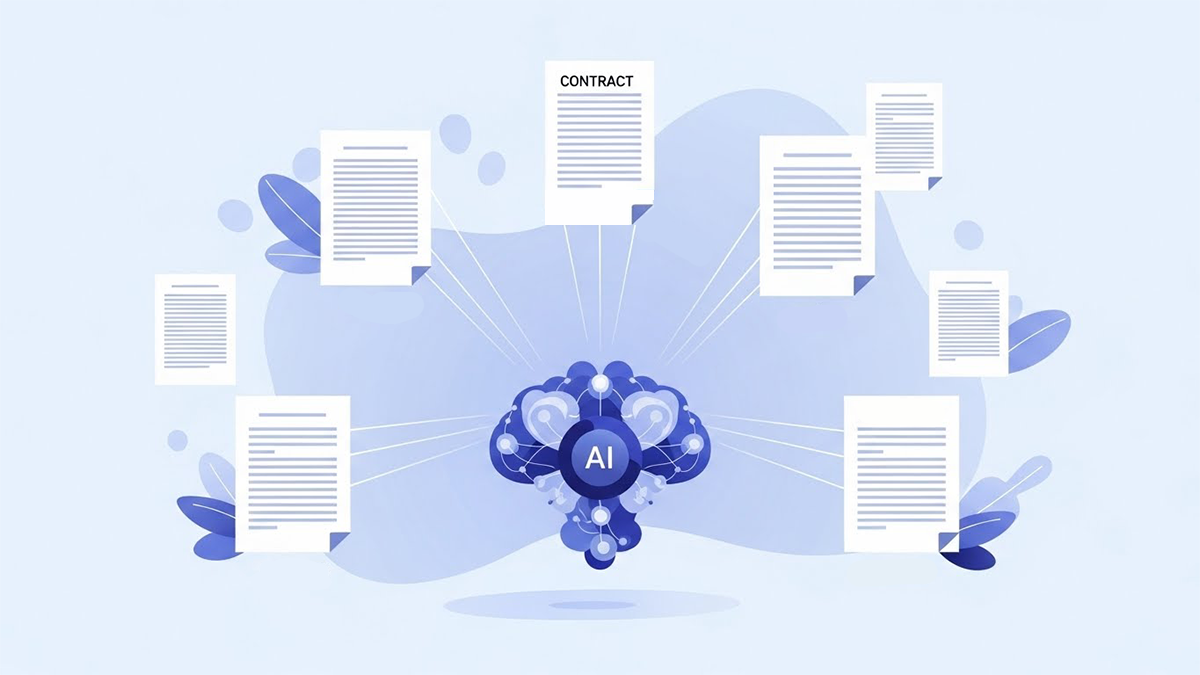
Enterprises track the contract lifecycle end-to-end with AI by turning contracts from static documents into data-driven, continuously monitored assets-across request, drafting, review, negotiation, signing, storage, and renewals. An AI-native platform like Legitt AI (www.legittai.com) connects these stages into a single, intelligent workflow, so every contract is visible, searchable, and measurable from inception to expiry. Instead of siloed tools and manual tracking, AI provides real-time visibility, risk insights, and automated actions at each step of the lifecycle.
This article explains what “end-to-end contract lifecycle tracking” really means, how AI plugs into each stage, and how enterprises can practically implement an AI-powered CLM (Contract Lifecycle Management) model. We will look at the full journey-Request → Draft → Review → Negotiate → Approve → Sign → Store → Monitor → Renew/Amend-and then finish with 10 detailed FAQs.
1. What Does “End-to-End Contract Lifecycle” Actually Mean?
For most large organizations, contracts don’t fail at a single point-they fail in the gaps between systems and teams. Legal drafts in Word. Sales and procurement communicate over email. E-sign happens in a separate tool. Signed contracts live in shared drives or local folders. Renewals are tracked in spreadsheets that quickly go stale.
“End-to-end” means:
- Every stage-from intake to post-signature obligations-is mapped and systematized.
- Data flows forward and backward between those stages.
- The enterprise can answer at any time:
- What contracts do we have?
- Where is each contract in its lifecycle?
- What risks and obligations exist, and how are we performing against them?
AI enables this by:
- Reading and understanding contracts at scale.
- Enforcing workflows and approvals based on rules and risk.
- Extracting and updating key terms as business conditions change.
- Generating alerts, dashboards, and recommendations across the portfolio.
Platforms like Legitt AI (www.legittai.com) are designed specifically to manage this lifecycle, rather than just one piece like drafting or e-signature.
2. Stage 1 – AI-Powered Intake and Request Management
The lifecycle starts when someone says: “We need a contract.” In a large enterprise, this could be sales, procurement, HR, finance, or operations. Without structure, this quickly devolves into email chaos and inconsistent processes.
2.1 Smart intake forms and routing
AI helps by:
- Providing guided intake forms that capture the purpose, counterparty, value, jurisdiction, and risk indicators.
- Using this information to automatically classify the request (NDA, MSA, SOW, vendor contract, DPA, HR letter, etc.).
- Routing the request to the correct team and workflow (sales ops, legal, procurement) based on rules.
2.2 Auto-linking to systems of record
An AI-native CLM like Legitt AI (www.legittai.com) can pull deal details from CRM, supplier data from ERP/procurement, and employee information from HRIS. This ensures:
- No double entry of basic data.
- Contract context is consistent with core business systems.
- Each request is linked to an opportunity, vendor, or employee from day one.
This first stage is where enterprises define the “contract DNA” that AI will use throughout the lifecycle.
3. Stage 2 – Drafting: From Templates and Clause Libraries to AI-Generated Contracts
Once a request is created, the next question is: “What contract do we send?” AI transforms this from a manual Word exercise into a structured, policy-driven workflow.
3.1 Template and clause selection
Instead of hunting for old files, enterprises maintain:
- Standardized templates for major contract types.
- A controlled clause library with approved variants (liability, IP, data, SLAs, etc.).
- Jurisdiction-, product-, and segment-specific configurations.
AI uses the intake data to:
- Pick the correct template.
- Select appropriate clause variants based on risk and geography.
- Auto-fill known variables (names, addresses, pricing, terms) from CRM/ERP/HR.
3.2 AI-native editor and in-line assistance
Within an AI-native editor (as offered by Legitt AI (www.legittai.com)), users can:
- Ask AI to propose language for bespoke sections, but within guardrails.
- See suggestions for aligning language with internal playbooks.
- Get inline explanations and risk flags for key clauses.
The result is a first draft that is faster, more consistent, and already closer to policy-compliant than ad hoc drafting.
 Hi, What do you want to Draft?

Click to upload or drag & drop
pdf, docx up to 5 MB
Click to upload or drag & drop
pdf, docx up to 5 MB
4. Stage 3 – Review, Negotiation, and Approval: AI as a Co-Pilot
Internal review and external negotiation are where most cycle time is lost-and where risk creeps in. AI addresses both.
4.1 Internal review and risk scoring
AI supports internal reviewers by:
- Comparing drafts to standard templates and highlighting deviations.
- Assigning a risk score based on specific clause changes (uncapped liability, unusual indemnity, extended SLAs, etc.).
- Summarizing the key differences between versions for busy approvers.
Approvals (legal, finance, security, leadership) are recorded in the same system, building a complete internal approval audit trail.
4.2 External negotiation inside the platform
Rather than emailing Word documents, external parties can:
- Redline contracts in a secure, shared workspace.
- Add comments, propose alternates, and accept/reject changes.
AI then:
- Categorizes requested changes by severity and topic.
- Suggests fallback language from the clause library.
- Flags changes that breach playbook or policy thresholds and require uplifted approval.
This allows enterprises to track who changed what, when, and why across multiple negotiation rounds, all tied to the same contract record.
5. Stage 4 – Execution: AI-Orchestrated E-Sign and Evidence
When the contract is ready, it must be signed correctly and traced properly. AI helps ensure the right people sign, in the right order, with the right assurance level.
5.1 Signature routing and sequencing
Using deal metadata and risk rules, AI can:
- Determine which internal roles must sign or approve (sales, legal, CFO, etc.).
- Define signing order (internal approvals → external signer → counter-signature).
- Select the appropriate signature type (standard e-signature vs higher-assurance digital signature if required).
A platform like Legitt AI (www.legittai.com) can automatically create the signing envelope, place fields, and route documents without manual setup every time.
5.2 Certificates, audit trail, and evidence package
AI-native CLM systems automatically generate:
- Certificates of completion summarizing who signed, when, and how.
- Detailed audit trails of all events: invites, views, authentication, signatures.
- Full evidence packages that combine executed documents, logs, and technical metadata.
These artifacts become part of the contract record, ensuring enterprises have defensible evidence for audits, disputes, and regulatory inquiries.
6. Stage 5 – Repository and Search: Turning Contracts into Data
Once signed, most enterprises historically “lose sight” of contracts-storing them in shared drives with limited structure. AI changes this fundamentally.
6.1 Central contract repository
An end-to-end system maintains a central repository where:
- Every fully executed contract is stored in a secure, access-controlled environment.
- Contracts are indexed by party, type, region, owner, and other attributes.
- Permissions and access are granular and auditable.
6.2 AI-powered extraction and search
AI reads each contract and automatically extracts key fields:
- Commercial terms: fees, discounts, payment terms, minimum commitments.
- Risk terms: liability caps, indemnities, termination rights, data protection.
- Operational terms: SLAs, deliverables, milestones, timelines.
- Lifecycle terms: effective dates, renewal windows, notice periods.
With this metadata, enterprises can:
- Search “show me all contracts with auto-renewal and 90-day notice.”
- Filter contracts by risk level or unusual clauses.
- Quickly locate obligations for a specific customer, vendor, or product line.
Platforms like Legitt AI (www.legittai.com) are built around this contracts-as-data paradigm, making repository insights accessible to legal, finance, sales, procurement, and HR.
7. Stage 6 – Post-Signature Monitoring: Obligations, Risks, and Renewals
The real business value of contracts appears after signature-through revenue, cost, risk, and relationships. AI ensures nothing falls through the cracks.
7.1 Obligations and SLA tracking
AI can:
- Identify obligations (deliverables, reports, service levels, audits) in contracts.
- Map them to internal owners and systems (delivery teams, support, finance).
- Trigger reminders, tasks, or workflows ahead of deadlines.
For example, AI can alert:
- Customer success before a renewal window.
- Operations before a key implementation milestone.
- Security before an audit or certification commitment comes due.
7.2 Revenue, cost, and risk analytics
With contract data in one place, enterprises can:
- Analyze revenue by contract type, region, or commercial model.
- Spot revenue leakage (discounts or price caps not aligned with policy).
- Identify clusters of risky clauses (uncapped liability, problematic termination rights).
- Compare vendor agreements to standard positions to see where the organization has over-accepted risk.
Legitt AI (www.legittai.com) can surface these insights through dashboards, alerts, and even AI-driven narratives (“Top 10 risks in your vendor contracts portfolio”).
7.3 Renewals and amendments
AI tracks key lifecycle dates and:
- Notifies owners well before auto-renewal or expiry.
- Suggests renewal strategies (price uplift, scope changes, consolidation of vendor or customer agreements).
- Supports generation of renewal amendments directly from the existing contract record.
Enterprises move from reactive, spreadsheet-driven renewals to proactive, AI-orchestrated lifecycle management.
8. Building an AI-Powered CLM Operating Model
Technology alone does not deliver end-to-end tracking; enterprises must adapt processes and governance.
8.1 Standardize templates and clause libraries
- Rationalize existing templates into a controlled, versioned library.
- Build clause libraries with clear guidance on when each variant may be used.
- Use AI to analyze legacy contracts and inform what “standard” should be.
8.2 Define workflows and policies
- Map roles and responsibilities across departments.
- Codify approval thresholds and risk rules.
- Decide which contract types use which signature methods and which post-signature monitoring rules.
8.3 Integrate systems and data
- Connect CLM with CRM, ERP, HRIS, procurement, and finance.
- Ensure that contract data flows both into and out of these systems.
- Align IDs and references so every contract is linked to the correct customer, vendor, or employee.
8.4 Measure and iterate
Use AI-driven analytics to track:
- Cycle time per stage (intake → sign).
- Deviation rates from standard clauses.
- Renewal performance and revenue realization.
- Contract-related dispute frequency and root causes.
Platforms like Legitt AI (www.legittai.com) provide the tooling; the enterprise provides governance and continuous improvement.
Read our complete guide on Contract Lifecycle Management.
FAQs
What is the biggest difference between AI-powered CLM and traditional contract management?
Traditional contract management focuses on storing documents and maybe tracking a few dates. AI-powered CLM treats contracts as living, data-rich objects that are created, negotiated, signed, and monitored in one unified system. The enterprise can see where every contract is in its lifecycle, what it contains, what risks it carries, and how it is performing, rather than just knowing “we have a signed PDF somewhere.”
Do we need to standardize all our contracts before using AI for lifecycle tracking?
You do not have to be perfect on day one, but standardization significantly improves results. AI can help by analyzing your existing portfolio and clustering similar contracts and clauses to inform your template strategy. Many enterprises start with a small set of prioritized templates (for example, NDAs, sales MSAs, key vendor agreements) and gradually standardize more categories. Using an AI-native platform like Legitt AI (www.legittai.com) accelerates this process by combining analysis, drafting, and governance capabilities.
How does AI know when a contract is stuck in the lifecycle?
AI monitors workflow events and timestamps across the lifecycle-request creation, drafting, internal review, external negotiation, signing, and post-signature tasks. By learning typical timeline patterns for similar contracts, it can identify when a particular agreement has been in a stage “too long” relative to benchmarks. It can then alert owners, suggest escalations, or surface likely root causes (for example, specific clauses frequently contested by counterparties).
What role do humans still play if AI manages the lifecycle end-to-end?
Humans remain responsible for strategy, judgment, and exception handling. Legal, sales, procurement, and HR define templates, clause libraries, workflows, and policies. AI then automates the execution of those rules and surfaces issues and opportunities. People still handle complex negotiations, critical risk decisions, and relationship management; AI handles repetitive tasks, monitoring, and data crunching that would be impossible to do manually at scale.
Can AI handle contracts in multiple languages and jurisdictions?
Yes, modern AI models are increasingly capable across many major languages, and AI-native platforms can be configured with jurisdiction-specific templates and clause libraries. For global enterprises, you can maintain different template families per region (for example, US, EU, UK, Middle East) and allow AI to choose the right one based on intake data. You still need local legal expertise to design those templates and rules, but AI can then apply them consistently across the lifecycle.
How secure is contract data in an AI-driven CLM system?
Security depends on the platform and how it is implemented. An enterprise-ready system like Legitt AI (www.legittai.com) uses encryption in transit and at rest, strict access controls, role-based permissions, audit logging, and data segregation between customers. Enterprises can also integrate with SSO/IdP systems, enforce strong authentication, and define granular access policies by geography, business unit, or contract category. AI operates inside this secure environment; it does not circumvent security controls.
How long does it typically take to implement AI-based lifecycle tracking in a large enterprise?
Timelines vary, but a practical approach is to phase implementation. Many organizations can get a first use case (for example, sales NDAs and MSAs) live in a few weeks to a few months, including template setup, workflows, and integrations with CRM and e-sign. Expanding to procurement, HR, and specialized agreements takes longer and should be done iteratively. The key is to treat this as an operational transformation, not just an IT project, with clear ownership and change management.
What KPIs should we track to measure success of AI-driven contract lifecycle management?
Common KPIs include:
• Average cycle time from request to signature by contract type.
• Percentage of contracts using standard templates and clauses vs bespoke.
• Number and severity of deviations from playbook positions.
• Renewal capture rate and reduction in unintended auto-renewals or lapses.
• Volume and impact of contract-related disputes or escalations.
• User satisfaction among legal, sales, procurement, and business stakeholders.
Over time, enterprises using platforms like Legitt AI (www.legittai.com) often see significant improvements across these metrics.
Can small and mid-sized enterprises benefit from AI lifecycle tracking, or is this only for large enterprises?
Small and mid-sized organizations can benefit just as much-and sometimes more-because they typically lack dedicated contract ops teams. AI-powered CLM gives them enterprise-grade capabilities without building large back-office functions. They can start with a limited scope (for example, customer contracts and vendor agreements) and scale as they grow. The same underlying principles-templates, clause libraries, workflows, and analytics-apply regardless of company size.
What are the biggest pitfalls enterprises face when rolling out AI-based CLM, and how can we avoid them?
Common pitfalls include:
• Treating CLM as a “tool swap” rather than a process and governance redesign.
• Under-investing in template and clause standardization.
• Failing to integrate with CRM, ERP, and HR systems, causing data silos.
• Ignoring change management and training, leading to low adoption.
To avoid these, enterprises should:
• Establish a cross-functional CLM steering group (legal, sales, procurement, finance, IT).
• Start with a clear, high-impact use case and measurable goals.
• Choose an AI-native platform like Legitt AI (www.legittai.com) that can grow with their needs.
• Iterate based on data and feedback, expanding scope only when early stages are working well.