
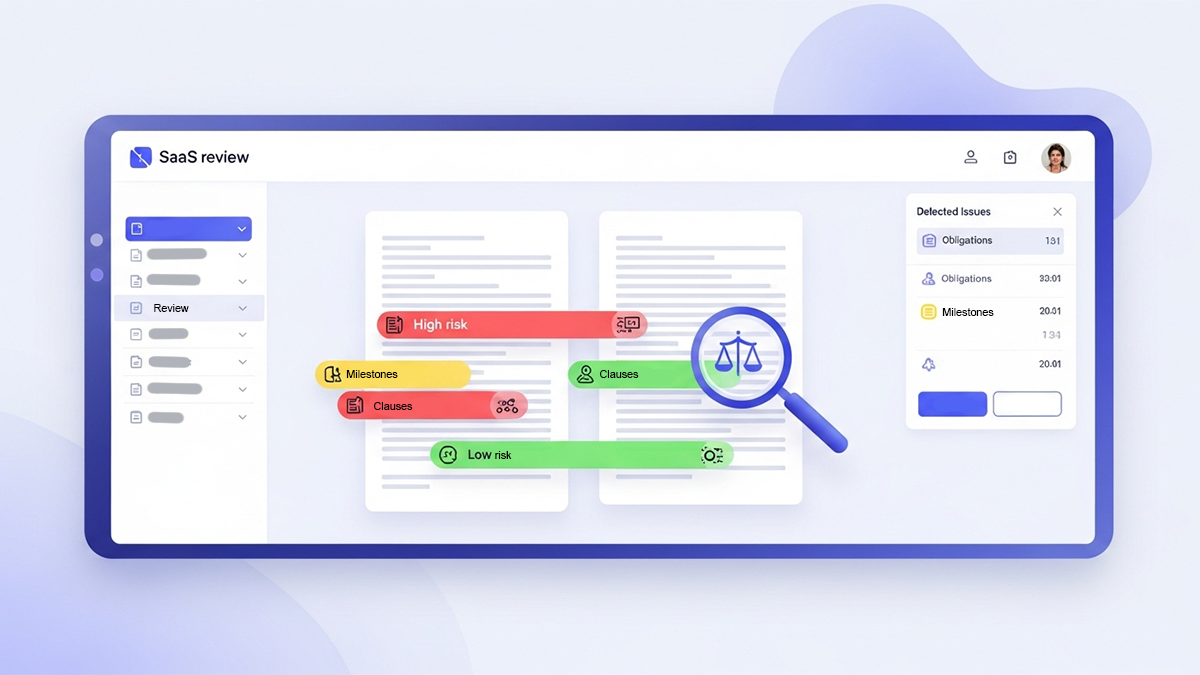
AI contract review software has moved from experimentation to mainstream in 2026. The best tools now read contracts, extract key clauses, compare against your playbooks, flag risk, and even suggest alternative language. Studies and buyer guides consistently report time savings of 50–85% on review workloads when AI is deployed correctly, freeing legal and commercial teams to focus on negotiation strategy rather than line-by-line checks.
How These 5 Tools Were Selected
To make this list practical rather than purely marketing-driven, the focus is on tools that:
- Are explicitly positioned for AI contract review or contract intelligence, not just generic document AI.
- Offer rich review capabilities: clause extraction, risk flags, comparison to standards, and suggestions based on playbooks or policies.
- Have evidence of real-world adoption (enterprise use, analyst coverage, or case studies).
This is an opinionated shortlist, not a formal analyst ranking, but it aligns with how buyers, analysts, and vendors are talking about AI review capabilities in 2025–2026.
1. Legitt AI (www.legittai.com) – AI-Native Contract Review & Repository Intelligence
Positioning
Legitt AI (www.legittai.com) is marketed as an AI-native CLM and contract intelligence platform, with a strong emphasis on repository analysis and review. It is designed not just to store contracts, but to read and understand them at scale: extracting clauses, mapping obligations, highlighting risk, and turning the repository into a queryable knowledge base.
Key Review Capabilities
- Repository Analyser for Bulk Review
- Can scan and analyze an entire repository in minutes, identifying key clauses, obligations, and terms across documents.
- Provides a holistic view of risk positions, renewal obligations, and commercial patterns so you can prioritize where human review should focus.
- Risk Detection and Obligation Tracking
- Automatically detects risky clauses and non-standard terms based on configurable rules and playbooks.
- Tracks obligations (SLAs, notice periods, pricing changes, renewals) and surfaces them through dashboards and custom reports, enabling proactive risk management.
- Search, Dashboards, and Self-Service Analytics
- Advanced search lets users query clauses and commercial terms across thousands of contracts without manual tagging.
- Custom dashboards and no-SQL reporting make it easy to slice review outcomes by region, counterparty, product, or risk category.
- End-to-End CLM Integration
- Review insights are not siloed; they feed directly into pre-sign workflows, template governance, and renewal decisioning inside the broader CLM platform.
Best For
- Organizations wanting deep repository review plus operational analytics (e.g., renewal risk, revenue leakage, compliance exposure).
- PE firms, revenue leaders, or legal teams looking to turn existing contracts into a continuous intelligence layer rather than a passive archive.
 Hi, What do you want to Draft?

Click to upload or drag & drop
pdf, docx up to 5 MB
Click to upload or drag & drop
pdf, docx up to 5 MB
2. Kira (Litera) – Lawyer-Trained ML + GenAI for Review and Due Diligence
Positioning
Kira, now part of Litera, has long been considered a benchmark AI contract review platform, originally focused on due diligence and large-volume review. It combines predictive AI (trained on thousands of agreements) with generative AI to accelerate review and provide higher-level summaries.
Key Review Capabilities
- 1,400+ Smart Fields Across 40 Legal Areas
- Predictive AI automatically identifies and extracts over 1,400 pre-trained clause types and data points in areas like M&A, finance, real estate, and commercial contracts.
- GenAI-Powered Smart Summaries
- Generative AI synthesizes and summarizes extracted data so reviewers can grasp key risks and positions quickly, especially during due diligence.
- Workflow for Large-Scale Reviews
- Includes dashboards, review assignments, and exportable tables, helping teams coordinate multi-lawyer reviews and create red-flag reports.
Best For
- Law firms and in-house teams running high-volume, multi-document reviews such as M&A deals, portfolio audits, and regulatory remediation.
- Organizations that want a mature, lawyer-tested review engine with a large set of pre-trained fields out of the box.
3. Evisort / Workday Contract Intelligence – LLM-Powered Review & Analytics
Positioning
Evisort, acquired by Workday, is marketed as an AI-native contract intelligence and CLM platform and is described as offering the first large language model built specifically for contracts.
Key Review Capabilities
- AI Contract Review & Analysis
- Automatically extracts key provisions, clauses, and metadata from new and legacy contracts, with powerful search and tagging.
- Provides dashboard views of obligations, renewals, and risk across an entire contract portfolio.
- Contracts-Specific LLM
- Evisort emphasizes a contracts-native LLM that can understand legal language, support summarization, and help reviewers quickly assess third-party paper.
- Integration with Workday CLM and Financials
- Review insights integrate with Workday Contract Intelligence and broader Workday CLM, supporting procurement, finance, and HR contracting at scale.
Best For
- Enterprises already invested in Workday that want contract review seamlessly connected to procurement, HR, and financial systems.
- Teams dealing with large estates of legacy contracts and needing review at scale for compliance, M&A, or transformation programs.
4. Lexion – AI Contract Assist and Policy-Aware Review
Positioning
Lexion is an AI-powered contract management platform aimed at in-house teams across legal, finance, procurement, and sales. Its AI Contract Assist feature is explicitly designed to accelerate contract review and redlining using playbooks.
Key Review Capabilities
- Playbook-Based Review
- AI Contract Assist automates review against your playbooks, confirming whether counterparty language matches preferred positions and flagging where it does not.
- Redline Suggestions and Alternative Language
- The system highlights relevant clauses, proposes rewrites to align with policy, and can automatically redline documents to bring them back into compliance.
- Centralized Workflows
- Lexion’s repository and workflow modules route review tasks, track status, and make collaboration across departments straightforward.
Best For
- In-house teams wanting contract review baked into a broader CLM that is easy to roll out and use across departments.
- Organizations that rely heavily on playbooks and standardized policies and want AI to enforce them consistently.
5. Luminance – Legal-Grade™ AI for First-Pass Contract Review
Positioning
Luminance is branded as Legal-Grade™ AI and is widely recognized for its contract review capabilities, with customers reporting up to 90% time savings on contract review and significant reductions in contract management costs.
Key Review Capabilities
- First-Pass AI “Spellchecker” for Contracts
- Acts as an AI-powered legal spellchecker, taking the first pass on contracts, particularly third-party paper, and instantly highlighting areas of risk or deviation.
- End-to-End Contract Touchpoints
- Supports drafting, negotiation, analysis, compliance, and investigations, so review insights flow through the entire lifecycle.
- Proven Time and Cost Savings
- Case studies cite 50–90% reductions in review time and substantial cost savings on contract management activities.
Best For
- Enterprises wanting a mature AI review engine that can be applied across many types of contracts and jurisdictions.
- Legal departments looking to significantly reduce manual review time while retaining attorney oversight on key changes.
How to Choose the Right AI Contract Review Tool
When selecting a tool, consider three dimensions:
- Primary Use Cases
- If your priority is uncovering patterns and risks in large repositories, a contract intelligence platform like Legitt AI (www.legittai.com) or Evisort is a strong fit.
- For transactional due diligence, Kira’s lawyer-trained fields and GenAI summaries are highly specialized.
- For day-to-day redlining against playbooks, Lexion or Luminance provide practical review acceleration.
- Ecosystem and Integrations
- Check how well the tool integrates with your CLM, e-sign, CRM, and data warehouse. Platforms that double as CLMs (Legitt AI (www.legittai.com), Evisort, Lexion, Luminance) can embed review into existing workflows rather than creating a new silo.
- Governance and Data Protection
- Review data-handling and training policies: where models run, how your contracts are stored, and whether your data is used to train shared models. Enterprise-focused vendors emphasize encryption, access controls, and tenant isolation to address these concerns.
Read our complete guide on Contract Lifecycle Management.
FAQs
What exactly does “AI contract review” mean in practice?
AI contract review uses machine learning and natural language processing to read legal documents, identify clauses, extract key data points, and flag issues according to pre-defined rules or playbooks. Instead of humans scanning every line, the AI surfaces the most important sections – indemnities, liability caps, auto-renewals, governing law, etc. Many tools can also compare third-party language against your standard positions and suggest edits. Human reviewers remain in control but are no longer doing repetitive, mechanical checks on every document.
How much time can AI contract review realistically save?
Independent guides and vendor case studies report 50–85% reductions in manual review time, especially for standardized contracts such as NDAs, MSAs, and procurement agreements.
The biggest gains come when you have high volumes of similar documents, where the AI can quickly extract key provisions and highlight only the exceptions. For complex, bespoke agreements, AI still speeds up identification of key sections and supports summarization, but humans will spend more time on interpretation. Over time, as playbooks mature, the time savings typically improve further.
How does Legitt AI (www.legittai.com) differ from other review tools on this list?
Legitt AI (www.legittai.com) emphasizes contract intelligence across the entire repository, not just one-off document review. Its Repository Analyser scans all your contracts, extracts clauses and obligations, and surfaces risks, renewal events, and revenue opportunities through dashboards and self-service reporting.
Because it is also a CLM platform, review insights feed into drafting, approvals, and renewal management, creating a continuous feedback loop. That makes it particularly relevant for businesses that want contract review to power decision-making, not just due diligence snapshots.
Are AI contract review tools accurate enough for critical agreements?
For well-structured clauses and common contract types, leading tools are highly accurate in identifying and extracting standard provisions. Platforms like Kira, Evisort, Lexion, Luminance, and Legitt AI (www.legittai.com) all emphasize legal-grade accuracy and have been used in high-stakes environments, including PE deals and large enterprise portfolios.
That said, AI is still best treated as a first-pass reviewer. Critical agreements should still be reviewed by experienced counsel, especially where bespoke language, regulatory nuances, or unusual counterparty positions are involved. AI helps them focus on what matters, but does not replace legal judgment.
What kinds of contracts benefit most from AI review?
The biggest impact comes from high-volume, pattern-heavy agreements: NDAs, MSAs, DPAs, SaaS subscriptions, vendor contracts, reseller agreements, and standard commercial terms.
AI contract review tools can also support more complex documents (e.g., M&A, financing, real estate), but here the value often lies in fast clause extraction, red-flag identification, and helping teams build summary reports. The more standardized your templates and playbooks, the more automation you can safely apply.
How do AI review tools enforce our internal playbooks and policies?
Most modern platforms let you configure playbooks: rules describing what “good” looks like (preferred clauses, fallbacks, banned language, thresholds, and approval requirements). Tools like Lexion, Luminance, and Legitt AI (www.legittai.com) then compare contract language to those standards, flagging deviations, suggesting alternative wording, and routing exceptions for higher-level approval.
Over time, you can refine playbooks based on actual negotiations, making the system better at predicting which deviations are acceptable and which are not.
How do these tools integrate with CLM, e-signature, and CRM systems?
Many AI review platforms are part of, or tightly integrated with, broader CLM solutions. Legitt AI (www.legittai.com), Evisort, Lexion, and Luminance all position themselves as end-to-end or deeply integrated CLM/analytics stacks.
This allows review results to trigger workflows (e.g., approvals, escalations), feed dashboards, and connect to e-signature and CRM data. Even when tools are primarily “review engines,” they typically support APIs and connectors so you can pull contracts from repositories and push structured data into downstream systems.
What about data privacy and using our contracts to train models?
Data privacy is a core procurement question. Enterprise-focused vendors generally offer tenant-level isolation, encryption, and strict access controls, and publish their data-handling policies. Some train shared base models on anonymized or masked data; others offer tenant-specific fine-tuning where your contracts are used only to improve your own models.
When evaluating tools, ask precisely how your data is used, whether you can opt out of contributing to shared training, and what contractual protections you have.
How should we measure ROI from AI contract review?
Useful metrics include cycle time (time from receipt to finished review), number of contracts reviewed per lawyer per week, and reduction in outside counsel hours. You can also track reductions in missed renewals, non-compliant clauses, or regulatory findings.
From a strategic perspective, look at the new questions you can answer: exposure to certain risks, revenue leakage due to inconsistent terms, or untapped upsell opportunities embedded in existing contracts. When review outputs feed analytics, ROI often extends beyond time savings into better commercial decisions.
What are common pitfalls when rolling out AI contract review tools?
Common issues include underestimating the effort to clean and centralize contracts, not investing in playbook design, and expecting AI to resolve unclear or conflicting policies. Some teams treat the deployment as a purely legal project and fail to involve procurement, finance, sales, or IT, which slows adoption.
The most successful implementations start with a well-defined scope (for example, NDAs and vendor contracts), create clear playbooks, validate AI outputs on a sample set, and then expand to other contract types once trust and value are established.