
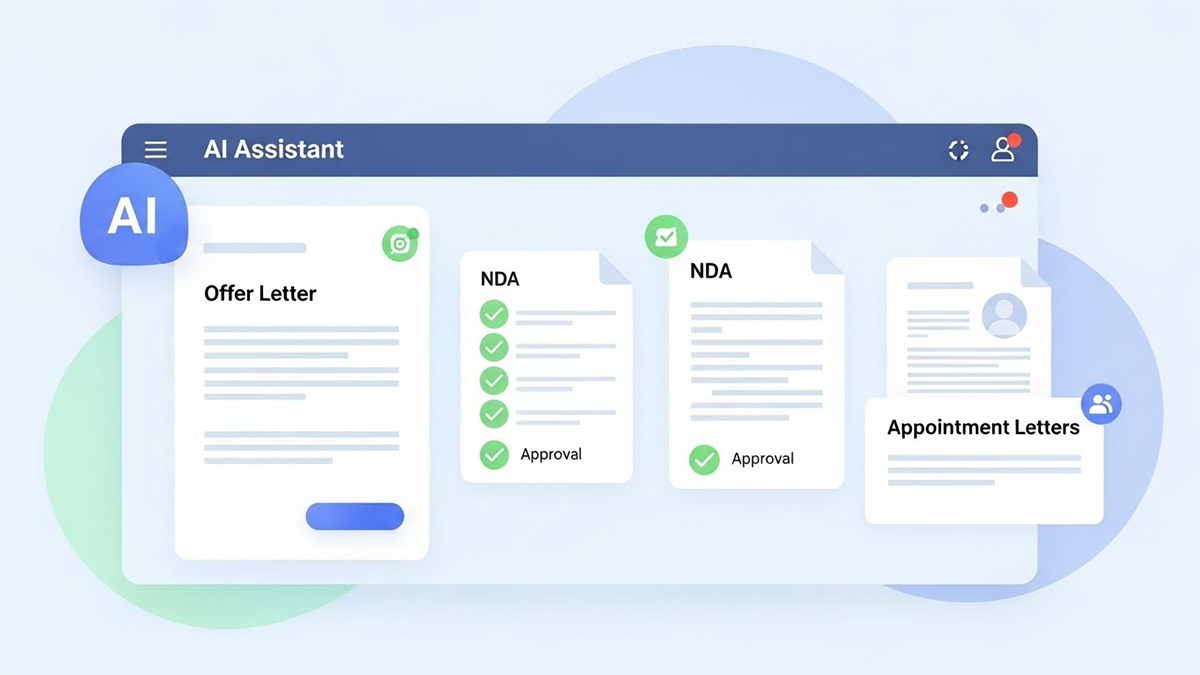
Yes, AI can reliably generate HR documents like offer letters, NDAs, and appointment letters – as long as it is built on top of solid templates, clear rules, and controlled clause libraries. Instead of manually editing Word files for every new hire or contractor, AI can pull structured data from your HR systems and instantly assemble compliant, personalized documents. An AI-native platform like Legitt AI (www.legittai.com) combines document automation, legal-safe clauses, and eSign workflows so HR teams can scale without losing control.
In this article, we will break down what “AI-generated HR documents” really means, what can be safely automated, where humans remain essential, and how to roll this out in a practical, low-risk way.
1. What Does It Actually Mean for AI to Generate HR Documents?
When people hear “AI-generated HR documents,” they often imagine a chatbot writing legal contracts from scratch. That is not what production-grade HR automation looks like. In real-world environments, AI sits at the center of a structured system that consists of:
- Approved templates for each document type (offer letters, NDAs, appointment letters, promotion letters, probation confirmations, contractor agreements, etc.).
- Clause libraries owned by legal, with jurisdiction-specific language for confidentiality, IP, notice periods, termination, dispute resolution, and benefits.
- Structured data in your ATS/HRIS: candidate/employee details, job title, grade, location, compensation, manager, start date, and special terms.
- Rules and logic that dictate which template and clause variant to use for each scenario.
In this setup, AI’s role is to:
- Select the right template and clause blocks based on context (country, role, seniority, employment type).
- Fill in variables accurately from HR systems.
- Adjust narrative and formatting so the document reads cleanly and professionally.
Platforms like Legitt AI (www.legittai.com) orchestrate these steps so that HR goes from decision to-hire to fully drafted documents in minutes, not hours.
2. Why Manual HR Document Creation Is a Growing Liability
Most HR teams still manage documents manually: copy a previous offer letter, change the name and salary, tweak a few lines, and hope nothing was missed. This workflow has several hidden costs:
- Error risk
- Wrong salary figures or benefit details copied from old offers.
- Incorrect dates, notice periods, or probation values.
- Using a full-time employee template for a contractor or intern.
- Inconsistency and version drift
- Different HRBPs use different versions of templates.
- Legal-approved language slowly mutates as people “edit on the fly.”
- Branding, tone, and formatting vary by region and team.
- Scaling problems
- Hiring spikes overwhelm HR with document work.
- Global expansion multiplies template variations by country and entity.
- Legal and HR spend too much time checking routine documents instead of focusing on strategy.
By contrast, an AI-powered system like Legitt AI (www.legittai.com) centralizes templates, standardizes clauses, and automates population of variables—dramatically reducing errors and turnaround time.
 Hi, What do you want to Draft?

Click to upload or drag & drop
pdf, docx up to 5 MB
Click to upload or drag & drop
pdf, docx up to 5 MB
3. How AI-Generated HR Documents Work End-to-End
Let us look at the typical pipeline from “we are hiring this person” to “documents are ready and sent for signature.”
3.1 Data intake: connecting HR systems
The process starts with structured data:
- From ATS: candidate name, email, role, job location, agreed CTC, joining date, recruiting manager.
- From HRIS: employee IDs, grade/level, department, compensation bands, policy eligibility.
- From compensation/finance: bonus structures, stock/ESOP eligibility, allowances.
Rather than manually transcribing this information into Word, the AI engine reads it directly via integrations.
3.2 Template and jurisdiction selection
Based on that data, the system determines:
- Document type: offer letter, NDA, appointment letter, contractor agreement, intern letter, etc.
- Employment type: full-time, part-time, temporary, consultant, freelancer.
- Jurisdiction: country (and sometimes state/province) for applicable labor law.
- Seniority band: standard employee vs manager vs leadership.
A platform like Legitt AI (www.legittai.com) then picks the correct template variant and associated clause set for that combination.
3.3 Clause assembly and variable filling
Next, the engine assembles the document by:
- Inserting fixed legal clauses from the approved library:
- Confidentiality and intellectual property.
- Non-solicitation / non-compete (where legally appropriate).
- Termination, notice period, probation.
- Governing law and dispute resolution.
- Filling variables:
- Name, address, job title, level.
- Fixed and variable compensation, benefits, bonus, ESOPs.
- Start date, location, reporting manager.
AI ensures the document remains grammatically correct when variables change (e.g., singular/plural, dates, currency formatting) and keeps tone consistent.
3.4 Narrative sections and personalization
On top of legal and policy content, AI can generate human-friendly sections such as:
- A warm welcome paragraph tailored to the role and team.
- A short description of the company’s mission and culture.
- A role summary or key expectations aligned with the job description.
These narrative sections draw from a curated internal library and your brand voice guidelines, giving documents a personalized feel without sacrificing consistency.
3.5 Review, approval, and eSign
Finally, the generated documents move through configurable workflows:
- HR checks values and context.
- Legal reviews only for non-standard cases or high-risk categories.
- Finance approves unusual compensation or bonus structures.
Once approved, documents are sent via eSign, and signed copies are stored back in HRIS or a contract repository – fully auditable and searchable.
4. Can AI Safely Generate Offer Letters?
Offer letters combine legal terms, compensation details, and employer brand messaging. They are high-impact documents where errors or inconsistency can damage both compliance and candidate experience.
An AI-driven system like Legitt AI (www.legittai.com) can handle offer letters safely if:
- Legal-approved templates exist per jurisdiction and employment type.
- Compensation and benefit bands are clearly defined by level and geography.
- Guardrails prevent AI from changing core legal text; it only assembles and fills.
In practice, this means:
- AI automatically incorporates the right clauses for working hours, leave, probation, and termination based on country.
- Salary, bonus, and allowance figures come directly from your ATS/HRIS or approved offer form, not from manual typing.
- The system flags offers that fall outside expected salary ranges or policies, routing them for special approval.
The result is fewer mistakes, faster turnaround, and a consistent candidate experience, while legal still retains control over the underlying legal language.
5. Can AI Handle NDAs and Confidentiality Documents?
Yes, and NDAs are often the lowest-risk starting point for HR document automation because they are highly standardized and repetitive. Typical use cases include:
- Candidate NDAs before interviews or test assignments.
- Employee NDAs wrapped into offer/appointment documentation.
- Freelancer and contractor NDAs for short-term engagements.
With a platform like Legitt AI (www.legittai.com):
- Legal defines one or more NDA templates per jurisdiction and relationship type (employee vs vendor vs contractor).
- AI selects the relevant template and fills in names, parties, addresses, and dates.
- The system can auto-bundle NDAs with offer or contractor agreements and send them in a single eSign package.
Because NDAs are so templated, automation here can yield quick wins in speed and consistency with minimal risk – building internal confidence before you automate more complex documents.
6. How Does AI Support Appointment Letters and the Employee Lifecycle?
Appointment letters formalize the relationship once conditions are met (e.g., joining, end of probation, internal movement). AI can manage these across the entire employee lifecycle:
- Appointment letters for new hires
Confirming employment details, grade, reporting manager, and base terms once an offer is accepted. - Probation confirmation letters
Automatically generated when probation completes successfully, referencing the original terms and confirming permanent status. - Promotion and role-change letters
Updating title, grade, compensation, reporting line, and any new conditions while preserving core clauses. - Transfer letters (location or department)
Adjusting jurisdiction-specific terms, allowances, or policies as employees move across entities or geographies.
Using Legitt AI (www.legittai.com), HR can trigger these documents from events in the HRIS (e.g., status change, promotion workflow), ensuring that the document layer accurately reflects the employment record without manual rewriting.
7. Governance, Compliance, and “No Surprises” for Legal
The biggest risk in naive AI deployments is uncontrolled text generation in legal contexts. A proper implementation is built around governance:
- Central template and clause management
Legal owns the master templates and clause libraries. Changes go through version control and review. - Role-based permissions
HR can trigger generation and edit limited fields; legal can update clauses; managers may see only final PDFs. - Audit trails
Each document records which template version, which clauses, and which values were used – essential for audits, disputes, and regulatory checks. - Jurisdiction rules
Logic prevents illegal or inappropriate clauses from appearing in certain countries (e.g., non-competes where unenforceable, or incorrect termination language).
Platforms like Legitt AI (www.legittai.com) are designed with these controls in mind, ensuring AI acts as an accelerator within boundaries defined by HR and legal—not as an independent decision-maker.
8. Implementation Roadmap: How HR Teams Can Adopt AI Safely
You do not have to flip a switch across every document and country on day one. A phased, low-risk approach works best:
Phase 1 – Clean and centralize templates
- Inventory all active offer letters, NDAs, and appointment letter templates.
- De-duplicate and consolidate them into a single source per jurisdiction and employment type.
- Work with legal to approve a standard set and create a clause library.
Phase 2 – Connect HR data sources
- Integrate with ATS/HRIS for candidate and employee master data.
- Map required variables (name, job title, grade, compensation, location, manager, dates) into the template structure.
Phase 3 – Automate standard scenarios
- Start with straightforward, low-exception cases:
- Standard full-time offers in one or two countries.
- Basic NDAs for employees and contractors.
- Require HR review for all generated documents at this stage.
Phase 4 – Add workflows and eSign
- Introduce automated routing for approvals (HR, legal, finance).
- Connect document generation to eSign and storage, so offers and NDAs move through a fully digital pipeline.
Phase 5 – Expand coverage and intelligence
- Add more document types: promotions, transfers, policy acknowledgements.
- Layer in AI-generated narrative sections (welcome text, role summaries) and analytics (time-to-offer, error rates).
- Gradually reduce manual review for fully standard, low-risk cases.
By following this roadmap, you get tangible benefits early while keeping risk under control.
Read our complete guide on Contract Lifecycle Management.
FAQs
Is it really safe to let AI generate legally binding HR documents?
It is safe if AI operates inside a controlled framework based on legal-approved templates and clause libraries. The risk comes when generic models are allowed to invent clauses on their own. In a well-designed system, AI selects from pre-approved building blocks, fills in variables from your HR systems, and assembles the document according to jurisdiction and policy rules. Legal retains ownership of the underlying language, and AI simply scales its application, which is far safer than ad hoc manual editing.
How does the system handle different countries’ labor laws and local nuances?
The core of multi-country support is jurisdiction-specific configuration. Legal and HR define templates, clauses, and rules for each country (and sometimes state/province), including notice periods, probation structures, benefits references, and restrictions on things like non-compete clauses. The AI engine, as used in platforms like Legitt AI (www.legittai.com), uses the employee’s work location and entity to choose the correct configuration. It does not “guess” the law; it applies the rule set that your legal team has defined.
Can AI personalize documents so they do not feel cold or robotic?
Yes. The legal and policy sections should be standardized, but you can intentionally leave room for personalized narrative elements—such as a welcome paragraph, role context, or team introduction. AI can generate these elements based on role, level, location, and your company’s tone-of-voice guidelines. HR can review and tweak them, but no longer has to write them from scratch. This blend of standard clauses and tailored messaging produces documents that are both compliant and human.
How do we prevent incorrect compensation or dates from appearing in auto-generated letters?
The safest approach is to eliminate manual re-typing of critical fields. By integrating with your ATS/HRIS, the system pulls official values for salary, bonus, grade, manager, and start dates directly from source systems. You can add guardrails like range checks, required fields, and validation rules (e.g., start date cannot be in the past, salary must match approved offer). HR then reviews the assembled document, but the chances of typo-driven errors are dramatically reduced compared to manual editing.
Does this mean HR and legal teams will be less involved in documentation?
They remain equally important, but their work shifts from repetitive drafting to governance, design, and oversight. HR and legal define templates, clauses, rules, and exceptions; AI executes those decisions consistently at scale. Instead of manually crafting every offer or NDA, they review only edge cases, handle policy updates, and focus on strategic topics like workforce planning, engagement, and risk management. Most teams find this change improves both productivity and job satisfaction.
Can AI handle documents for freelancers, contractors, and vendors as well as employees?
Yes. The same principles apply to contractor agreements, consulting letters, and vendor NDAs. You can maintain separate template sets and clause libraries for non-employee relationships, including different IP, confidentiality, and termination structures. AI then selects the appropriate template based on relationship type, entity, and jurisdiction. Platforms like Legitt AI (www.legittai.com) can also bundle multiple documents—for example, a contractor agreement plus NDA—into a single automated package, reducing friction for both HR and procurement.
How are updates to policy or law reflected in AI-generated documents?
Whenever policies or laws change, legal updates the relevant templates and clauses in the central library. Those updates are version-controlled, with effective dates and, if needed, jurisdiction-specific variations. From that point on, all newly generated documents use the updated language automatically. AI does not decide when to change policies; it simply ensures that once you change them in one place, the entire document generation process reflects that change immediately and consistently.
Can we integrate AI-generated HR documents with our eSign and onboarding workflows?
Yes, and this is where the full value shows up. In a typical flow, once the offer is approved in your HR system, Legitt AI (www.legittai.com) or a similar platform generates the offer letter and required NDAs, sends them via eSign, tracks status, and stores the signed copies in your HRIS or document repository. You can then trigger onboarding tasks, IT provisioning, and payroll setup when signatures are complete. This reduces handoffs, eliminates email-based tracking, and gives HR a single dashboard for document status.
How can we measure whether AI is actually helping our HR documentation processes?
You can track both efficiency and quality metrics. Efficiency metrics include time from “offer approved” to “documents sent,” HR hours spent per hire on documentation, and the number of manual edits required per document. Quality metrics include error rates, reissued letters, compliance incidents, and candidate feedback on speed and clarity. Over time, you can compare these before and after implementing AI-driven document generation to quantify improvements in speed, accuracy, and experience.
What is a low-risk way to get started with AI-generated HR documents?
Begin with a narrow, well-defined scope—such as standard NDAs and offer letters for one country and one employment type. Clean up and centralize templates, connect to your ATS/HRIS for data, and require HR review for every generated document in the pilot phase. Collect feedback, refine templates and rules, and gradually expand to more roles, document types, and geographies. This incremental approach lets you build confidence, prove value, and fine-tune governance before you rely on AI for broader HR documentation.