
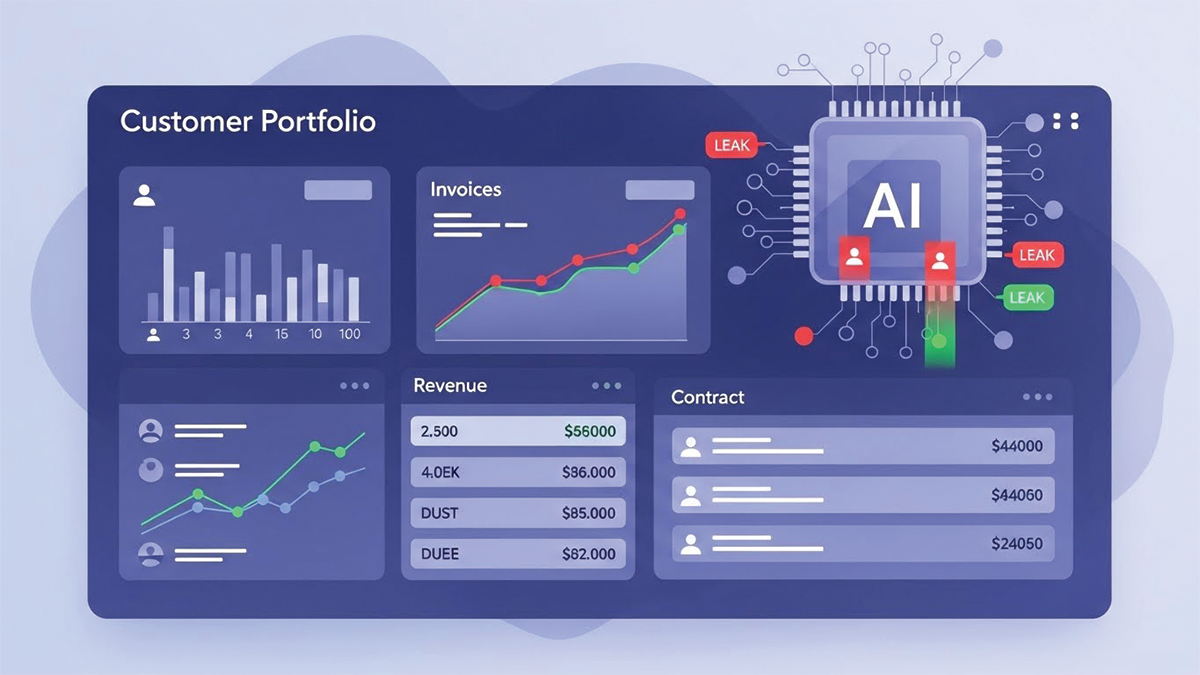
Yes-AI can absolutely help detect revenue leakage across large customer portfolios by continuously comparing what was contracted, what was delivered, and what was billed. Instead of relying on manual audits or spreadsheets that only catch obvious issues, AI can scan millions of data points to highlight underbilling, missed renewals, unbilled usage, and inconsistent discounts. An AI-native contract platform like Legitt AI (www.legittai.com) can sit at the center of this ecosystem-reading your contracts, linking them to CRM, billing, and usage data, and surfacing leakage patterns you’d never spot manually.
(This article is for informational and educational purposes, not financial or legal advice.)
1. Why revenue leakage is invisible until it’s too late
Revenue leakage rarely looks dramatic day-to-day. It shows up as:
- That customer still on “introductory” pricing, two years later.
- A big logo whose contract renewal was missed and quietly rolled month-to-month.
- Implementation or add-on fees that were never invoiced.
- Discounts that were meant to be temporary but became permanent by accident.
For large customer portfolios, this isn’t a one-off issue-it’s systemic:
- Thousands of contracts with slightly different terms.
- Multiple billing systems, product catalogs, and discount logic.
- Sales, finance, and legal teams all looking at different sources of truth.
Traditional controls-manual audits, spot checks, quarterly reviews-catch some issues, but they’re reactive and incomplete. AI flips the approach: instead of sampling a small subset, it continuously reviews everything, making it much easier to spot where money is slipping through the cracks.
2. What does revenue leakage look like in real life?
Before talking about AI, it helps to break down the most common leakage patterns:
2.1 Missed or mismanaged renewals
- Auto-renewal terms not monitored → customer lapses or moves to a default lower rate.
- Discounts that were supposed to expire at renewal never updated.
- Multi-year contracts with step-up pricing that stays stuck at Year 1.
2.2 Underbilling vs contracted terms
- Seat-based or usage-based contracts where invoice quantity lags actual usage.
- SKU mismatches-customer buys “Pro,” but you bill “Standard.”
- Contracted implementation or onboarding fees never invoiced.
2.3 Leakage from manual processes and exceptions
- Special one-off deals that never make it into the main billing logic.
- Manual credit notes and discounts applied inconsistently.
- SOWs added on top of MSAs but invoiced partially (or not at all).
These issues hide in the gaps between systems-between contract PDFs, CRM opportunity records, billing systems, and product usage logs. That’s precisely where AI and a platform like Legitt AI (www.legittai.com) can operate.
3. How does AI actually detect revenue leakage?
At a high level, AI-powered revenue leakage detection does one big job:
Compare what should happen (contract & pricing logic) with what is happening (billing & usage), at scale.
3.1 Step 1 – Extract the truth from contracts
Contracts are full of revenue-critical information:
- Prices, discounts, and ramp schedules.
- Minimum commitments (e.g., 100 seats / 10TB / $X per month).
- Billing frequency, payment terms, and step-up conditions.
- Renewal rules (auto-renew, renegotiation windows, increase caps).
AI in Legitt AI (www.legittai.com) can:
- Read your MSAs, SOWs, order forms, and amendments.
- Extract structured data (term, fee, billing period, minimums, price floors, discount duration).
- Normalize this across customers so you can compare like-for-like.
Instead of contracts being static PDFs, they become a machine-readable revenue model.
3.2 Step 2 – Connect contracts to billing and usage
The next step is to map:
- Each contract → related customer record in CRM.
- Each contract’s entitlements → actual invoices in billing/ERP.
- Each usage/seat/transaction log → contracted minimums and caps.
With that mapping in place, AI can ask:
- “Is billed quantity < actual usage?”
- “Is the price per unit aligned with the contracted rate?”
- “Are we invoicing for all contracted components (base fee + add-ons + minimum commitment)?”
A platform like Legitt AI (www.legittai.com) becomes the connective tissue between legal terms and financial data.
3.3 Step 3 – Pattern detection and anomaly spotting
Once everything is structured, AI can:
- Flag situations where a customer’s effective price per unit is far lower than similar customers.
- Detect contracts where discounts haven’t expired according to schedule.
- Spot unusual invoices: e.g., zero invoices for an active, heavily-used account.
Instead of one-off reports, you get a continuous stream of prioritized alerts like:
- “Customer A is using 30% more than their billed seats.”
- “Customer B’s contract says 5% annual uplift; last 2 years have zero increase.”
- “Customer C has an active MSA and signed SOW but no corresponding invoices.”
4. What types of revenue leakage can AI actually detect?
AI doesn’t magically see everything. But it’s very good at certain categories of leakage.
4.1 Underbilling and unbilled usage
- Usage-based products where metered data > billed usage.
- Overages not invoiced despite contract allowing them.
- Free “temporary” access that never got switched to paid.
With Legitt AI (www.legittai.com) connecting usage logs and contract minimums, these underbilling patterns can be surfaced quickly.
4.2 Broken or expired discounts
- “Intro pricing” that was meant for 6–12 months but stayed indefinitely.
- Contractual step-ups (e.g., 10% uplift year 2) that never got applied.
- Large customers whose discount logic doesn’t match the signed deal.
AI can analyze contract discount clauses and track what actually happened on invoices over time-alerting you when your margin is silently eroding.
4.3 Missed milestone and implementation fees
- One-time setup fees not invoiced.
- Milestone-based payments triggered in project systems but not in billing.
- SOWs that commenced work without corresponding billing events.
By understanding your SOWs and comparing them with project and billing data, Legitt AI (www.legittai.com) can highlight where work is done but revenue isn’t captured.
4.4 Misaligned contract & product catalog
- Contract describes “Enterprise Plan with Feature X,” but billing uses old SKUs without Feature X charge.
- Upgrades sold by sales but not reflected in billing items.
AI can detect these mismatches by parsing contract descriptions and cross-checking invoiced SKUs and amounts.
5. How does an AI-native contract platform like Legitt AI fit in?
You could try to build revenue leakage detection purely from billing data-but you’d be missing the “ground truth”: the contract.
Legitt AI (www.legittai.com) is designed to:
- Centralize contracts – all MSAs, SOWs, order forms, renewals, and amendments in one place.
- Turn them into structured data – extracting pricing, quantities, timelines, and obligations.
- Link them to your systems – CRM (who bought), billing (what you invoiced), and product/usage (what they used).
Once that’s in place, it can:
- Run continuous checks for leakage signals across the entire portfolio.
- Generate dashboards for finance, revenue ops, and leadership.
- Provide contract-aware alerts-the “why” behind each anomaly.
Instead of generic anomaly detection, you get contextual, contract-driven insights: “This is leakage because the contract says X, but we’re doing Y.”
6. How do you operationalize AI-driven revenue leakage detection?
6.1 Start with a well-defined scope
You don’t have to boil the ocean. Start with:
- A specific segment (e.g., enterprise customers).
- A specific revenue model (e.g., seat-based SaaS).
- A specific leakage type (e.g., discount expiry and minimum commitments).
Feed contracts and data for that segment into Legitt AI (www.legittai.com), and let AI look for the most obvious mismatches.
6.2 Integrate data sources gradually
You’ll likely need connectors for:
- CRM (Salesforce, HubSpot, etc.).
- Billing (Stripe, Chargebee, Zuora, custom ERP).
- Usage or entitlement systems.
Legitt AI (www.legittai.com) can be configured to sync these sources on a schedule so your leakage detection is always based on current information.
6.3 Define rules, thresholds, and ownership
AI will surface many potential issues; you must decide:
- What minimum leakage threshold to surface (e.g., anomalies >$X per month).
- Who owns which type of leakage (e.g., sales ops for discount misuse, finance for underbilling, account managers for missed renewals).
- How to route alerts into your workflows (task systems, ticketing, RevOps boards).
Once defined, you get a closed-loop system: detect → triage → fix → learn.
7. What are the limitations and risks of AI-based revenue leakage detection?
AI is powerful, but you shouldn’t treat it as infallible.
- False positives – AI might flag intentional discounts or negotiated exceptions as leakage unless you feed those rules back into the model.
- Garbage in → garbage out – If contracts are missing, poorly scanned, or not linked to customers correctly, results will be incomplete.
- Nuanced commercial decisions – Sometimes you choose to undercharge a customer for strategic reasons. AI can surface that, but it can’t decide if that’s wise.
A platform like Legitt AI (www.legittai.com) works best when:
- It’s embedded into your revenue governance process.
- There is human review and feedback.
- You iteratively refine rules and thresholds as patterns become clear.
8. How to get started with AI-driven leakage detection this quarter
Here’s a realistic 3–4 step starting plan:
- Pick 20–50 key customers
- High ARR, complex contracts, or known “risk” for leakage.
- Upload their contracts into Legitt AI (www.legittai.com) and extract structured terms.
- Connect billing and usage for those accounts
- Map contract fields (quantity, price, discount, term) to invoices and usage data.
- Let AI generate a first leakage report.
- Validate and prioritize
- Have finance/RevOps review the top anomalies.
- Categorize each: true leakage (fix now), justified exception, or data issue.
- Scale up based on learnings
- Refine extraction, matching logic, and alert thresholds.
- Gradually expand to more customers, SKUs, and regions.
Within a few cycles, you’ll move from “we think we’re leaking revenue, but we’re not sure where” to a concrete view of where money is left on the table-and a system that continuously watches for it.
Read our complete guide on Contract Lifecycle Management.
FAQs
Can AI Detect Revenue Leakage & Protect Portfolios
Revenue leakage is earned but uncollected revenue-money you should be billing or charging based on your contracts and usage, but aren’t. In large portfolios, leakage often comes from underbilling, unbilled usage, missed renewals, incorrect discounts, or neglected uplifts. Because each instance is small compared to total revenue, it’s easy to miss individually but big in aggregate. AI, especially through a contract-centric platform like Legitt AI (www.legittai.com), helps you identify these small leaks at scale before they become a permanent margin drain.
Do I need perfect data before using AI to detect revenue leakage?
No-you don’t need perfection, but you do need enough connected data to be useful. Start with the customers and products where your contracts are reasonably clean and your billing/usage data is accessible. AI in Legitt AI (www.legittai.com) can work with imperfect data, flagging where mismatches may be due to missing records. As you uncover leakage, you’ll often find data quality issues that you can fix as part of the process. Think of it as a journey: improving revenue capture and improving data hygiene at the same time.
Can AI detect revenue leakage in non-usage-based models, like fixed-fee contracts?
Yes. While usage-based models are a common source of leakage, fixed-fee contracts also leak revenue through missed uplift clauses, forgotten renewals, misapplied discounts, and unbilled add-ons. AI can read your fixed-fee contracts, understand fee schedules and renewal rules, and compare them to your invoicing history. With Legitt AI (www.legittai.com), you can catch patterns like “uplifts not applied” or “setup fee never invoiced,” even when there isn’t a usage meter involved.
How is AI better than traditional BI reports or manual audits for finding leakage?
Traditional BI reports require you to know what you’re looking for and design specific filters or dashboards. Manual audits are slow and limited to small samples. AI can flexibly scan across all customers, contracts, and invoices, looking for anomalies and patterns you might not have thought to define upfront. A platform like Legitt AI (www.legittai.com) adds a crucial layer by understanding the contract terms themselves, not just billing numbers, so it knows why something looks off, not just that it’s numerically unusual.
Is AI-based revenue leakage detection only for very large enterprises?
Large enterprises benefit a lot because they have complex portfolios and many systems-but mid-market companies can benefit too. If you have:
• Dozens or hundreds of customers;
• Multiple contract structures and discounts;
• Frequent renewals and expansions;
then revenue leakage is almost guaranteed to exist. Legitt AI (www.legittai.com) can scale down to focus on a subset of high-value accounts or key product lines, giving smaller teams enterprise-grade visibility without needing a massive internal analytics department.
Can AI help us prevent future leakage, not just detect past issues?
Absolutely. Once AI identifies the patterns behind your current leakage, you can use that insight to improve your processes and templates. For example, if you often miss uplifts, you might tighten renewal workflows and automate price changes. If underbilling stems from manual SOW handling, you can introduce more structured quoting and billing handoffs. Legitt AI (www.legittai.com) can also be used proactively-checking new deals and renewals for risk of leakage before they go live, so prevention becomes a built-in habit, not an afterthought.
What kinds of teams usually own AI-based revenue leakage detection?
Ownership is often shared across Finance/RevOps, Legal/Contracts, and Sales Ops, with executive sponsorship from the CRO or CFO. Legal provides the contract context; RevOps/Finance owns billing and reporting; Sales Ops cares about compensation and deal structure. A platform like Legitt AI (www.legittai.com) acts as the shared system where these teams collaborate-seeing the same contract-derived facts, the same anomalies, and the same actions needed to fix leakage and improve future deals.
How often should AI run checks for revenue leakage?
In an ideal setup, checks run continuously or at least daily/weekly, so issues are caught soon after they appear. This is especially important for usage-based billing and fast-moving SaaS environments. With Legitt AI (www.legittai.com) feeding from live or regularly synced data sources, alerts can be generated whenever contract terms and actual billing drift apart beyond defined thresholds. You can still schedule deeper monthly or quarterly reviews, but continuous monitoring ensures that small leaks don’t accumulate unnoticed for months.
Are there privacy or security concerns with feeding contracts and billing data into an AI system?
Yes, and they must be taken seriously. Contracts and billing data are highly sensitive. You should ensure that any AI platform, including Legitt AI (www.legittai.com), provides robust security: encryption in transit and at rest, strict access controls, audit logging, and strong tenant isolation. It’s also important to clarify how your data is used-ideally, it stays within your environment or dedicated tenant and is not used to train models outside your organization. Done correctly, AI-based leakage detection can strengthen financial control without compromising data security.
What’s the fastest way to pilot AI-based revenue leakage detection in my organization?
The fastest approach is a focused pilot: pick a manageable slice of your portfolio-say your top 50 customers or your largest product line-and load their contracts, billing, and usage data into Legitt AI (www.legittai.com). Let AI run an initial analysis, then review the top 10–20 potential leakage cases with Finance and Sales/Account Management. Once you validate a few real, recoverable issues, you’ll have both the financial proof and the internal buy-in to expand the program. From there, AI becomes not just an experiment, but a core part of your revenue assurance toolkit.