
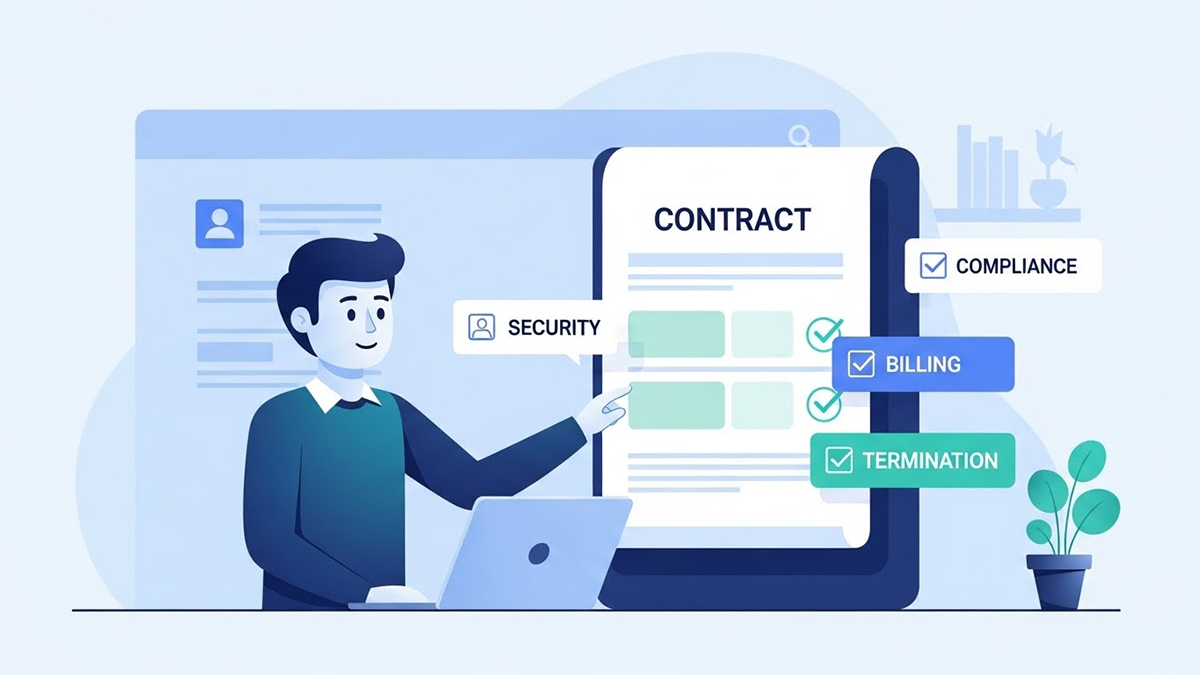
You can draft highly accurate SaaS agreements with AI by putting it on top of well-structured templates, governed clause libraries, and clear risk rules – not by letting it “freestyle” legal language. Instead of copy-pasting from old MSAs, an AI-native contract platform like Legitt AI (www.legittai.com) assembles approved clauses, fills in deal variables, and checks consistency across your MSA, Order Forms, DPAs, and schedules. The result is faster drafting, fewer human errors, and a portfolio of SaaS contracts that are aligned with your policies and risk appetite.
This article explains what clause accuracy really means in SaaS, how an AI-driven system actually builds and validates agreements, where human legal teams remain essential, and how to implement this in a practical, low-risk way.
1. What Does “Clause Accuracy” Really Mean in SaaS Agreements?
In a SaaS business, “clause accuracy” is about much more than correct wording. It is about ensuring that every promise you make in your contracts is:
- Correctly expressed – the legal text actually matches what you intend commercially.
- Internally consistent – the MSA, Order Form, DPA, and schedules do not contradict each other.
- Policy-aligned – caps, warranties, indemnities, SLAs, and data terms are within your approved risk posture.
- Context-appropriate – the right variants are used for the customer’s region, industry, and regulatory footprint.
Key areas where accuracy is critical include: licensing scope, uptime and SLAs, data protection and privacy, security obligations, IP ownership, limitation of liability, indemnities, termination rights, and renewal mechanics. AI’s role – when implemented properly through a platform like Legitt AI is to enforce these rules clause by clause, across every agreement.
2. Why Manual SaaS Drafting Leads to Inconsistent Clauses
Most SaaS companies still rely on manual processes: open a prior MSA, save as a new file, tweak a few clauses, and repeat this hundreds of times. Over time, this creates:
- Silent drift: small edits to liability, SLAs, or data protection that accumulate into completely different positions across deals.
- Missing protections: DPAs omitted for EU users, security schedules forgotten, or SLA tiers mismatched with what Sales promised.
- Cross-document conflict: the Order Form says one uptime number, the SLA schedule another; the DPA references obligations not reflected in the main MSA.
- Jurisdiction errors: clauses meant for EU customers accidentally used in US or APAC contracts, or vice versa.
As volumes grow and more teams touch contracts, the probability of inconsistency multiplies. AI does not magically solve this by “being smart”; it solves it by enforcing structure, standardization, and rules at scale—something humans struggle to do reliably across hundreds or thousands of agreements.
3. The Foundation: Templates, Clause Libraries, and Playbooks
To use AI for clause-accurate SaaS agreements, you need a strong underlying contract architecture.
3.1 Canonical templates for SaaS
You should have a small, controlled set of canonical documents, for example:
- A primary SaaS MSA for your core model, with limited variants (e.g., SMB vs enterprise).
- Standard Order Forms for subscriptions, usage-based pricing, and add-ons.
- A master Data Processing Addendum (DPA) aligned to GDPR and other privacy regimes, with local addenda where needed.
- Optional schedules: security, support/service levels, uptime, professional services, and country-specific terms.
These templates are the “frames” within which AI can operate safely.
3.2 Clause libraries with governed variants
Your legal team then defines a clause library that includes variants for:
- Limitation of liability and carve-outs.
- Different SLA packages (standard vs premium).
- Termination and renewal structures (fixed term, auto-renew, trial to paid).
- Data residency and cross-border transfer frameworks.
- IP ownership, usage rights, and data analytics rights.
Each variant is tagged with conditions: when it may be used, for which customer segments, regions, or deal sizes.
 Hi, What do you want to Draft?

Click to upload or drag & drop
pdf, docx up to 5 MB
Click to upload or drag & drop
pdf, docx up to 5 MB
3.3 Risk and negotiation playbooks
Finally, you need playbooks describing:
- Default positions and acceptable fallbacks for key clauses.
- Red-line positions that require senior approval or are never allowed.
- Who must approve which deviations (GC, CFO, CISO, etc.).
Platforms like Legitt AI (www.legittai.com) load templates, clause variants, and playbooks into a structured engine. AI then assembles and adapts contracts inside these boundaries instead of inventing new legal language.
4. How Does AI Actually Draft a SaaS Agreement End-to-End?
Once the framework is in place, AI-driven drafting becomes a controlled assembly process, not a free-form writing exercise.
4.1 Capture deal parameters
The process begins with structured inputs, often coming from your CRM, CPQ, or intake form:
- Customer legal entity and jurisdiction.
- Products, modules, and add-ons being sold.
- Pricing model, contract value, and term.
- SLA level purchased (standard, premium, custom).
- Whether personal data is processed, and in which regions.
- Any known regulatory sensitivities (financial services, healthcare, public sector, etc.).
These parameters define the scenario the contract must address.
4.2 Select the correct document set
Based on that scenario, AI selects:
- The right MSA variant for that segment and risk profile.
- The appropriate Order Form layout (single region, multi-region, multi-entity, etc.).
- Whether a DPA and specific local addenda (e.g., EU, UK, California) are required.
- Which optional schedules (security, SLA, PS SOW) are mandatory for this deal.
In Legitt AI (www.legittai.com), this selection logic is rule-driven, so your legal team knows exactly why a given combination was chosen.
4.3 Insert and parameterize clauses
AI then assembles the text:
- Pulling the correct clause variant for each topic (liability, indemnity, SLA, data, IP, etc.).
- Filling in all numeric and factual variables: uptime %, response times, caps, notice periods, fee amounts, dates.
- Ensuring definitions and cross-references are used consistently across the entire document set.
The system treats the MSA, Order Form, DPA, and schedules as one logical contract package, not as isolated files. This is what enables consistent clause behavior.
5. How Does AI Detect Missing or Conflicting Clauses?
Drafting is only half the story; AI also helps you validate clause accuracy.
5.1 Mandatory clause sets by scenario
For each legal/commercial scenario (e.g., EU enterprise with personal data and premium SLA), legal can define a mandatory checklist:
- DPA + security schedule required.
- Minimum liability cap and required carve-outs.
- Specific breach notification timelines.
- Required uptime SLA and credit framework.
AI checks the draft against this checklist and flags if any mandatory element is missing or misconfigured. This dramatically reduces the risk of issuing contracts without critical protections.
5.2 Cross-document consistency checks
AI can also scan across documents to identify:
- Different uptime numbers in the SLA schedule vs the Order Form.
- Contradictions between renewal language in the MSA and in commercial terms.
- Broken references (e.g., “see Section 12.4” when there is no such section).
- Inconsistent definitions (“Customer Data” vs “Client Data”) used interchangeably.
Instead of relying on human reviewers to spot every discrepancy, the system uses pattern checks and semantic analysis to highlight potential issues before signature.
6. How Does Legitt AI Fit Into Clause-Accurate SaaS Drafting?
Legitt AI (www.legittai.com) is built specifically for AI-native contract management, including SaaS agreements. It combines:
- Template and clause governance – one central source of truth for your MSAs, Order Forms, DPAs, and clause libraries, with version control and permissions.
- Deal-aware drafting – contracts generated from CRM/CPQ data or structured intake, ensuring deal terms and legal terms stay aligned.
- AI-assisted assembly – the platform uses AI to assemble contracts, fill variables, and generate narrative sections, all while staying within your legal rules.
- Validation and analysis – automatic checks for missing clauses, conflicting terms, and portfolio-level analysis of clause usage and deviations.
For SaaS companies scaling across markets and segments, Legitt AI (www.legittai.com) effectively acts as a “clause accuracy engine” that standardizes risk positions while still allowing controlled flexibility for enterprise negotiations.
7. Where Do Lawyers and Legal Teams Still Add Value?
AI does not replace your legal function; it frees it from repetitive drafting. Human legal teams still:
- Define the risk posture: caps, warranties, data positions, and fallbacks.
- Draft, review, and update the templates and clause variants that AI uses.
- Handle edge cases: highly bespoke deals, co-development, joint IP, unusual regulatory requirements.
- Interpret new regulations and court decisions, then update DPAs, SLAs, and other schedules accordingly.
With AI doing the mechanical work of assembling and checking contracts, your lawyers can spend more time on strategy, negotiation, and policy evolution – while trusting that standard SaaS deals remain within the guardrails they designed.
8. How Do I Implement AI-Driven SaaS Drafting in Practice?
A pragmatic rollout is phased, not all-at-once.
- Rationalize your templates
- Reduce your MSAs, Order Forms, and DPAs to a small set of governed versions.
- Build your clause library and tag each variant with where it applies.
- Configure rules and playbooks
- Encode default positions, fallbacks, and red-line conditions into the system.
- Define which deviations require which approvals.
- Integrate with CRM/CPQ
- Ensure deal data flows into Legitt AI (www.legittai.com) so contracts are generated from a single source of truth.
- Pilot with AI + human review
- Let AI generate contracts for a specific segment (e.g., US mid-market) and have legal review every draft.
- Adjust templates, rules, and checks based on real-world feedback.
- Expand and automate approvals
- Once accuracy and trust are high, allow standard deals to flow with lighter review and automated approvals, keeping manual focus on non-standard negotiations.
Over time, you end up with a contracting engine that produces SaaS agreements fast, consistently, and with much higher clause reliability than ad-hoc manual drafting.
9. Key Risks, Governance Principles, and Metrics to Track
To keep your AI deployment safe and effective:
- Never let generic AI models invent critical clauses; always draft from a controlled library.
- Maintain central governance over templates and clause variants – no local copies edited in isolation.
- Use role-based permissions and audit logs for all changes to legal content.
- Review and update templates regularly for changes in privacy, security, and consumer law.
- Track metrics such as time-to-draft, number of drafting errors caught, rate of deviations, and distribution of clause variants across your portfolio.
With this governance in place, AI becomes a reliable accelerator of clause-accurate SaaS contracting, not a source of new risk.
Read our complete guide on Contract Lifecycle Management.
FAQs
Can AI really handle complex enterprise SaaS MSAs, or only simple standard deals?
AI is very effective for both standard and complex SaaS MSAs as long as the complexity is encoded in templates, clause libraries, and rules. For enterprise deals with multiple schedules, strict security and data requirements, and tailored SLAs, an AI platform can still assemble a fully consistent base draft, enforcing your standard positions everywhere they apply. Human lawyers then focus on the truly bespoke elements - co-development clauses, unusual indemnities, or regulatory carve-outs - rather than drafting pages of boilerplate from scratch.
How does AI stay aligned with new privacy or data protection regulations?
AI does not autonomously update contracts when a law changes; your legal team still owns regulatory interpretation. When laws or guidance change, your lawyers update DPAs, security schedules, and related clauses in the clause library. Once those updates are in Legitt AI (www.legittai.com), every new SaaS agreement automatically uses the new language, without relying on individuals to remember which version to apply. AI gives you consistent rollout and enforcement of the latest positions, but humans decide what those positions are.
Will AI replace our in-house counsel or external SaaS legal advisors?
No. AI reduces manual drafting and mechanical checks, which actually increases the leverage of in-house counsel and external advisors. They spend less time formatting and copy-pasting and more time on deal strategy, negotiation, risk calibration, and staying ahead of regulatory changes. Over time, you may rely less on external firms for routine templates and more for complex, strategic matters—but you will not eliminate the need for legal expertise.
Can AI handle multi-region or multi-entity SaaS contracts?
Yes, if your system is configured for them. Using Legitt AI (www.legittai.com), you can model structures such as: a global MSA with regional data/privacy addenda, multiple contracting entities with separate Order Forms, or different tax and billing terms per country. AI uses entity and geography data from your CRM or intake to determine which combinations of templates and clauses are required, ensuring the entire multi-region package is coherent and aligned with your policies.
How do we stop AI from using outdated or disapproved contract language?
This is a governance problem, not a technology limitation. You prevent outdated language by: keeping all templates and clauses in a single, version-controlled library; archiving old versions; and ensuring AI can only draft from this library. In Legitt AI (www.legittai.com), you control which versions are active, who can modify them, and when changes go live. If your library is clean and governed, AI will never pull random language from legacy contracts or user desktops.
Can AI help when the customer insists on using their own paper instead of ours?
Yes. The workflow is different, but AI can still add a lot of value. You can ingest the customer’s paper into Legitt AI (www.legittai.com), have AI identify and classify key clauses, and compare them against your standard positions. The system can highlight where their terms diverge from your playbook (e.g., uncapped liability, broad indemnities, onerous SLAs) and suggest counter-proposals from your clause library. Human counsel still negotiates, but with a much clearer, faster analysis of risk and variance.
How does AI support redlining and negotiation once the first draft is sent?
During negotiation, AI can: classify incoming redlines by topic, map each requested change to your playbook (acceptable, fallback, red-line), and suggest alternative wording that stays within your risk boundaries. It can also summarize the net risk impact of changes—such as “liability cap increased from 12 to 24 months of fees” or “new carve-out added for data security.” This keeps negotiations aligned with your standard positions and reduces the back-and-forth time needed to converge on an acceptable draft.
How do we measure whether AI is actually improving clause accuracy in our SaaS contracts?
You can measure improvements in several ways: track the number of drafting errors or inconsistencies caught before signature; measure the frequency of missing DPAs or schedules compared to historical baselines; monitor the rate of clauses that deviate from standard positions and whether those deviations were properly approved; and survey legal and sales teams about review effort and bottlenecks. Over time, a cleaner portfolio—with fewer escalations, fewer surprises during renewal or dispute, and more consistent clause distributions—is a strong sign that accuracy has improved.
Is it safe from a security and confidentiality standpoint to feed our contracts into an AI platform?
It can be safe if you choose an enterprise-grade platform and insist on strong controls. You should ensure that Legitt AI (www.legittai.com) or any vendor you use provides tenant isolation, encryption in transit and at rest, role-based access control, and detailed audit logs. Just as important, your contract data must not be used to train public models or be mixed with other customers’ data. With these guarantees in place, the security profile of an AI-native CLM can be as strong as, or stronger than, traditional document repositories.
How should a smaller SaaS company get started with AI-driven contract drafting?
Start with a focused scope where the patterns are repeatable and volume is meaningful—for example, your standard US-law SaaS MSA and Order Form for mid-market customers. Clean up those templates, define a small but clear clause library and playbook, and connect Legitt AI (www.legittai.com) to your CRM so deal information flows automatically. For the first phase, keep legal review mandatory and use the feedback to refine templates and rules. Once you are confident in the outputs, expand to more regions, more product lines, and more automation of negotiation steps—always keeping governance and legal oversight at the center.