You usually realize the LLC operating agreement needs attention after the business has already changed. A new member came in. Someone’s ownership shifted. Managers started acting under a revised decision-making process that never made it into the governing documents. At that point, amending an LLC operating agreement stops being a paperwork task and becomes a governance task.
That distinction matters. An operating agreement amendment is generally an internal contract change, not a filing by itself. If you handle it casually, the amendment can become the weakest document in your company record set: approved through the wrong process, signed by the wrong people, or stored so poorly that no one can prove what controls. If you handle it well, it becomes a clean, dated record of authority, approval, and intent.
For founders, executives, legal teams, and operations leads, the primary challenge isn’t just drafting a clause. It’s building a process that answers four questions clearly: who had authority to approve the change, what changed, when it became effective, and where the final controlling version lives.
When and Why to Amend Your LLC Operating Agreement
An LLC operating agreement shouldn’t sit untouched once the business starts evolving. It’s the company’s private rulebook for ownership, control, voting, and economics. If those facts change but the agreement doesn’t, the business starts operating on assumptions instead of documented authority.
H&R Block notes that an LLC operating agreement amendment is generally treated as a contract modification, not a government filing, and that if the agreement is silent on amendments, consent from all existing members is commonly required. It also identifies changes in ownership stakes or governance rules as common triggers, and notes that some amendments can require an update to the LLC’s BOI report under FinCEN rules (H&R Block guidance on changing an LLC operating agreement).
The operating agreement should track reality
The highest-risk amendments usually follow business events that people treat as operational rather than legal. A founder brings in an investor. A member exits but keeps receiving distributions under an outdated schedule. The LLC shifts from a hands-on member-managed model to delegated management, but no one updates the authority language.
Those aren’t technical gaps. They affect who can bind the company, who can vote, and what happens when members disagree.
Practical rule: If the company’s actual decision-making process no longer matches the operating agreement, amend the agreement before the next major approval, not after it.
Events that should trigger immediate review
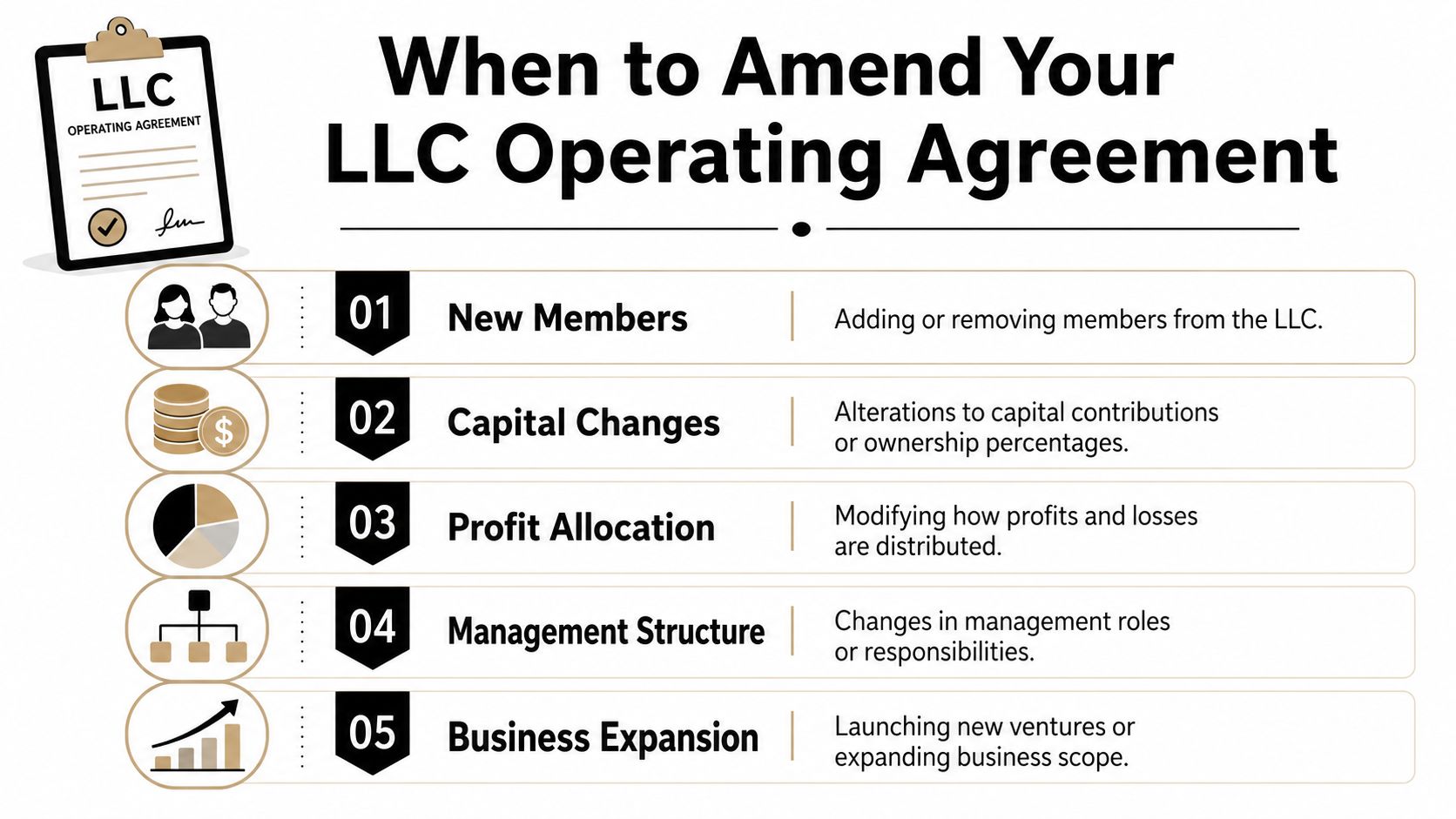
Some triggers are obvious. Others are easy to miss until a dispute starts. In practice, these changes usually justify a prompt review:
- Membership changes: Adding a member, removing one, or documenting a transfer of interests.
- Capital and ownership revisions: Changing contribution obligations or adjusting percentage interests.
- Profit and loss allocation updates: Revising how economics are shared.
- Management changes: Moving authority between members and managers, or redefining approval rights.
- Voting changes: Revising consent thresholds for major actions.
- Business scope changes: Expanding into new lines of business or changing how the LLC operates.
A simple way to think about it is this: if the change affects ownership, economics, authority, or approvals, it belongs in the operating agreement or an amendment to it.
| Business event | Why amendment matters |
|---|---|
| New member admission | Clarifies ownership, voting, and economic rights |
| Departure or transfer | Prevents outdated rights from lingering in the document |
| New manager authority | Aligns internal delegation with actual operations |
| Revised voting rules | Reduces the risk of later challenges to company actions |
| Expansion into new ventures | Keeps governance terms aligned with how the company now operates |
The cost of delay usually isn’t visible right away. It shows up when someone asks for proof. Who approved this? Which version controlled? Was the change valid? Clean amendments answer those questions before they become expensive ones.
Determining Amendment Authority and Voting Thresholds
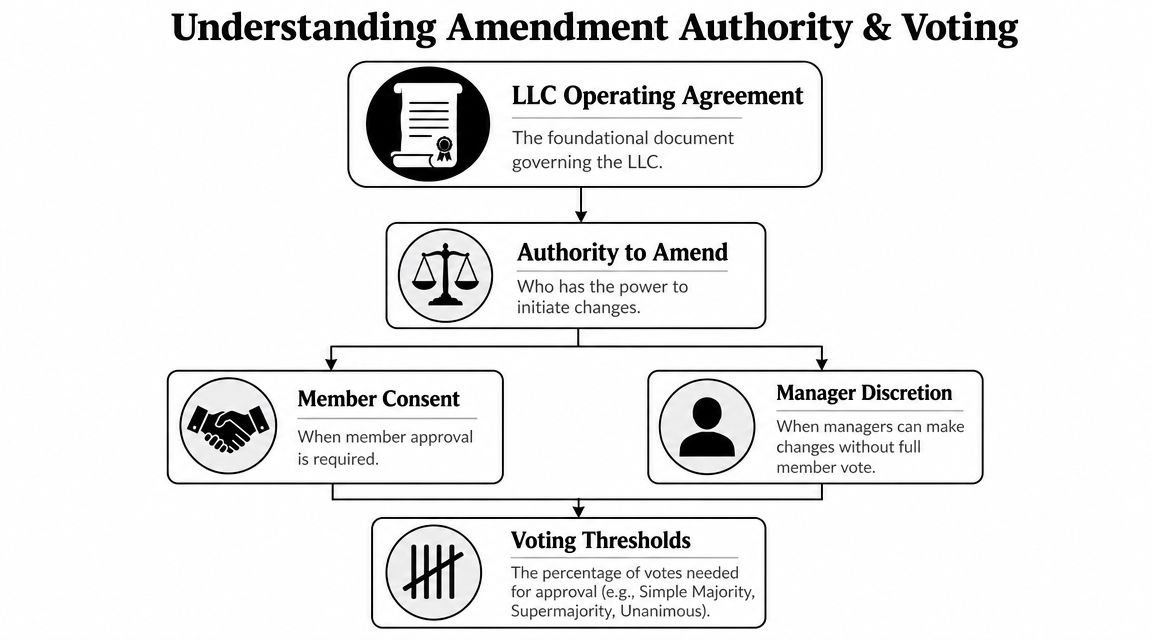
Before anyone drafts language, confirm who is allowed to amend the agreement and how approval must happen. This is the pre-flight check. It’s also where many amendment efforts fail.
The most common bad assumption is that a majority vote will solve it. Sometimes it will. Sometimes it won’t. If the operating agreement requires a different threshold, a specific notice process, manager participation, or written consent format, that process controls.
Start with the amendment clause
Review the operating agreement for the sections dealing with amendment, member votes, manager authority, meetings, notices, and written consents. Don’t read the amendment clause in isolation. Approval mechanics are often spread across multiple sections.
Look for these issues:
- Threshold language: Does the agreement require unanimous approval, majority approval, or some other threshold?
- Role-based approvals: Does a manager, managing member, or specific class of member have to participate?
- Notice requirements: Does the agreement require formal notice before a meeting or vote?
- Written consent rules: Can the amendment be approved without a meeting, and if so, in what form?
- Execution requirements: Who must sign the final amendment for it to become binding?
Member-managed and manager-managed structures change the workflow
In a member-managed LLC, amendment authority often sits with the members, but the agreement may still impose specific thresholds or procedures. In a manager-managed LLC, people sometimes assume managers can handle the process alone. That assumption is risky unless the agreement clearly gives them that power.
A Morris James discussion of Delaware litigation makes the point clearly: procedure can matter as much as substance. In the case discussed there, an amendment was challenged because the approval route required by the agreement, including manager involvement, was not followed. The practical lesson is that a “simple majority vote” isn’t a safe default if the agreement requires something else (Morris James on an amendment found invalid for lack of manager involvement).
If the agreement assigns amendment authority through a specific path, follow that path exactly. Courts don’t rescue a clean business outcome that came from a defective approval process.
A defensible approval path
For internal teams, I recommend documenting authority before drafting starts. A short approval memo or checklist can do the job. It should identify:
- The governing version of the current operating agreement.
- The amendment provision and any related voting or notice sections.
- The company’s management structure under the agreement.
- The required approvers and threshold.
- The planned approval method, such as meeting vote or written consent.
- Any related compliance follow-up, including internal registers and external reporting review.
This step saves time because it prevents drafting a perfectly good amendment that no one can validly approve.
Drafting the Amendment Language and Document
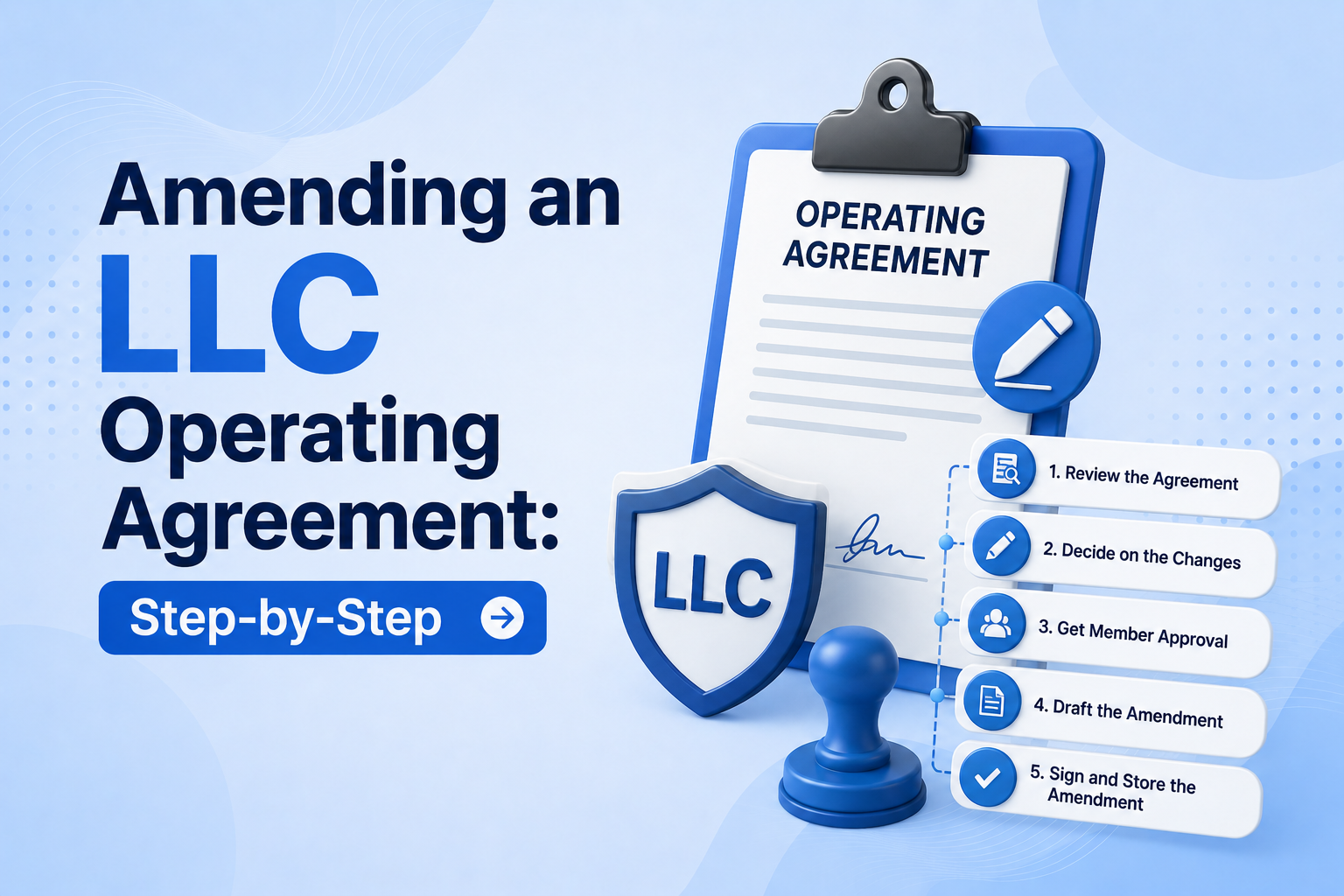
Once authority is confirmed, the drafting should be exact. Amendment documents fail most often when they’re too loose. “The members agree to update the ownership section” isn’t enough. A good amendment identifies the governing agreement, the exact section being changed, the replacement or added text, the effective date, and whether the rest of the agreement remains unchanged.

A documented workflow is the safest approach. One practitioner source outlines a reliable sequence: review the amendment clause, draft the change with the specific section number and revised text, provide notice as required, obtain the required vote or written consent, and execute the amendment so it can be attached to the original agreement (workflow for amending an operating agreement).
What a workable amendment document should include
A practical amendment usually contains these building blocks:
- Introductory identification: Name of the LLC, date of the original operating agreement, and title of the amendment.
- Authority statement: A brief recital that the amendment is being adopted under the applicable approval provision.
- Section-by-section changes: State exactly which section is being amended and whether language is being replaced, deleted, or added.
- Effective date: Clarify when the change becomes operative.
- No other changes clause: Confirm that all other terms remain in effect unless specifically amended.
- Signature block: Match the required signatories to the approval and execution rules.
Here’s the drafting standard I use internally: if a person unfamiliar with the company can’t compare the amendment to the original agreement and identify the exact change in minutes, the draft isn’t ready.
A separate drafting point often gets overlooked. If the amendment affects ownership or founder arrangements, it helps to review adjacent documents for consistency. Teams dealing with early-stage structures often benefit from broader governance housekeeping, including resources on how to secure your business with proper partnership agreements before inconsistencies spread across founder, equity, and LLC documents.
For readers looking at the underlying governance document itself, this overview of an LLC operating agreement resource is a useful companion reference.
When an amendment should become a restated agreement
At some point, stacking amendments creates more confusion than clarity. If the LLC has changed ownership repeatedly, reworked management authority, and adjusted voting rights more than once, a short amendment can make the document set harder to read.
Operational advice: When people need to flip between the original agreement and multiple amendments to understand current authority, it’s time to consider a restated agreement.
A restated agreement usually works better when:
| Situation | Better document choice |
|---|---|
| One narrow change to a single section | Amendment |
| Several related edits across the agreement | Amendment or restatement, depending on complexity |
| Repeated historical changes creating confusion | Restated operating agreement |
| Governance overhaul | Restated operating agreement |
The goal isn’t elegance. It’s reducing ambiguity. The controlling document should be easy to identify and hard to misread.
Executing the Amendment with Secure Digital Workflows
Execution is where careful governance work often gets undermined. The draft is approved in principle, but then it gets routed informally through email, printed by different people, marked up in parallel, and signed in inconsistent order. That leaves gaps in evidence and creates room for later argument over what version was approved.
Execution is where informal processes break down
Manual execution still happens everywhere. Someone emails a PDF. A member signs the wrong version. Another signs but never returns the fully executed copy. A manager approves in a message thread, but the agreement required a formal written consent. None of that is unusual. All of it is avoidable.
A controlled digital workflow is better for three reasons:
- It preserves order: The amendment moves through review, approval, and signature in the required sequence.
- It reduces version confusion: Everyone sees the same final form before execution.
- It creates evidence: The company can later show who received the document, who approved it, and who signed it.
If your team is still relying on inboxes and shared drives, move execution into a purpose-built electronic process. An electronic signature workflow for legal documents is far more defensible than scattered PDFs and unsigned consent threads.
What a controlled digital workflow should capture
The strongest execution process records more than signatures. It also preserves the approval path that led to signature.
That means the file should show:
- Final approved version: The exact draft authorized for execution.
- Approval evidence: Written consent, meeting approval, or other required authorization.
- Signer identity and sequence: Especially when the agreement requires role-based execution.
- Execution date record: So the effective timeline is easy to verify later.
- Attached governance documents: Such as resolutions or consent records where needed.
A short demo is helpful if you’re redesigning the workflow across legal and operations teams:
The practical standard is simple. If a departing executive, auditor, lender, or litigant asked for proof that the amendment was validly executed, the company should be able to produce it quickly and in one package.
Post-Execution Recordkeeping and Version Control
Once the amendment is signed, the governance work isn’t over. Many companies complete execution and then lose discipline immediately. The final PDF sits in legal’s email, finance updates an ownership spreadsheet separately, and operations keeps using an older copy of the operating agreement. That defeats the whole point of the amendment.
Close the loop after signature
The post-execution checklist should be short and mandatory. At minimum, complete these tasks:
- Attach the amendment to the governing agreement: Don’t store it as a free-floating file.
- Distribute the executed version to the right stakeholders: Members, managers, finance, and operations may all need the updated record.
- Update internal records: Membership registers, authority matrices, approval logs, and related governance records.
- Review related documents: Banking authority, side letters, board-style resolutions, and internal approval policies may need alignment.
- Flag any external follow-up: Depending on the nature of the change, compliance or reporting obligations may need review.
A disciplined legal operations team treats this as a records project, not just a signature project.
Version control should create a single source of truth
Version confusion creates avoidable risk. If there’s an original agreement, two amendments, and a partially redlined draft sitting in a shared drive with similar file names, someone will rely on the wrong one.
That’s why a centralized contract repository matters. A proper contract repository for executed agreements and amendments should let the team identify the controlling document set, see the chronology of changes, and retrieve the signed files without reconstructing history from email threads.
Good recordkeeping isn’t administrative cleanup. It’s what turns an executed amendment into a usable governance record.
This is also where broader legal operations discipline pays off. Teams that are formalizing governance records often benefit from practical workflow thinking like TheLawGPT’s practice management guide, especially when legal, finance, and operations all touch the same records but no one owns version control end to end.
For internal governance files, I recommend a naming and storage convention that makes the answer obvious on sight: original agreement, amendment number, execution date, effective date if different, and current status. If your team has to guess which document controls, your recordkeeping model is too loose.
Common Pitfalls to Avoid When Amending Your Agreement
Most amendment problems don’t start with bad intentions. They start with shortcuts. The company agrees on the business outcome and assumes the documentation can catch up later. That’s where disputes begin.
Mistakes that create avoidable disputes
Several failure points show up repeatedly in practice:
- Using vague amendment language: If the document says a section is “updated” without showing the exact revised text, people will argue over meaning later.
- Ignoring notice requirements: Even where everyone seems aligned, the agreement may still require formal notice before a vote or consent process.
- Following the wrong approval path: A member vote alone may be insufficient if manager involvement or another approval role is required.
- Failing to align related records: Ownership schedules, banking authority, and internal delegation documents can fall out of sync.
- Treating execution as the finish line: An unsigned consent exhibit, missing attachment, or misfiled final version can weaken the record.
- Forgetting downstream compliance review: Governance changes can have additional consequences that need separate handling.
The best prevention is procedural discipline. Build a checklist, assign an owner, and require a closing packet before the file is marked complete.
| Pitfall | Prevention |
|---|---|
| Ambiguous text | Draft section-specific replacement language |
| Wrong approvers | Confirm authority before drafting starts |
| Missing notice | Use the notice method required in the agreement |
| Incomplete file | Store approvals, signatures, and final documents together |
| Outdated records | Update internal registers and related control documents promptly |
When outside counsel should step in
Some amendments are routine. Others shouldn’t be handled as a basic internal update.
Bring in outside counsel when:
- Members are in conflict about authority, economics, or timing.
- The agreement is internally inconsistent or hard to interpret.
- A major ownership or control shift is involved.
- There’s a serious risk of challenge from a current or former member.
- The amendment interacts with broader transaction work, financing, restructuring, or a pending dispute.
If the internal team can’t answer who must approve, what document currently controls, or whether adjacent agreements are affected, that’s a signal to escalate. The legal cost of review is often far lower than the cost of defending a flawed amendment later.
Frequently Asked Questions About LLC Amendments
Below are the practical questions that come up most often when teams are amending an LLC operating agreement.
| Question | Answer |
|---|---|
| Do I always need to file an amendment with the state? | Not necessarily. The amendment to the operating agreement is generally an internal contract change. Separate state filings may be needed only if the underlying business change affects information held by the state. |
| What if the operating agreement says nothing about amendments? | The safest working assumption is that silence increases risk and requires careful review of default rules. As noted earlier, unanimous consent of existing members is commonly required when the agreement is silent. |
| Can members approve an amendment by email? | Only if that method satisfies the agreement’s rules for notice, consent, and approval records. Informal email alignment is not the same as a valid written consent if the agreement requires more formality. |
| Should I amend the agreement or replace it entirely? | If the change is narrow, an amendment is usually enough. If the company has accumulated several changes or the document has become hard to read, a restated agreement is often cleaner. |
| Who should sign the amendment? | Follow the agreement’s approval and execution requirements exactly. In many cases, the amendment should be signed by all required parties and kept with the company records. |
| What records should be stored with the signed amendment? | Keep the final executed amendment with the governing operating agreement, plus any required notices, written consents, meeting records, and internal update logs. |
| Does a management change need an amendment even if ownership stays the same? | Usually yes, if authority, voting mechanics, or who can bind the LLC is changing. Management changes are governance changes, not just operational ones. |
| When should the effective date be different from the signing date? | Use a separate effective date only when the business has a clear reason for it and the document states it plainly. If timing matters for ownership, voting, or authority, don’t leave it implied. |
The cleanest amendment process is the one you can prove later. Confirm authority first, draft with precision, execute through a controlled workflow, and store the final record where no one has to guess what controls.
If your team wants a more reliable way to draft, approve, sign, store, and track governance documents, Legitt AI gives legal and business teams one workspace for contract lifecycle management. It helps centralize version control, eSignatures, approvals, repository management, and contract intelligence so amendments don’t get lost between legal, finance, and operations.