As digital transformation accelerates across industries, organizations face mounting pressure to ensure document authenticity and maintain tamper-proof records. Traditional e-signature solutions often rely on centralized systems that can be vulnerable to data manipulation or system failures. In 2026, blockchain technology is emerging as a revolutionary approach to document integrity, offering immutable audit trails that provide unprecedented levels of trust and verification for electronic signatures.
This shift toward blockchain-based document integrity represents more than just a technological upgrade—it addresses fundamental concerns about long-term document validity, regulatory compliance, and cross-border recognition. For businesses evaluating modern e-signature solutions, understanding how blockchain enhances document security and creates verifiable proof of authenticity has become essential for strategic decision-making.
What Is Blockchain-Based Document Integrity
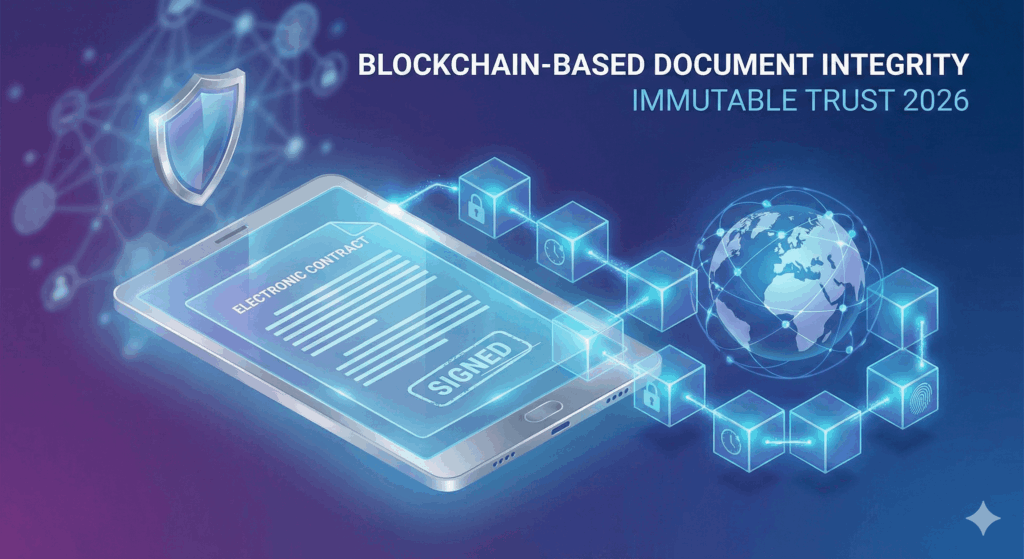
Blockchain-based document integrity leverages distributed ledger technology to create permanent, tamper-resistant records of document transactions. Unlike traditional e-signature systems that store audit trails on centralized servers, blockchain solutions create cryptographic hashes of documents and transaction data that are distributed across multiple nodes in a decentralized network.
When a document is signed using blockchain-enhanced e-signature technology, several key processes occur simultaneously. The system generates a unique cryptographic fingerprint of the document, records the signing event with precise timestamps, and distributes this information across the blockchain network. Any attempt to alter the document or signing data would require changing records across the entire network, making tampering virtually impossible.
This approach provides several distinct advantages over conventional audit trails. Document integrity can be verified independently without relying on the original e-signature provider. Cross-border transactions benefit from universal verification standards that don’t depend on specific jurisdictional requirements.
Why Blockchain Document Integrity Matters Now
Several converging factors are driving adoption of blockchain-based document integrity in 2026. Regulatory frameworks worldwide are increasingly emphasizing long-term document preservation and verifiable audit trails. Industries such as healthcare, finance, and real estate require documents that remain valid for extended periods, often spanning decades.
Recent high-profile cases of document tampering and data breaches have highlighted vulnerabilities in centralized storage systems. Organizations are seeking solutions that eliminate single points of failure and provide cryptographic proof of document authenticity. Blockchain technology addresses these concerns by creating distributed verification systems that don’t rely on any single entity or server.
The rise of remote work and digital-first business processes has also increased the volume of electronic documents requiring long-term integrity assurance. Companies are processing more contracts, agreements, and compliance documents electronically than ever before. Traditional backup and archival systems, while functional, don’t provide the same level of verifiable integrity that blockchain solutions offer.
International business transactions particularly benefit from blockchain-based document integrity. When contracts involve parties across multiple jurisdictions, having universally verifiable proof of document authenticity simplifies processes and reduces disputes. Blockchain verification doesn’t depend on specific national regulations or certification authorities, making it ideal for global commerce.
Business Impact and Operational Benefits
Organizations implementing blockchain-enhanced e-signature solutions report significant improvements in several key areas. The cryptographic proof provided by blockchain systems often eliminates the need for extensive forensic analysis when document integrity is questioned.
Compliance teams benefit from automated audit trail generation that meets or exceeds regulatory requirements. Blockchain-based systems create comprehensive records of all document interactions, including viewing, signing, and modification events. These records are immutable and can be independently verified, simplifying compliance reporting and regulatory audits.
Risk management improves substantially when organizations can demonstrate unalterable proof of document integrity. Insurance claim, and regulatory investigations become more straightforward when blockchain verification provides clear evidence of document authenticity and transaction history.
Operational efficiency gains emerge from reduced manual verification processes. Teams can quickly confirm document integrity using blockchain verification tools rather than relying on time-consuming manual checks or third-party authentication services. This acceleration is particularly valuable for high-volume document processing environments.
Real-World Implementation Scenarios
Healthcare organizations are implementing blockchain-enhanced e-signatures for patient consent forms, treatment agreements, and medical research documentation. The immutable nature of blockchain records ensures that patient consent can be verified years later, even if the original healthcare system changes or merges with other organizations.
Financial services firms use blockchain document integrity for loan agreements, investment contracts, and regulatory filings. The technology provides auditors and regulators with cryptographic proof that documents haven’t been altered since signing, streamlining compliance processes and reducing audit costs.
Real estate transactions benefit significantly from blockchain-based document integrity. Property deeds, purchase agreements, and title documents require long-term validity that often spans decades. Blockchain verification ensures these critical documents remain verifiable regardless of changes in agencies or systems.
Supply chain management increasingly relies on blockchain-enhanced contracts for vendor agreements, quality certifications, and compliance documentation. The technology enables companies to verify the authenticity of supplier certifications and contract terms throughout complex global supply networks.
Don’t just read about the future of document security—see it in action. We’ve integrated Legitt’s blockchain verification engine directly below.
Try signing a sample document now to see how a tamper-proof, blockchain-verified audit trail is generated instantly.

Click to upload or drag & drop
pdf, docx up to 5 MB
Addressing Common Concerns and Misconceptions
Some organizations hesitate to adopt blockchain-based document integrity due to concerns about complexity and cost. Modern blockchain solutions designed for document integrity are significantly more user-friendly than early cryptocurrency implementations. Users typically interact with familiar e-signature interfaces while blockchain verification operates transparently in the background.
Energy consumption concerns, often associated with cryptocurrency mining, don’t apply to document integrity blockchain networks. These systems use consensus mechanisms optimized for verification rather than mining, resulting in minimal energy requirements compared to traditional data centers.
Scalability questions arise when organizations consider processing large volumes of documents. Current blockchain document integrity solutions can handle enterprise-scale document volumes while maintaining verification speed and accuracy. The technology has matured significantly from early implementations that faced throughput limitations.
Integration with existing systems is often simpler than anticipated. Many blockchain-enhanced e-signature platforms provide APIs and integration tools that work with common business applications, CRM systems, and document management platforms.
What This Means for Business Strategy
Organizations should evaluate their current document integrity requirements and consider how blockchain technology aligns with long-term business objectives. Companies handling high-value contracts, regulatory documentation, or cross-border transactions will likely benefit most from blockchain-enhanced e-signature solutions.
IT teams should assess integration requirements and ensure that blockchain document integrity solutions can work with existing technology infrastructure. The most effective implementations combine blockchain verification with familiar user interfaces and established business processes.
Risk management teams should consider how immutable document integrity affects their overall security posture. Blockchain verification can significantly reduce document-related risks while providing stronger evidence for regulatory compliance.
Preparing for the Future of Document Integrity
As blockchain technology continues to mature, organizations that adopt these solutions early will be better positioned for future regulatory requirements and business opportunities. The trend toward verifiable, immutable document records is likely to accelerate as digital transformation deepens across industries.
Businesses should begin evaluating blockchain-enhanced e-signature solutions now, even if immediate implementation isn’t required. Understanding the technology’s capabilities and limitations helps organizations make strategic decisions about document management and digital transformation initiatives.
Training and change management become important considerations as teams adapt to new verification processes. While blockchain technology operates largely in the background, understanding its benefits helps employees and stakeholders appreciate the enhanced security and integrity it provides.
Conclusion
Blockchain-based document integrity represents a fundamental advancement in e-signature technology, addressing critical concerns about long-term document validity and tamper-proof verification. As organizations increasingly rely on digital documents for essential business processes, the ability to provide cryptographic proof of authenticity becomes a competitive advantage.
The technology offers practical benefits that extend beyond theoretical security improvements. Reduced verification costs, streamlined compliance processes, and enhanced protection provide tangible value for organizations across industries. As blockchain document integrity solutions become more accessible and user-friendly, adoption will likely accelerate throughout 2026 and beyond.
For businesses ready to enhance their document integrity capabilities, exploring modern e-signature solutions that incorporate blockchain verification is a strategic investment in long-term operational security. Legitt are at the forefront of this technological evolution, offering advanced electronic signature solutions that combine user-friendly interfaces with cutting-edge security features, including blockchain-based document integrity options that ensure your critical agreements remain verifiable and tamper-proof for years to come.
Read our complete guide on Contract Lifecycle Management.
FAQs
What is blockchain-based document integrity?
Blockchain-based document integrity is a security method that uses decentralized ledger technology to create a permanent, unalterable record of a document. Unlike traditional e-signatures, it generates a cryptographic hash of the file and anchors it to a blockchain, proving that the document has not been tampered with since the moment it was signed.
How is a blockchain e-signature different from a standard e-signature?
Standard e-signatures rely on a central server (like the vendor's database) to verify validity. If that server is compromised, the proof is lost. Blockchain e-signatures distribute the verification data across thousands of nodes, making the audit trail immutable and independent of any single vendor.
Why do I need blockchain for document security?
For high-value contracts, intellectual property, and long-term agreements, standard security isn't enough. Blockchain ensures that a document's history is preserved forever. It prevents "backdating" fraud and provides mathematical proof of ownership and integrity that holds up in court decades later.
Does the actual document get stored on the blockchain?
No. This is a common misconception. Legitt store only the unique cryptographic "fingerprint" (hash) of the document on the blockchain. The actual file remains private and secure on your encrypted storage or cloud, ensuring GDPR compliance and data privacy.
Can a blockchain-verified document be hacked?
It is virtually impossible to hack the verification record. Because the hash is distributed across a decentralized network, a hacker would need to alter the data on 51% of the global nodes simultaneously to fake a record—a feat that is currently computationally impossible.
What happens if the e-signature company goes out of business?
This is the main advantage of blockchain. Because the verification data is on a public or permissioned ledger, you can verify the integrity of your documents independently, even if the original provider no longer exists. Your proof of ownership is permanent.
Does using blockchain e-signatures consume a lot of energy?
Modern document integrity solutions, including Legitt, typically use "Layer 2" solutions or eco-friendly consensus mechanisms (like Proof of Stake) that consume minimal energy—comparable to sending a standard email—unlike early Bitcoin mining.
Can I use blockchain signatures for detailed contracts?
Absolutely. It is ideal for NDAs, sales contracts, real estate deeds, loan agreements, and IP registrations. The more critical the document, the more it benefits from the "trustless" verification of blockchain.
Is Legitt compatible with my existing file formats?
Yes, Legitt supports all standard document formats, including PDF, DOCX. The hashing algorithm works on the binary data of any file type.
Is it expensive to switch to blockchain document integrity?
Not anymore. In 2026, Legitt have made the cost comparable to traditional premium e-signature services. The cost of not having it (potential fraud, lost disputes) is significantly higher.