$97.4 billion went into corporate sponsorships worldwide in 2022, and the market is projected to reach $189.5 billion by 2030. That's why a proposal for a sponsorship has to read like a measurable marketing investment, not a funding request.
Sponsors aren't buying goodwill anymore. They're buying audience access, engagement, and a defensible path to return on investment, which means the strongest proposals now look a lot more like marketing briefs than donation letters.
Why Sponsorship Proposals Now Read Like Marketing Briefs
The old sponsorship pitch was built around exposure. Put the logo on the banner, thank the brand on stage, and hope that was enough. That approach feels thin now because sponsors already work inside a budget framework, and they want proof that the spend can be measured against the rest of their marketing mix.
Sponsors typically evaluate proposals using impressions, reach, click-through rate, conversion rate, and media value. A proposal that cannot speak in those terms usually gets passed over, not because the event lacks value, but because the value is not framed in commercial terms.
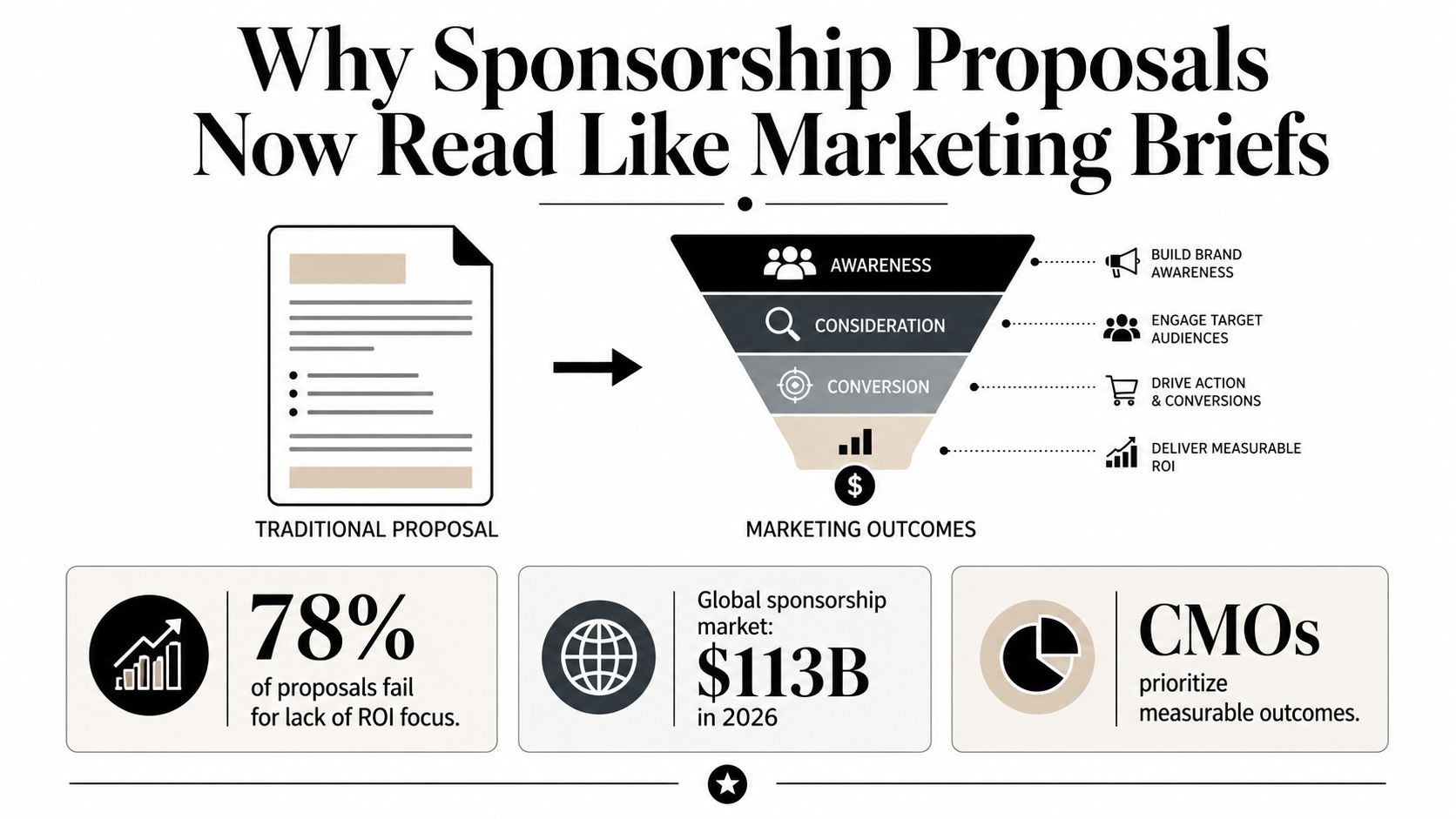
If you are building a proposal for a sponsorship today, write like a marketer and a deal owner. The sponsor wants to know who will see the brand, who will engage, what they will get in return, and how the result will be reported after activation. That shift matters because the proposal is being judged as an accountable marketing investment, not a general request for support.
Data-driven personalization in proposals fits this mindset well, because sponsorship buyers respond better when the pitch reflects their audience, goals, and current campaigns. The best proposals do more than ask for money. They show why this partnership deserves budget over every other option on the sponsor's desk.
A sponsorship proposal now has to answer three buyer questions
Practical rule: if your proposal cannot answer fit, value, and measurement in plain language, it is not ready to send.
Those questions are straightforward. Does this audience match the sponsor's customers, can the activation produce visible business value, and how will success be measured after the event or campaign ends?
Use that filter before you write the rest of the document. It also helps to organize your sponsorship assets early, then match them to sponsor goals with the kind of specificity outlined in PlanSeats nonprofit event tips. Once that match is clear, the proposal stops feeling like a request and starts working like a sales asset.
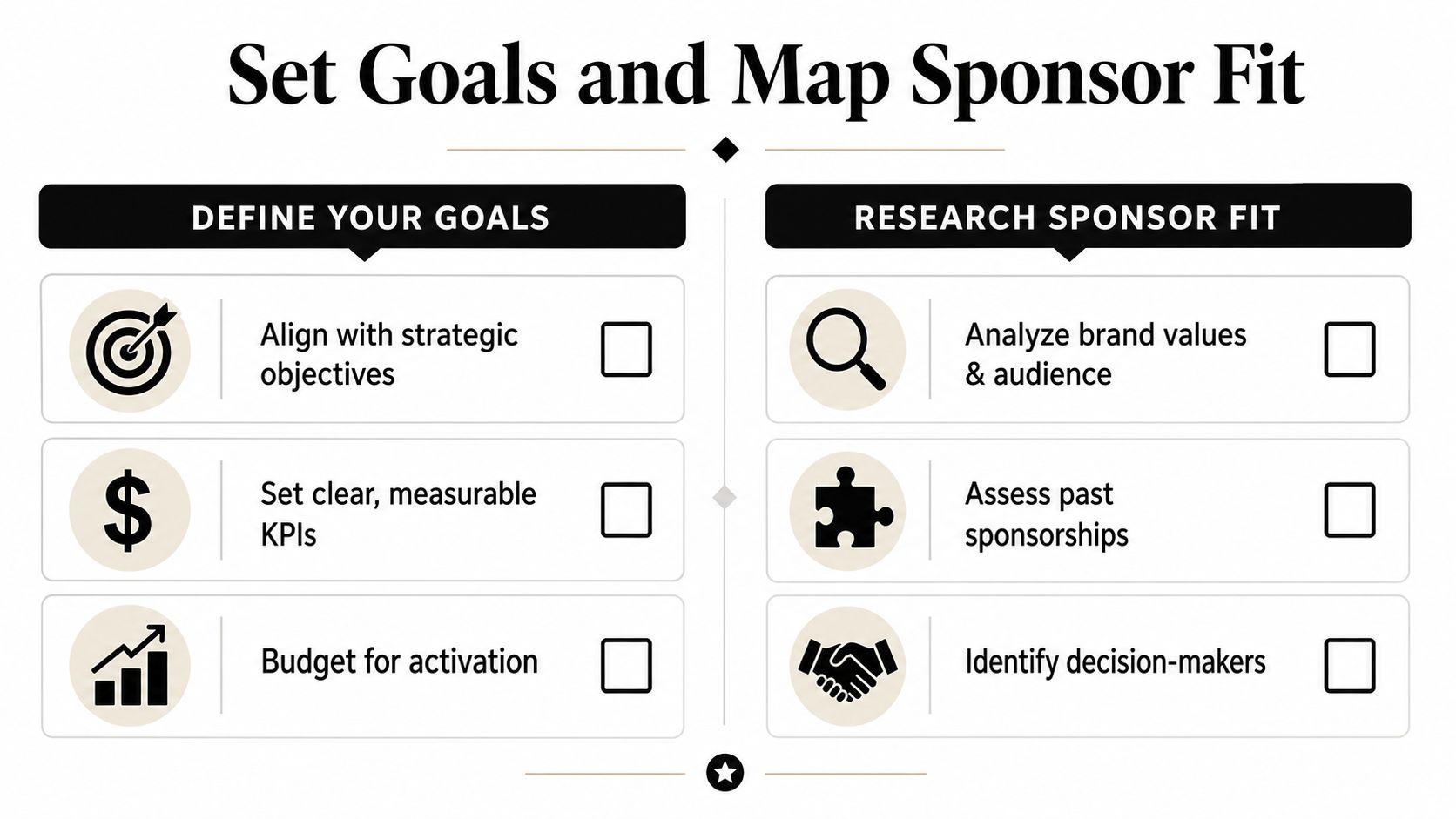
Set Goals and Map Sponsor Fit Before Writing a Single Word
The fastest way to lose a sponsor is to write first and research later. A good proposal starts with your own objective, then matches that objective to a sponsor whose marketing goals line up with the audience and assets you can offer.
Define your outcome before you define the package
Start with the business result you need. That might be event funding, lead generation, brand visibility in a niche market, or support for a community initiative with a well-defined audience. If you can't name the outcome, you'll end up building packages that are easy to describe but hard to buy.
Then inventory your sponsorship assets. That means the event itself, speaking slots, newsletter placements, content mentions, social posts, registration pages, attendee data, or access to a highly specific community. For nonprofit planners, PlanSeats nonprofit event tips is a useful reminder that sponsorship readiness starts with organizing the event experience before you start asking for support.
Research fit like a buyer, not a fan
The next step is sponsor-compatibility checking. Review the sponsor's recent campaigns, social presence, and existing partnerships, then look for one-to-one alignment between what they're trying to market and what you can deliver. Audience-fit tables help here because they force the match to be explicit instead of implied.
The best sponsorship pitch reads like, “your goal, your audience, our asset, our measurement,” not “we'd love your support.”
This is also where niche decision-makers matter. A B2B sponsor may care more about account targeting, product education, or demand generation than broad event awareness, so your proposal has to translate the asset into that language. Using AI to identify and prioritize high-value leads is relevant for teams building sponsor target lists, because a better-fit list usually beats a larger list every time.
Once the alignment is clear, contact the right decision-maker, not the general inbox. If you send a polished proposal to the wrong person, the document still dies in triage.
The Seven Sections Every Proposal Needs
A sponsor usually scans before they read. That's why the document has to surface fit, value, and next steps quickly, without hiding the key facts inside long prose.
Build the document in the order buyers actually evaluate it
Start with a cover page and table of contents if the proposal is longer than a quick pitch. They signal that this is an organized business document, not an email attachment assembled at the last minute.
Lead the next page with a personalized executive summary. Open with one headline stat or one sharp statement of value, then connect the sponsor's goal to your audience in one paragraph. If the opening feels generic, the rest of the proposal rarely recovers.
The project or event summary should explain what the event is, why it matters, and what the sponsor is supporting. Keep it concise, but make the mission or commercial purpose unmistakable. A sponsor shouldn't have to infer the point.
Show the value, not just the venue
Your unique selling proposition needs to explain why this opportunity is worth funding instead of a similar one. That might be a specialized audience, a strong community reputation, unusually good access to decision-makers, or content that lives beyond the live event. The sponsor is buying the difference, not the category label.
The target audience details section should pair demographics with engagement statistics and a plain-English explanation of why that matters to the brand. Many proposals get too thin in this area. If the audience is attractive, prove it with enough context to make the match believable.
The sponsorship packages section should show 2 to 3 tiers, clear benefits, and a transparent price structure. A sponsor should be able to compare the options in under a minute, then understand why one tier maps to a deeper business outcome than another.
Close with proof, terms, and action
If you have existing sponsors or testimonials, place them where they reinforce credibility, not where they pad the deck. Social proof is useful when it reduces perceived risk, especially if the sponsor hasn't worked with you before.
Add terms and conditions that cover scope, limitations of liability, and obligations for both parties. Finish with a direct call to action and contact information, so the next move is obvious.
For teams that want a cleaner layout, sponsorship proposals that convert are worth studying because they show how structure affects readability. Essential elements of sales proposal is also a useful reference point, since the same discipline that helps close sales deals usually improves sponsorship approval too.
Sample Copy and a Sponsorship Tier Table That Closes Deals
Sponsors approve faster when the copy reads like a buying brief. Clear wording shows the exchange, the audience, and the business result without making the reader sort through hype.
Copy that makes the buy decision easier
A usable executive summary might read like this:
Our annual community summit brings together a concentrated audience of decision-makers, practitioners, and buyers in one room. We are seeking a sponsor who wants direct access to that audience through speaking visibility, branded content, and post-event reporting tied to business outcomes.
That paragraph works because it names the audience, the access, and the measurable return in plain language. It does not promise magic, and it does not hide the fact that the sponsor is being asked to invest for a result.
A stronger value proposition paragraph does the same thing:
This sponsorship gives your brand a focused presence across event touchpoints, with the chance to reach an audience already engaged in the topic, not a cold audience you still have to convert later. The package includes activation points that support awareness, lead capture, and follow-up, so the partnership can be evaluated as a marketing channel rather than a logo placement buy.
That framing is easier to defend in a budget review. It gives the sponsor a reason to compare the package against other channels, instead of treating it as a discretionary favor.
For ROI language, keep it simple and grounded. One example framework shows that a $10,000 sponsorship projected to generate 100 leads gives a $100 cost per lead benchmark, which sponsors can compare against other channels SponsorCX guidance on sponsorship proposal economics. That is the kind of math that changes a conversation from “nice event” to “interesting acquisition path.”
Sample sponsorship tier table
| Tier | Investment | Deliverables | Estimated Reach |
|---|---|---|---|
| Gold | Premium package | Top billing, speaking slot, branded content, premium logo placement | Highest visibility across the program |
| Silver | Mid-level package | Secondary logo placement, shared speaking mention, social amplification | Moderate visibility across event channels |
| Bronze | Entry package | Logo inclusion, acknowledgment, basic digital mention | Limited but clear brand presence |
The table format matters because it creates comparison. A sponsor does not want to decode benefits hidden in paragraphs, they want to see which tier fits the budget and the objective. Standard options also help internal champions defend the choice, which is why standardized sales proposal and pricing structures usually get reviewed faster than custom clutter.
An audience slide should also make the exposure tangible. Some event playbooks note that well-organized events can see 15% to 35% of attendees actively posting on social media, and full-day dwell times of 4 to 8 hours are common, both of which strengthen sponsor visibility SponsorCX guidance on sponsorship proposal economics. If you can show that kind of behavior in your own audience, you make the package easier to price.
Build the document in the order buyers evaluate it. The clearer the tiers are, the easier it is for a buyer to justify the decision internally.
Negotiation and Follow-Up That Move the Deal Forward
Most proposals don't close on the first send. They move through a few rounds of clarification, internal review, and trade-off discussion, which means follow-up isn't a courtesy, it's part of the deal process.
Write the outreach email for a busy sponsor
Keep the subject line under 50 characters and make the body easy to skim. The strongest structure is problem context, a custom solution, then risk mitigation, because that sequence mirrors how a sponsor evaluates whether your offer deserves attention.
The first message should feel personal, not mass-produced. Mention the sponsor objective you matched, reference the relevant asset, and make the next step obvious. If your email looks like a template, it'll get treated like one.
If deliverability is shaky, even a strong pitch can miss the inbox. How to stop email from going to spam in Gmail is worth reviewing before you send high-stakes sponsorship outreach, because the best proposal still fails if nobody sees it.
Follow up with timing, not pressure
A sensible follow-up lands within one week. That cadence is enough to stay present without feeling aggressive, and it gives the sponsor time to circulate the proposal internally.
Use the follow-up to reference one specific sponsor objective and add a soft deadline. The deadline creates urgency, but it shouldn't sound like a threat. You're making it easier for the buyer to act, not forcing a rushed yes.
Negotiation rule: trade deliverables before you cut price. If the sponsor wants more, change the package shape first.
That rule matters because price cuts can cheapen the offer fast. If the sponsor pushes on budget, look at moving speaking time, logo prominence, content inclusion, category exclusivity, or post-event promotion instead of automatically discounting the tier.
Move the redline process into a controlled workflow
Once there's interest, the conversation needs version control. Internal stakeholders and the sponsor should be working from the same document, with comments tracked and approval decisions visible, so you don't lose context across email threads.
Contract and payment terms negotiations becomes relevant at this stage, because the terms you settle here will shape the actual agreement. A clean redline process keeps the momentum alive and prevents small misunderstandings from becoming late-stage blockers.
ROI Tracking and the Contract Handoff That Closes the Loop
The proposal shouldn't die after the yes. It should feed the contract, the activation plan, and the reporting structure that proves whether the sponsorship delivered value.
Turn the agreed deal into a contract the team can execute
Once tiers and deliverables are approved, convert them into a sponsorship agreement with explicit scope, payment milestones, reporting obligations, limitations of liability, and renewal terms. Those details matter because a sponsor needs to know what happens if the event shifts, the deliverables change, or the reporting arrives late.
AI contract management and CLM software become operational tools instead of abstract tech categories. A team can generate a sponsorship agreement from a prompt, route it through approval workflows, capture eSignatures, and store the executed version in a searchable repository alongside the proposal, redlines, and post-event report. That workflow cuts down the handoff friction that often slows revenue and partnerships teams.
Build reporting into the sponsorship from day one
The reporting plan should be written before the event starts. Decide what will be measured, who owns the follow-up, and when the sponsor gets the results, so the closeout doesn't become a scramble.
A good post-event report ties spend to actual leads, impressions, and engagement, then carries forward the obligations and renewal cues that matter for the next cycle. If the sponsor sees evidence instead of reassurance, renewal conversations become much easier to justify.
For legal and operations teams, contract lifecycle management is the bridge between marketing intent and commercial control. Repository management, obligation tracking, and contract analytics keep the sponsorship from becoming a one-off file that disappears after signature. That matters because sponsorships are only valuable when the promise made in the proposal survives the execution phase.
Common Mistakes to Avoid and Your Sponsorship Proposal Checklist
A smaller, better-matched sponsorship with explicit reporting usually beats a larger package with vague exposure claims. The clearest proposals win because they reduce risk, show fit, and make approval easier.
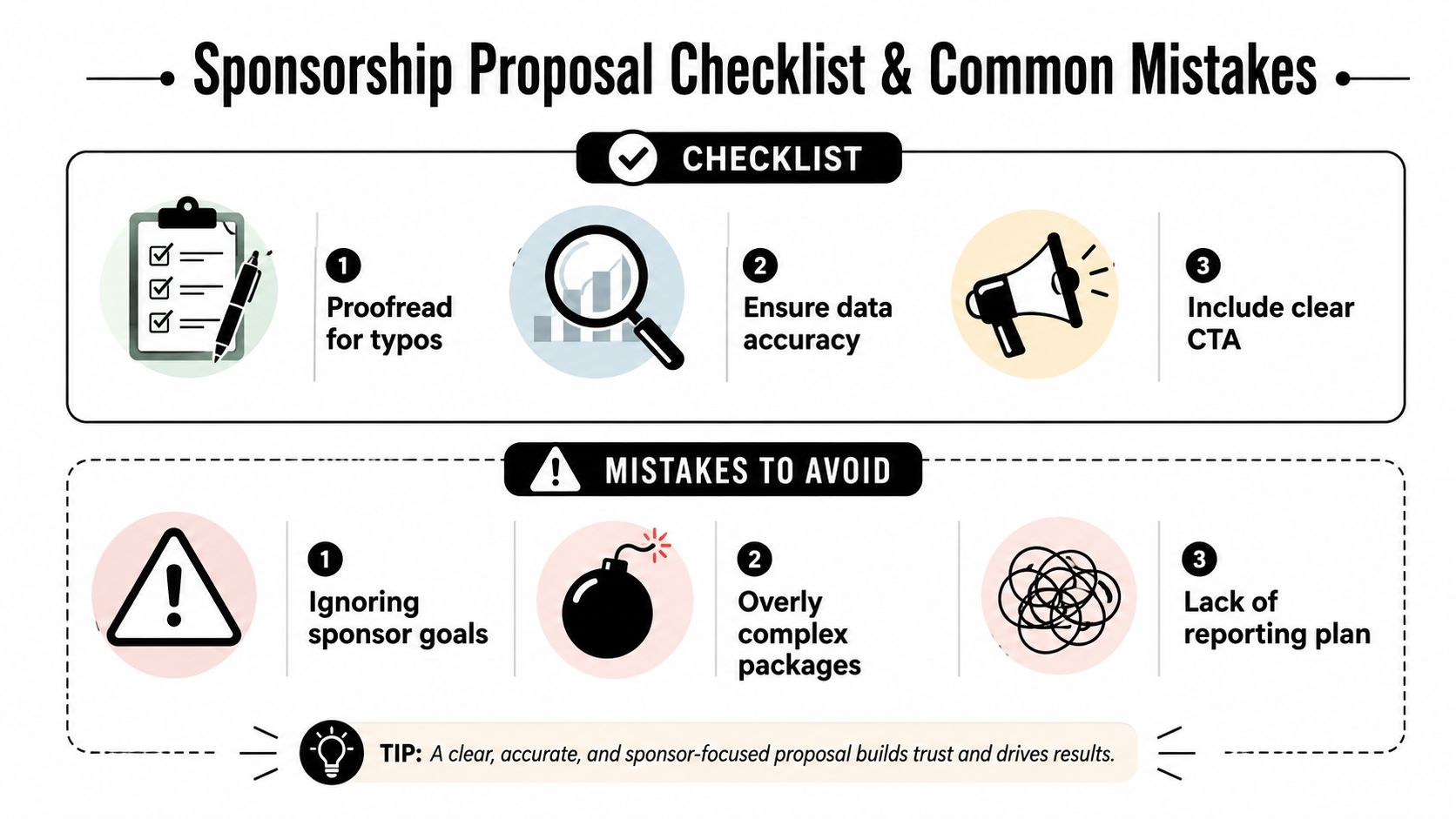
Before you send, check these items
- Proofread for typos. Sloppy copy signals sloppy execution.
- Ensure data accuracy. Every number should support the business case.
- Include a clear CTA. The sponsor should know exactly what happens next.
- Map sponsor goals. If the fit isn't explicit, the proposal feels generic.
- Add a measurement plan. Exposure without reporting is just a hope.
Common mistakes usually come from trying to make the proposal look bigger than the opportunity really is. Skip the vague Gold, Silver, Bronze deck if the audience data isn't there, and don't leave contract terms loose enough to create confusion later.
A better process is simple. Set the goal, prove sponsor fit, structure the document, use copy and tiering that read like a business case, negotiate thoughtfully, follow up within one week, and hand the deal into a managed contract workflow.
If you're building a sponsorship pipeline and want the proposal, redline, eSignature, and renewal process to live in one place, Legitt AI can help your team move from pitch to signed agreement without losing track of scope, approvals, or obligations. It's a practical fit for teams that want sponsorship proposals to turn into managed contracts, not scattered files.