Including but not limited to means the items named in the clause are examples, not the full list, so the wording also covers additional similar items even if they aren't listed. In contract drafting, that matters because courts and legal authorities treat it as a nonexhaustive list of examples that preserves broader coverage and helps prevent narrow readings of the clause's scope.
A procurement manager sees the phrase in a vendor agreement, pauses, and asks a sensible question, what exactly am I agreeing to here? In practice, that one sentence can shape whether a contract reaches beyond the named items to capture related duties, exceptions, or rights in a way that matches the business deal. For teams reviewing commercial agreements, the phrase is less about legal ornament and more about making sure the contract doesn't leave an opening for a loophole.
The Plain-English Meaning of Including but not Limited To
A scope-of-services clause can look harmless until a business dispute starts. A procurement manager reads “including but not limited to” and wonders whether the list that follows is the whole promise or just a sample of what the vendor must do.
The plain-English answer is simple. The phrase means the listed items are examples, not the complete universe, so the clause also reaches other similar items that fit the broader category. That's why the wording shows up so often in NDAs, SaaS agreements, policies, job descriptions, and other commercial contracts, where drafters want flexibility without giving up clarity.
Why the phrase shows up so often
Legal writing guides note that “including” is commonly used to introduce a nonexhaustive list, and drafting authorities often treat “including without limitation” and “including but not limited to” as having the same practical effect. In other words, the business point is not the exact phraseology, it's the signal that the list is illustrative.
Practical rule: if a clause uses this wording, read the list as a starting point, not as a ceiling.
That matters when a contract allocates risk or describes an obligation. A clause that says a vendor must provide “support, training, documentation, and including but not limited to implementation help” tells you the parties did not intend to stop at those three examples. The broader category still matters, especially in commercial agreements where one definitional sentence can affect whether extra obligations or exceptions are captured.
For teams standardizing drafting, it helps to pair the phrase with a clear category. Plain language contract drafting works best when the general class comes first, then the examples follow. That keeps the clause readable and reduces the chance that someone later argues the list was meant to be exhaustive.
The practical habit is straightforward. When you see the phrase, ask whether the list is meant to guide interpretation or fully limit it. If it's meant to preserve scope, the phrase is doing real work.
How Courts and Legal Authorities Interpret the Phrase
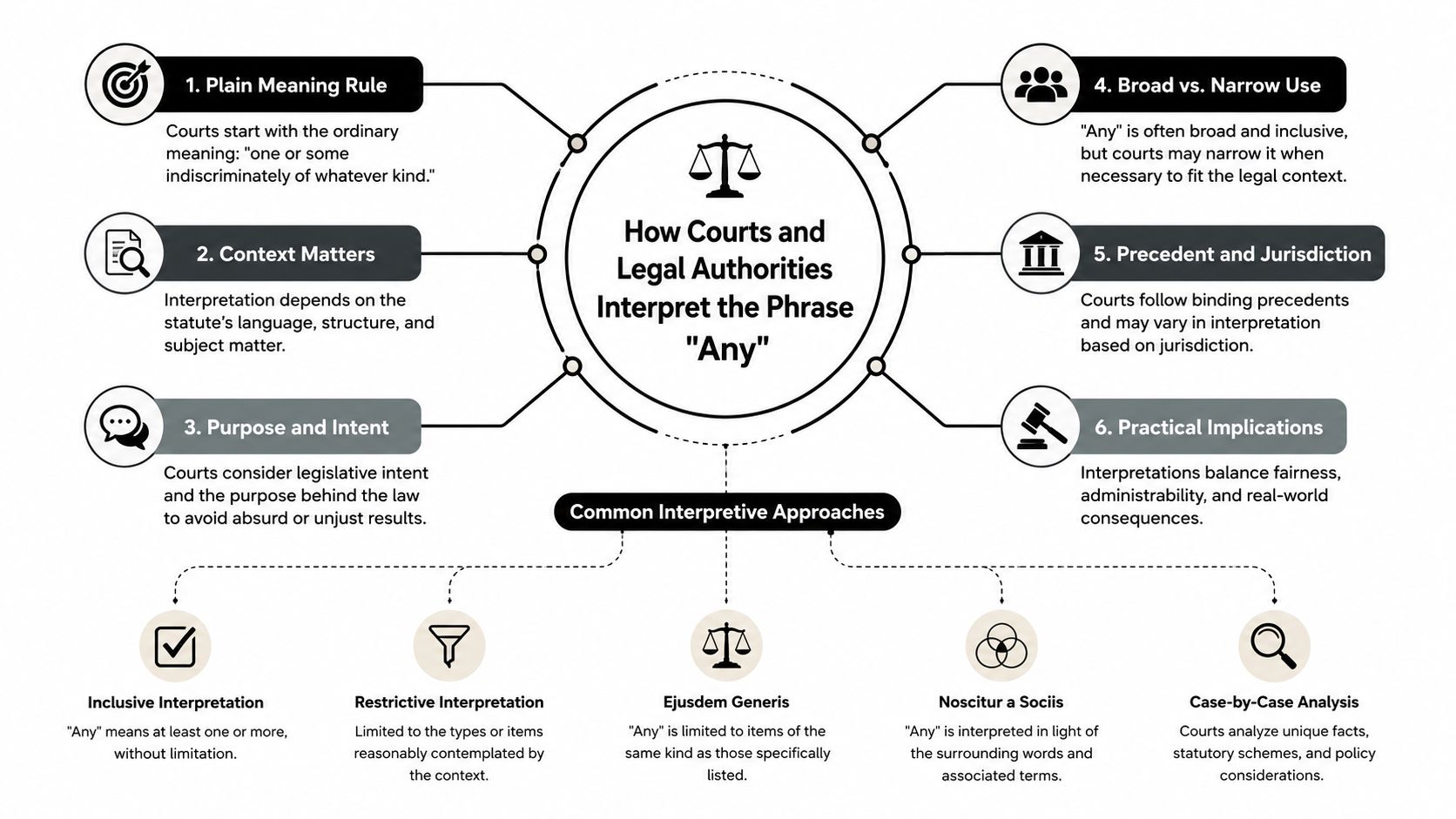
Courts do not treat “including but not limited to” as decorative language. The phrase is a drafting signal that the list is illustrative, not complete, and legal commentary uses it to reduce the risk that a reader will narrow the clause to the examples named. That matters most where ejusdem generis could pull a provision into a tighter reading, because specific examples followed by general words can invite an argument that only similar items were meant.
Why drafting authorities like the phrase
Law Insider explains that this wording prevents the interpretation that only the listed items are included, which is why transactional lawyers rely on it in commercial agreements. Black's Law Dictionary, as summarized in the legal-drafting material, treats “including without limitation” and “including but not limited to” as having the same practical effect. The goal is to keep the clause open, so items within the broader category remain covered even when the agreement does not name them one by one.
A common drafting practice is to define “including” once to mean “including but not limited to” throughout the agreement. That keeps the same nonexclusive meaning across the contract and avoids repeating the full phrase in every provision. It also helps legal and procurement teams that work through long agreements with multiple definitions, schedules, and incorporated terms, because the same interpretive rule stays in place from clause to clause.
Courts usually care less about the label and more about the signal the clause sends, whether the writer meant an open list or a closed one.
The business logic behind the legal rule
A grocery list that says “produce, including apples and pears” gives the same basic signal. The named items are examples, not the full order. Contract language works the same way, because a narrow reading can leave gaps in rights, prohibited conduct, or service obligations.
That is why boilerplate clauses deserve close attention. Boilerplate often looks routine, but a phrase like this can change the reach of an entire provision, especially if the surrounding language is vague. Modern AI contract management platforms like Legitt AI help legal and procurement teams spot those clauses, standardize preferred wording, and negotiate the open-ended language at scale, so a recurring drafting issue becomes a manageable review step instead of a hidden risk.
For legal and compliance teams, the takeaway is practical. The phrase is a scope-management tool, not just legal flavor. Used well, it keeps the written contract aligned with the deal the parties thought they were making.
Real Contract Examples With and Without the Phrase
A clause can look tidy on the page and still create a dispute later. The difference often comes down to whether the list reads as complete or only illustrative, and that choice matters when the parties later disagree about scope.
Side-by-side examples
A services clause without the phrase might say, “Vendor will provide onboarding, training, and support.” If a later dispute arises, the parties may argue over whether implementation help, documentation updates, or related launch tasks were part of the deal. With the phrase, the clause can read, “Vendor will provide onboarding, training, and support, including but not limited to implementation assistance and documentation updates.” That wording signals that the named items are examples, not the full universe of work.
A confidentiality clause shifts in the same way. Without the phrase, a definition of confidential information that lists business plans, pricing, and source code can be argued as complete. With the phrase, the definition tells the reader those items are examples of protected information, not the outer boundary of the definition.
A force majeure provision can benefit from the wording too. If a clause lists “fire, flood, and pandemic-related shutdowns,” the listed events may be read too tightly. Adding the phrase helps show that other similar disruption events can qualify if they fit the contractual standard.
A public example of broad service drafting appears in CloudOrbis Inc.’s HIPAA-compliant service terms, where the contract language shows how covered activities can be described without accidentally turning an open list into a closed one.
| Clause Comparison: With vs Without Including but Not Limited To |
| Clause Type | Without the Phrase | With the Phrase | Risk Difference |
|---|---|---|---|
| Scope of services | Only named tasks are clearly covered | Named tasks are examples, related tasks can still fit | Lower risk of loopholes |
| Confidentiality definition | List may be read as complete | List is clearly illustrative | Better protection against narrow reading |
| Force majeure | Named events may be treated as exclusive | Other similar events can still qualify | Less chance of missing a disruption event |
Contract teams often start from a template, then inherit language that looks consistent but behaves differently clause by clause. The core question is simple. Does the business need breadth, or does it need precision? If the list is meant to be closed, the phrase may add noise. If the list is meant to capture similar items without naming every one of them, the phrase does useful work.
For drafting teams that want to review this choice quickly and consistently, how to draft a simple contract is a practical starting point. The point is not to add more words. The point is to make sure the category, the examples, and the exclusions all fit together, so sales teams, procurement leaders, and operations managers can see the intended scope without guessing.
Common Misinterpretations and Drafting Myths
A contract reviewer sees a clause that reads, “including but not limited to,” and the first instinct is often to treat those words as magic. They are not. The phrase usually signals an open list, but it does not rescue weak drafting, and it does not turn an unclear category into a clear one.
One common myth is that the full phrase is always required. It isn't. Legal-drafting authorities note that “including” already implies a nonexclusive list, so the longer wording is often only a belt-and-suspenders choice when the drafter wants to remove any doubt about scope.
Another mistake is assuming the phrase overrides everything around it. It does not. If the surrounding language is narrow, inconsistent, or poorly defined, the phrase will not fix the problem. A broad label attached to a weak category still leaves room for argument.
What teams get wrong in negotiations
Some drafters use the phrase as a shortcut and stop there. They add it to clause after clause, then skip the harder work of defining the category itself. That creates false confidence, especially in agreements where scope, exceptions, and obligations need to be mapped with care.
A cleaner habit is to decide whether the list should be open or closed before redlining begins. If the clause is meant to be illustrative, the phrase or a similar open formulation fits. If the clause is meant to be tight, say so directly and avoid language that invites broader reading.
Drafting rule: do not rely on the phrase to solve a category problem the sentence itself has not solved.
Another negotiation myth is that the phrase must survive every counterparty review. That is not true. In some clauses, a shorter formulation like “such as” or “for example” may communicate the same practical idea more cleanly, depending on the context and the governing law. The test is whether the reader can see that the list is nonexclusive without having to guess.
Email examples create a similar problem. A footer that says “confidential” does not do the work of a real confidentiality clause, which is why why email footers fall short is a useful reminder for legal and procurement teams that want actual contractual protection rather than a decorative warning.
A further point matters for legal operations teams. Consistency across the contract repository matters more than one isolated clause. If one template uses “including but not limited to,” another uses “including without limitation,” and a third uses plain “including,” the team should decide whether that variation is intentional or just legacy drafting drift.
For a practical framework on avoiding inconsistent language, avoid ambiguity in contracts is the right mindset. Clear drafting beats defensive wording every time when the business wants fewer disputes and faster reviews.
Drafting and Negotiation Tips for Modern Contract Teams
The fastest way to clean up this phrase is to standardize how your team uses it. Legal, procurement, and sales teams do better when they treat inclusive wording as a drafting choice, not a habit.
A practical redline playbook
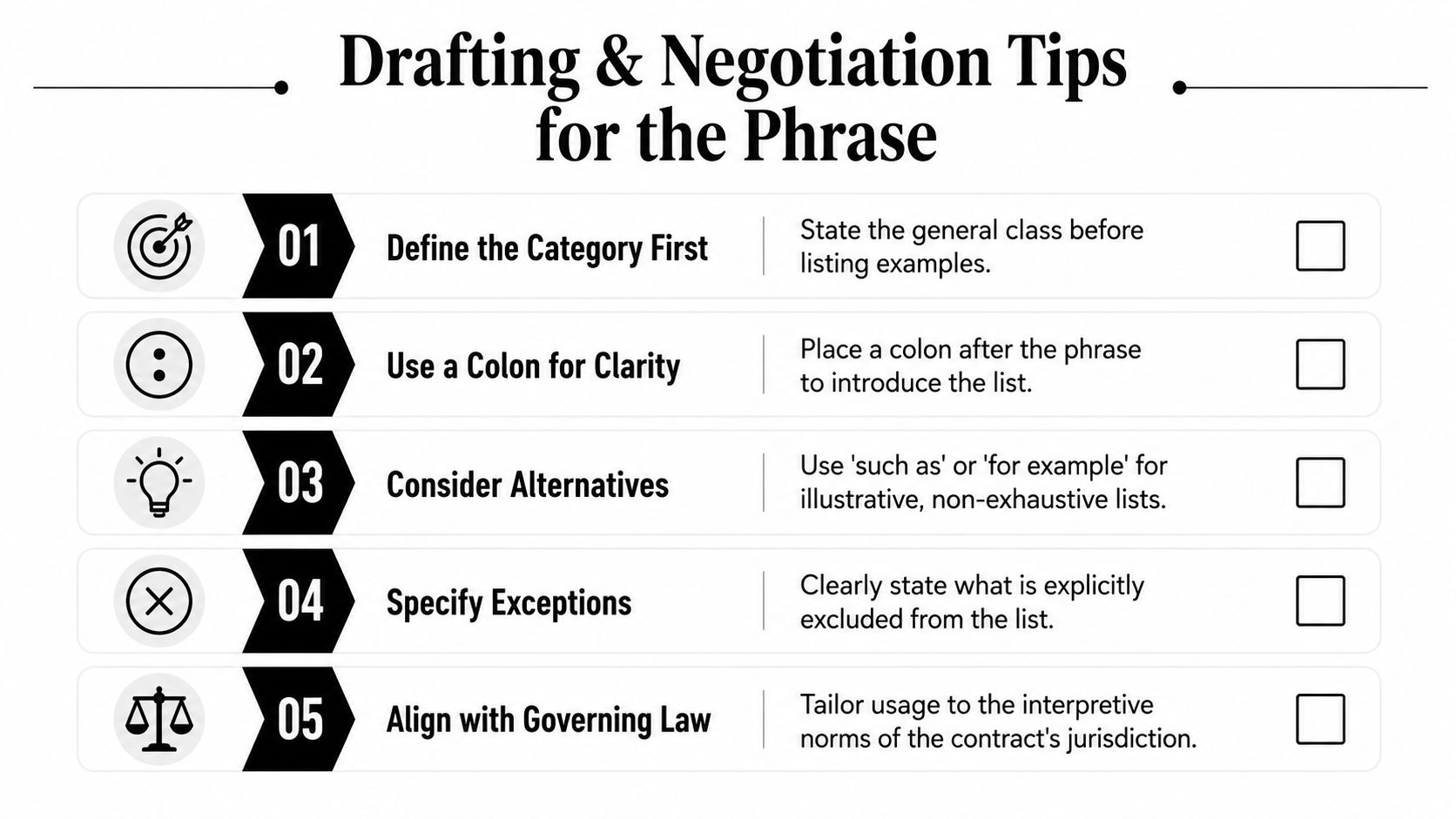
Start by defining the category before the examples. If the clause says “services, including but not limited to,” the category should be specific enough that the examples make sense on first read. If the category is too vague, the open-ended phrase only spreads the uncertainty.
Then decide whether you want the longer wording at all. Many teams accept “including without limitation” when they want the same nonexclusive effect but prefer a more formal style. Others define including in the definitions section so the agreement uses one consistent meaning throughout.
Here's a simple negotiation framework:
- Keep the phrase when the clause needs breadth, such as rights, obligations, prohibited acts, or covered materials that could evolve over time.
- Push back when the clause is meant to be narrow, especially in indemnities, limitations, or exclusion lists.
- Replace it with cleaner wording when “such as” or “for example” better matches the business intent.
- Add explicit exclusions if the counterparty is worried the list is too open-ended.
- Check the defined terms to make sure the phrase doesn't conflict with a separate definition elsewhere in the contract.
How AI contract management helps
AI contract management platforms earn their keep. A system like Legitt AI can help teams generate and edit contract language, review clause patterns, and flag inconsistent use of inclusive phrases across templates and third-party paper. That matters when a company wants one drafting standard for thousands of agreements rather than a different version in every business unit.
Contract review tools also help during negotiation. They can surface where a counterparty swapped “including but not limited to” for a narrower list, where a definition section uses one standard and the body of the agreement uses another, and where approval workflows need legal review before signature. That reduces manual hunting through redlines and helps legal ops keep preferred language in circulation.
If your team already uses negotiating contract terms as part of its playbook, make this phrase one of the standard checkpoints. The goal isn't to cling to boilerplate, it's to make the language match the risk you're willing to take.
Jurisdictional Notes and Contract Management Best Practices
Interpretation can vary by jurisdiction, so governing law matters. The phrase has a broadly similar practical meaning in many settings, but enterprise teams shouldn't assume every court will treat drafting nuance the same way, especially when a contract crosses borders or sits alongside local regulatory obligations.
That's why repository discipline matters. If legal operations can't see which templates use the phrase, where they appear, and how they vary by business unit, the organization will keep inheriting the same drafting drift. A contract intelligence layer helps surface those patterns so the team can standardize language during renewals, amendments, and template refreshes.
Where the clause affects the lifecycle
The drafting choice reaches beyond signature. Broad wording can influence how teams track obligations, monitor exceptions, and assess renewal risk. If a clause is meant to cover additional similar items, then the contract management team needs to know what those items are so it can assign the right owners and follow-up tasks.
That's especially useful in enterprise workflows where one contract family feeds many downstream processes. Legal operations can use clause analysis to identify inconsistent definitions, procurement can compare supplier paper against the house standard, and compliance can map obligations without rereading every agreement from scratch.
If the clause is broad, the workflow has to be broad enough to match it.
A platform such as Legitt AI can support that by centralizing executed agreements, surfacing clause deviations, and helping teams track renewals and obligations across a repository. The value is not just faster search. It's the ability to see whether the company's own drafting habits are consistent enough to support clean enforcement later.
For multi-jurisdiction portfolios, the practical best practice is simple. Use one approved formulation where possible, note where local law or deal structure justifies a variation, and review the wording again at renewal instead of waiting for a dispute to expose it. That approach keeps the clause from becoming a hidden source of risk.
Frequently Asked Questions About Including but Not Limited To
Is “including but not limited to” legally enforceable everywhere?
It's widely used and generally understood as nonexclusive, but interpretation can still depend on the contract language, the governing law, and the surrounding context. The safest move is to draft clearly and make the category itself precise.
How is it different from “including without limitation”?
In practical contract drafting, legal authorities treat them as having the same effect. The difference is mostly stylistic, not substantive.
Can AI contract review tools detect this phrase?
Yes. AI contract review and contract intelligence tools can flag the phrase, compare it across templates, and identify where a counterparty has narrowed or altered the wording. That makes it easier to standardize language across a contract repository.
When should I remove it entirely?
Remove it when the clause is supposed to be closed, when the examples are unnecessary, or when a cleaner phrase like “such as” better matches the business intent. If the sentence still feels vague after that, tighten the category instead of adding more boilerplate.
What's the biggest drafting mistake?
Assuming the phrase fixes a vague clause. It doesn't. Good drafting starts with a clear category, then uses the phrase only if you want an open list.
If your team wants to standardize inclusive clauses, reduce review time, and keep contract language consistent across every template, take a look at Legitt AI. It helps teams draft, review, negotiate, and manage contracts in one workspace, so phrases like “including but not limited to” stay aligned with your actual risk posture instead of drifting from one agreement to the next.