The fastest way to lose control of a new vendor is to let intake happen in email, due diligence happen in a spreadsheet, and contract approval happen somewhere else entirely. That's when a procurement lead discovers, after a security incident or a renewal scramble, that nobody can show why one supplier was approved, why another was escalated, or what evidence supported the decision.
A strong vendor risk assessment template fixes that by turning a scattered review into a repeatable decision record. It gives legal, procurement, security, and operations one place to capture vendor exposure, score controls, set escalation paths, and connect the result to contract terms, renewals, and ongoing monitoring.
Why Vendor Risk Assessments Fail Without the Right Template
A familiar failure mode starts with urgency. Procurement needs a signature, legal wants the paper reviewed, and security is asked to “just take a quick look” at a critical SaaS vendor that will touch customer data. If the review is only a questionnaire, there's usually no consistent scoring, no tiering logic, and no clear trigger for escalation when the answers raise concern.
That's where many programs break. The assessment becomes a snapshot instead of a decision instrument, and once the contract is signed, the result sits in a folder with no follow-through. A better template is a structured worksheet that converts qualitative answers into a defensible risk score, a risk tier, and an evidence log the business can act on.
Questionnaire, assessment, and program are not the same thing
A vendor questionnaire collects answers. A vendor risk assessment interprets those answers against policy, evidence, and threshold logic. A vendor risk management program uses that assessment to decide who gets deeper diligence, what contract terms must be added, how often a vendor is rechecked, and who has approval authority.
That difference matters because the template is the connective tissue between intake and execution. Without it, teams rely on memory and judgment. With it, they can show why one vendor got fast-tracked and another got blocked until controls were verified.
Practical rule: if the template doesn't tell the team what happens next, it's paperwork, not governance.
For teams modernizing vendor workflows, it helps to align the assessment with broader vendor governance practices, not treat it as an isolated form. A useful starting point is this guide on vendor management best practices, because the assessment only works when intake, review, approval, and monitoring are part of the same operating model.
Core Fields Every Vendor Risk Assessment Template Should Capture
A usable template starts with structure, not a giant list of generic questions. The fields should map to the decisions your team makes, who the vendor is, what they can touch, how serious the exposure is, what controls they claim to have, and what proof backs those claims. If a field won't change a decision, it probably doesn't belong in the core template.
Start with vendor identity and exposure
Capture the basics first, legal entity name, business owner, service description, data processed, systems accessed, subcontractors, and contract owner. These fields sound administrative, but they drive tiering and approval routing later because a payroll processor with employee data is not treated the same way as a facilities vendor with no sensitive access.
Then add inherent risk inputs. The most important ones are data sensitivity, access scope, regulatory exposure, and business criticality. Those fields define the risk before controls enter the picture, which keeps the process honest.
Add control maturity and evidence, not just yes or no
The next layer should capture security controls, compliance posture, business continuity, incident response, and contractual safeguards. But the difference-maker is the evidence log. A checkbox that says “yes, we have controls” doesn't help an approver. A linked artifact, such as a certification, audit report, or control description, does.
That's where the template earns its keep. If the vendor claims strong controls, the form should require the supporting file or reference, not a vague assertion. Teams that want to build and adapt these questions at scale can also use create custom surveys online to structure intake so the evidence requirements are built into the response flow instead of bolted on afterward.
| Template Section | What It Captures | Downstream Decision It Feeds |
|---|---|---|
| Vendor Profile | Legal name, owner, service, data scope, subcontractors | Intake completeness, ownership, routing |
| Inherent Risk Inputs | Data sensitivity, access scope, regulatory exposure, criticality | Initial tier and review depth |
| Control Maturity | Security, compliance, resilience, contractual safeguards | Residual risk scoring |
| Evidence Log | Certifications, audit reports, control descriptions | Approval, remediation, audit trail |
For contract-heavy teams, it also helps to connect the assessment to the paper itself. The clauses in this vendor contract clause guide should be influenced by what the template surfaces, not drafted separately from the risk review.
Building the Scoring Matrix That Turns Inputs Into a Risk Tier
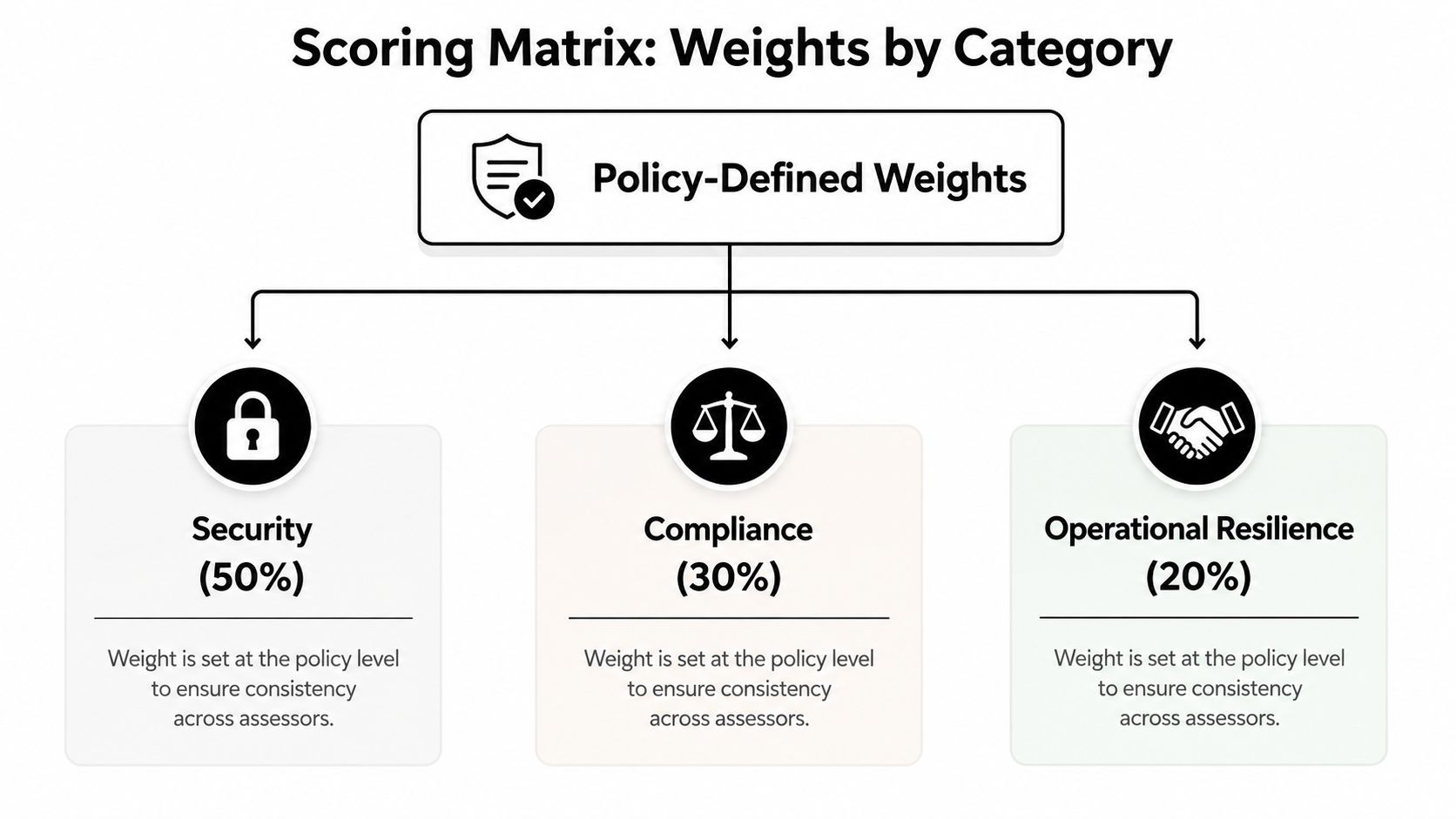
A scoring matrix only works when the weights are defined at the policy level, not improvised by individual reviewers. That keeps the template reproducible across assessors and across time. The practical shape is simple, a weighted scoring model that converts qualitative review into a risk tier, often using 1-to-5 scoring or a probability × impact matrix.
Put weights at the policy layer
A good matrix pushes the highest weight toward controls that directly affect risk exposure. In one example template, vendors are scored across 12 weighted dimensions, including data sensitivity accessed, access scope, authentication, encryption, compliance attestations, subprocessor management, business continuity, incident response, vulnerability management, questionnaire responsiveness, contractual safeguards, and financial and operational stability, with several controls weighted as high as ×5 or ×4 and lower-signal factors weighted ×2 (Uproot Security). That pattern shows the right instinct, direct security and compliance exposure should matter more than admin convenience.
A benchmark-style approach may also set explicit thresholds. One published model uses High risk above 75, Medium risk 40 to 74, and Low risk below 40 to make escalation more consistent (OrbiqHQ). If your organization prefers named tiers like Critical, High, Medium, and Standard, map those labels to numeric thresholds in policy and keep them stable.
A short worked example
Take a SaaS vendor that stores customer PII and supports a core workflow. If the vendor scores well on certification, authentication, and encryption, but has weaker evidence on subprocessor management and incident response, the matrix should still reflect the remaining exposure. The point isn't to reward polished answers. It's to calculate whether the controls offset the inherent risk.
That logic is similar to how regulated teams think about weighted assessments in other contexts, including how to run double materiality under CSRD, where the category structure matters as much as the final score. For vendor review, the same discipline keeps assessors from inflating scores because one dimension looks good while another is weak.
To make the matrix operational, tie the output to named approval paths in the form itself. If the vendor lands in a higher tier, the assessment should automatically require deeper evidence, more signatures, and a tighter contract review. That workflow is where the template stops being a spreadsheet and becomes control logic, which is the same design principle used in this contract risk assessment with Legitt AI.
Residual Risk and How to Score Control Effectiveness
A raw exposure score doesn't tell you whether the vendor is safe to use. That's why strong programs score residual risk instead of stopping at inherent risk. The sequence is straightforward, score the initial exposure, score how strong the compensating controls really are, then decide whether to accept, mitigate, or reject.
Use evidence to grade control strength
One published template describes control effectiveness bands such as Strong, Adequate, Weak, and Insufficient, with evidence expectations tied to each band, including ISO 27001 or SOC 2 Type II for stronger assessments, plus verified critical controls and audit-quality documentation (OrbiqHQ). That approach matters because two vendors can look equally risky on paper while one has mature controls and the other doesn't.
Here's the practical difference:
- Vendor A: same inherent risk, but strong evidence, current certification, clear incident response documentation, and verified continuity controls.
- Vendor B: same inherent risk, but thin evidence, vague answers, and no reliable proof the controls are operating.
Those vendors shouldn't end up in the same bucket. A residual-risk model forces the template to separate exposure from mitigation.
Keep the decision record audit-ready
The template should require an evidence log next to each rating. That's not a nice-to-have. It's what makes the result reproducible and reviewable when legal, audit, or regulators ask why a vendor was approved.
A practical template also needs explicit follow-up logic. If controls are weak, the form should trigger remediation, a narrower contract scope, or a shorter review cycle. If controls are strong, the review can move faster without losing rigor. Independent guidance from Bitsight also emphasizes evaluating a vendor across security controls, compliance status, operational stability, data handling practices, and legal and contractual obligations, with ongoing monitoring and audits rather than a one-time review (Bitsight).
The biggest trap is letting the inherent-risk score dominate the conversation. Control maturity changes the decision, and the template needs to make that visible.
Mapping Risk Tiers to Approvals, Escalation, and Contract Terms
A risk tier only matters if it changes what people do next. The template should encode that logic directly, so the output routes the review to the right approver, demands the right evidence depth, and inserts the right contract language. If the result is just a number in a spreadsheet, the process still depends on someone remembering the next step.
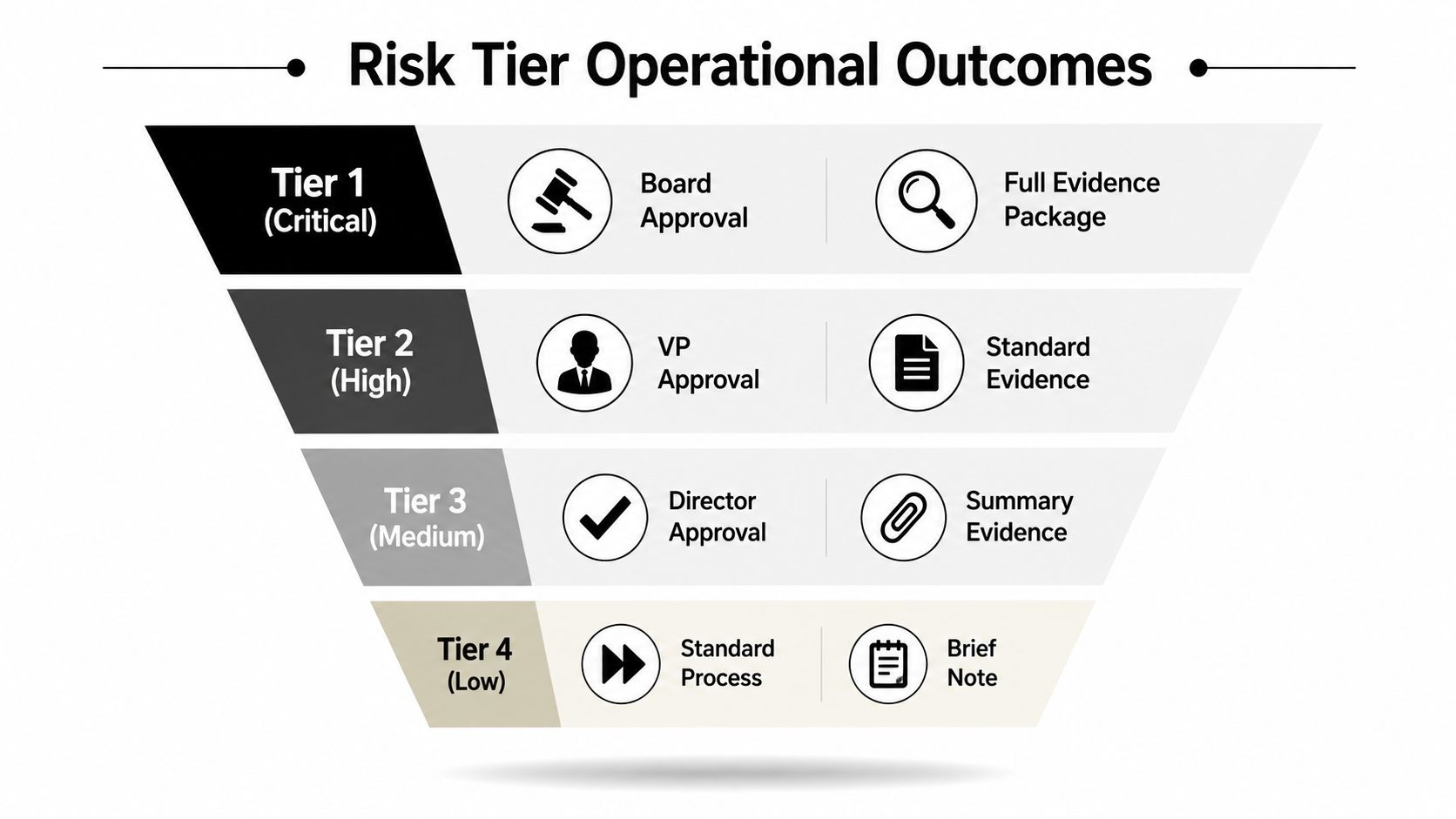
Tie each tier to an action
A clean model looks like this:
- Critical: board or executive approval, full evidence package, stronger contract controls, and continuous monitoring.
- High: senior leadership review, standard evidence plus targeted follow-up, and tighter renewal checks.
- Medium: director-level approval, summary evidence, and periodic reassessment.
- Low: fast-track approval, light evidence, and standard monitoring.
That structure keeps the process fast for low-impact vendors without weakening control over the ones that matter most.
The contract terms should follow the tier. High and Critical vendors often need audit rights, clearer breach notification language, data residency requirements where relevant, and termination or exit rights tied to ongoing risk thresholds. The goal is to prevent the assessment from becoming disconnected from the paper that governs the relationship.
Escalation should be automatic, not optional
One practical control is a tier-to-authority map that lives inside the template. If a vendor lands in the Critical range, the form should route the case to the right approvers without manual chasing. That model is consistent with role-based approval design, like the controls discussed in this role-based contract approval guide.
No one should have to interpret the score in a meeting after the fact. The template should already have decided who sees it next.
That same principle supports stronger contract operations. A vendor that scores high on risk should not only get more scrutiny at onboarding, it should also face shorter renewal review cycles and tighter ongoing monitoring. The tier becomes a live operating rule, not a retrospective label.
Plugging the Template Into Contract Lifecycle Management
A vendor assessment only creates value when its output follows the contract. If it stops at intake, the score sits in a file while the deal moves on. The assessment should travel with the vendor record through drafting, redlining, approval, signature, and obligation tracking inside the CLM, so the team can trace a clause back to a risk finding and a renewal alert back to the original rating.
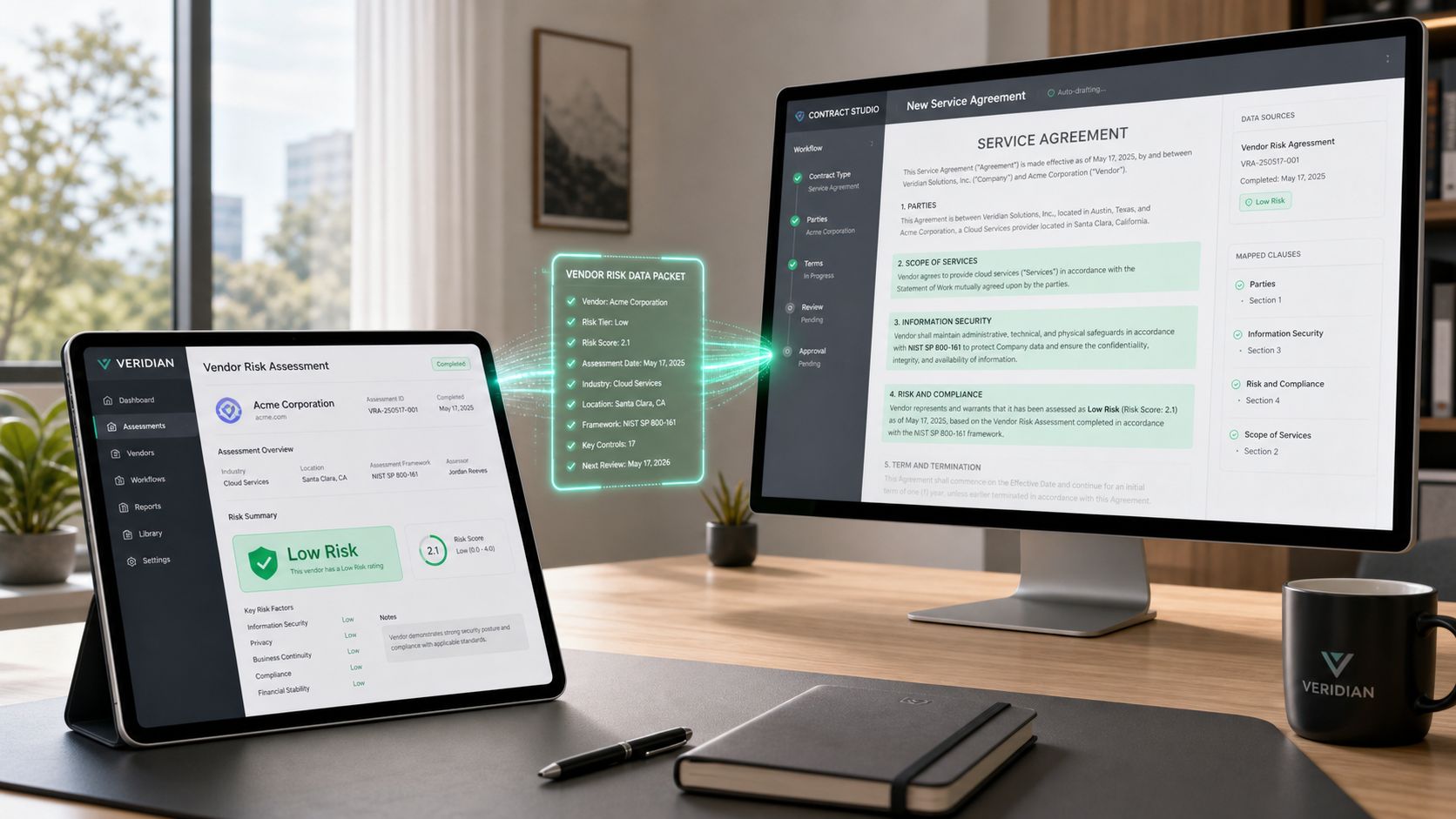
Treat the assessment as contract metadata
The cleanest integration pattern is straightforward. Store the risk tier, residual risk score, evidence log, and key findings with the executed agreement, then tie those fields to contract clauses, reviewer comments, and renewal milestones so the record stays connected as the relationship changes.
That connection matters in day-to-day work. If a vendor was approved with a data residency exception, the contract should carry that exception forward and the renewal workflow should flag it again. If the evidence package showed a weaker control area, the CLM should preserve that note so the next review starts from the actual status, not from a blank page.
The assessment output should also drive what the CLM asks for next. A higher-risk vendor may need a specific clause set, a tighter review path, and a clearer obligation record, while a lower-risk vendor may only need standard language and lighter monitoring. For a closer look at how these workflows connect, see our complete guide to contract lifecycle management.
Use the CLM to keep risk alive after signature
Once the contract is signed, the work is not over. The CLM should keep the assessment active by linking the risk tier to renewal alerts, obligation tracking, and deviation checks so the controls promised during review stay visible after execution.
In a CLM like Legitt AI, teams can keep vendor risk data, contract clauses, and approval workflows in one workspace, while clause extraction and deviation analysis help surface where third-party paper diverges from the company standard. That is useful when legal needs to compare a supplier's draft against the risk profile captured during assessment.
A connected workflow also changes what happens at renewal. A vendor that scored higher on risk should surface earlier for review, and any contract language that was tied to the original assessment should be easy to find and test again. Obligation tracking can reflect the controls the vendor agreed to, while deviation analysis can flag when later edits weaken a term the assessment relied on. For CLM teams, that difference matters. It separates a static document store from a working control system.
The same setup also supports eSignature and approval routing without extra handoffs. Procurement can send the contract, legal can review deviations, security can confirm the control evidence, and the business owner can see status without chasing email threads. The assessment becomes part of the enterprise contract workflow, not a side document.
Common Pitfalls and How the Template Should Prevent Them
The biggest failure is usually a template that leaves too much room for interpretation. One team skips vendor inventory reconciliation, another rates every supplier at the same depth, a third uses yes or no answers that hide nuance, and no one ties the score to a required next step. The process stays busy, but it does not reduce risk.
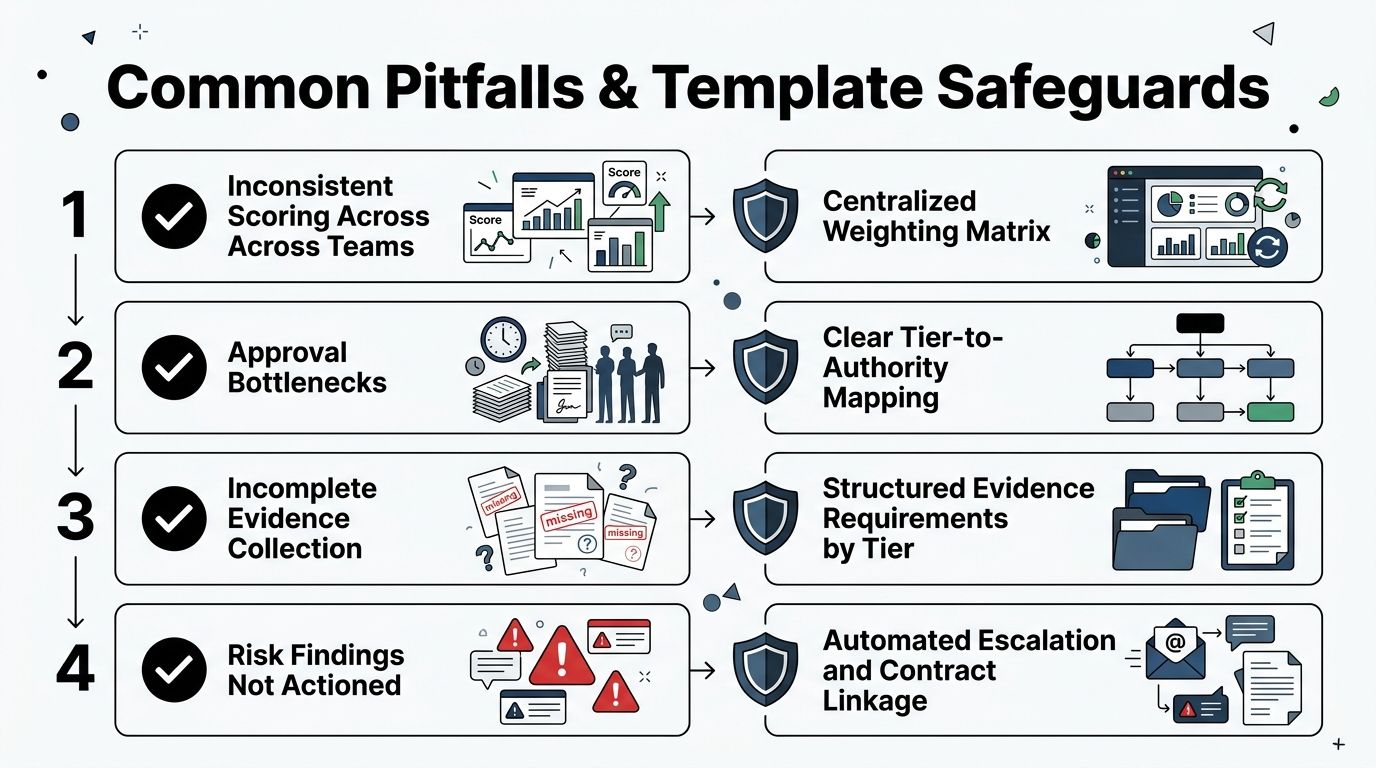
Build the safeguard into the field design
Each failure mode needs a structural fix, and the template should force that fix at the point of input.
- Inconsistent scoring across teams, use a centralized weighting matrix with clear scoring guidance.
- Approval bottlenecks, define tier-to-authority mapping before the first review starts.
- Incomplete evidence collection, require structured evidence fields by risk tier and question type.
- Risk findings not actioned, connect the assessment output to escalation paths and contract workflows.
The template should also drive reassessment on a schedule tied to tier. That prevents the common habit of treating vendor risk review as a one-time event. As vendor controls, business relationships, and regulations change, the original answer can go stale quickly, and the template needs to surface that change before renewal or contract changes are approved.
A practical form should also reject weak inputs. If a reviewer assigns a risk rating, the form should require the reason, the evidence used, and the follow-up action. A field set like that turns a questionnaire into an auditable control process and gives legal, procurement, and security a clean record to use later in approval, renewal, and monitoring decisions.
One more trap is using a single questionnaire for every vendor. Low-risk suppliers do not need the same evidence burden as a critical SaaS provider handling customer data. A good vendor risk assessment template routes deeper diligence only where the risk tier justifies it, which keeps review speed acceptable without giving up rigor. A chart showing common vendor risk assessment pitfalls paired with corresponding template safeguards and process solutions.
If the template is built well, the output is more than a score. It tells the team which vendors need deeper diligence, what evidence is missing, when escalation is required, and which contract clauses, renewal triggers, and monitoring steps should follow in the CLM workflow.
If you want vendor risk data to flow cleanly into contract drafting, approval routing, eSignature, renewals, and ongoing monitoring, Legitt AI gives legal and procurement teams one place to manage those steps. Visit Legitt AI to see how contract intelligence and workflow automation can keep vendor assessments tied to the agreement itself.