
Evergreen clauses are where contracts quietly keep going-sometimes with pricing changes-because the agreement renews automatically unless someone sends the right notice, in the right way, within the right window. In a single contract, that’s manageable. Across hundreds or thousands of agreements-MSAs, Order Forms, SOWs, amendments-it becomes one of the most common (and expensive) sources of “we didn’t realize we renewed.”
This is exactly the type of problem AI is good at solving-not because AI “understands contracts like a lawyer,” but because it can read every document consistently, surface the right evidence, normalize the renewal logic into structured fields, and trigger workflows before humans miss the deadline.
In this article, we’ll explain how AI detects evergreen clauses you might miss, what makes those clauses hard to catch, where AI can fail, and what a production-grade implementation looks like inside a modern contract intelligence platform like Legitt AI-from clause detection and evidence capture to renewal calendars, alerts, and portfolio-level risk views.
The evergreen clause problem: why it’s a real operational risk
Evergreen clauses are not inherently “bad.” Vendors like them because they reduce churn; customers accept them because they’re convenient. The risk comes from execution: missed deadlines, incorrect notice delivery, unclear term triggers, and inconsistent contract structures that hide renewal logic.
In real portfolios, evergreen exposure shows up as:
- Surprise renewals because notice windows were missed
- Auto-renew + uplift (or price escalators) that increase spend silently
- Non-standard notice requirements (certified mail, specific address, portal-only) that invalidate attempted termination
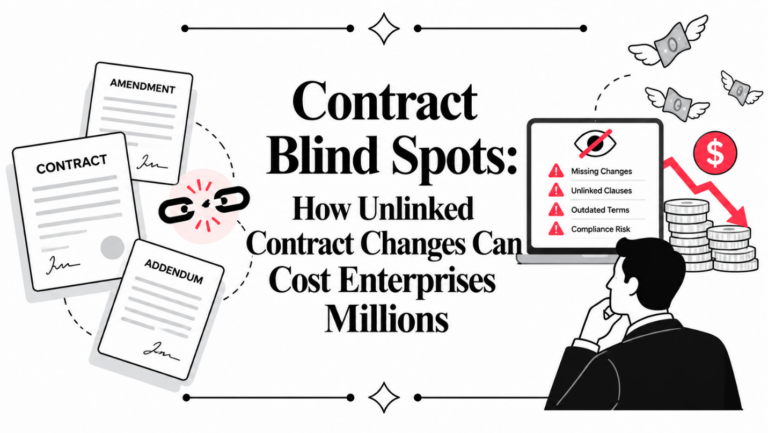
- Conflicting terms across MSA vs Order Form vs Amendment
- No clear “term start date” because the contract starts “upon go-live” or “acceptance”
Humans don’t miss these because they’re careless. They miss them because the information is distributed, inconsistent, and time-sensitive-exactly where automation excels.
What counts as an evergreen clause?
A true evergreen clause typically includes three components:
- Auto-renew trigger
“This Agreement will automatically renew…” - Renewal period definition
“…for successive one-year terms…” or “…month-to-month…” - Non-renewal / termination notice requirement
“…unless either party provides notice at least 60 days prior to the end of the then-current term.”
But evergreen behavior can also appear as:
- Perpetual-until-terminated terms
“This Agreement remains in effect until terminated…” - Auto-extension mechanisms
“Term extends for additional periods unless…” - Renewal by default combined with restrictive termination clauses
“You may terminate only at the end of the term with 90 days’ notice…”
This variability is why keyword searches alone (“renew automatically”) don’t solve the problem.
Why evergreen clauses are commonly missed (even by strong reviewers)
1) The language is inconsistent
Evergreen rarely says “evergreen.” Instead it appears as:
- “automatically renews”
- “successive renewal terms”
- “continues in effect”
- “shall extend”
- “unless terminated / unless non-renewed”
2) The logic is split across sections
Term definitions might be in “Term,” notice mechanics in “Notices,” and constraints in “Termination.” Reviewers must mentally join these sections.
3) Start/end dates can be conditional
If the contract says the term begins at “go-live,” you cannot calculate the renewal date without operational data-so renewal tracking breaks.
4) The governing document may not be the one you think
Often the Order Form overrides the MSA. Or an amendment changes only the notice period. Those precedence relationships create subtle traps.
5) Redlines create contradictions
In negotiated documents, you’ll frequently see mismatched windows (30 days in one section, 60 in another) because edits weren’t harmonized.
How AI detects evergreen clauses you might miss
Inside a contract intelligence platform like Legitt AI, evergreen detection is best treated as a pipeline, not a single “LLM prompt.” A production-grade approach uses multiple layers to maximize recall, then tighten precision and extract actionable fields.
Instead of just reading about evergreen clause detection, you can try it on your own contract.
Upload a document below to see how AI identifies auto-renewal language, notice periods, and renewal risks that are easy to miss manually.
 Hi, What do you want to Draft?

Click to upload or drag & drop
pdf, docx up to 5 MB
Click to upload or drag & drop
pdf, docx up to 5 MB
Layer A: Clause discovery (high-recall detection)
Goal: “Don’t miss candidates.”
Techniques:
- Pattern rules for known renewal phrases
- Semantic retrieval using embeddings to catch paraphrases
- Structure-aware scanning (headings like “Term,” “Renewal,” “Termination,” “Notices”)
Output: a shortlist of candidate passages with context boundaries.
Layer B: Renewal-type classification (is it evergreen?)
Goal: “Is this truly auto-renew / perpetual-until-terminated, or not?”
AI classifies into a finite set:
- Auto-renew
- Optional renewal / mutual agreement
- Perpetual until terminated
- Fixed term (no renewal)
- Ambiguous / conflicting
This is crucial because many contracts mention renewal but do not auto-renew.
Layer C: Parameter extraction (turn text into fields)
Goal: “Make it operational.”
AI extracts:
- Initial term length
- Renewal term length
- Notice window (e.g., 30/60/90 days)
- Notice method (email, certified mail, portal)
- Timing condition (“before end of then-current term”)
- Uplifts/escalators tied to renewal
- Precedence indicators (what controls if multiple docs exist)
Layer D: Evidence-first output (trust and auditability)
A serious system does not just output “Evergreen: Yes.”
It outputs:
- the exact snippet(s)
- where it appeared (section/page if available)
- extracted fields
- confidence score
- and flags (conflict, missing input, OCR uncertainty)
This evidence layer is what makes legal and ops teams actually adopt it.
The highest-value evergreen misses AI tends to catch
1) “Evergreen until terminated” buried in termination language
Many agreements don’t say “auto-renew,” they say the agreement continues unless terminated, and then restrict termination heavily.
2) Renewal logic split across MSA and Order Form
AI can link MSA + Order Form and detect inconsistencies like:
- MSA: annual auto-renew
- Order Form: month-to-month after initial term
Humans often review only the Order Form at signing, then forget what the master says.
3) Notice requirements that invalidate termination
A team might send an email to terminate, but the contract requires:
- written notice to a specific physical address,
- by certified mail,
- delivered to a particular role/title,
- within a specific period.
AI can extract these requirements and push them into a “notice playbook.”
4) Renewal + pricing uplifts hidden in fees
Renewal clauses often pair with:
- automatic annual uplifts,
- index-based increases,
- renewal at “then-current list price,”
- or removal of discounts at renewal.
AI can surface renewal economics, not just renewal timing.
5) “Term starts at acceptance/go-live” missing from the document
AI will flag: “Cannot compute renewal date; start trigger requires external date.”
That is a major win because it forces the business to capture the missing operational input.
Where AI fails-and how Legitt AI should mitigate it
AI is not infallible. The failures are predictable, and you can design around them.
Failure mode 1: OCR and layout errors
If renewal terms are inside a table (common in Order Forms), weak OCR may lose structure.
Mitigation:
- strong OCR + layout extraction
- detect “table-likely” regions
- route low-confidence extractions to review
Failure mode 2: Conflicts across documents
AI may extract two different notice windows.
Mitigation:
- introduce a “conflict” state instead of guessing
- run precedence analysis (does Order Form override MSA?)
- require validation before calendar automation
Failure mode 3: “Mutual renewal” misclassified as auto-renew
Mitigation:
- strict label definitions
- adversarial examples in prompts
- rule checks (must have default renewal without affirmative action)
Failure mode 4: Hidden overrides in amendments
Mitigation:
- amendment detection + “supersedes” language parsing
- linking contract sets into a single agreement graph
The production-grade workflow: evergreen detection that drives action
Here’s how this should work end-to-end inside Legitt AI.
Step 1: Ingest documents and build the agreement set
- Identify MSA, Order Forms, SOWs, Amendments
- Link them via metadata, naming patterns, and internal references
Step 2: Run renewal detection across the entire agreement set
- Discover candidates across all docs, not just the “main” one
- Store snippets with context and offsets
Step 3: Classify renewal type and extract parameters
- Renewal type (auto/optional/perpetual)
- Term length(s)
- Notice window + method
- Renewal economics (uplift/price changes)
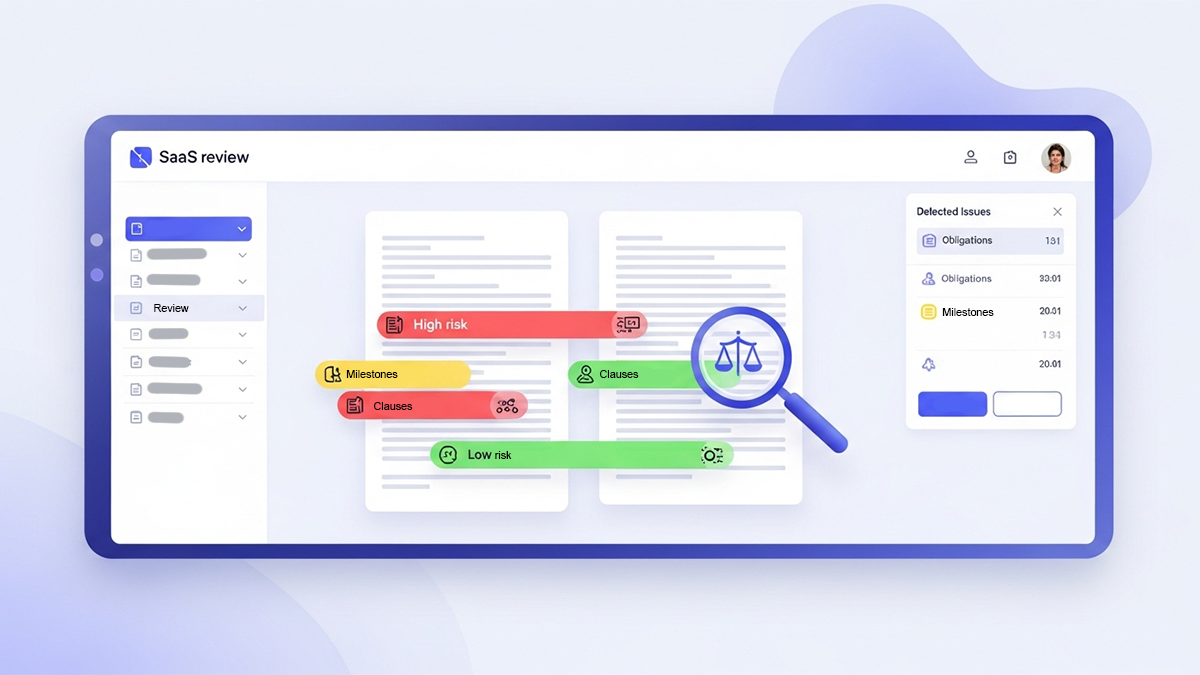
Step 4: Validate via “traffic light” triage
- Green: high confidence, no conflicts, compute deadlines
- Yellow: missing start trigger or key input
- Red: conflicting terms, low confidence, OCR uncertain
Step 5: Compute renewal deadlines and create a renewal object
Once validated, create a normalized renewal record:
- next renewal date
- latest date to send notice
- notice method checklist
- owner + stakeholder mapping
- links back to evidence
Step 6: Trigger alerts and workflows
- Alerts at 120/90/60/30 days (configurable)
- Push tasks into CRM, ticketing, or internal workflow
- Create “Renewal Playbook” tasks if notice method is strict
Step 7: Portfolio insights (the compounding value)
Now you can answer questions like:
- Which vendors have auto-renew + notice > 60 days?
- Which contracts renew in the next 90 days?
- Which renewals include automatic uplifts?
- Which agreements are perpetual-until-terminated?
This is where AI stops being “analysis” and becomes “control.”
Measuring success: what metrics matter
If you’re implementing evergreen detection, measure outcomes that tie to business impact:
- Recall (must be high): evergreen clauses found vs missed
- Precision (improves over time): correct detections vs noise
- Time-to-triage: how quickly legal confirms/denies
- Missed-deadline rate: should drop dramatically
- Surprise renewals avoided: direct savings
- Renewal renegotiation rate: leverage gained
The highest ROI often comes from combining evergreen detection with a renewal calendar and consistent alerting-because even perfect clause detection doesn’t matter if nobody acts on it.
The strategic value: beyond “finding the clause”
Evergreen detection is a wedge into higher-value capabilities:
- Renewal risk scoring: notice window length + uplifts + strict notice mechanics
- Standardization enforcement: flag clauses that violate internal policy
- Negotiation intelligence: detect vendor-friendly renewal language during drafting, not after signing
- Continuous compliance: periodic rescans as amendments arrive
In short: AI makes evergreen management proactive, not reactive.
Read our complete guide on Contract Lifecycle Management.