30% of legal professionals reported using AI in 2024, up from 11% in 2023, and among those already using or considering it, 52% preferred ChatGPT. The question in law isn't whether to adopt AI anymore, it's how to adopt it without turning confidential work into unmanaged risk.
ChatGPT is changing legal practice because lawyers are using it for the work that fills the calendar but doesn't require final judgment, first drafts, summaries, issue spotting, and cleanup. The problem is that most firms are still treating it like a loose chat window instead of a governed workflow. That gap is where efficiency gets lost, and where privilege, accuracy, and supervision become real operational issues.
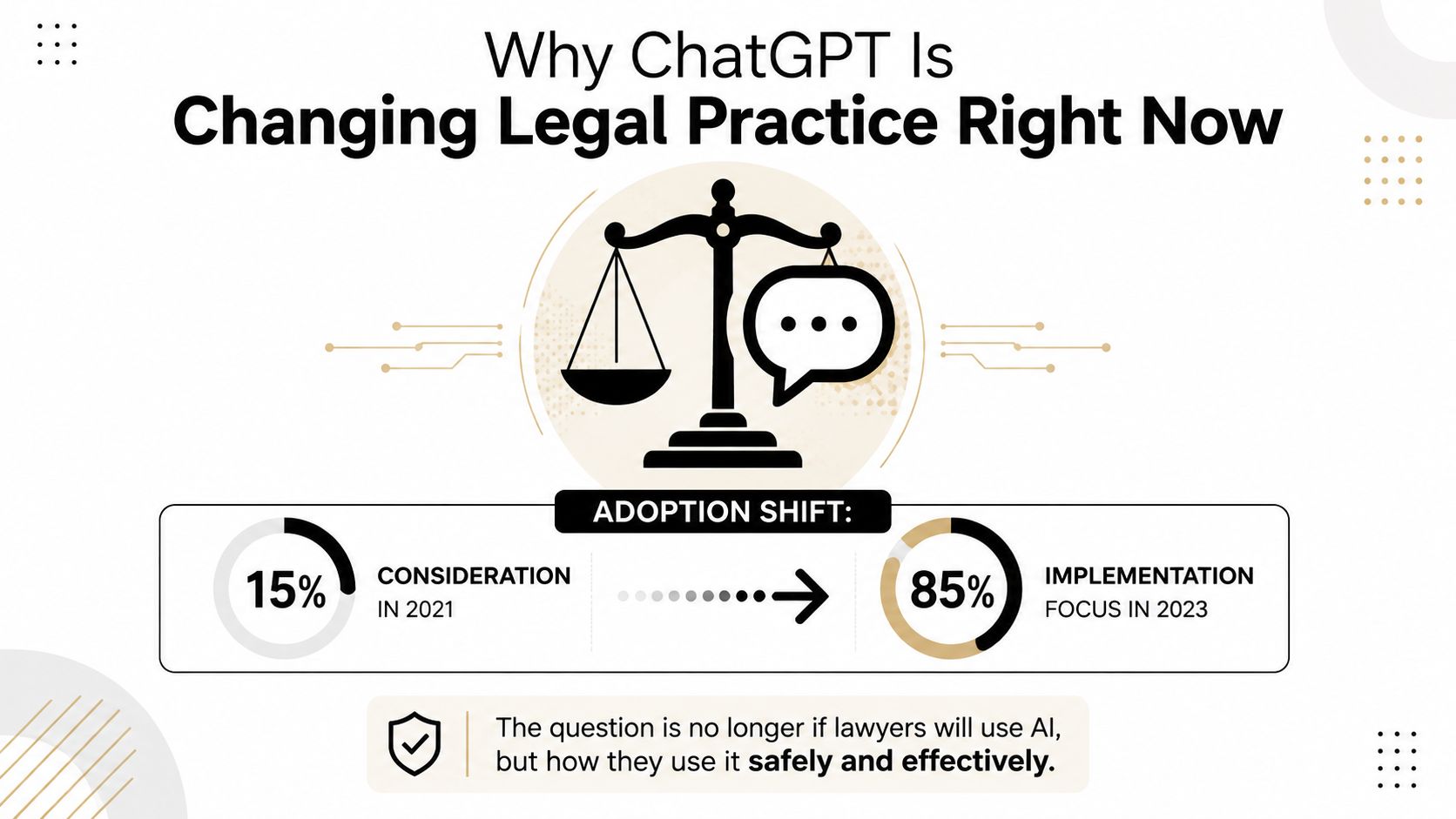
Why ChatGPT Is Changing Legal Practice Right Now
The legal market has crossed a line. In the American Bar Association's 2024 Legal Technology Survey, 30% of respondents said they were already using AI technology, up from 11% in 2023, and ChatGPT was the most popular solution among firms using or considering AI at 52%; 54% said the main expected benefit was saving time or increasing efficiency source. That combination matters more than the raw adoption number, because it shows lawyers are already organizing work around speed, and they are doing it with a tool that feels familiar enough to use without a long training curve.
Adoption is moving faster than governance
The profession's habits changed faster than its control framework. A tool that was a novelty two years ago is now showing up in intake, drafting, research triage, and contract review, but many firms still haven't defined what counts as acceptable use, what must be verified, or who owns the review trail. That gap is the operational problem. It is where efficiency gains get lost, and where privilege, accuracy, and supervision become live issues instead of abstract policy topics.
Practical rule: if AI output can influence a client decision, it needs a human verification step before it leaves the team.
The business pressure is obvious. Lawyers want less time spent on repetitive work and more time spent on judgment-heavy work, and ChatGPT fits that need because it can speed up the early stage of almost any matter. It works best as a first-draft and synthesis layer, not as a legal authority.
A smart legal team does not ask whether ChatGPT is “good.” It asks where it can be inserted without weakening the control points that matter most. That question leads to use case selection, prompt discipline, confidentiality boundaries, and workflow design, all of which matter more than the novelty of the model itself. For teams building a contract-centered deployment, Legitt AI's overview of streamlining legal processes shows how AI can sit inside a governed system instead of living in a free-form chat box.
Where ChatGPT Adoption Stands in Legal Work Today
The current pattern is clear. ChatGPT has moved from a curiosity to a working tool in legal teams, and the question inside firms is shifting from whether people are trying it to where it can be used without weakening control.
A 2025 Clio-based legal trends summary reported that 79% of legal professionals were using AI tools, and among those currently using or seriously considering AI, 52% said they used or were considering ChatGPT source. That points to a tool that is already familiar to many lawyers. It is becoming a default starting point for drafting, synthesis, and first-pass review.
Smaller firms are moving faster
The same summary showed a sharp difference by firm size, with 64% of firms with 2 to 9 attorneys preferring ChatGPT, compared with 36% of firms with 100 or more attorneys source. Smaller firms can trial a tool quickly, change habits without much internal drag, and feel the benefit of shaving time off routine work.
Large firms usually move slower due to structural reasons such as legacy systems, more permissioning, more review layers, and heavier client-data sensitivity. That slower pace is a governance issue, not a signal that the tool has less value. Smaller firms often accept more experimentation because the payoff is easier to see in daily work.
Efficiency is the reason lawyers care
Efficiency is the main reason lawyers see value in generative AI, which matches how ChatGPT is being used in practice. The focus is on reducing time spent moving from raw matter input to a structured working draft, not on handing judgment over to the model.
That difference matters operationally. ChatGPT is being folded into routine work because it helps lawyers start faster, and because it can support the early stages of a matter without replacing review. Firms that understand that boundary are better positioned to write usage policies that reflect how lawyers work. For teams building a contract-centered deployment, how AI can help legal teams manage contracts more efficiently shows how AI can fit inside a governed system instead of sitting in a free-form chat box.
| Firm context | Typical ChatGPT posture | Operational consequence |
|---|---|---|
| Small firm | Quick experimentation and fast adoption | Less inertia, more direct time savings |
| Large firm | Slower rollout and heavier governance | More controls, fewer surprises |
| In-house team | Focus on repeatable contract and memo work | Stronger need for review and confidentiality rules |
The market signal is straightforward. ChatGPT is no longer being tested only at the edge of legal work, it is being folded into everyday workstreams. What separates a useful deployment from a risky one is control, not enthusiasm.
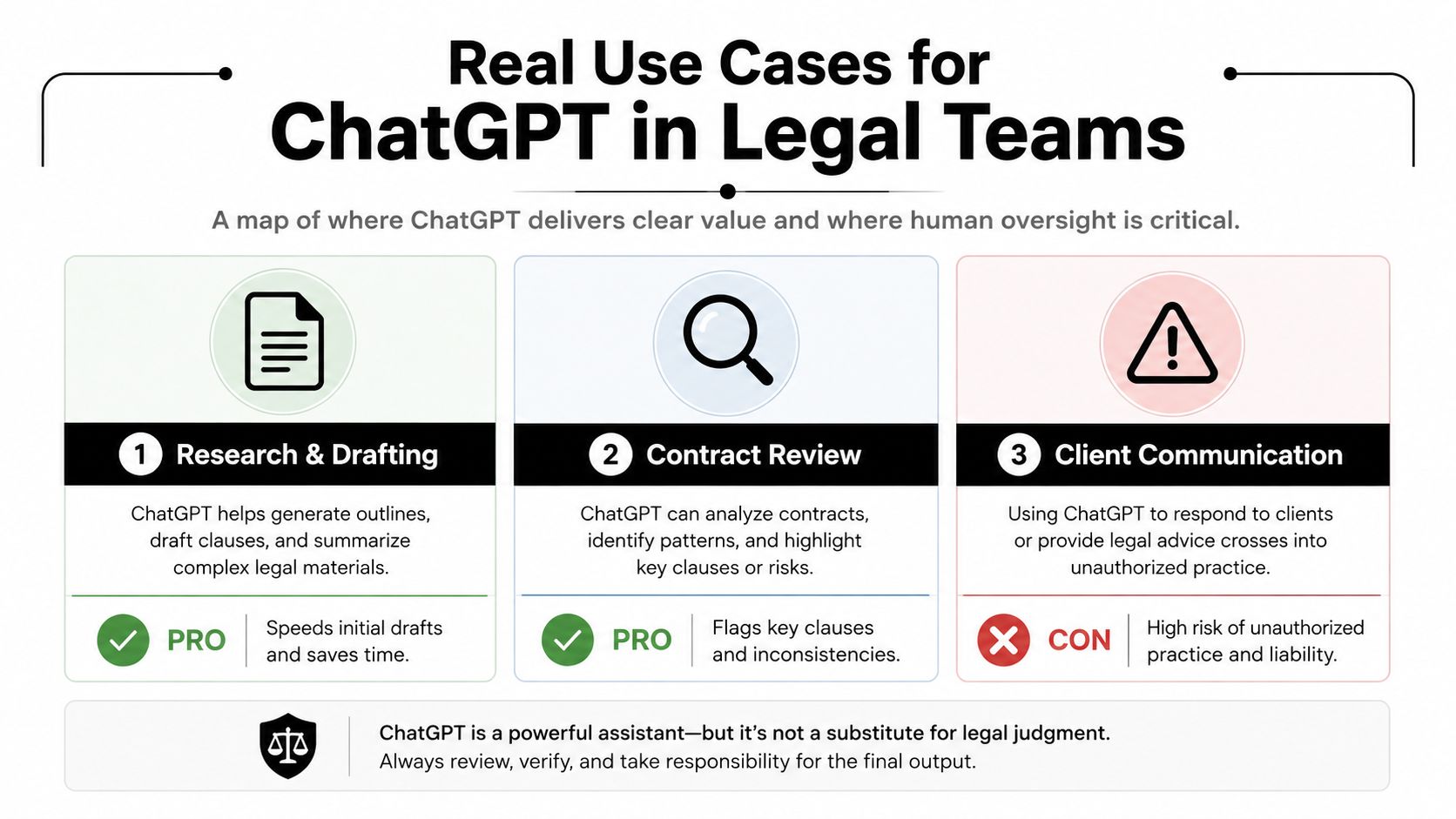
Real Use Cases for ChatGPT in Legal Teams
ChatGPT does its best work when the task is structured, bounded, and easy to verify. It's useful for early drafting, quick summarization, and triage, but it becomes brittle when it's asked to make final legal judgments or handle sensitive communications without review. That boundary matters more than the feature list.
Where the tool adds real value
Drafting is the most obvious use case. A lawyer can feed in plain-language deal terms and get a usable first pass at an NDA, a service agreement, or a client email, then shape it into firm style. Summarization is another strong fit, especially for long contracts, deposition notes, and matter updates that need to be reduced into something a partner or business stakeholder can act on.
Research triage is also legitimate. ChatGPT can help identify the issues likely to matter, surface themes, and organize follow-up questions before a lawyer goes to primary sources. Clause analysis works the same way, especially when a team needs to scan several agreements for patterns, inconsistencies, or missing terms.
| ChatGPT Use Cases for Legal Teams | ChatGPT Role | Human Oversight Required |
|---|---|---|
| Drafting NDAs and routine agreements | Create a first draft from structured inputs | Yes, for clause accuracy and jurisdiction |
| Summarizing long contracts | Condense obligations, deadlines, and risk points | Yes, for completeness and source checking |
| Triage of incoming contracts | Sort documents by risk tier or issue area | Yes, for final classification |
| Clause comparison across agreements | Flag inconsistent indemnity or termination language | Yes, for legal interpretation |
| Client-facing advice or final opinions | Not appropriate as a standalone authority | Full human control required |
ChatGPT is strongest when it helps a lawyer think faster, not when it pretends to think for the lawyer.
Where it should stop
Client communication is where many teams overreach. A polite draft email is fine. A message that drifts into legal advice, sensitive facts, or nuanced admissions is not. The same is true for final research citations, jurisdiction-specific analysis, and anything that will be filed, sent, or relied on without independent review.
For contract-heavy teams, this guide on how AI can help legal teams manage contracts more efficiently lines up with the practical reality here, ChatGPT helps most when the task is repetitive and reviewable, not when it's determinative. If the output changes legal risk, a human has to own the decision.
The fastest way to use the tool well is to treat it as a drafting and triage layer. The fastest way to use it badly is to treat it as a substitute for legal judgment.
Prompt Engineering for Legal Drafting and Review
Good output starts with good structure. A vague prompt gives you generic legal language that sounds polished but may miss the exact facts, jurisdiction, or drafting constraints that matter. A disciplined prompt produces something closer to a usable working draft.
The four-part prompt structure
Start with the role. Tell ChatGPT who it is supposed to be, such as a senior associate, contract analyst, or litigation paralegal. That single instruction changes tone, depth, and the kind of answer you get.
Next, give complete context. Include the jurisdiction, the transaction type, the party roles, and the relevant facts. Then specify the output format, whether that's bullet points, a memo structure, a clause list, or a table. Finally, ask for sources or uncertainty flags and treat anything unclear as something to verify manually.
Best practice: if the prompt wouldn't be enough for a smart junior lawyer to do the task, it isn't enough for the model either.
A vague prompt like “draft an NDA” often returns boilerplate. A structured prompt can ask for a mutual NDA under a specific state's law, with confidentiality exceptions, term length, and defined obligations laid out in separate fields. That makes the output easier to review and much easier to edit into a matter-ready draft.
Three prompt patterns that work
Role plus scope.
“You are a contract lawyer. Review Section 4.2 of this vendor agreement for indemnification risk and summarize issues in bullets.”Context plus output.
“Use these facts, this jurisdiction, and this transaction type. Provide a short memo with headings for risk, missing language, and suggested revisions.”Break the task apart.
First ask for issue categories, then ask for each category separately. This is usually better than demanding a complete analysis in a single pass.
For teams standardizing document drafting, this explanation of how AI is transforming legal document drafting fits neatly with a prompt-first approach. The model does better when each task is small enough to inspect.
| Prompt Structure for Legal Tasks | What to Include | Example |
|---|---|---|
| Component | Role, facts, jurisdiction, and output format | “You are a senior associate drafting an NDA.” |
| Scope | The exact clause, issue, or document type | “Review Section 7 for termination risk.” |
| Constraint | Tone, length, and structure | “Use bullets and keep it under one page.” |
| Verification | Request uncertainty flags and source checks | “Mark anything that needs legal confirmation.” |
The practical goal isn't to get the model to sound smart. It's to make the output predictable enough that a lawyer can edit it quickly and safely.
Compliance Risks and the Privilege Question
The hardest question isn't whether ChatGPT can draft. It's whether it can be used on confidential matters without crossing into privilege exposure or data-governance failure. A lot of public advice stops at “don't paste privileged information,” which is too shallow to help a general counsel make a real decision.
What the ethics baseline actually requires
ABA Formal Opinion 512, issued in July 2024, says generative AI use is permissible only if lawyers maintain competence, supervision, and confidentiality when they use it source. In practice, that means the lawyer has to understand the tool well enough to use it responsibly, review its output closely, and protect client data from unnecessary disclosure.
Competence means more than knowing the interface. It means knowing the tool's limits, including where it can hallucinate or flatten legal nuance. Supervision means a lawyer remains accountable for every downstream use of the output. Confidentiality means the input itself has to be controlled, not just the final result.
Why consumer-grade use is different
A 2026 federal ruling cited in legal commentary held that written exchanges with a consumer-grade generative AI platform were not protected by attorney-client privilege because the court found failures in counsel direction, contractual confidentiality, and use tied to legal advice source. That is the part many teams miss. Privilege isn't preserved by good intentions. It depends on how the interaction is structured and whether the facts support a legal advice relationship with adequate confidentiality controls.
The operational question is therefore simple. Is the model being used as an internal drafting aid inside a controlled system, or is it being fed matter data in a way that could later be characterized as uncontrolled disclosure? That distinction should be made before any sensitive prompt is entered.
If the data would worry you in a deposition exhibit, it doesn't belong in a consumer chat window.
A practical privilege test
- Purpose check: Is the prompt tied to legal advice, drafting, or analysis, or is it just exploratory convenience?
- Data check: Does the prompt include confidential facts, privileged strategy, or identifying client information?
- Control check: Is the tool governed by enterprise security, role restrictions, and retention rules?
- Review check: Will a lawyer verify the result before anyone acts on it?
For teams trying to decide where the line sits, this security and confidentiality guide from Legitt AI is relevant because it frames AI use inside the controls that matter most. That's the right lens. The question isn't whether AI can help. It's whether the workflow preserves privilege, supervision, and a defensible record.
Building Bounded Workflows with CLM Integration
Consumer AI creates the biggest compliance risk when one person controls the input, the model response, and the handoff, with little or no record of what was checked. Contract lifecycle management changes that by placing AI inside a defined process instead of leaving it in an open chat. That structure is what makes the tool safer in practice.
The workflow that holds up in practice
A bounded workflow starts at intake. A sales team or legal requester enters the deal into a controlled system, rather than opening a standalone chat thread and typing the full transaction story into it. From there, AI can help generate a draft, but only within templates, clause libraries, and approval paths that the organization already trusts.
In a CLM environment, a platform such as Legitt AI can generate agreements from plain-English prompts or CRM data, use structured templates, and keep redlines, comments, approvals, and executed versions in one repository. That matters because the AI is no longer improvising. It works inside pre-set business logic and leaves a clearer record behind.
Where ChatGPT fits inside the workflow
ChatGPT is useful as a drafting accelerator, a summarizer, or a clause triage layer when it sits inside a process that already defines what good looks like. It can turn intake notes into a first draft, summarize deviations in counterparty paper, or suggest follow-up questions for the reviewer. The CLM layer then captures the changes, routes approvals, and preserves the audit trail.
For contract operations, the workflow should extract the task, constrain the prompt, review the result, and store the final paper with version history. That control model is very different from a free-form chat session, and it is the one enterprise legal teams need.
Security criteria that should be required
A serious platform evaluation should include SOC 2 Type II, ISO 27001/27701, GDPR, HIPAA, SSO/MFA, RBAC, and AES-256 encryption. Those controls matter because AI is only as safe as the environment around it. If the platform cannot restrict access, separate duties, and preserve records, the AI layer just magnifies the problem.
A CLM workflow also makes contract intelligence more useful. Obligations tracking, renewal alerts, repository-wide search, and deviation analysis all depend on structured data, not loose chat outputs. Once the contract sits in a governed repository, legal, procurement, and sales teams can see the same status instead of rebuilding it manually each time.
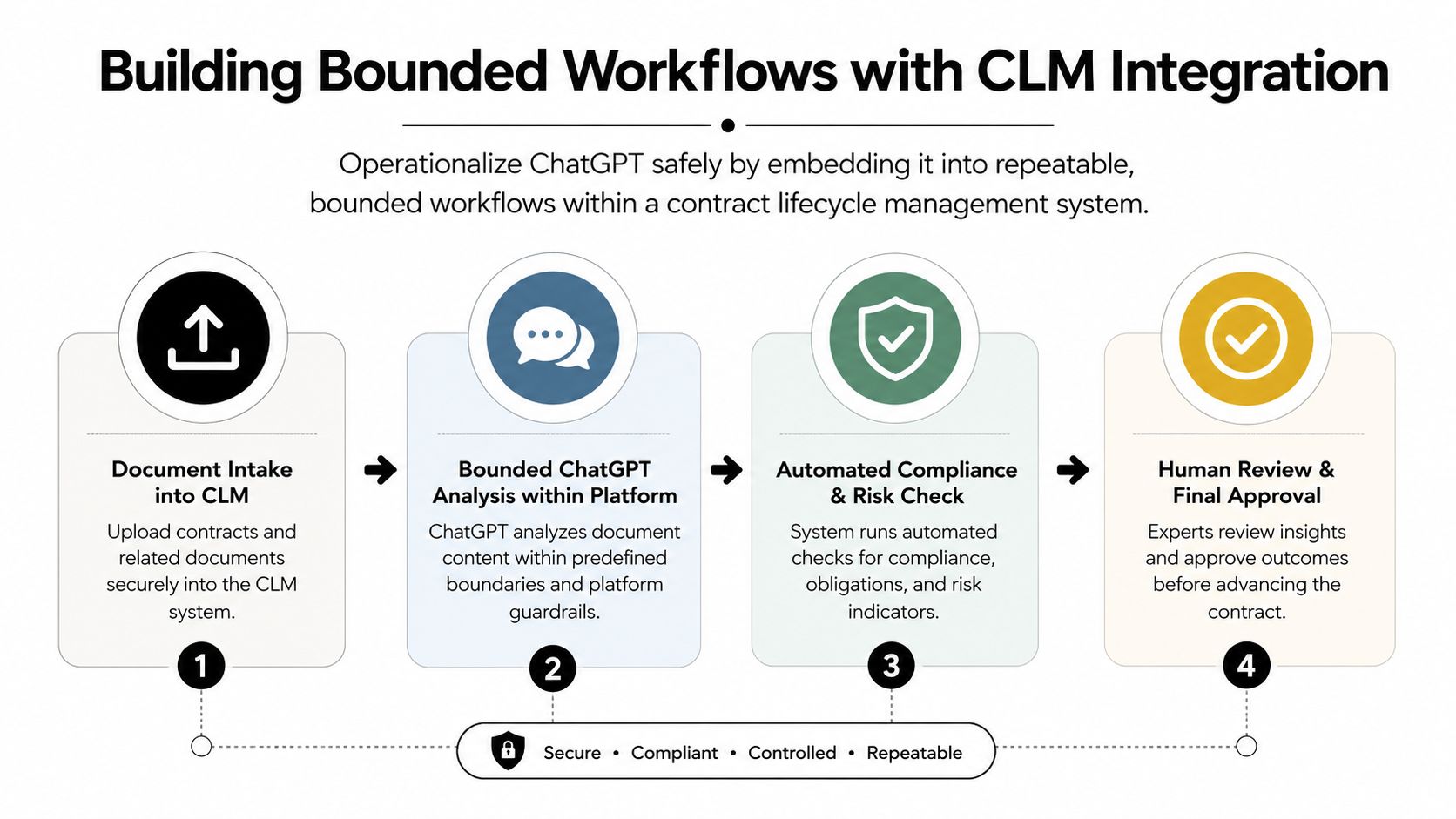
For broader process design, the complete guide to contract lifecycle management gives the right frame. The main takeaway is direct. ChatGPT belongs inside a controlled contract workflow, not outside it.
Best Practices Every Legal Team Should Adopt
The teams getting real value from ChatGPT are the ones that treat it like a governed legal tool, not a casual productivity hack. They also accept that AI governance has to be maintained, tested, and updated as usage changes. A policy sitting in a folder doesn't protect anyone.
The checklist that should be in every legal ops playbook
- Verify citations against primary sources. Never trust AI-generated legal authority without checking the underlying source.
- Keep privileged and confidential material out of consumer tools. If a matter is sensitive enough to worry you, route it through a secure platform or don't use AI on it.
- Label AI output as draft. People should know immediately that the text needs human review.
- Maintain a matter-level log. Record what was prompted, what was changed, and who approved the final output.
- Train on prompt discipline. Lawyers and operations staff should know how to scope a task and how to stop when the task gets too sensitive.
- Use AI inside the CLM. Don't leave it as a standalone chat session when the work is contract-heavy.
- Measure quality, not just speed. Faster drafting means little if error rates or rework rise.
What good measurement looks like
Quality tracking should focus on review burden, correction patterns, and consistency across matters, not just how quickly a draft appears. If a team saves time but creates more cleanup work downstream, the process isn't better. Legal operations has to look at both sides of the ledger.
Governance isn't a one-time policy. It's part of professional competence now.
The strongest legal teams are making AI part of their normal controls, the same way they already handle approval routing, access permissions, and document retention. That's the right standard because ChatGPT is useful only when the organization can prove it was used carefully.
If you want ChatGPT to support real legal and contract workflows instead of creating loose risk, look at how Legitt AI structures drafting, review, approvals, eSignature, and repository control in one environment. Visit Legitt AI to see how a bounded CLM workflow can keep AI useful, auditable, and easier to govern across legal, procurement, and sales teams.