A venue ops lead approves a DJ by email. Sales confirms the date in a chat thread. The performer sends a rider as a PDF attachment. Finance expects an invoice after the event. Then the ballroom has no clean power, the DJ arrives to a cramped corner behind a photo booth, the client disputes overtime, and everyone starts searching inboxes for “the latest version.”
That's how preventable risk turns into live-event chaos.
For teams managing contracts for DJs across weddings, club nights, corporate functions, and festivals, the contract isn't paperwork after the fact. It's the operating system for the booking. It defines who performs, who pays, what the venue must provide, what happens if plans change, and how disputes get contained before they become reputational damage.
At scale, this becomes a legal operations problem, not just an event problem. Once you're handling recurring talent agreements, technical riders, amendments, deposit collection, approvals, eSignatures, and post-event obligations across multiple stakeholders, ad hoc contracting breaks down fast. A disciplined contract lifecycle management approach is what keeps bookings reliable, revenue protected, and teams aligned.
Why Your DJ Contract Is Your Most Important Gear
The failure point usually isn't the music. It's the ambiguity around the music.
A common pattern looks like this: the agency books a DJ for a premium event on a short email chain. The date is clear. The fee is “roughly agreed.” The client assumes ceremony audio is included. The DJ assumes it isn't. The venue has a power-sharing issue with catering equipment. Load-in gets delayed because access was never confirmed. By the time legal or ops gets involved, the event has already happened and the argument is about refunds, blame, and whether future business is at risk.
That's why the strongest DJ contracts work like technical equipment. They're not decorative. They're functional. They reduce uncertainty, force decisions early, and give every stakeholder a common reference point when pressure rises.
Verbal understandings fail under event pressure
In low-volume operations, teams sometimes tolerate informal booking practices because they seem faster. They aren't. They move the work downstream, where it becomes more expensive and more public.
A structured agreement does four things immediately:
- Defines the service clearly: set times, add-ons, MC duties, ceremony support, overtime, and teardown.
- Allocates responsibility: who provides sound, power, staging, access, security, and venue coordination.
- Protects revenue: deposit timing, balance due, cancellation terms, and late payment consequences.
- Controls exceptions: illness, force majeure, equipment failure, substitutions, and rescheduling.
Practical rule: If a booking detail matters on event day, it belongs in the contract or attached rider.
The operational upside is measurable. A success analysis found that using a standardized reusable template with event-specific blanks increased booking conversion by 35% and reduced payment disputes by 52% compared with ad hoc verbal agreements or one-off drafts, according to Orphiq's DJ contract template analysis.
Standardization is what makes scale possible
That result matters for legal teams and entertainment agencies because scale doesn't come from writing more contracts by hand. It comes from standardizing the repeatable parts and tightening review around the variables.
A good DJ agreement should be treated like a managed commercial template. Core legal terms stay stable. Event details change. Riders attach cleanly. Approval logic is predictable. Signature collection is traceable. Repository records are searchable. That's legal ops discipline applied to live entertainment.
Without that structure, contracts become reactive documents. With it, they become business controls.
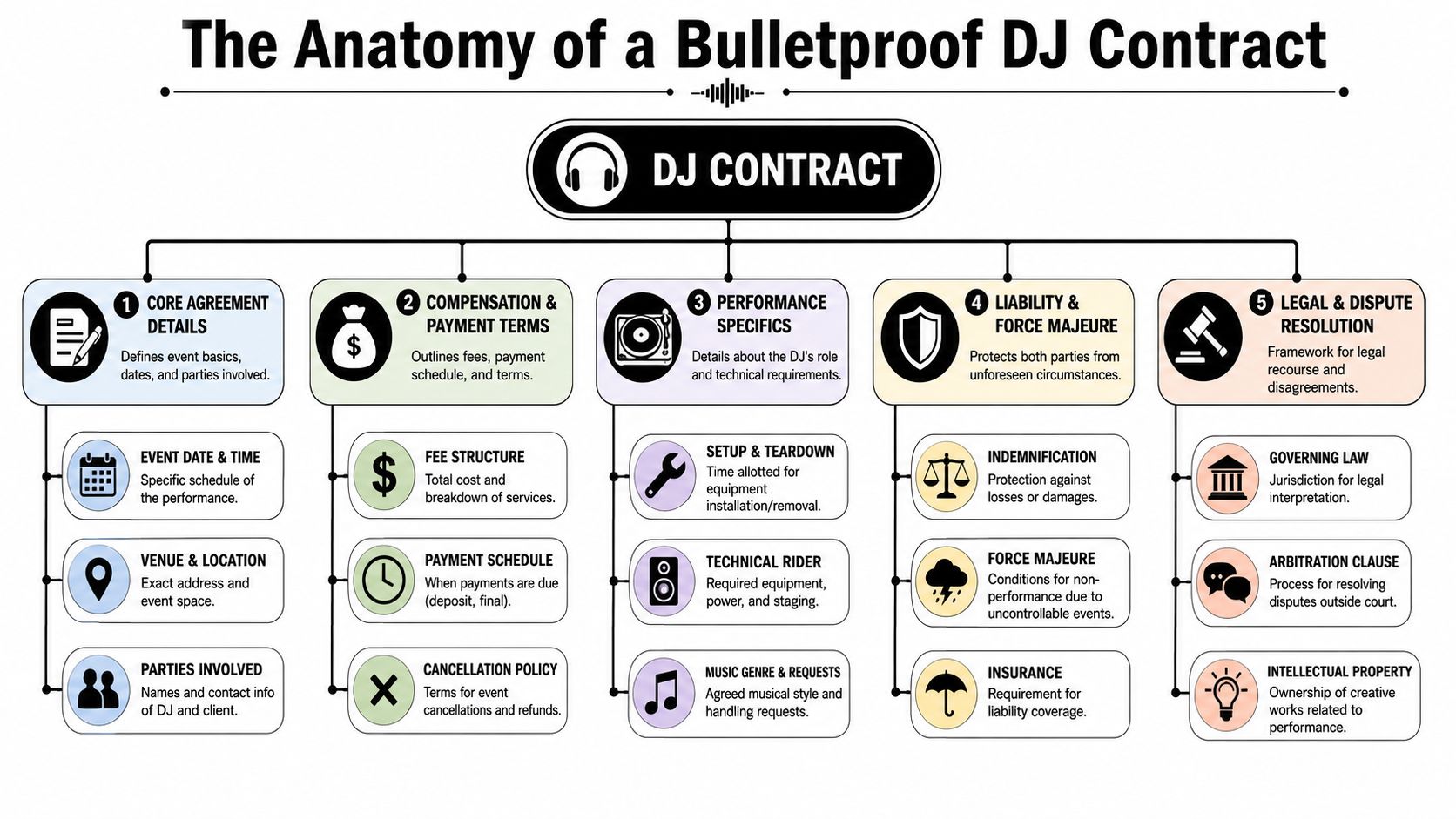
The Anatomy of a Bulletproof DJ Contract
A DJ contract should read like an operational checklist with legal force. If a clause only looks formal but doesn't help the booking survive real-world pressure, it's weak drafting.
The quickest way to improve contracts for DJs is to separate the agreement into a few core clause groups and define each one in plain business language.
Payment terms that remove friction
Payment language should answer every finance question before anyone asks it later.
Include the total fee, what services are included, what triggers extra charges, when invoices go out, accepted payment methods, and when final payment is due. If the booking includes optional services such as ceremony sound, lighting, or extended hours, list them as separate line items rather than folding everything into one vague package price.
Effective language is simple: the client pays a deposit on signing, the remaining balance is due on a stated date, and extra services require written approval.
What doesn't work is “payment due as discussed” or “deposit to confirm booking” without stating the amount, due date, or refund treatment.
Cancellation language that prevents arguments
Cancellation provisions should cover three separate situations: client cancellation, DJ cancellation, and rescheduling. Most disputes happen because those scenarios get blended together.
Spell out:
- Client cancellation terms: whether prior payments are retained, credited, or applied to a new date.
- Rescheduling rules: whether transfer depends on date availability and written confirmation.
- Notice mechanics: email address for notice, effective date of notice, and whether weekends or holidays affect timing.
If you need drafting guidance for independent contractor deals that share the same risk logic, this breakdown of freelancer contract clauses is a useful companion.
Vague cancellation wording doesn't create flexibility. It creates a later argument about what both sides “meant.”
Force majeure and illness provisions
A force majeure clause should address events outside either party's control, but that alone isn't enough for DJ bookings. Entertainment contracts often need a separate illness or substitute structure because the performer is frequently the service itself.
Well-run clauses answer these questions:
- Can the DJ provide a vetted substitute?
- Does the client have approval rights over a substitute?
- What happens if no suitable substitute is available?
- Does rescheduling take priority over refunding?
- Which obligations survive cancellation?
The practical mistake is copying a broad force majeure clause from a generic services agreement and assuming it covers performer-specific continuity risk. It usually doesn't.
Technical rider terms that belong in the contract set
Technical clauses are where many event teams under-draft and then pay for it on site.
Expert methodology for DJ contracts requires a dedicated 110V, 20A electrical circuit, a minimum 8ft x 6ft footprint, and a 90-minute pre-event access window. When contracts fail to codify these constraints, on-site service disputes rise by 68%, according to Check Cherry's DJ contract analysis.
That should change how legal and ops teams treat riders. These aren't courtesy notes. They're operating requirements.
Use rider language that states:
- Power specification: dedicated power, isolated from kitchen or vendor loads where applicable.
- Space requirement: exact footprint for base rig and expanded setup.
- Access window: load-in, soundcheck, and teardown timing.
- Venue dependency: performance obligations are subject to the venue meeting listed requirements.
For corporate planners coordinating broader logistics, this 2026 corporate event guide is a useful reference because it shows how entertainment requirements sit alongside staging, guest flow, and supplier coordination.
Performance scope and service boundaries
You define the actual work.
A solid scope clause should state event timing, number of sets, breaks, music format, whether the DJ acts as MC, whether requests are accepted, and whether the DJ supplies full sound, booth, microphones, or only performance services. If the client expects emceeing, timeline coordination, or ceremony cue management, say that explicitly.
This is also where multi-vendor confusion needs to be controlled. If another supplier handles audiovisual production, livestreaming, staging, or backline, the contract should name that boundary.
Liability, indemnity, and media rights
The liability section should align with the booking's actual risk profile. Event agencies often over-focus on headline indemnity language while leaving equipment damage, guest interference, and venue-caused technical failure too vague.
At minimum, address property damage allocation, limitations tied to venue compliance, and responsibility for third-party claims arising from the client's event conditions. If recordings, photography, or promotional use are relevant, state whether the DJ may be filmed, whether the set may be recorded, and who can use resulting media.
A short review table helps when legal and ops are pressure-testing a template:
| Clause area | What it should answer | Common failure mode |
|---|---|---|
| Payment | What is owed, when, and for which service | Fee is agreed but extras aren't |
| Cancellation | What happens if plans change | No clear notice or fee treatment |
| Technical rider | What the venue must provide | Power and space assumed, not written |
| Scope | What the DJ will and won't do | MC duties implied, not defined |
| Liability | Who bears which risks | Broad blame language, poor fit |
| Media rights | Who can record and reuse content | Social use assumed without consent |
Customizing Contracts for Different Venues
A standard DJ template is valuable. A single generic DJ template for every event type is risky.
The legal structure can stay consistent, but the business terms should change depending on the venue, audience, timeline, and technical complexity. A wedding booking doesn't fail for the same reasons as a weekly club residency. A festival contract introduces another layer of production and vendor coordination entirely.
Weddings need timeline control and expectation management
In the U.S. wedding market, the average DJ cost in 2025 was $1,700, and standard practice includes a non-refundable deposit of 25% to 50% due on signing to secure the date, according to Beat Tribe's wedding DJ market overview.
That matters because wedding contracts usually carry high expectation density. The client isn't only buying music. They may expect introductions, ceremony cues, cocktail-hour transitions, first-dance timing, and close coordination with planners and photographers.
For venue and agency teams, the contract should lock down:
- Run-of-show detail: major moments, timing windows, and who gives final cues.
- Point of contact: who can approve changes on the day.
- Add-on separation: ceremony audio, lighting, and MC duties listed individually.
Tent and floor planning often affect DJ placement more than clients realize. For outdoor or marquee events, this guidance on Surrey wedding tent rentals advice is useful because it connects dance floor layout, guest circulation, and DJ space planning.
Club residencies need repeatable operational terms
A residency is less about one spectacular night and more about sustained consistency. These deals benefit from recurring schedule language, brand usage permissions, promotional obligations, and cancellation treatment for individual dates within a longer engagement.
The contract should identify whether the DJ is exclusive on certain nights, whether substitute performers are allowed, and who controls social promotion assets. It should also define whether the club provides house equipment or expects the DJ to bring core gear.
Festivals need production-grade drafting
Festival contracts tend to be operationally dense. Multiple stakeholders touch the booking, including promoter, stage manager, production, artist liaison, and security. A generic DJ contract won't hold up if travel, credentialing, stage access, or backline compatibility are left to email.
Use a side-by-side comparison when building your template library:
| Clause area | Wedding | Club Residency | Festival |
|---|---|---|---|
| Scope | Ceremony, reception, MC duties | Recurring set schedule | Performance slot and stage obligations |
| Payment | Deposit and final balance | Periodic payments across dates | Fee with production-linked logistics |
| Technical terms | Load-in, floor plan, power | House gear compatibility | Backline, stage access, production rider |
| Cancellation | Date-sensitive and emotional | Per-date cancellation rules | Broader promoter contingency terms |
| Contacts | Planner or couple rep | Venue manager | Production and artist liaison |
The practical lesson is simple. Build a master template family, not one universal document.
The Art of Negotiation Do's and Don'ts
The best DJ contract negotiations don't feel adversarial. They feel precise.
Most friction appears when one side treats the contract as a formality and the other treats it as risk allocation. Legal ops teams can lower that tension by making the process structured, fast, and transparent. Clear version control, tracked edits, and disciplined approval routing do more for negotiation outcomes than aggressive redlines ever will.
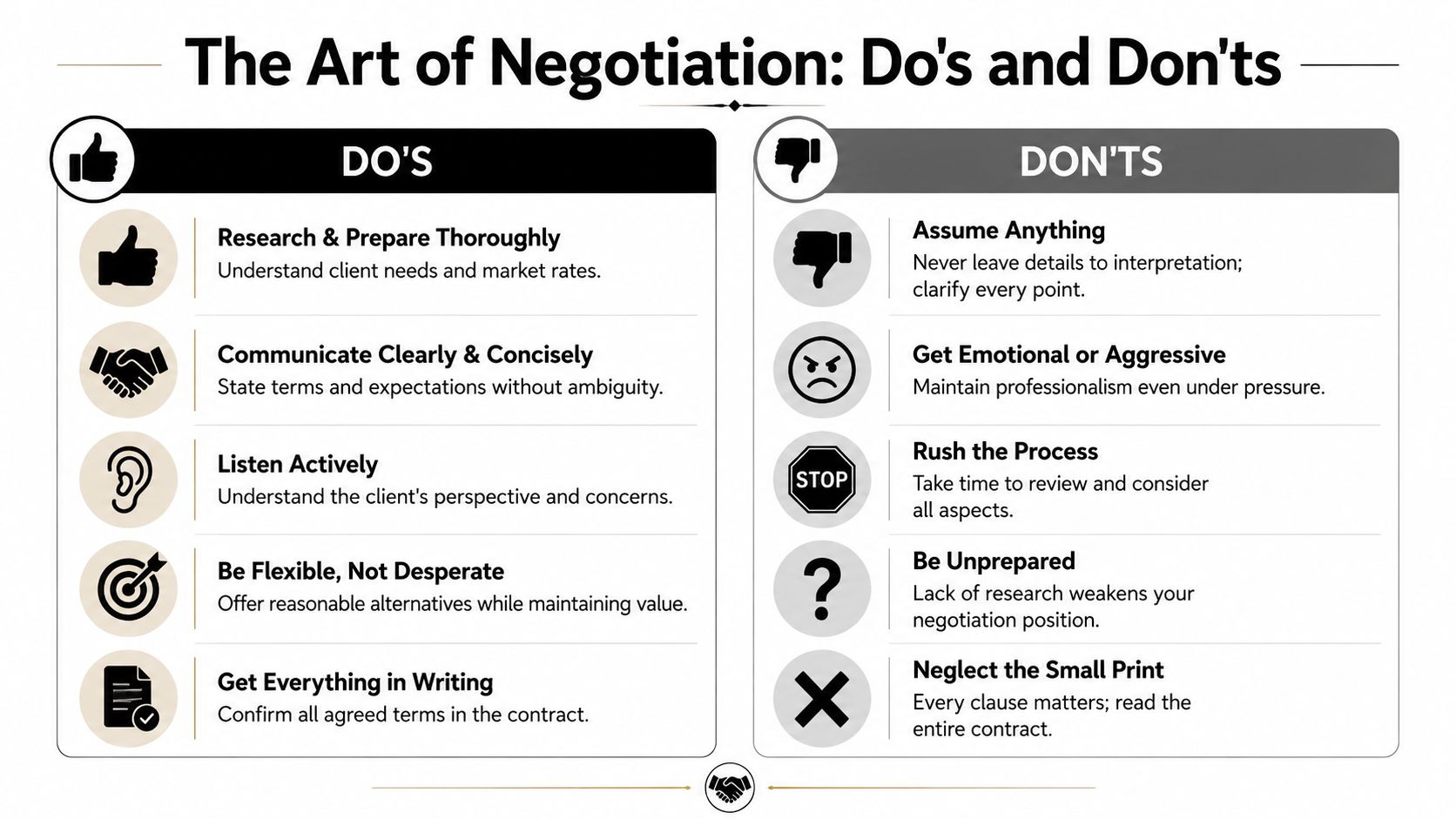
What to do
- Prepare before the first draft: confirm the event format, venue realities, service scope, and internal fallback positions before paper goes out.
- Lead with business intent: explain why a clause exists. Counterparties are more receptive when they understand the operational reason behind a payment term, rider, or cancellation structure.
- Document every change: if a commercial term moves during a call, update the draft. Don't leave side promises in meeting notes.
- Use a payment framework that people can understand: finance disputes often start with ambiguity around deposits, milestones, and timing. This explainer on payment terms is a practical reference for business teams that need clearer language.
- Separate fixed requirements from preferences: venue access, power, and liability structure may be fixed. Hospitality details may not be.
Negotiation works better when both sides know which terms protect safety and delivery, and which terms are simply defaults.
What not to do
- Don't rely on verbal assurances: if the promoter says, “We'll sort the rider later,” that's a warning sign.
- Don't accept undefined extras: phrases like “standard MC support” or “basic sound” create future disagreement.
- Don't rush signature collection before approvals are complete: a partially reviewed contract is operational debt.
- Don't negotiate in fragmented email threads: use one controlled draft and one approval path.
- Don't over-lawyer a low-risk booking: some event deals need speed. The answer is a better template, not unnecessary complexity.
Teams that negotiate well usually follow the same discipline. They shorten the path from commercial agreement to clean paper, and they avoid turning preventable ambiguity into live-event conflict.
Streamlining DJ Contracts with AI and Automation
Manual DJ contracting breaks first in the handoffs.
Sales sends the booking details. Ops adds technical notes. Legal revises liability language. Finance chases deposit status. The client signs an outdated version. Then someone asks which copy is final, whether the rider was attached, and who approved the exception on cancellation terms.
That's the point where contract lifecycle management stops being a nice-to-have and becomes operational infrastructure.
Where manual workflows break down
Email and shared folders can support a few contracts. They don't scale well across recurring bookings, multiple venues, or agency rosters.
The typical failure points are familiar:
- Template drift: teams reuse old drafts with outdated terms.
- Approval gaps: commercial changes happen without legal visibility.
- Version confusion: counterparties sign the wrong draft.
- Missed obligations: deposits, insurance documents, rider confirmations, and renewal dates slip.
- Poor reporting: leadership can't quickly see booked value, unsigned contracts, or upcoming expirations.
A CLM platform addresses those issues by standardizing drafting, controlling workflow, centralizing storage, and making executed agreements searchable.
What AI contract review changes in practice
AI matters most when it removes repetitive review work without removing legal judgment.
For example, AI-powered contract review tools can analyze a standard NDA in 26 seconds compared with 92 minutes for a human lawyer, achieving 94% accuracy and a 212x speed improvement in review workflows, according to Tracking Contracts CLM statistics. That data point isn't about DJ NDAs specifically. It does show why legal teams are rethinking first-pass review across repetitive contract categories.
In an entertainment workflow, that same logic applies to:
- incoming venue forms
- promoter paper with non-standard cancellation language
- rider inconsistencies
- insurance and indemnity deviations
- amendments that change dates, scope, or payment timing
AI review won't replace counsel on a high-risk festival deal. It can accelerate issue spotting, clause comparison, and deviation analysis on repeatable DJ agreements.
If your team is evaluating how AI drafting works upstream of review, this guide to AI-powered contract drafting automation is a solid reference point.
High-volume contracting improves when lawyers review exceptions, not every repeated sentence from scratch.
The CLM workflow that fits event entertainment
A workable enterprise process for DJ agreements usually looks like this:
Intake begins in a structured form
Event date, venue, performer, service package, and business owner are captured consistently.The draft pulls from an approved template
The system inserts event-specific fields and attaches the correct rider version.Approval routing happens automatically
Legal reviews only if certain clauses deviate. Finance reviews only if payment logic changes. Ops reviews technical requirements.Negotiation stays inside one controlled workspace
Redlines, comments, and fallback language live with the draft, not across disconnected inboxes.eSignature closes the loop
Signature status is visible, and the executed version stores automatically in the repository.Post-signature obligations are tracked
Deposit due dates, certificate requests, access confirmations, and renewal reminders stay visible.
AI contract management, contract automation, eSignature, repository management, and contract intelligence begin to operate as a unified system rather than distinct tools. For legal ops leaders, that yields significant ROI. Better cycle time matters, but so do cleaner approvals, stronger compliance, faster retrieval, and fewer preventable disputes.
Contract Red Flags and Final Checklist
A DJ contract usually tells you where the problem is if you read it like an operator instead of just a signer.
The biggest red flags aren't always dramatic. More often, they're omissions. Missing payment detail. Undefined scope. A force majeure clause that says almost nothing. Liability language copied from an unrelated vendor agreement. Those gaps create the exact disputes that event teams later call “unexpected.”
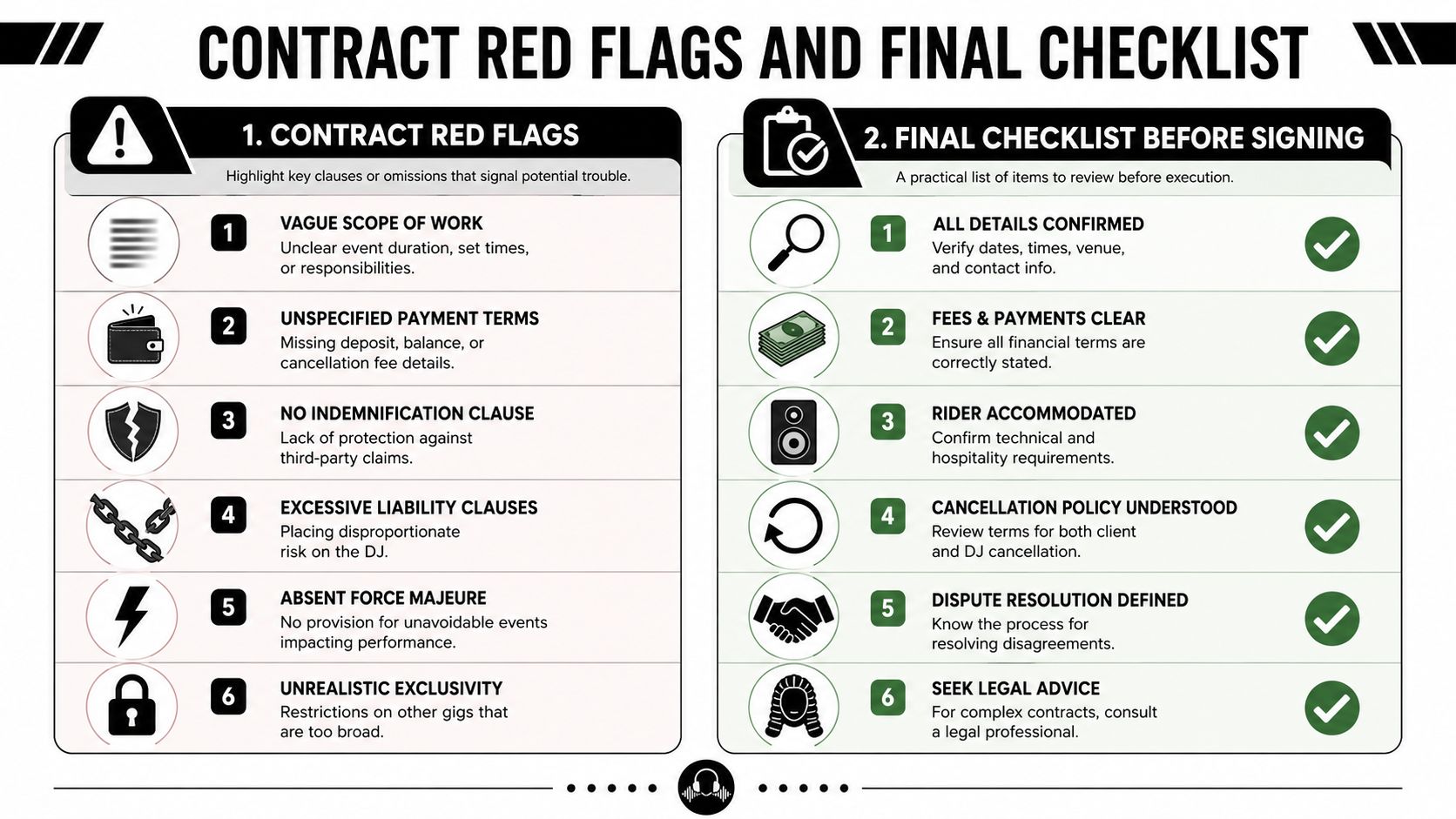
Red flags that deserve immediate scrutiny
- No deposit clause: if the agreement doesn't explain how the date is secured, revenue protection is weak from the start.
- Vague cancellation wording: if notice mechanics, payment treatment, or rescheduling rules are unclear, expect conflict.
- Missing technical obligations: if the venue's power, space, access, or load-in responsibilities aren't stated, ops will be left improvising.
- Overbroad liability transfer: if one party assumes nearly all risk regardless of fault, escalate for review.
- No performer continuity language: if illness, substitute rights, or force majeure treatment are absent, the event may have no practical backup path.
For teams reviewing contingency language in more detail, this explainer on force majeure clauses is worth keeping in the playbook.
Final pre-signature checklist
Review the contract as if the event were happening tonight. Anything unclear now will be worse on site.
- Confirm identities: legal names, entity names, venue details, and authorized signers.
- Check event specifics: date, access times, set times, overtime treatment, and teardown window.
- Validate money terms: fee, deposit, balance timing, reimbursable items, and tax treatment if applicable.
- Review attachments: rider, schedule, amendments, and any house rules incorporated by reference.
- Test the exception path: if the DJ can't perform, if the client reschedules, or if the venue can't meet technical requirements, does the contract tell you what happens next?
A checklist won't replace judgment. It does catch preventable mistakes before they become live liabilities.
Secure Your Performance and Your Paycheck
Strong contracts for DJs don't signal mistrust. They signal operational maturity.
The best agreements give legal, ops, finance, and talent teams one shared source of truth. They define service boundaries, make payment enforceable, set technical expectations, and create a plan for disruption before the room fills up. That's what moves a booking from hopeful to reliable.
For agencies and event companies managing volume, the bigger shift is strategic. DJ agreements shouldn't live as isolated PDFs passed around by email. They should move through a repeatable contract workflow with controlled templates, disciplined approvals, searchable records, and clean execution. That's how contract management becomes a business advantage instead of an administrative drag.
Insurance review belongs in that same discipline. If your teams are revisiting contractor risk allocation, this overview of whether independent contractors require liability insurance is a practical starting point. And when a DJ engagement is structured as an independent contractor relationship, it also helps to review the core elements of how to create an independent contractor agreement.
A better contract won't guarantee a great event. It will make a great event far easier to deliver.
If your team is ready to standardize DJ agreements, speed up review, automate approvals, track obligations, and keep every contract in one searchable workspace, Legitt AI is worth a close look. It brings AI contract drafting, review, negotiation workflows, eSignatures, repository management, renewals tracking, and contract intelligence into one CLM platform so legal and business teams can scale entertainment contracting with less friction and better control.