
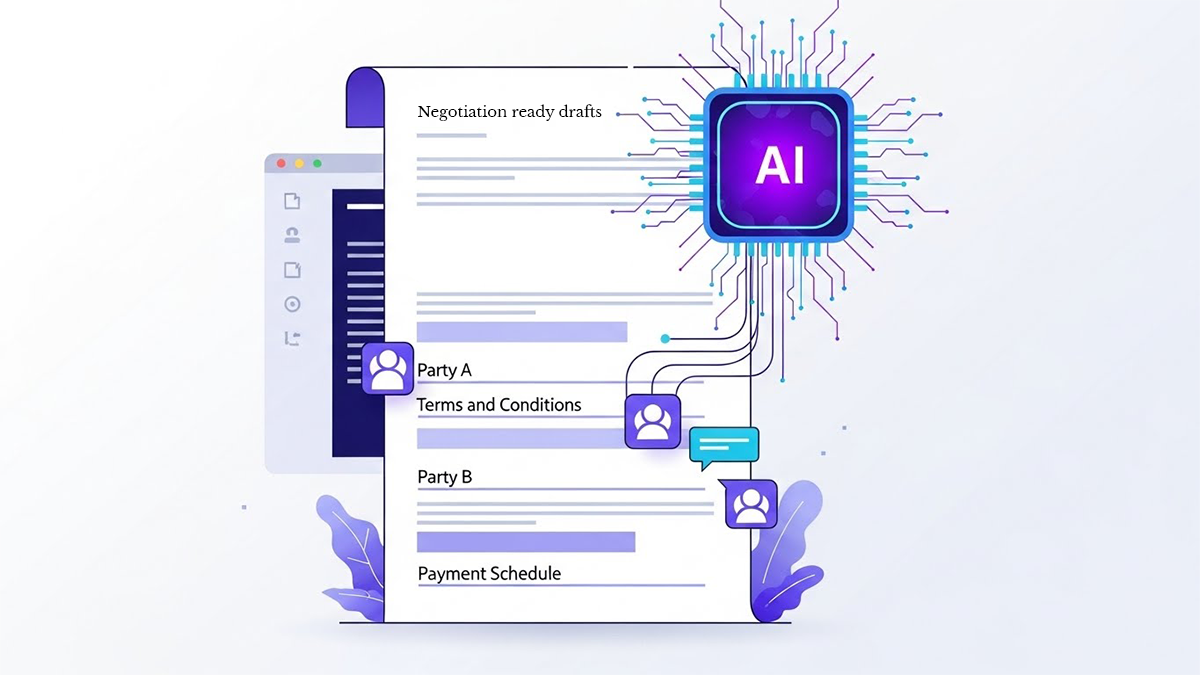
For many organizations, the biggest slowdown in closing deals is not finding customers, but getting contracts into a shape that everyone can live with. First drafts are either too generic to be useful or too heavily lawyered to move quickly. Sales, procurement, and legal teams go back and forth cleaning up language, aligning with playbooks, and fixing basic inconsistencies before real negotiation even begins.
AI changes this starting point. Instead of generic templates or copy-paste from old deals, you can generate negotiation-ready drafts that are aligned with playbooks, tailored to the deal context, and clear enough for both sides to engage immediately. AI-native platforms like Legitt AI (www.legittai.com) are built specifically to help legal and commercial teams move from blank page or messy precedent to structured, high quality drafts in minutes, not days.
1. What does a “negotiation-ready” draft actually mean?
A negotiation-ready draft is not a perfect contract. It is a contract that is clear, coherent, internally consistent, and aligned with your risk appetite so that discussions can start from a strong baseline. It should reflect your current templates, playbooks, and business model rather than being a random mix of old wording. It should also be tailored to the specific transaction, so the counterparty does not feel they are receiving something generic and irrelevant.
Practically, this means the draft:
- Uses the right structure and clause set for that deal type
- Applies current approved language, not legacy clauses
- Fills in deal-specific details accurately, including commercial terms and parties
- Avoids contradictory or duplicated clauses
- Is formatted and referenced correctly, so it can be redlined immediately
AI helps reach that starting point faster and more consistently. Instead of stitching together old Word files, you orchestrate a system that knows your standards and can assemble a deal-specific draft automatically.
2. How can AI turn templates and playbooks into smart drafting assistants?
Most organizations already have good ingredients: templates, clause libraries, fallback positions, and negotiation playbooks. The problem is that they live as static documents that depend on humans to apply them correctly. AI transforms these assets into a dynamic drafting engine.
Here is how that works:
- Templates and clause libraries are ingested and structured so AI understands which clauses apply to which deal types
- Playbooks are digitized into rules: preferred positions, acceptable fallbacks, escalation thresholds
- AI learns to classify clauses and map them to your internal categories (for example limitation of liability, data protection, termination)
- When you start a new draft, AI selects the correct template and clause variants based on deal context such as product, geography, entity, and customer segment
In a platform like Legitt AI, the playbook is not just a PDF on a shared drive. It becomes the logic that drives drafting and review, so that every first draft already reflects your institutional know-how.
3. How does AI personalize drafts to the deal context and counterparties?
One of the weaknesses of traditional templates is that they are often “one size fits all”. AI allows you to keep a strong core while tailoring around the edges based on structured inputs. These inputs can include deal size, risk profile, industry, governing law, product bundle, and whether the counterparty is a customer, vendor, reseller, or partner.
AI can then:
- Adjust the tone, detail, and strictness of clauses based on deal criticality
- Choose appropriate variants for data protection, security, or audit clauses based on industry and geography
- Pre-populate commercial schedules with pricing structures and SLAs aligned with the product and service tier
- Insert relevant optional modules or annexes only when needed, rather than shipping a bloated document every time
AI-native systems such as Legitt AI (www.legittai.com) can use structured deal data from CRM or intake forms to generate drafts that feel tailored rather than generic, which often leads to smoother negotiation and fewer fundamental objections.
4. How can AI help when I am starting from third party paper rather than my own template?
Real life contracting often starts with the other side’s document. This can feel like losing control of the first move. AI helps you regain structure even when you are working from third party paper.
Key capabilities include:
- Clause detection and classification, so each paragraph in the third party draft is mapped to your internal clause categories
- Comparison against your playbook, with clear labeling of standard, acceptable, and high risk positions
- Suggested redlines that bring their language closer to your preferred clauses or acceptable fallbacks
- Detection of missing clauses that you consider mandatory, such as specific compliance, data, or limitation provisions
Instead of reading the draft line by line with the playbook on another screen, you receive a marked up version that shows where the document diverges from policy and offers proposed edits. You still make the judgment calls, but AI eliminates much of the mechanical work needed to reach a negotiation-ready counter draft.
5. How do I use AI to keep drafts consistent, compliant, and internally aligned?
One of the biggest risks in fast drafting is inconsistency. Different versions of the same clause, misaligned definitions, or outdated compliance language can creep into documents. AI can enforce consistency across drafts and over time.
It can:
- Validate that all required clauses for a given contract type and jurisdiction are present
- Check that defined terms match across the document and that references are correct
- Flag where a clause deviates from the current approved version in your library
- Warn when outdated or deprecated language is used, especially in compliance heavy areas like data protection or sanctions
- Align entity names, signatures, and internal roles with your corporate and approval structures
This automation decreases the amount of “housekeeping” senior lawyers need to do and reduces the likelihood of embarrassing inconsistencies that derail negotiations or create future disputes.
6. How can AI accelerate collaboration between legal, sales, procurement, and other teams?
Negotiation-ready drafts are not just a legal product. They sit in the middle of a workflow that includes sales, procurement, finance, security, and operations. AI helps by making contract content more intelligible and actionable for non lawyers, and by linking drafting to upstream and downstream systems.
Examples of collaboration benefits:
- Intake forms that collect structured business inputs which AI uses to assemble the draft, reducing back and forth with legal
- Plain language summaries of key commercial and risk terms that sales or procurement can share internally before negotiations
- Risk flags and approval routing based on AI analysis of clauses, connected to your internal delegation of authority
- Status dashboards that show where each draft sits in the negotiation pipeline and which issues are still open
Platforms like Legitt AI are designed to operate as a shared environment where legal and business teams can see the same information in different views, rather than passing static Word files around via email.
7. How do I implement AI-driven drafting without losing control or increasing risk?
A common concern is that AI might generate “creative” language that slips past controls or that non legal users might over rely on AI without proper review. The answer is to treat AI drafting as a controlled system, not a free form chatbot.
Good practices include:
- Restricting AI generation to approved templates and clause libraries as building blocks
- Configuring AI to propose from a curated set of variants rather than inventing entirely new positions for sensitive clauses
- Ensuring that high risk or high value contracts always go through formal legal review, regardless of how they were drafted
- Using audit trails to record which AI suggestions were applied, and by whom
- Providing training and clear internal policies about when AI can be used and what level of human oversight is required
Used this way, AI reduces drafting effort but does not change who is accountable. Legal teams define “what good looks like”; AI helps deliver it multiple times a day with less friction.
8. What does a practical roadmap for AI generated negotiation-ready drafts look like?
You do not need to automate everything at once. A phased approach is safer and more effective.
A realistic roadmap might look like this:
- Choose one or two core contract types, such as NDAs or standard customer MSAs, where volume is high and patterns are clear
- Clean up and standardize templates and clause libraries for those contracts
- Implement AI-assisted drafting for these use cases and route all AI drafts through legal for the first phase
- Collect feedback on accuracy, usefulness, and exceptions, and refine templates and playbooks
- Gradually expand to more complex contracts, and relax full legal review only for low risk cases and within defined thresholds
- Integrate intake, CRM, and CLM so that AI drafting plugs into your wider contracting and deal processes
By iterating, you build trust in the technology and in your own governance, while generating real time savings and shortening negotiation cycles.
Read our complete guide on Contract Lifecycle Management.
FAQs
Can AI really understand our internal playbooks, or does it just generate generic legalese?
AI can be configured to work directly from your playbooks, templates, and historical contracts. It is strongest when those sources are structured and consistently applied. Instead of writing legal language from scratch, AI selects, adapts, and assembles from your approved building blocks. Generic legalese is only a risk if you allow unconstrained generation; in an AI-native platform like Legitt AI, drafting logic is grounded in your own standards.
How accurate are AI generated drafts compared to those created manually?
For standard contract types where your templates and playbooks are clear, AI generated drafts can be highly accurate and internally consistent, often more so than rushed manual work. Accuracy needs to be measured in context: AI is very good at structure, clause selection, and mechanical consistency, while humans remain better at handling unusual fact patterns and nuanced trade offs. The best results come from combining AI drafting with targeted human review, especially for complex or high value deals.
Will using AI for first drafts reduce the need for lawyers?
It will reduce the amount of time lawyers spend on mechanical drafting, but it does not eliminate the need for legal expertise. Lawyers will spend more time defining playbooks, refining clause libraries, deciding risk positions, and advising on edge cases. Their role shifts from being primary drafters to being architects and overseers of the contracting system. In most organizations, this shift increases legal impact and reduces burnout rather than making lawyers redundant.
Can sales or procurement teams safely use AI to generate drafts without legal involvement?
For low risk, low value, highly standardized agreements, it is possible to allow business teams to generate AI based drafts within tight guardrails, especially if the contract stays within pre approved parameters. However, legal should always define the rules and monitor outcomes. For more complex contracts, legal oversight at least at the final review stage remains essential. AI should make legal involvement more efficient, not remove it entirely.
How does AI handle unusual negotiation points that are not in the playbook?
When a counterparty proposes something truly novel, AI may not have a ready made pattern. In those situations, it can still assist by highlighting similarities to existing clauses, flagging potential risks, and suggesting questions to consider. Ultimately, though, a lawyer must decide how to respond and whether to expand the playbook to include a new variant. Over time, as new patterns are added, AI’s coverage improves.
Do we need a CLM system to benefit from AI drafting, or can we start with simpler tools?
A CLM system helps manage the full lifecycle, but you can start with AI drafting even if you currently work with shared drives and email. An AI-native drafting solution can ingest your templates and clauses, generate negotiation-ready drafts, and let you export Word or PDF files. Over time, integration with CLM gives you better tracking and analytics, but it does not have to be the starting point.
How do we ensure security and confidentiality when using AI to draft sensitive contracts?
You should choose platforms that are built for contractual data, with strong encryption, access control, and audit capabilities. Understand where your data is stored, who can access it, and whether it is used to train shared models beyond your environment. Enterprise tools like Legitt AI are designed to keep contract content segregated and protected, so AI can work on sensitive drafts without expanding your risk surface.
Can AI help make our drafts more readable for business stakeholders and counterparties?
Yes. AI can assist not only with legal correctness but also with clarity. It can suggest clearer wording, reduce unnecessary repetition, and generate plain language summaries of key terms. This is particularly helpful for executive approvals, customer communications, and international counterparties. Better readability often leads to faster negotiation because fewer points are misunderstood or perceived as overly aggressive.
How do we measure the impact of AI on our negotiation and drafting process?
Useful metrics include time from intake to first draft, number of negotiation cycles required to reach signature, frequency of deviations from playbook, and percentage of contracts using fully standard clauses. You can also track user satisfaction and error rates (for example, how often inconsistencies or missing clauses are found later). Over time, you should see shorter cycle times, more consistent risk positions, and less manual rework.
What is the advantage of an AI-native platform like Legitt AI versus using a generic chatbot and copy-paste?
A generic chatbot does not know your templates, playbooks, or approval rules. It can generate plausible sounding language, but it is not anchored in your standards or integrated with your workflows. An AI-native platform like Legitt AI is built around structured clause libraries, entity models, playbooks, and integrations with deal systems. That means its drafts are not just linguistically fluent, but operationally aligned with how your organization actually contracts, negotiates, and manages risk.