
As businesses increasingly operate across international borders, the complexity of e-signature compliance has become a critical operational challenge. With evolving regulations like eIDAS 2.0 in Europe, updated data protection laws in Asia-Pacific, and varying recognition standards across jurisdictions, organizations need strategic approaches to ensure their digital signature workflows remain valid worldwide.
The stakes have never been higher. A single compliance misstep can invalidate contracts, delay critical business processes, or expose organizations to regulatory penalties. This article examines the current landscape of cross-border e-signature compliance and provides actionable guidance for businesses navigating these complex requirements in 2026.
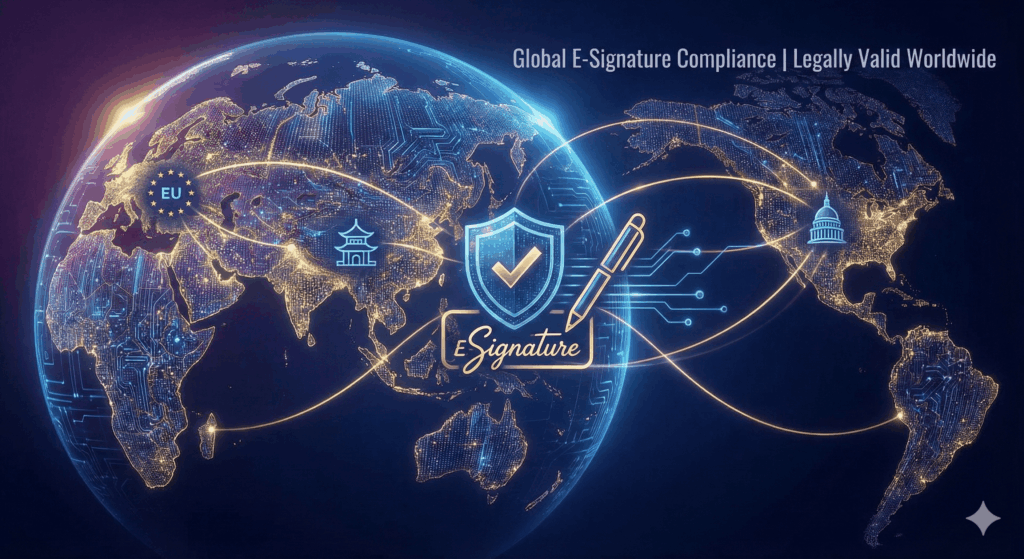
The Evolving Global E-Signature Regulatory Landscape
International e-signature regulations are experiencing unprecedented change in 2026. The European Union’s eIDAS 2.0 framework has introduced stricter requirements for qualified electronic signatures, while Asia-Pacific markets are implementing new cross-border recognition protocols.
Key regulatory developments include:
- Enhanced identity verification requirements for qualified electronic signatures
- New mutual recognition agreements between trading partners
- Stricter data localization requirements affecting signature storage
- Updated compliance standards for financial services and healthcare sectors
These changes reflect a global trend toward standardization while maintaining regional sovereignty over digital identity frameworks. Organizations must now balance compliance with multiple jurisdictions simultaneously.
Why Cross-Border Compliance Matters More Than Ever
The business impact of cross-border e-signature compliance extends far beyond requirements. Companies report that compliance gaps can delay contract execution by weeks, particularly in regulated industries like pharmaceuticals and financial services.
Modern businesses face several compliance challenges:
- Different technical requirements for signature validity
- Conflicting data protection and privacy regulations
- Industry-specific compliance obligations
The cost of non-compliance has increased significantly. Recent studies indicate that organizations face average penalties of $2.3 million for cross-border signature compliance violations, not including the operational disruption and reputational damage.
Regional Compliance Frameworks: Key Differences
Understanding regional differences is essential for effective compliance strategy. Each major market has distinct requirements that affect how e-signatures must be implemented and validated.
European Union (eIDAS 2.0)
The updated eIDAS regulation emphasizes qualified electronic signatures with enhanced security requirements. Organizations must use qualified trust service providers and implement stronger identity verification processes.
United States (ESIGN Act & UETA)
US regulations focus on consent and record retention. The framework is technology-neutral but requires clear evidence of signatory intent and agreement to electronic processes.
Asia-Pacific Markets
Countries like Singapore, Japan, and Australia have developed interoperability frameworks that facilitate cross-border recognition while maintaining local compliance requirements.
These regional differences require organizations to implement flexible e-signature solutions that can adapt to multiple regulatory frameworks simultaneously.
Practical Implementation Strategies
Successful cross-border e-signature compliance requires systematic planning and implementation. Organizations should focus on building adaptable processes that can accommodate multiple regulatory requirements.
Essential implementation steps include:
- Conducting comprehensive regulatory mapping for target markets
- Implementing flexible identity verification processes
- Establishing clear data governance and retention policies
- Creating jurisdiction-specific signature workflows
- Developing audit trails that meet multiple regulatory standards
Technology selection plays a crucial role in compliance success. Organizations need e-signature platforms that support multiple authentication methods, provide comprehensive audit capabilities, and maintain compliance certifications across relevant jurisdictions.
Common Compliance Risks and How to Avoid Them
Many organizations unknowingly create compliance gaps that can invalidate their e-signature processes. Understanding these common pitfalls helps prevent costly mistakes.
Frequent compliance risks include:
- Using simple electronic signatures where qualified signatures are required
- Inadequate identity verification for high-value transactions
- Insufficient audit trail documentation
- Failure to obtain proper consent for electronic processes
- Inconsistent data retention practices across jurisdictions
Prevention strategies focus on implementing robust processes that exceed minimum requirements. This approach provides a compliance buffer and reduces the risk of regulatory violations as requirements evolve.
What This Means for Businesses in 2026
The trend toward stricter cross-border e-signature compliance will accelerate throughout 2026. Organizations that proactively address these requirements will gain competitive advantages through faster contract execution and reduced risk.
Strategic preparation should focus on:
- Investing in compliance-ready e-signature technology
- Training teams on jurisdiction-specific requirements
- Establishing relationships with qualified trust service providers
- Developing contingency plans for regulatory changes
The regulatory landscape will continue evolving as governments balance digital transformation goals with security and certainty requirements. Organizations that build adaptable compliance frameworks will be better positioned for future regulatory changes.
Don’t let legacy tools expose you to 2026’s regulatory penalties. Switch to the platform built for the new era of borderless business. Legitt combines AI-driven governance with global legal validity.

Click to upload or drag & drop
pdf, docx up to 5 MB
Conclusion
Cross-border e-signature compliance represents both a challenge and an opportunity for global businesses. While regulatory complexity continues to increase, organizations that implement comprehensive compliance strategies can achieve significant operational advantages.
Success requires understanding regional requirements, implementing flexible technology solutions, and maintaining proactive compliance monitoring. As regulations continue evolving, businesses need e-signature platforms that can adapt to changing requirements while maintaining security and validity.
For organizations evaluating their current e-signature processes, now is the time to assess compliance readiness and explore modern solutions that support global operations. Legitt provide the compliance capabilities and flexibility needed to navigate complex international requirements while streamlining business processes.
Read our complete guide on Contract Lifecycle Management.
FAQs
What is the difference between an Electronic Signature and a Digital Signature?
Think of an "Electronic Signature" as the act of signing (like clicking "I Agree"), while a "Digital Signature" is the technology behind it (encryption) that proves the document hasn't been tampered with. For cross-border compliance, you almost always need a Digital Signature to ensure legal admissibility.
Does a US-based "Simple Electronic Signature" (SES) work in Europe?
Often, no. While an SES is standard in the US, the European Union requires a "Qualified Electronic Signature" (QES) for many high-value transactions. Using a US-standard simple signature in the EU may result in the contract being rejected by local courts or regulatory bodies.
How do I know which country’s laws apply to my digital contract?
This is determined by the "Governing Law" clause in your contract. However, for the signature itself to be valid, it must meet the technical standards of the country where the signature is relied upon or enforced.
What is a "Qualified Electronic Signature" (QES)?
A QES is the "gold standard" of e-signatures in the EU. It requires face-to-face or equivalent video verification of the signer’s identity by a certified Trust Service Provider. In legal disputes, a QES is given the same automatic legal status as a handwritten signature.
Can I use a QES for business outside of Europe?
A QES is the "gold standard" of e-signatures in the EU. It requires face-to-face or equivalent video verification of the signer’s identity by a certified Trust Service Provider. In legal disputes, a QES is given the same automatic legal status as a handwritten signature.
Can AI agents legally sign contracts on my behalf?
This is a developing legal area known as "Agentic AI." Currently, most jurisdictions require a human intent to sign. While AI can draft or negotiate, the final "click" or authorization should be traced back to a verified human identity to ensure the contract is binding.
What is "Liveness Detection" in e-signing?
Liveness detection is a security feature used during identity verification (video KYC) to ensure the person signing is real and present, not a deepfake or a static photo. This is becoming a standard requirement for high-security cross-border deals.
Can I use e-signatures for Employee Offer Letters and NDAs globally?
Generally, yes. HR documents are low-risk in most jurisdictions (including the US, UK, and EU) and can be signed with Standard Electronic Signatures (SES). However, in countries with strict labor protections like Germany or Spain, termination notices often still require a wet-ink signature or a Qualified Electronic Signature (QES) to be valid.
Can multiple people sign the same document from different countries?
Yes. A robust cross-border platform will allow you to set different verification standards for each signer. For example, Signer A in the US can use a standard email link, while Signer B in Belgium is prompted to use their itsme® digital ID app to apply a Qualified Signature.
Can I revoke an e-signature after sending?
You can void the envelope (the transaction) before it is fully signed. However, once all parties have signed, the contract is legally binding. You cannot "unsign" it; you would need to create a formal "Deed of Revocation" or a new contract to cancel the previous one.