Your vendor just sent over a data use agreement, and the business wants the dataset live by Friday. Procurement sees a routine form, legal sees risk, and ops wants the handoff to stop stalling in email threads. That's exactly the point where a DUA stops being paperwork and starts being a control document.
A data use agreement is the legal instrument that defines what data are shared, for what purpose, for how long, and under what access and security restrictions. In U.S. health and research settings, DUAs matter most for limited data sets and other nonpublic data, because they translate a legal permission into operational guardrails for real systems and real people. If you treat them like a signature page, you'll miss the clauses that prevent misuse.
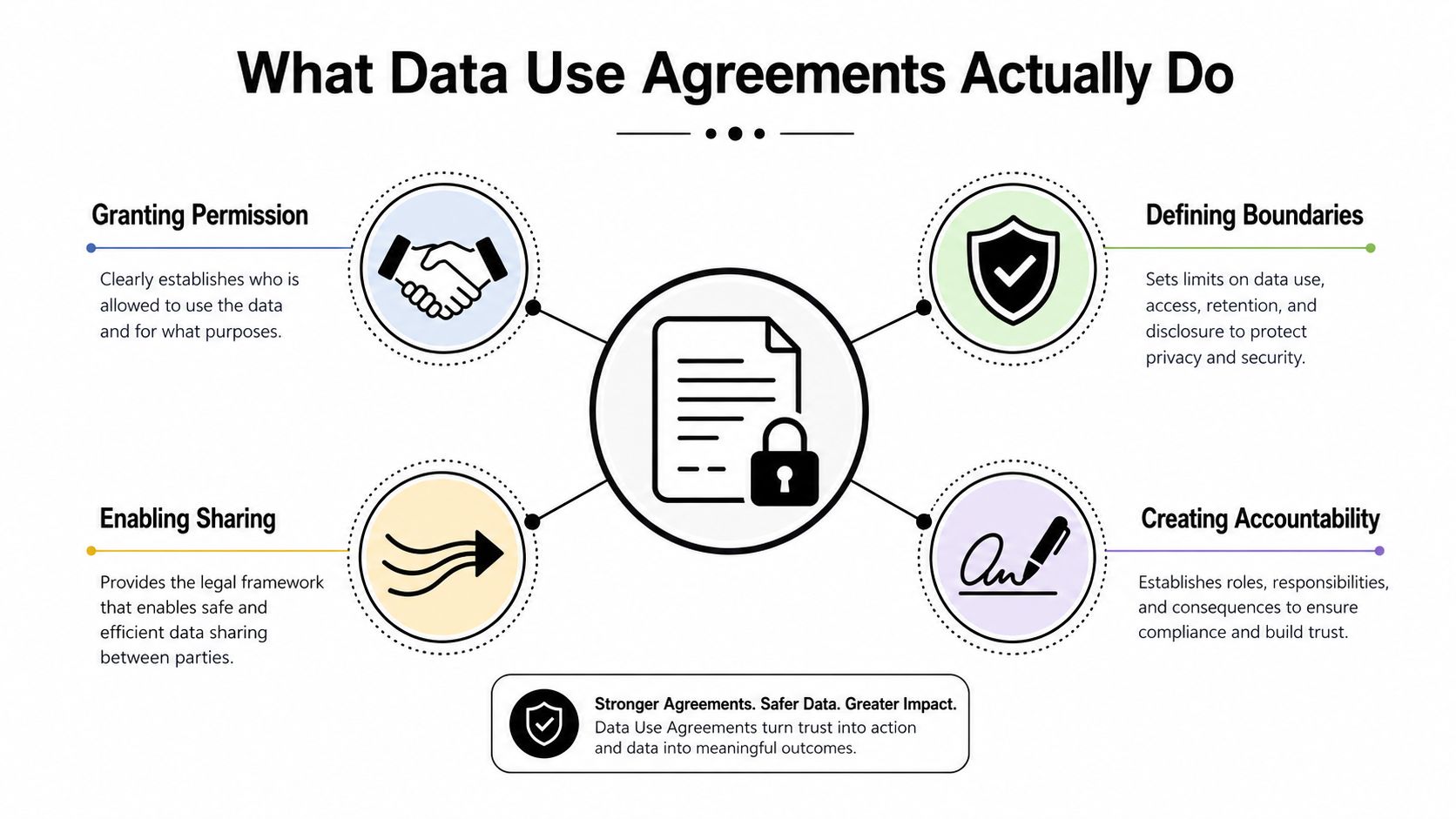
For a useful outside reference point, truelabel dataset licensing terms show how licensing language can make usage limits easier to understand before anyone touches the data. That's the right mindset for a DUA too, clear permission, clear boundaries, clear accountability. The internal governance angle is just as important, and a strong contract governance framework is what keeps those terms from disappearing after signature.
What Data Use Agreements Do
A DUA answers the questions business teams usually want to skip. What data are we sharing? Who can use it? For what purpose? For how long? Under what safeguards? If those answers are fuzzy, the agreement is weak, even if it looks formal.
The practical job of a DUA
In healthcare and research, DUAs are common control documents. CMS says it enters into DUAs to track disclosure of protected health information and/or personally identifiable information, and research institutions often require them for datasets containing PHI, with conditions that can include institutional affiliation, faculty status, and IRB approval. The point is simple, if a dataset leaves your control, the contract has to travel with the data and stay enforceable. See how contract governance principles apply across agreement types
Practical rule: If the recipient can't explain the permitted use, the retention rule, and the re-disclosure limit in plain English, the DUA is not ready.
A DUA also needs to work inside your systems, not just in a PDF. In technical settings, it can be a machine-readable policy object that binds a specific provider-consumer pair, defines the agreement lifecycle, and drives automated access control. That matters because manual enforcement breaks down fast when multiple teams, projects, and processors touch the same data.
Use the agreement to make access decisions auditable. The stronger the structure, the less your team has to rely on memory, side emails, or a Slack thread that no one can find two months later.
What it is for
A DUA is the contract layer that tells your legal, security, and systems teams what they are allowed to do with a named dataset, and what they must stop doing. It should spell out transfer limits, access controls, retention rules, re-disclosure restrictions, and audit rights in plain language that a recipient can operationalize.
That is where the clause set has to match the workflow. If the data may move across affiliates, say so. If it must be deleted at term end, require deletion evidence. If it cannot be reused for AI training or model fine-tuning, write that limit into the agreement and make sure your CLM setup can flag it for review before signature and route it for renewal or termination tracking.
The useful benchmark is clear permission, clear boundaries, clear accountability. That is the same governance logic reflected in truelabel dataset licensing terms, and it is the standard your internal contract process should enforce every time a dataset changes hands.
How DUAs Differ from DPAs, Data Sharing Agreements, and NDAs
Teams get this wrong because the documents sound similar but do different jobs. A DUA controls a specific dataset and the permitted use of that dataset. A DPA governs personal data processing on behalf of a controller. A broader data sharing agreement can cover the mechanics of sharing between parties. An NDA protects confidential information, but it doesn't automatically authorize data use.
| Agreement | What it governs | Regulatory anchor | Best used for |
|---|---|---|---|
| DUA | Use of a specific dataset, plus purpose, term, access, security, and re-disclosure limits | HIPAA, health research, public-sector controls, contract | Sharing a defined dataset under narrow conditions |
| DPA | Processing of personal data on behalf of a controller | GDPR and similar privacy frameworks | Vendor processing where the recipient acts as processor |
| Data Sharing Agreement | Broader sharing arrangement and operating rules | Contractual, sector-specific, or institutional policy | Multi-party data exchange where governance is broader than one dataset |
| NDA | Confidential information protection | Contractual confidentiality | Protecting secrets without necessarily permitting data transfer |
The simplest rule is this. If you need to control how a named dataset can be used, start with a DUA. If the vendor is processing personal data for you, you probably need a DPA. If the main concern is disclosure of confidential information, an NDA may be enough, but don't pretend it covers data governance.
Where the documents overlap
A data sharing agreement may include DUA-style restrictions, especially in research and public-health workflows. But overlap is not the same thing as fit. The risk is building a hybrid contract that looks thorough and still misses the actual control point.
A good contract is the one that matches the legal trigger, not the one with the longest appendix.
If your team is already using a DPA template, don't bolt DUA language onto it without checking whether the agreement needs to control retention, downstream use, or re-identification. The structure matters as much as the clause text, and a DPA framework is not a substitute for a dataset-specific use agreement.
Essential Clauses Every DUA Should Contain
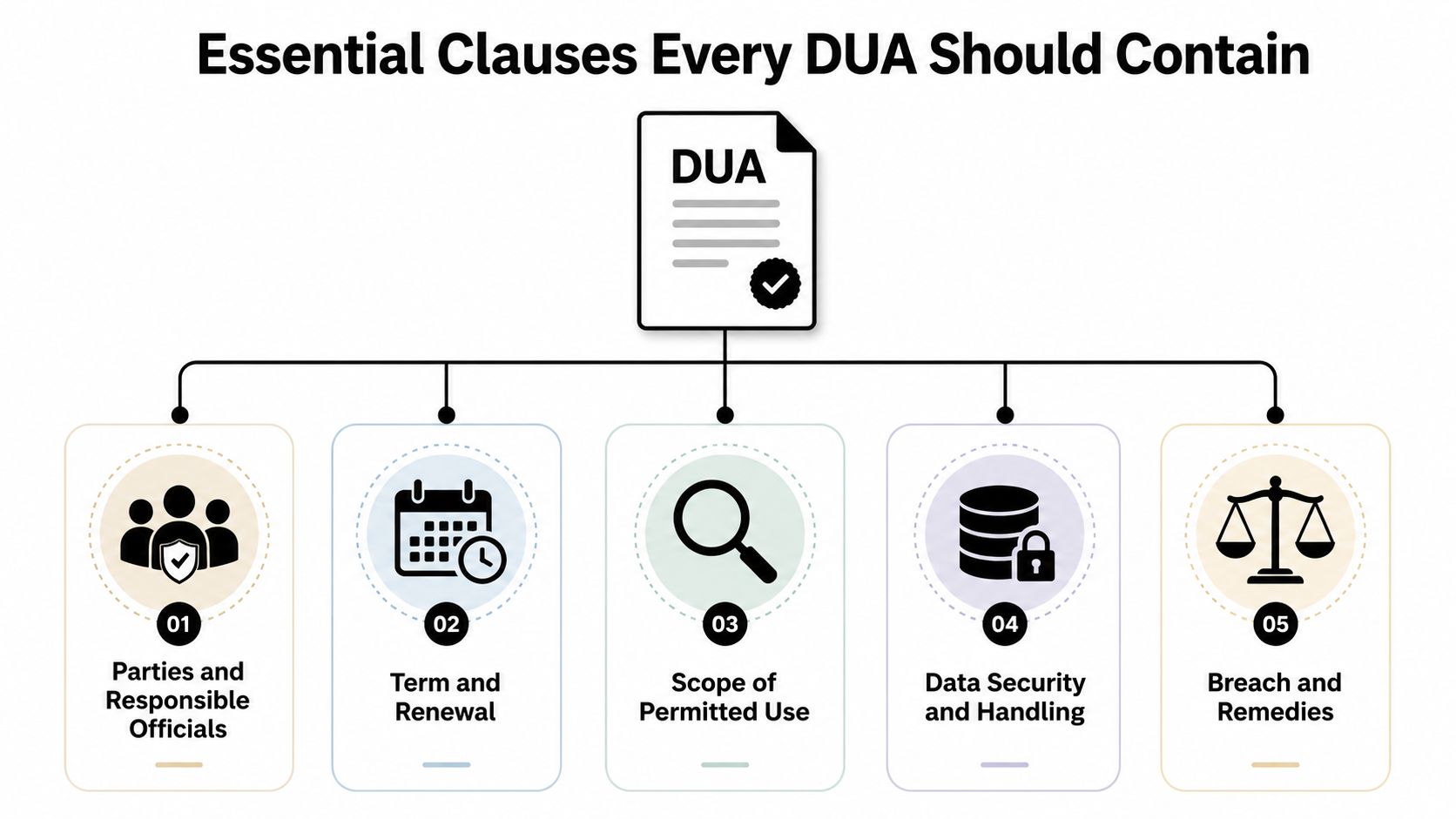
A DUA only works if it functions as a control document. Vague language leaves gaps in transfer, retention, re-disclosure, and reuse, and those gaps show up after the data has already moved. Draft each clause so a procurement team, legal team, and CLM workflow can enforce it without guessing.
Parties, purpose, and scope
Start with the basics, and make them precise. Identify the disclosing organization, the receiving organization, the exact dataset, the permitted purpose, and the people who are responsible for each side. The U.S. HHS common structure includes sections for the parties, period of agreement, scope of agreement, authority to share data, purpose or use case, scope of data, access controls, reporting requirements, and applicable laws and regulations, and that structure is useful because it forces the contract to answer the questions operations need answered.
Weak drafting says the data may be used for “business purposes.” Strong drafting names the dataset, the business function, and the approved use case. If your CLM platform cannot route approvals against that level of specificity, the agreement is too loose.
Security, transfer, and downstream controls
Security obligations should be written as operating instructions, not as decoration. HHS guidance says DUAs for external entities using protected personal data should spell out confidentiality requirements, security safeguards, and data-use policies and procedures, including transfer methods and review of security arrangements. The point is simple, if the clause does not say how the data moves, where it is stored, and who can access it, nobody can police the control environment later. See the HHS data use agreement guidance for the common structure that underpins this approach.
Operational advice: Write the transfer rule so security teams can implement it without a second legal interpretation.
Re-disclosure needs the same level of specificity. The recipient should be barred from passing the data to anyone outside the permitted chain, and any subcontractor or agent should be bound to the same restrictions. CLM should flag those flow-downs, track them against approved counterparties, and block signature until the language is in place. If that control is missing, the paper says one thing and the vendor can do another.
Retention, destruction, breach, and term
A DUA should say what happens at the end of the project, not leave cleanup to memory. Require return or destruction, state when that obligation kicks in, and define what proof the recipient has to provide. The agreement should also address breach reporting, governing law, and the recipient's obligation to cooperate if something goes wrong. For a useful drafting reference, the confidentiality clause guidance is worth reading alongside your DUA template because confidentiality and data use often fail at the same control points.
Use the term clause to tie the legal end date to the operational end of access. If the vendor keeps copies, backups, or exports after termination, the retention language was not drafted tightly enough. CLM should surface the destruction date, capture completion evidence, and hold the file open until the obligation is satisfied.
Compliance Considerations Under HIPAA, GDPR, and State Laws
HIPAA is the easiest place to be strict because the rule is direct. Under HIPAA, a DUA is required before any use or disclosure of a Limited Data Set from a medical record to an outside institution or party for research, public health, or health care operations, and the recipient must not re-identify the information or contact individuals. The recipient also has to use appropriate safeguards, report violations it becomes aware of, and bind downstream agents to the same restrictions.
HIPAA is about use limits, not just access
That means the DUA has to do more than authorize sharing. It has to prohibit re-identification, control onward disclosure, and match the operational reality of the recipient's system. If your counterparty can't commit to those limits, the share should stop there.
For a similar privacy posture in broader data programs, review the privacy commitments from Ekipa AI and compare them against your own internal standards for handling restricted data. You want the DUA to be concrete enough that privacy promises can be audited, not just marketed.
GDPR and state law pressure
GDPR often means a DUA sits beside, or inside, a DPA. The DPA handles processing roles and controller-processor obligations, while the DUA can still be the better instrument for limiting a named dataset's use, retention, and onward sharing. State privacy laws add another layer, especially where contractor language, sensitive data handling, and use restrictions need to line up with the agreement's operational controls.
That's why a single “standard sharing form” usually fails. The legal trigger changes the clause set, and the clause set changes the technical controls you need.
Use contract compliance controls to map obligations to actual workflow steps
What to align in the contract
- Purpose and legal basis: Make the authorized use narrow enough to fit the rule set.
- Safeguards and access: Tie access to named roles, systems, and security controls.
- Retention and deletion: State when the data must come back or be destroyed.
- Disclosure limits: Prohibit re-disclosure unless the agreement expressly allows it.
- Breach reporting: Make the reporting path unambiguous.
If those points are missing, you're not really negotiating compliance. You're negotiating ambiguity.
Modern Risks DUAs Must Cover AI, Metadata, and Reuse
A DUA written for a static file transfer does not hold up once the data moves into analytics, automation, or AI workflows. The agreement has to control where the data goes, who can touch it, what can be copied out of it, and whether anyone can reuse it for training, inference, or another project. Government guidance on AI governance and data handling keeps pointing at the same weak spots, including opacity around vendor processing, hidden data fields like metadata, and secondary use that exceeds the original purpose, as reflected in NIST's AI Risk Management Framework and the OMB memo on federal agency use of AI.
Why the old language breaks
A vendor can receive a customer dataset, enrich it, and keep the derived fields unless the DUA says those outputs stay restricted. An internal analytics team can repurpose the same dataset for a second initiative unless the agreement blocks secondary use. An AI vendor can push shared records into training or inference pipelines unless the contract draws a hard line around model use.
That gap matters because the old form usually stops at naming the dataset and the purpose. It leaves the operational questions unanswered, and that is where risk enters.
The better paper should address:
- Derived data
- Metadata and hidden fields
- Model training and inference rights
- Retention of enriched outputs
- Secondary use across departments
- Auditability of downstream processing
These are the controls that should be written into the DUA if the data will touch an AI-enabled workflow. If the agreement does not speak to them, the recipient will default to the broadest reading it can defend.
What to add to the clause set
State who owns derived data, or state that it remains subject to the same restrictions as the original data. Define whether metadata counts as data under the agreement, because a lot of disputes start there. If the recipient uses AI, the DUA should say whether the data can be used for training, whether outputs can be retained, and whether those outputs can expose the original source data.
If the vendor cannot explain where the data ends up, the agreement needs tighter use and reuse language.
CLM teams should stop relying on generic templates. A modern agreement needs fields a platform can read, route, and enforce, not just prose a lawyer can review once and forget. The same discipline applies to data localization and security in AI models, because where the data is processed affects what controls the DUA has to require.
Negotiation Tips and Common Redlines
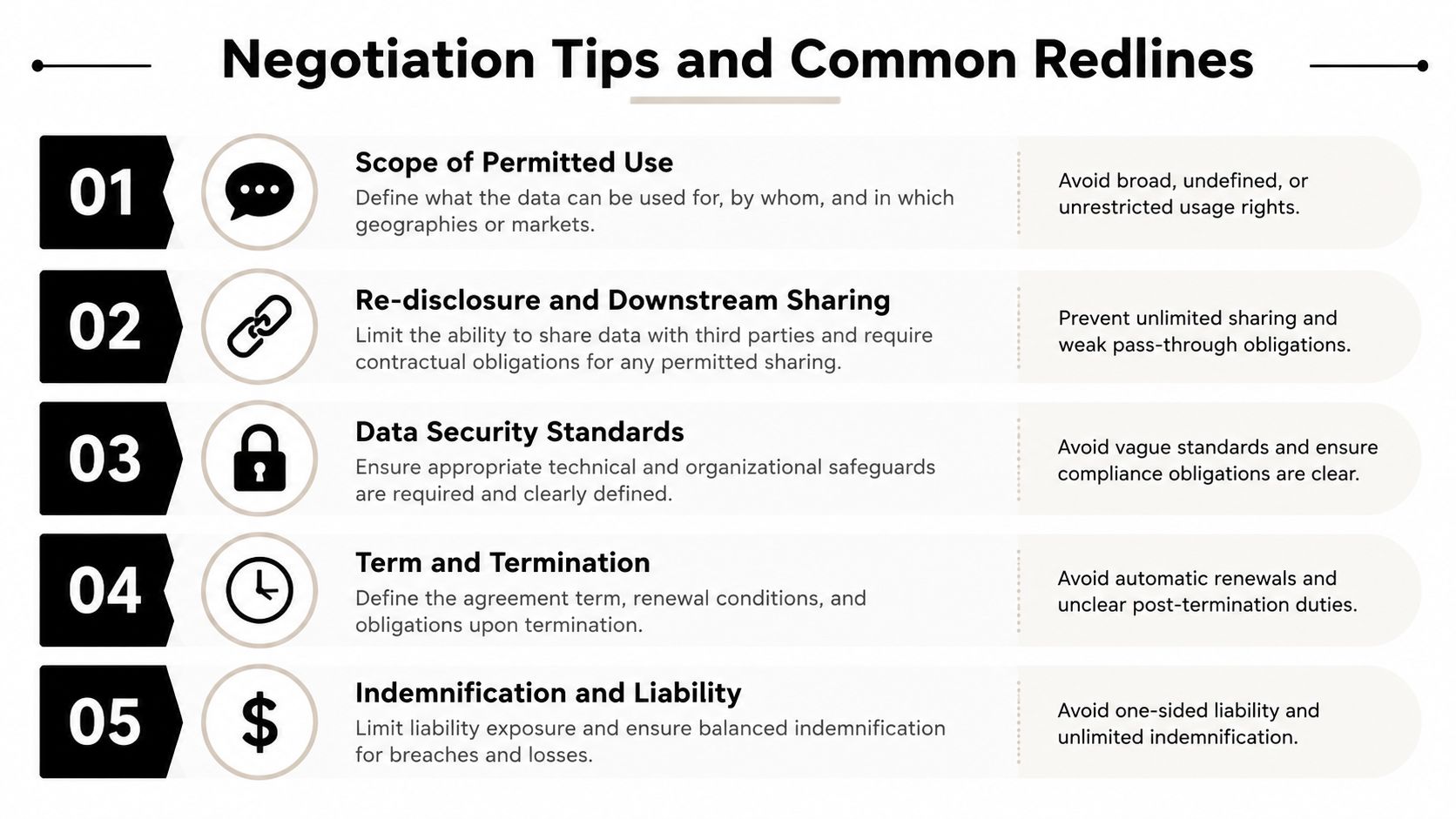
In our experience, DUA negotiations usually stall on five clauses: scope of permitted use, re-disclosure, retention, breach notice, and liability. Those are the points where legal exposure and launch pressure collide. Procurement feels the timing pressure, legal owns the fallout if the language is loose, and both teams end up paying for ambiguity later.
The five clauses that usually move
- Scope of permitted use: Counterparties will ask for broad use rights. Keep the language tied to the named project, the specific purpose, and any approved internal teams, so the recipient cannot repurpose the data later.
- Re-disclosure and downstream sharing: Vendors often want room to use subcontractors and affiliates. Require named categories, prior written approval, or hard flow-down obligations so the same restrictions follow the data.
- Retention and destruction: Open-ended retention is where reviews go sideways. Put a return or destruction deadline in the agreement, and make it line up with the actual project end date and any legal hold process.
- Breach notification: “Promptly” is not enough. Spell out who must notify whom, what gets reported, and how fast incident response information must move so security and legal can act on it.
- Indemnification and liability: Match the risk allocation to the sensitivity of the data and the access granted. If the recipient gets broad access to regulated data, the indemnity and liability caps should reflect that exposure.
The better fallback position is to make the agreement operationally enforceable. That means the DUA should tell the receiving team exactly what it can do, what it must block, what it must delete, and when it must report a problem. A mutual template built on the HHS structure helps, but only if security signs off on a pre-approved schedule of controls that a CLM platform can route, store, and track.
How to save negotiation time
Front-load the hard questions before the business team sets a launch date. Ask about use, retention, downstream processors, and breach reporting at the intake stage, because once a launch is framed as already approved, redlines get harder to move and exceptions start to pile up.
A DUA template should identify the disclosing and receiving organizations by full legal name, registered business address, and responsible officials. It should also set the start date, end date, renewal mechanics, and a clear retention rule that requires return or destruction at the end of the project. That specificity cuts review time and gives the CLM team fields it can route, search, and enforce.
Managing DUAs Across the Contract Lifecycle with CLM
A DUA should move through drafting, review, approval, signature, storage, obligations tracking, and renewal in one system, not sit as a PDF in a shared drive. CLM earns its keep because the agreement stays searchable, trackable, and enforceable instead of getting buried after signature.
How the workflow should work
The process should start in a CLM platform with a jurisdiction-aware template, then move through structured redlining and approval routing. After signature, the contract should live in a central repository with version history, searchable fields, and linked obligations. Renewal alerts should fire before term expiry, and compliance teams should be able to review breach exposure or reuse risk from the same record.
That only works if the DUA is machine-readable. In technical implementations, a DUA can function as a policy object that binds a specific provider-consumer pair, defines the lifecycle, and drives automated access control so systems can grant or revoke access based on agreement state.
What to automate
- Clause extraction: Pull out term, purpose, safeguards, and renewal language automatically.
- Deviation analysis: Flag missing re-disclosure, retention, or breach reporting language.
- Obligation tracking: Turn deletion, notice, and approval duties into tasks.
- Renewal alerts: Surface agreements that need renegotiation before access should continue.
- Repository analytics: Identify which DUAs expose reused data, stale terms, or missing controls.
Legitt AI fits this workflow as one option for teams that want AI contract drafting, review, repository management, eSignature, and obligation tracking in one place. The practical value is simple. It helps legal and ops teams extract clauses, compare deviations, and track renewal points without manually combing through every file.
Checklist, Template, and FAQs
Before signature, check the basics: parties, purpose, scope, security, retention, breach reporting, term, downstream flow-down, AI and reuse rights, and governing law. Use a template aligned to the HHS structure, then confirm the contract matches the actual workflow, not just the intended one.
Starter structure:
- Parties and responsible officials
- Period of agreement
- Scope of agreement and authority
- Purpose and data scope
- Access controls and safeguards
- Reporting obligations
- Retention, destruction, and return
- Applicable law and renewal terms
FAQ 1. How long should a DUA run?
It should run only as long as the approved use case needs access. Build in a clear end date and renewal mechanics so the agreement doesn't drift into indefinite use.
FAQ 2. Can one agreement satisfy HIPAA and GDPR?
Sometimes, but only if the clauses are mapped carefully. HIPAA limits, GDPR processing obligations, and state law requirements don't always line up cleanly, so don't assume one form covers all three without review.
FAQ 3. What if a vendor refuses standard DUA language?
Push back on the clauses that control risk, especially use, retention, re-disclosure, and breach reporting. If they won't accept the limits, the business should decide whether the data share is worth the exposure.
If your team is still managing DUAs by email and spreadsheets, it's time to move them into a system that can draft, review, approve, sign, and track obligations in one workflow. Visit Legitt AI to see how contract automation and CLM can help you operationalize data use agreements instead of just storing them.