
As businesses worldwide intensify their focus on Environmental, Social, and Governance (ESG) initiatives in 2026, e-signature technology has emerged as a powerful tool for reducing corporate carbon footprints. With global sustainability regulations tightening and stakeholders demanding greater environmental accountability, organizations are discovering that digital signature workflows offer measurable environmental benefits alongside operational efficiency gains.
The shift toward paperless operations through e-signature adoption represents more than just technological modernization—it’s becoming a strategic component of corporate sustainability programs. This comprehensive analysis examines how digital signature technology contributes to environmental goals while delivering business value.
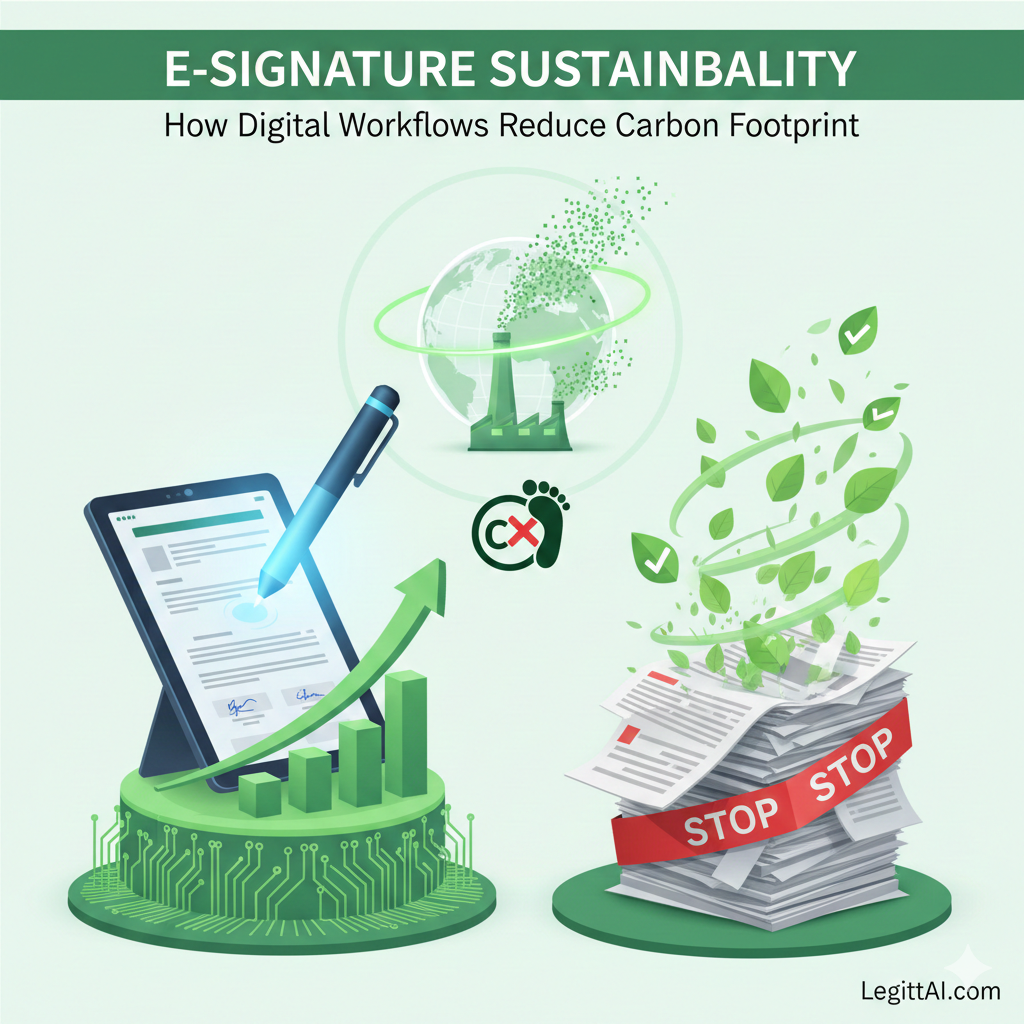
The Environmental Cost of Traditional Paper-Based Processes
Traditional document signing processes carry significant environmental burdens that many organizations underestimate. Paper production requires substantial natural resources, including water, energy, and raw materials.
A single sheet of standard office paper requires approximately 2.6 gallons of water and 0.05 kilowatt-hours of energy to produce. When multiplied across enterprise-scale document workflows, these numbers become substantial.
The environmental impact extends beyond paper production:
• Printing consumes energy and requires ink or toner cartridges
• Physical document transportation generates carbon emissions
• Storage facilities require climate control and physical space
• Document disposal creates waste streams
• Scanning and copying processes consume additional energy
For organizations processing thousands of contracts, agreements, and forms annually, these cumulative impacts represent a significant environmental footprint.
Quantifying E-Signature Environmental Benefits
Digital signature adoption delivers measurable environmental improvements across multiple dimensions. Research indicates that organizations can reduce paper consumption by 70-90% through comprehensive e-signature implementation.
Ready to see your impact? Transitioning to a paperless workflow is the fastest way to hit your 2026 sustainability targets. Start your journey toward a zero-carbon document process today.

Click to upload or drag & drop
pdf, docx up to 5 MB
Carbon Emission Reductions
E-signature workflows eliminate transportation-related emissions from document courier services, postal delivery, and business travel for signing meetings. A typical contract requiring multiple signatures across different locations can generate 15-25 pounds of CO2 emissions through traditional processes.
Digital workflows reduce these emissions to near zero, with only minimal server energy consumption required for document processing and storage.
Resource Conservation Impact
Large enterprises report saving millions of sheets of paper annually through e-signature adoption. This translates to:
• Reduced deforestation pressure
• Lower water consumption in paper manufacturing
• Decreased energy usage in production processes
• Minimized chemical usage in paper bleaching and processing
Waste Stream Elimination
Digital documents eliminate physical waste streams associated with document disposal, filing system maintenance, and storage facility operations.
ESG Integration and Sustainability Reporting
Modern sustainability frameworks increasingly recognize digital transformation initiatives as measurable ESG contributions. E-signature adoption provides quantifiable metrics for environmental reporting.
Measurable Sustainability Metrics
Organizations can track specific environmental improvements:
• Paper consumption reduction percentages
• Carbon emission decreases from eliminated transportation
• Energy savings from reduced printing and scanning
• Waste reduction through paperless processes
• Water conservation through decreased paper production demand
These metrics integrate directly into sustainability reporting frameworks like GRI (Global Reporting Initiative) and SASB (Sustainability Accounting Standards Board) standards.
Stakeholder Communication Benefits
E-signature sustainability initiatives resonate with multiple stakeholder groups:
• Investors increasingly evaluate ESG performance in funding decisions
• Customers prefer environmentally responsible business partners
• Employees value working for sustainability-focused organizations
• Regulatory bodies recognize proactive environmental initiatives
Industry-Specific Environmental Impact
Different industries experience varying levels of environmental benefit from e-signature adoption, depending on their document-intensive processes.
Real Estate and Property Management
Real estate transactions traditionally involve extensive paper documentation. E-signature adoption in property management can eliminate thousands of printed pages per transaction, including:
• Lease agreements and renewals
• Property inspection reports
• Maintenance work orders
• Tenant communications
• Regulatory compliance documentation
Healthcare and Medical Services
Healthcare organizations process enormous volumes of patient forms, consent documents, and administrative paperwork. Digital signature implementation reduces environmental impact while improving patient experience and regulatory compliance.
Financial Services and Banking
Financial institutions handle millions of documents annually, from loan applications to account opening forms. E-signature adoption delivers substantial environmental benefits while accelerating customer onboarding and service delivery.
Technology Infrastructure and Green Computing
Modern e-signature platforms leverage cloud computing infrastructure optimized for energy efficiency. Leading providers invest in renewable energy sources and carbon-neutral data centers.
Cloud-Based Environmental Advantages
Cloud-hosted e-signature solutions offer superior environmental efficiency compared to on-premises alternatives:
• Shared infrastructure reduces per-user energy consumption
• Optimized server utilization improves energy efficiency
• Renewable energy adoption by major cloud providers
• Reduced need for local IT infrastructure and cooling systems
Advanced platforms incorporate AI-powered document processing that minimizes computational resource requirements while maximizing processing efficiency.
Implementation Strategies for Maximum Environmental Impact
Organizations seeking to maximize environmental benefits from e-signature adoption should consider comprehensive implementation approaches.
Workflow Assessment and Optimization
Successful sustainability-focused e-signature implementation begins with thorough workflow analysis:
• Identify high-volume document processes
• Calculate current environmental impact baselines
• Prioritize workflows with greatest environmental benefit potential
• Establish measurement systems for ongoing impact tracking
Employee Training and Change Management
Environmental benefits require widespread adoption across the organization. Effective change management emphasizes sustainability advantages alongside operational improvements.
Integration with Existing Sustainability Programs
E-signature initiatives should align with broader corporate sustainability strategies, including:
• Green office initiatives
• Carbon reduction programs
• Waste minimization efforts
• Renewable energy adoption
• Sustainable supply chain management
Future Trends in Sustainable Digital Signatures
The intersection of e-signature technology and environmental sustainability continues evolving as organizations prioritize ESG initiatives.
Carbon Footprint Tracking Integration
Emerging e-signature platforms incorporate carbon footprint tracking features that automatically calculate environmental impact reductions from digital workflows.
Blockchain and Distributed Ledger Efficiency
Next-generation digital signature technologies leverage energy-efficient blockchain implementations that provide enhanced security while minimizing computational energy requirements.
AI-Powered Process Optimization
Artificial intelligence integration optimizes document workflows for maximum environmental efficiency, automatically routing documents through the most resource-efficient processing paths.
What This Means for Businesses in 2026
E-signature sustainability represents a convergence of operational efficiency and environmental responsibility that delivers measurable business value. Organizations implementing comprehensive digital signature strategies position themselves advantageously across multiple dimensions.
Competitive advantages include enhanced ESG ratings, reduced operational costs, improved stakeholder relationships, and alignment with regulatory trends toward environmental accountability.
Businesses should evaluate their current document workflows to identify opportunities for environmental impact reduction through e-signature adoption. The technology has matured to support enterprise-scale implementations while delivering quantifiable sustainability benefits.
Conclusion
E-signature technology offers organizations a practical pathway to meaningful environmental impact reduction while improving operational efficiency. As sustainability becomes increasingly central to business strategy, digital signature adoption represents both an environmental imperative and a competitive advantage.
The measurable benefits—from carbon emission reductions to resource conservation—provide concrete contributions to corporate sustainability goals. Organizations ready to advance their environmental initiatives should explore modern e-signature solutions that align with their sustainability objectives.
For businesses seeking to implement comprehensive digital signature workflows with built-in sustainability tracking, platforms like Legitt offer advanced electronic signature capabilities designed for enterprise-scale environmental impact. Learn more about sustainable e-signature solutions at Legitt.
Read our complete guide on Contract Lifecycle Management.
FAQs
How do e-signatures specifically reduce a company's carbon footprint?
E-signatures eliminate the entire lifecycle of paper-related emissions, including production energy, chemical processing, courier transportation, and waste decomposition in landfills.
What is the "water footprint" of a single sheet of paper?
On average, one sheet of standard office paper requires 2.6 gallons of water to produce. Switching to digital workflows saves thousands of gallons annually for even small teams.
What are "Scope 3" emissions, and how do e-signatures reduce them?
Scope 3 emissions are indirect emissions in your value chain. E-signatures reduce these by eliminating the need for clients and employees to travel for physical document signing.
How does LegittAI ensure the security of signed documents?
LegittAI uses advanced encryption and creates a tamper-proof audit trail that tracks the "who, when, and where" of every signature.
What is the typical ROI of switching to a paperless workflow?
Businesses usually see a return on investment within 3-6 months by saving on paper, ink, storage space, and administrative labor.
How does going paperless improve employee productivity?
It eliminates the time spent printing, scanning, filing, and searching for lost documents, allowing teams to focus on high-value tasks.
Do customers prefer digital signatures over physical ones?
Research shows that modern customers value convenience and sustainability; 79% of digital agreements are signed within 24 hours.
What industries benefit most from e-signature sustainability?
Real Estate, Healthcare, and Financial Services see the highest impact due to their high volume of document-intensive processes.
How does AI optimize the e-signature process?
AI can automate document routing, identify missing signatures instantly, and even track real-time carbon savings for your sustainability dashboard.
Can I integrate Legitt e-signatures with my existing CRM?
Yes, LegittAI is designed to integrate seamlessly with platforms like Salesforce, HubSpot, and Microsoft 365.