You’re probably in a familiar spot right now. The board wants clearer risk visibility. The CEO wants faster answers. Sales wants legal to move deals without slowing revenue. Procurement wants cleaner vendor terms. Your team wants relief from contract volume, scattered requests, and constant escalation.
That tension defines modern general counsel responsibilities. The job isn’t just about giving legal advice anymore. It’s about helping the company make decisions with enough speed, control, and judgment that legal becomes a business enabler instead of a bottleneck.
The hardest part is that the scope expanded faster than most budgets did. Many newly appointed GCs inherit the same problem: more strategic exposure, more operational work, and no proportional increase in headcount. That’s why disciplined operating models, clear delegation, and strong contract systems matter so much now.
The Evolution of the General Counsel Role
A generation ago, many companies treated the GC as the senior lawyer who stepped in when a deal got complicated, a dispute escalated, or a regulator asked hard questions. That model is gone in most serious organizations.
Harvard’s Center on the Legal Profession describes a major shift in the role. The GC has increasingly become the CEO’s and board’s primary counselor, with responsibilities extending into ethics, risk, governance, citizenship, public affairs, taxes, environment, privacy, and sustainability, and the position is treated as a top-management function comparable in stature to the CFO, as described by Harvard’s Center on the Legal Profession.
That change matters because it alters the standard by which the GC is judged. You’re not there only to identify what the law says. You’re expected to help leadership choose a path, define guardrails, and build a repeatable control environment around that choice.
Why the role feels so broad
The modern GC sits at the intersection of three pressures:
- Business pressure: leadership wants speed, revenue support, and practical answers.
- Risk pressure: exposure rarely stays in one lane. A contract issue can become a compliance issue, then a board issue.
- Operational pressure: the legal department has to handle intake, contracts, approvals, records, outside counsel, and reporting with finite resources.
That combination is why newly appointed GCs often feel pulled in opposite directions. The business wants acceleration. The legal reality demands discipline. The job is to design a system that gives the company both.
The strongest GCs don’t act as the department of “no.” They define where the company can move quickly, where escalation is mandatory, and who owns the decision at each step.
What the elevation of the role changes
Once the GC becomes a core executive, the questions change. Instead of “Is this legally permissible?” you’ll hear:
| Executive question | What the GC must provide |
|---|---|
| Can we do this deal fast? | A risk-based path, fallback terms, and approval thresholds |
| Can we enter this market? | Legal exposure translated into operating requirements |
| Can we defend this position? | A documented rationale, evidence trail, and governance view |
| Can we scale without adding people? | Process design, delegation, and technology-backed execution |
That’s the practical reality behind general counsel responsibilities today. The role expanded from specialist adviser to enterprise operator. If you don’t build structure around that expansion, the job becomes reactive very quickly.
The Four Pillars of Modern GC Responsibilities
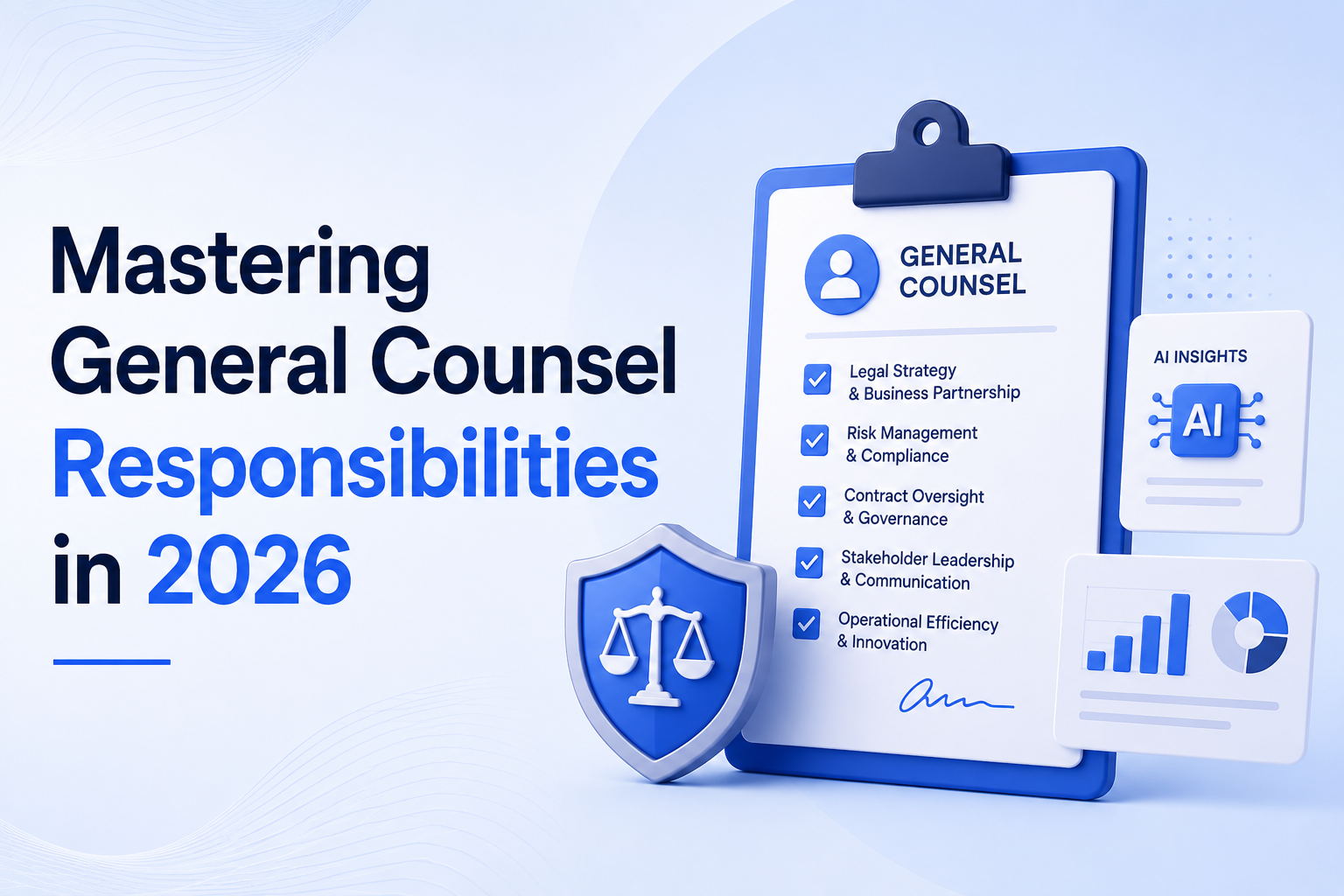
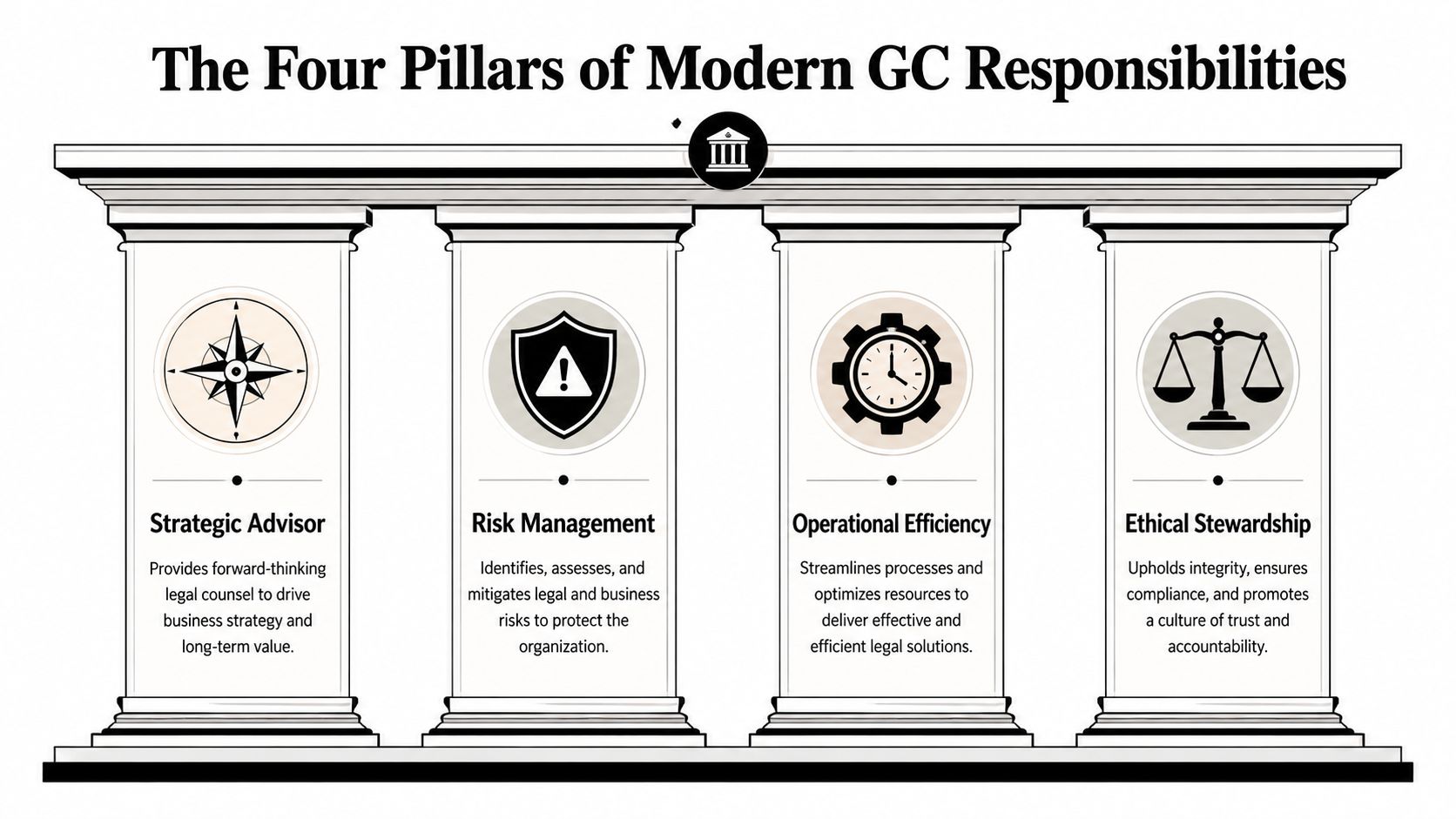
A useful way to manage the role is to stop thinking of it as one job. It’s really four connected jobs that share the same owner.
A widely cited survey of corporate legal leaders found that about 70% of general counsels focus on corporate transactional work, 28% handle compliance, and 21% are charged with board relations, as noted in this survey summary on general counsel work. That mix tells you something important. The role isn’t centered on litigation alone. It sits across transactions, oversight, and governance.
A practical four-pillar model
Strategic advisor
This is the part of the role most executives notice first.
- Shape business decisions: assess options, not just legal defects.
- Support major transactions: guide structure, approvals, and negotiation posture.
- Advise leadership directly: help the CEO and business heads understand trade-offs in plain language.
- Protect decision quality: distinguish acceptable risk from unmanaged risk.
Risk management
This pillar is what keeps the company from paying later for shortcuts taken now.
- Identify enterprise exposure: map where legal, operational, and compliance risks converge.
- Set escalation paths: define when business teams can proceed and when they must involve legal leadership.
- Prepare for breakdowns: maintain response plans for disputes, investigations, and urgent incidents.
- Control outside counsel: use external specialists intentionally, not by habit.
Operational efficiency
Many GCs underestimate this pillar at first. They shouldn’t.
- Run intake and triage: decide what deserves lawyer time and what should be standardized.
- Manage contract flow: keep templates, approvals, repositories, and obligations under control.
- Reduce avoidable rework: eliminate version confusion, duplicated review, and missing data.
- Build reporting discipline: make legal work visible to the business in operational terms.
Ethical stewardship
This pillar is often less visible day to day, but it defines credibility.
- Support the board: maintain clean reporting lines on governance and material issues.
- Strengthen compliance culture: make policies usable, not theoretical.
- Protect institutional integrity: speak clearly when leadership is drifting toward unmanaged exposure.
- Guard records and process: good governance often depends on evidence, documentation, and consistency.
Why the four pillars matter
Problems start when a GC overinvests in one pillar and neglects the others. A lawyer who gives excellent advice but ignores legal operations creates backlog. A process-minded GC who avoids hard board conversations leaves governance exposed. A commercially sharp GC who doesn’t set ethical boundaries creates long-term damage.
Practical rule: Review your calendar for the last month. If almost all of your time went to only one pillar, your operating model probably needs adjustment.
Mastering Strategic Counsel and Risk Management
The GC’s most valuable work usually happens before a dispute, not after it. That requires a shift in mindset. You can’t wait for business teams to bring fully formed legal problems to your desk. You need to spot patterns early and convert exposure into controls people can follow.
The Association of Corporate Counsel describes the function as increasingly one of risk aggregation and controls rather than pure advice. That includes identifying, assessing, and mitigating legal risk across the enterprise, designing compliance and crisis-management programs, overseeing outside counsel, and establishing record-retention and licensing practices across jurisdictions, as outlined in this ACC resource on general counsel responsibilities.
From legal reviewer to risk integrator
That description sounds abstract until you apply it to real decisions.
If sales wants a non-standard indemnity, the GC’s job isn’t merely to approve or reject language. The actual task is broader:
- Who can approve that deviation?
- What fallback clause should legal propose?
- Does finance need to price the risk?
- Does the repository tag this clause for later monitoring?
- If there’s a claim, do we have evidence preservation rules in place?
That’s what strategic risk management looks like. It turns legal judgment into operating discipline.
For teams comparing frameworks and software categories, it can help to evaluate governance risk compliance tools alongside your contract and policy systems. The best stack depends on your regulatory profile, transaction complexity, and reporting obligations.
What good risk management looks like in practice
Strong GCs usually standardize a few things early.
- Approval thresholds: certain deviations, markets, counterparties, or dispute values should trigger mandatory escalation.
- Policy-to-workflow alignment: if the policy says legal review is required, the intake system must route it accordingly.
- Cross-border consistency: local obligations may differ, but the company still needs one coherent control model.
- Documented playbooks: crises move too fast for improvised governance.
A useful operating principle is simple. Don’t leave recurring risk decisions trapped in email, memory, or individual judgment. Move them into systems, templates, and approval rules.
That’s where technology starts to matter. A risk program becomes far more durable when the legal team can connect policy controls with intake, review, and monitoring workflows through tools built for risk and compliance operations.
Driving Operational Excellence with Contract Lifecycle Management
Most legal departments feel operational stress first in contracts. Not because contracts are glamorous. Because they carry revenue terms, purchasing commitments, renewal triggers, indemnities, data obligations, and approval history all at once.
Sources describing the GC role tie the function directly to negotiating, drafting, overseeing, and supervising major contracts and transactions. They also make the practical point that weak contract controls cause legal teams to lose visibility into commercial terms, renewal triggers, indemnities, and compliance obligations, as explained in this overview of general counsel work in contract management.
Why contracts sit at the center of the legal function
A GC can tolerate some imperfection in many workflows. Contracting is not one of them.
When the contract process is fragmented, the same failure modes appear over and over:
| Weak point | What happens next |
|---|---|
| Templates live in folders and inboxes | Business teams start from outdated paper |
| Reviews happen by email | Redlines get lost and ownership gets blurred |
| Approvals are informal | Non-standard terms slip through without the right sign-off |
| Signed agreements aren’t centralized | No one can find renewal dates, obligations, or amendments |
Those issues don’t stay administrative for long. They become risk, cost, and delay.
What works better than email and shared drives
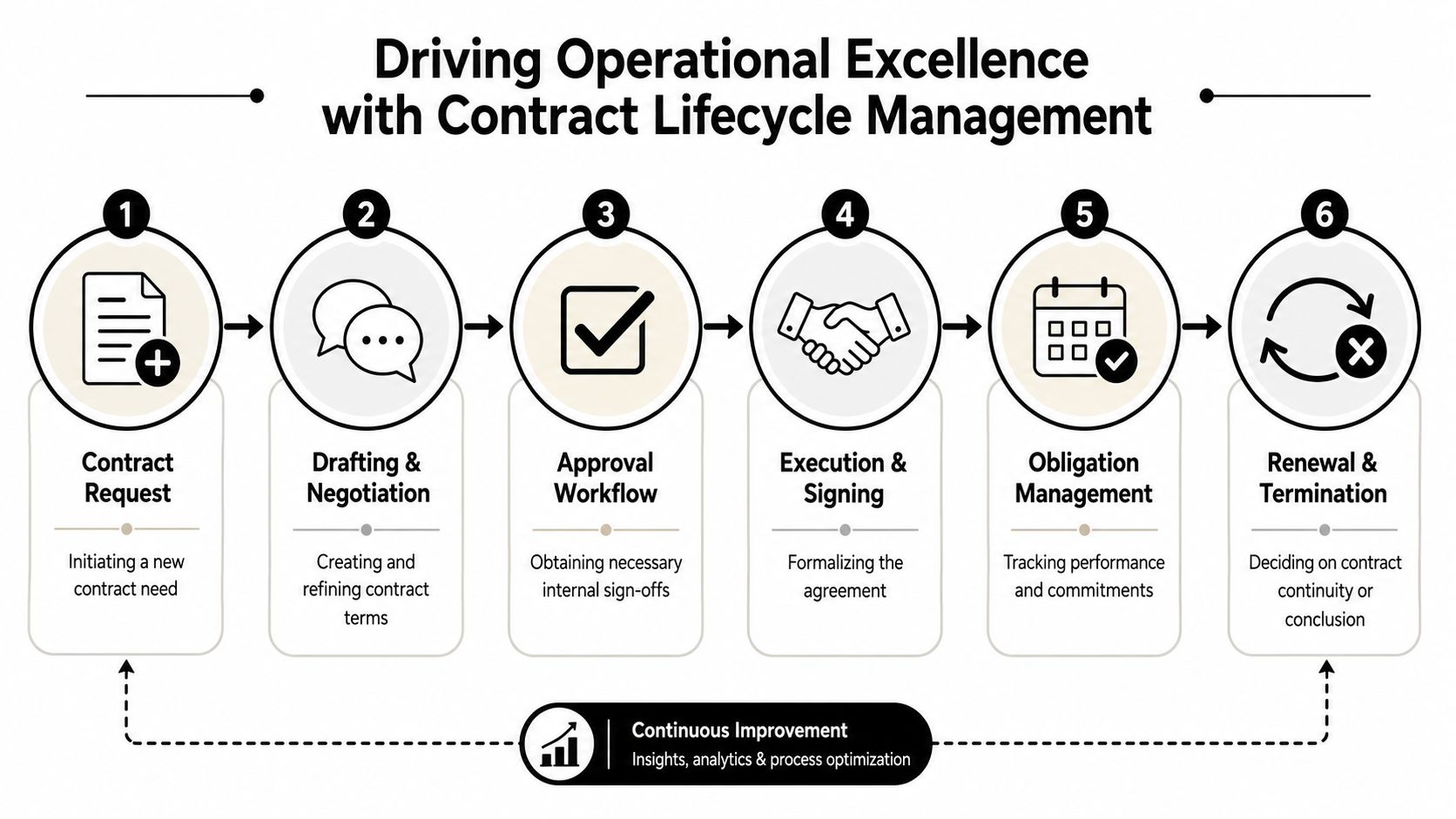
A proper CLM system gives the legal function a managed workflow from request through renewal or termination. That means structured intake, approved templates, controlled redlining, approval routing, execution, searchable storage, and post-signature monitoring.
For teams that still build agreements manually, an Automated contract drafting solution can be a useful starting point for standard paper. But drafting alone won’t fix the operating problem if approvals, repository management, and obligation tracking remain manual.
Here’s a practical walkthrough of the lifecycle in action.
The CLM capabilities that matter most
Not every legal tech purchase improves outcomes. The tools that help a GC most are the ones that reduce handoffs, standardize judgment, and preserve visibility after signature.
Look for these capabilities first:
- AI-assisted drafting: business users and legal teams should be able to generate first drafts from approved language and structured prompts.
- Contract review support: the system should flag deviations, missing clauses, and higher-risk third-party terms.
- Approval workflows: route contracts based on value, clause variance, counterparty type, or business unit.
- Repository controls: every version, amendment, and executed agreement should live in one searchable system.
- Obligation and renewal tracking: legal shouldn’t discover dates and duties only after someone misses them.
- eSignature integration: execution should happen inside the workflow, not in a disconnected process.
- Contract intelligence: legal leadership should be able to search the portfolio for clauses, expiries, obligations, and deviation patterns.
One practical example is Legitt AI, which combines AI-powered drafting, review, workflow automation, repository management, eSignatures, renewals, and contract intelligence in one workspace. A key advantage of a platform like that isn’t novelty. It’s operational continuity. Teams can move from request to signed agreement without losing control or context. That same point is why many legal teams struggle when they buy software without redesigning the workflow first, a challenge discussed in this analysis of why CLM platforms fail.
Contracts should be treated as a managed portfolio, not a pile of documents. Once a GC adopts that mindset, CLM stops looking like admin software and starts looking like core legal infrastructure.
Building and Leading the Modern Legal Team
Every GC eventually reaches the same conclusion. You can’t personally own every issue that reaches legal. If you try, response time collapses, your judgment gets spread too thin, and the department becomes dependent on your inbox.
That’s why workload design is part of general counsel responsibilities, not a side issue. Thomson Reuters recommends clarifying roles, determining risk tolerance, documenting risk processes, and offloading or outsourcing non-core responsibilities as a workload-management strategy in this guidance on managing growing GC workloads.
Decide what must stay close to the GC
Some work belongs near the GC because it carries enterprise consequence.
Keep these matters close:
- Board and governance matters: they require judgment, sensitivity, and consistent reporting lines.
- Material disputes and investigations: the stakes are too high for loose ownership.
- High-impact transactions: strategic deals need senior legal coordination.
- Issues that reset risk posture: new markets, major policy changes, sensitive employment matters, or novel regulatory exposure.
Other work can often move down or out if the process is mature.
Build a delegation model instead of reacting case by case
A lean legal department performs better when it defines service lanes.
| Work type | Best ownership model |
|---|---|
| Standard NDAs and routine procurement paper | Self-service or junior in-house review |
| Recurring commercial contracts with approved fallback terms | In-house legal with workflow rules |
| Specialized litigation, tax, or local law questions | Outside counsel with scoped instructions |
| Overflow drafting and repeatable support work | Alternative providers or fractional support |
| Governance-critical or high-risk matters | GC or senior legal lead |
The key is to make delegation intentional. Write down risk tiers. Define who approves exceptions. Build template playbooks for common issues. Then train the business to use the system you created.
This applies to external support too. If you use fractional or outsourced legal help, don’t let the relationship stay vague. Use clear scopes, response expectations, approval boundaries, and documented deliverables. Even a straightforward template such as an attorney agreement framework can help set expectations before work starts.
A small legal team can operate with discipline. A small legal team without role clarity burns out quickly.
Measuring Success with Legal KPIs and Reporting
A GC who can’t explain legal’s value in operational terms will spend too much time defending budget and too little time shaping decisions. The answer isn’t to invent vanity metrics. It’s to report on outcomes the business already understands.
Track operational outcomes the business understands
Good legal reporting usually includes a mix of speed, control, and demand indicators.
Consider a KPI set like this:
- Contract turnaround time: how long standard paper, negotiated paper, and high-risk paper take from request to signature.
- Approval cycle duration: where deals slow down, and which approvers create avoidable delay.
- Deviation volume: how often counterparties push the company off standard positions.
- Repository completeness: whether executed agreements and amendments are captured.
- Renewal and obligation visibility: whether the team can see upcoming decisions before they become emergencies.
- Outside counsel usage: what work is being sent out, why, and whether the scope matches policy.
- Legal intake by category: what the business asks for most often, which helps with staffing and self-service design.
Those metrics matter because they let you identify where legal work is strategic and where it is repetitive. They also expose process defects that otherwise stay anecdotal.
Turn legal reporting into management reporting
The board doesn’t need a list of tasks. The executive team doesn’t need legal jargon. They need a concise picture of exposure, throughput, bottlenecks, and trend lines.
A simple reporting format works best:
| Audience | Report focus |
|---|---|
| CEO and executive team | top enterprise risks, major deal support, key bottlenecks |
| Board or committee | governance issues, material disputes, compliance posture, escalation themes |
| Business leaders | contract cycle times, common fallback issues, approval delays |
| Internal legal management | workload mix, queue aging, template usage, outsourcing patterns |
The reason CLM and legal operations software matter here is straightforward. Manual reporting is fragile. If legal has to pull data from inboxes, spreadsheets, and shared drives, reporting becomes inconsistent and expensive. A strong contract platform creates structured data as part of the work itself. That’s what makes reporting sustainable.
A practical test is this. If your quarterly legal report takes heroic effort to assemble, your systems aren’t producing management-grade visibility yet.
Common GC Challenges and Actionable Playbooks
The role gets easier when you stop treating every problem as unique. Most GC pain points repeat. Intake chaos. Contract bottlenecks. unclear ownership. weak reporting. scattered documents. overloaded senior lawyers. The answer is usually a playbook, not more improvisation.
A first ninety days playbook
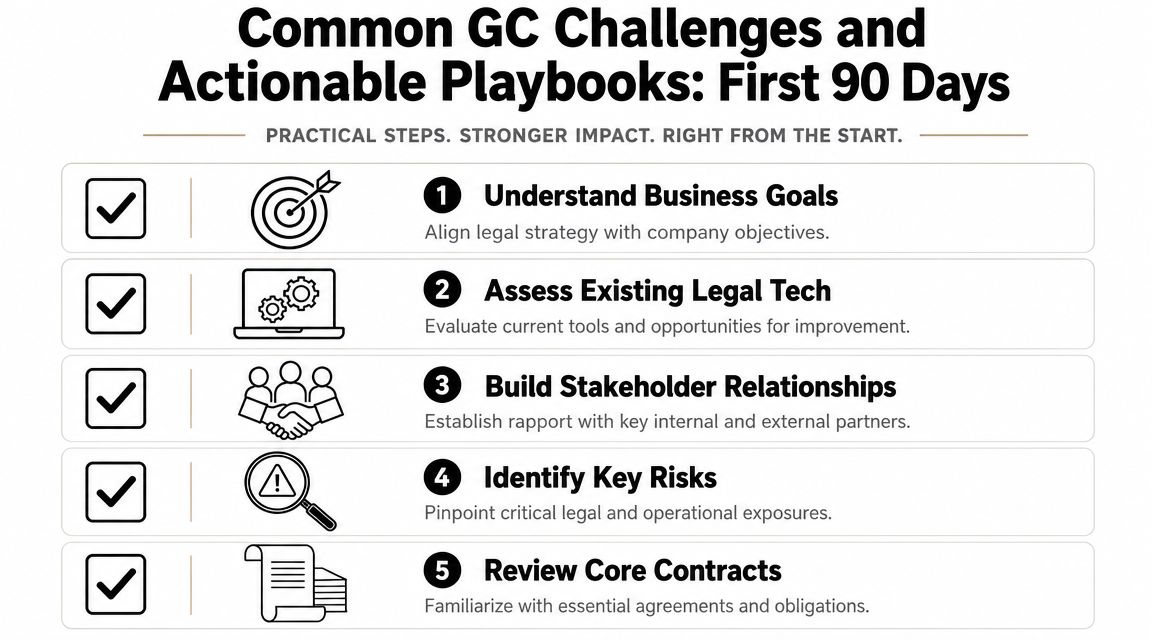
If you’re newly in the seat, focus on visibility before optimization.
-
Meet business leaders early
Ask where legal helps, where it slows work, and where risk feels least controlled. -
Map the contract flow
Find out how requests start, who reviews what, how approvals happen, where documents are stored, and what gets missed after signature. -
Review the top recurring risk areas
Look at non-standard commercial terms, board reporting cadence, outside counsel usage, key policies, and unresolved disputes. -
Identify hidden dependency points
Determine which decisions rely on one lawyer’s memory, one folder, or one business approver. -
Set a small number of operating rules
Define escalation thresholds, standard intake channels, and who can approve common exceptions.
A legal tech checklist for contract-heavy teams
Don’t buy software because the demo looks polished. Buy it if it fixes a defined legal workflow problem.
Use this checklist:
- Workflow fit: does it match your request, review, approval, and execution process?
- Template control: can legal lock approved language while still allowing structured flexibility?
- AI review utility: does it flag clause deviations and risk points in a way lawyers can trust and edit?
- Repository quality: can you search contracts by clause, party, obligation, renewal date, and amendment status?
- Approval logic: can you route by risk, business unit, contract type, or value?
- eSignature continuity: does signature happen inside the same operating flow?
- Post-signature management: can the team track obligations, milestones, notices, and renewals?
- Integration: does it connect with CRM, procurement, email, document tools, and internal systems?
- Adoption design: can business users submit requests and follow status without legal hand-holding?
The best playbook is the one people follow under pressure. Keep it simple, documented, and tied to tools that reduce manual work instead of adding another layer to it.
If your legal team is carrying strategic responsibility with limited headcount, Legitt AI is worth evaluating as part of your operating model. It gives in-house legal teams one place to draft, review, negotiate, approve, e-sign, store, and monitor contracts, which helps turn contract volume into structured, manageable workflow instead of constant reactive work.