Incorporation by reference is a legal shortcut in contracts that makes an external, separate document a binding part of the agreement without physically including its full text. In formal rulemaking, incorporated material can carry the same force and effect of law, and in contract practice that same idea matters because a short clause can pull in pages of obligations you never saw during the deal.
You've probably seen the setup. A vendor sends over a master services agreement that looks manageable, then one sentence says the deal is also subject to “supplier standards,” “security requirements,” or “website terms, as updated from time to time.” Sales wants signature today. Procurement wants pricing locked. Legal is trying to answer the core question: what exactly are we agreeing to?
That's where incorporation by reference becomes more than a drafting detail. It can be efficient, especially when teams need standardization across many contracts. It can also create hidden operational risk when the referenced document is hard to find, changes later, or conflicts with the signed agreement.
For legal operations, CLM, contract review, and enterprise contract workflows, this is a practical issue, not an academic one. If your team can't identify every incorporated document, track its version, and tie it back to the right agreement, you don't fully know your contract estate.
A Contract Clause That Points Elsewhere
A procurement leader once forwarded me a supplier agreement with a note that said, “Looks fine, just standard paper.” The contract itself was short. The problem sat in one line near the back: the buyer would also comply with the supplier's “technical policies and usage standards posted online.”
Nobody had attached those policies. Nobody had confirmed which version applied. Nobody knew whether the web page would stay the same after signature.
That's incorporation by reference in everyday contract life. One document points to another and treats that outside document as part of the deal. If it's done well, it keeps the main agreement lean. If it's done poorly, it turns a clean signature process into a dispute about missing terms, surprise obligations, and moving targets.
Why business teams miss the risk
Business leaders usually focus on the commercial terms first:
- Price and payment: Are the economics acceptable?
- Scope: What are we buying or selling?
- Timing: Can we sign this quarter?
- Liability: Are the caps and indemnities workable?
But incorporated documents often hide in operational language. Security schedules, onboarding rules, product manuals, compliance standards, support policies, and acceptable use terms may all become binding without being pasted into the contract itself.
Practical rule: If the contract points elsewhere, treat that other document as if it were printed on the signature page.
That's why clause literacy matters. A team that can spot vague references early usually avoids late-stage friction. A helpful primer on common contract clauses can make those review conversations much faster, especially for procurement, sales, and operations stakeholders who aren't reading contracts all day.
What this means for your deal
For your deal, the question isn't whether incorporation by reference is “good” or “bad.” The question is whether the outside document is:
- identifiable,
- accessible,
- stable,
- and consistent with the signed agreement.
If any of those answers is no, the clause needs work before signature.
What Is Incorporation by Reference
Incorporation by reference is a legal method for making one document part of another by referring to it instead of copying its text into the agreement. In practice, it lets a short contract pull in a separate set of terms that may live in an exhibit, a policy library, a technical standard, or a webpage.
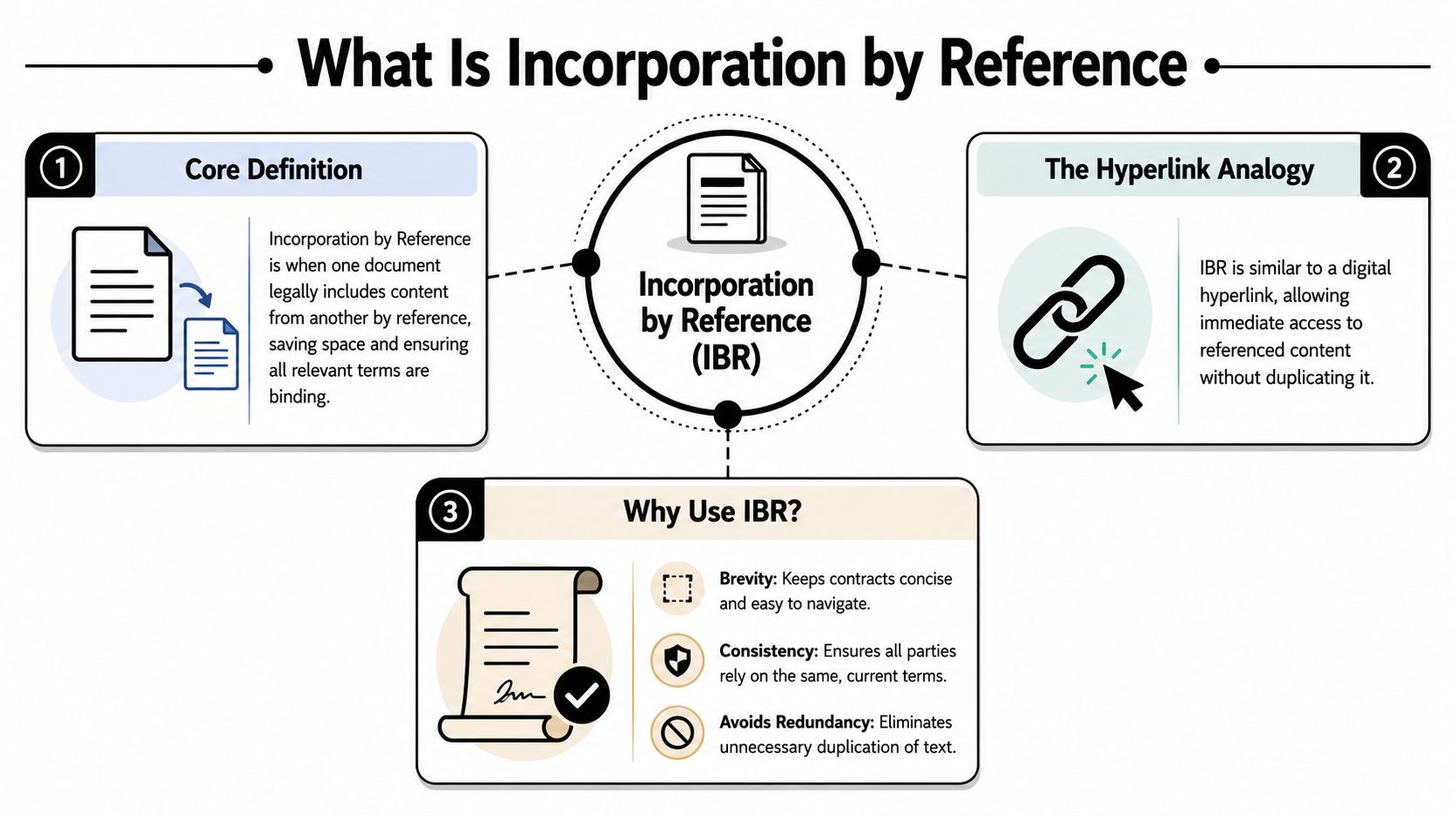
A useful comparison is a house plan that says “build according to drawing set B-12 dated January 2026.” The instructions are not repeated on every page, but they still control the work. Contracts use incorporation by reference the same way. The signed agreement points to another document, and that outside text can become just as binding as the words on the signature page.
Business teams usually see the upside first. The main agreement stays shorter. Standard requirements can be reused across many deals. Product, security, and operations teams can update their own supporting documents without rewriting the commercial paper each time.
That efficiency has a cost if no one manages the referenced material.
A clean-looking contract can hide a large amount of legal and operational content off-page. If the outside document is hard to find, changed after signature, or described loosely, the deal team may approve obligations it never reviewed. That is where incorporation by reference stops being a drafting convenience and becomes an execution risk.
Why contract teams use it
Used carefully, incorporation by reference solves real drafting problems:
- Brevity: A master agreement can refer to a detailed security schedule without pasting in dozens of technical controls.
- Consistency: A company can apply the same service levels, compliance terms, or onboarding rules across many contracts.
- Operational ownership: Subject-matter teams can maintain separate documents for implementation, support, or acceptable use requirements.
This structure also matters inside CLM. Referenced documents are often the terms that procurement, legal, security, and customer success must perform against after signature. If those documents are not captured, versioned, and tied to the record, the contract repository shows only part of the deal.
What makes it different from an attachment
Part of the confusion is that parties often treat every extra document as if it works the same way. It does not. Some attachments are informational. Others are legally operative because the contract says they are incorporated and form part of the agreement. For teams sorting out that difference, the distinction between an addendum and an appendix helps clarify which documents actually change contractual rights and duties.
A plain-English example
Suppose your SaaS agreement says:
“Customer shall comply with the Security Requirements, version 3.1, dated January 2026, attached as Exhibit C and incorporated by reference.”
That single sentence does several jobs at once. It tells you there is a separate document, confirms that it is binding, identifies the version that applies, and shows where to find it. A reviewer can assess the obligation because the target is clear.
Now compare that with “subject to our policies available online.” That wording creates avoidable uncertainty. Which policies? Which version? As of what date? Could the vendor change them after signature without notice? Those questions are not academic. They go straight to scope control, implementation burden, and post-signature dispute risk.
A short clause can import a long list of obligations, so the real deal terms may sit outside the four corners of the main document.
That is the operational lesson business leaders should keep in mind. Incorporation by reference is not just a definition issue. It is a visibility issue. The more your contracts rely on outside standards, web terms, manuals, and evolving policy sets, the more you need a system that can surface the exact referenced document, preserve the governing version, and flag later changes before they become phantom amendments.
Legal Standards and Enforceability
A reference clause earns its keep only if a court can tell, with confidence, what the parties meant to pull into the deal. The practical test is usually simple to state and hard to satisfy under deadline pressure: did the contract clearly say the outside document is part of the agreement, and did it identify that document well enough that no one can credibly argue over which text controls?
The questions courts usually ask
Courts often return to two basic points.
Clear intent
The contract has to say, in substance, that the outside document is part of the bargain. A vague pointer such as “see vendor handbook” may read like a convenience note, not a binding incorporation. By contrast, “the Vendor Handbook dated March 2026 is incorporated by reference and forms part of this Agreement” leaves much less room for argument.
That difference matters more than it may seem. In a dispute, a judge is trying to separate background material from actual obligations. If the clause sounds casual, the other side may say the document was informational only.
Specific identification
The document also needs to be identified with real precision. Title, version, date, author, exhibit number, URL, and storage location all help. The goal is practical: if your implementation lead, outside counsel, and a judge each look for the referenced material, they should all land on the same document.
Federal rulemaking applies this idea with unusual rigor. Agencies that incorporate outside standards into regulations are expected to identify the material with exact details and make the reference unmistakable. Contract drafters may not face the same formal checklist, but the lesson is the same. Precision is what turns a reference into an enforceable term.
Why enforceability changes by context
Incorporation by reference is widely used in U.S. contracts, but the rules are not identical in every legal setting. New York shows why legal teams should resist template complacency. As discussed in this analysis of New York law, the doctrine has developed unevenly across statutes and regulations, which is a good reminder that the governing law clause can affect how confidently a court reads your reference language.
For a business team, that translates into two operational points. First, a clause that worked in your last deal may still create debate under a different state's law or in a different regulated context. Second, enforceability is tied to the quality of the record. If the execution packet, attachment set, or approval trail is incomplete, the argument shifts from “what does this standard require?” to “was this standard ever part of the contract at all?”
That is one reason disputes over incorporated materials often overlap with written contract requirements under the statute of frauds. If the signed record does not clearly show the referenced document, a party may challenge inclusion before anyone even reaches the substance of the obligation.
Future documents create a harder problem
Some references do not point to a fixed document. They point to a stream of future changes. Securities law offers a useful analogy. In some filings, later documents can become part of an earlier filing through forward incorporation by reference, but only under specific rules and limits, as described in this discussion of SEC incorporation by reference rules.
The contract lesson is direct. A clause that pulls in future policy updates, later manuals, or revised online standards creates a moving target. That can be enforceable in some circumstances, but it raises harder questions about notice, assent, auditability, and change control.
In this context, legal doctrine and contract operations meet. If your business cannot prove which version applied on the signing date, who approved a later revision, or whether the counterparty had access to the changed text, enforceability weakens fast. Modern AI-powered CLM helps by preserving the referenced artifact, tying it to the signed agreement, flagging version drift, and surfacing hidden dependencies before they become phantom amendments or post-signature surprises.
The Hidden Risks and Common Pitfalls
Incorporation by reference is commonly viewed as a drafting shortcut. The operational risk is that the shortcut often bypasses visibility, ownership, and version control.
Where deals go sideways
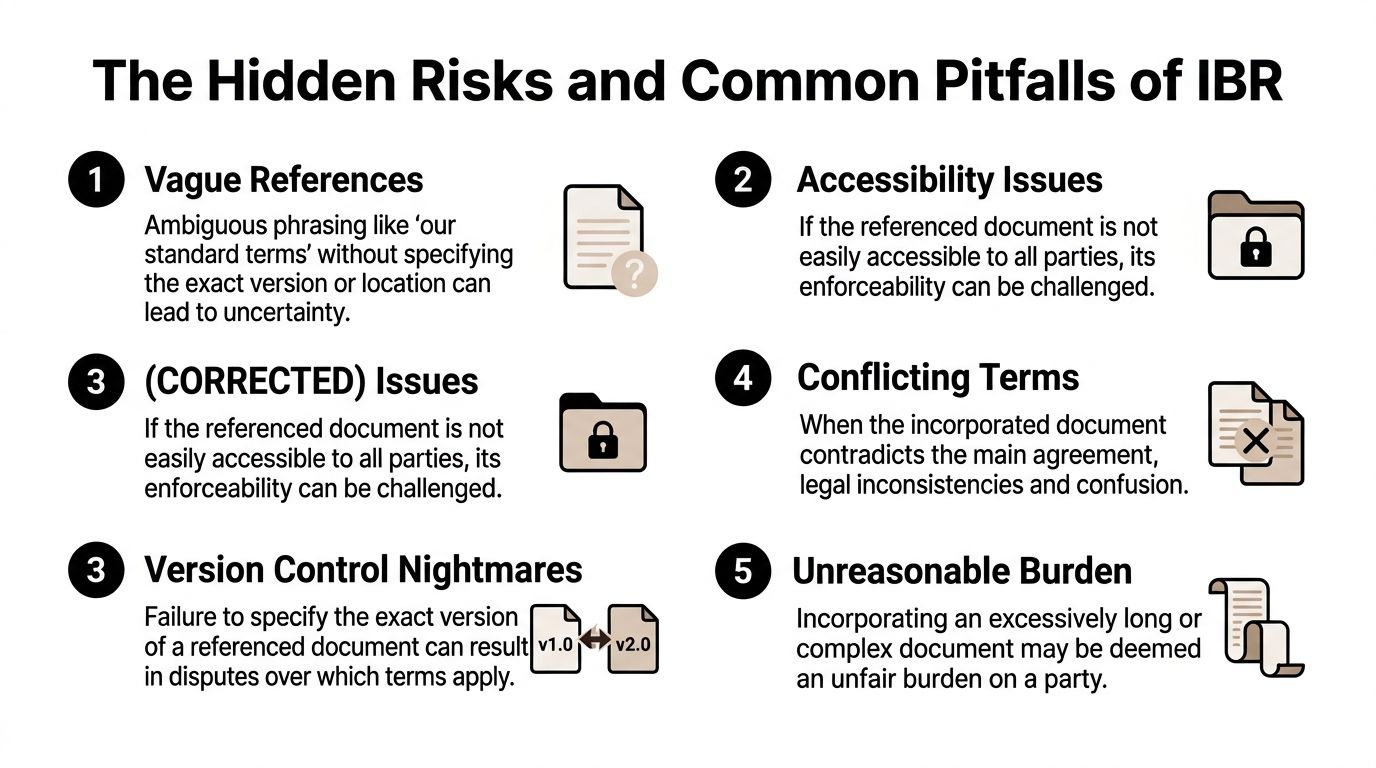
A few patterns show up again and again in contract review:
- Vague external terms: “Supplier policies,” “website terms,” or “industry standards” without identifying the exact document.
- Phantom amendments: Language such as “as updated from time to time,” which lets one party change obligations after signature.
- Missing attachments: The agreement refers to an exhibit that nobody included in the execution packet.
- Conflicts with the main paper: The MSA says one thing, the incorporated standard says another.
- No operational owner: Legal negotiated the clause, but no one in security, procurement, or operations tracks compliance after signature.
These issues don't stay theoretical for long. They become disputes during implementation, renewal, audit, or breach review.
The public access problem
One of the least discussed risks is the public access paradox. Agencies can incorporate private standards into binding rules, yet the regulated party may have to pay to read the very material that now governs its conduct. The problem isn't abstract. A review of recent trends noted that 68% of new IBR actions in 2025 involved proprietary documents requiring payment, as discussed in The Regulatory Review's analysis of incorporation by reference.
That issue has a direct contract parallel. In private deals, one party may incorporate manuals, standards, or policy sets that the other side can't easily access, can access only through a portal, or can't preserve as a fixed record.
If your team has to ask for the governing document after signature, your contract process already failed.
What business leaders should watch for
The phrase “incorporated by reference” isn't the only trigger. Watch for these formulations during contract review and contract analytics:
| Risk signal | Why it matters |
|---|---|
| “Available on request” | You don't yet have the binding text |
| “Posted on our website” | The document may change without a formal amendment |
| “Current policies” | No clear version is identified |
| “Applicable standards” | The scope may be too broad |
| “As amended from time to time” | Future obligations may appear automatically |
For legal teams trying to avoid ambiguity in contracts, this is one of the most practical places to start. Ambiguity around incorporated documents often creates more downstream friction than heavily negotiated liability language because the business never operationalized what it accepted.
Best Practices for Drafting and Review
A strong incorporation clause doesn't try to be clever. It tries to be findable, fixed, and workable.
Draft for certainty
If you're drafting on your paper, assume a future reviewer will ask three questions: What document is this? Which version applies? Where can I see it? Answer all three in the clause itself or in clearly labeled exhibits.
Use this comparison when drafting or redlining.
IBR Clause Drafting Do's and Don'ts
| High-Risk Clause (Avoid) | Low-Risk Clause (Use) |
|---|---|
| “This agreement is subject to Vendor's standard policies.” | “The Information Security Requirements titled ‘Vendor Security Schedule,’ version 2.4, dated February 2026, attached as Exhibit B, are incorporated by reference into this Agreement.” |
| “Customer will comply with website terms as updated from time to time.” | “Customer will comply with the Acceptable Use Policy dated as of the Effective Date, available at the URL listed in Exhibit D. Any later change is effective only if both parties agree in writing.” |
| “Services are governed by industry standards.” | “Services will conform to the implementation standard titled ‘Deployment Specification,’ revision 5, issued by the Provider on the Effective Date and attached to this Agreement.” |
| “See handbook for additional obligations.” | “The Supplier Handbook dated January 2026 is incorporated by reference solely for onboarding and site-access procedures. If the Handbook conflicts with this Agreement, this Agreement controls.” |
Review like an operator, not just a lawyer
When third-party paper includes incorporation by reference, ask operational questions, not just legal ones.
- Get the document now: Don't accept “we'll send it later.”
- Freeze the version: Title, date, edition, and revision matter.
- Define precedence: State which document wins if there's a conflict.
- Limit scope: Incorporate only the needed section, not an entire library.
- Resist future updates: If the other side wants change flexibility, require notice and written acceptance.
Negotiation shortcut: “We can accept the referenced document if you attach the current version and confirm that later updates won't apply without written agreement.”
Attach when it matters
Attachment isn't mandatory in every deal, but it's often the cleanest answer. In enterprise contract workflows, the fastest way to reduce friction later is to execute one package containing the agreement and the incorporated documents together.
That approach helps with:
- repository management,
- audit readiness,
- approval workflows,
- and post-signature obligations tracking.
For procurement, vendor management, and legal operations, this is low-cost prevention. It reduces the chance that a team spends renewal season arguing about what was agreed to two years earlier.
How AI Contract Management Tames IBR Complexity
Manual contract management breaks down quickly when incorporation by reference appears across hundreds or thousands of agreements. A lawyer may catch the issue in one redline. The harder problem is enterprise scale. Which contracts pull in external security schedules? Which reference a vendor portal? Which ones allow future updates? Which incorporated documents have changed since signature?
Those are CLM and contract intelligence questions as much as legal ones.
Why spreadsheets and shared drives fail
In many companies, incorporated documents live in scattered places:
- the signed PDF mentions them,
- an email thread contains an attachment,
- a procurement portal holds the latest version,
- and the business owner assumes Legal has it all under control.
That setup creates blind spots. Contract review may have been good at signature, but contract lifecycle management fails during performance. Nobody can easily map parent agreements to the referenced materials that govern day-to-day behavior.
A capable CLM system solves that by treating incorporated documents as first-class records, not side notes.
What AI should do with incorporated documents
Modern AI contract review and contract automation tools can help in several specific ways.
Detect the clause automatically
AI review can scan incoming paper for phrases that signal incorporation by reference, including looser formulations that don't use the exact legal label. That matters because risk often hides in plain business language.
Link parent and child documents
A strong contract repository should connect the signed agreement to each referenced exhibit, schedule, manual, or policy. That gives legal operations, procurement, and sales one source of truth.
A useful workflow is to auto-link NDAs, MSAs, SOWs, and amendments using AI. The same logic helps with incorporated standards and external schedules that would otherwise sit outside the contract graph.
Flag version and access issues
AI can identify whether the clause names a specific version, whether the external document is missing, and whether the contract allows unilateral future changes. It can also surface precedence conflicts between the main agreement and the incorporated text.
Extract obligations from the outside document
Contract intelligence becomes practical through specific applications. If an incorporated security schedule imposes audit cooperation, notice duties, data handling rules, or response timelines, the system should extract those obligations and assign them to owners. Otherwise, the repository stores the risk but doesn't manage it.
The efficiency case is real
The business case for AI-assisted contract management isn't hypothetical. Organizations using AI in contract management achieve a 39% reduction in contract lifecycle time from drafting to approval, according to these contract management statistics. If your approval cycle includes chasing missing incorporated documents, validating versions, and checking whether website terms changed, that time savings has a very practical explanation.
AI review also changes turnaround speed on standard paper. AI-powered contract review tools can analyze a standard NDA in 26 seconds compared with 92 minutes for a human lawyer, while maintaining 94% accuracy, as summarized in these CLM statistics. For an in-house team triaging high-volume inbound contracts, that kind of first-pass review helps surface incorporation issues before they become approval bottlenecks.
From hidden liability to managed asset
The primary value isn't just speed. It's visibility.
When AI-native CLM handles incorporation by reference well, the workflow becomes much more disciplined:
- the system detects the clause,
- requires the referenced file or validated link,
- records the applicable version,
- extracts obligations,
- routes review to the right stakeholder,
- and monitors renewals, changes, and downstream compliance tasks.
That's how a buried clause stops being a lurking liability and becomes a managed part of your enterprise contract workflow.
Conclusion Turning IBR from Risk to Advantage
Incorporation by reference looks small on the page, but it can reshape the economics and operational burden of a deal. A sentence that points elsewhere may import security controls, service rules, payment conditions, technical standards, or future changes your team never priced, staffed, or approved properly.
The practical answer isn't to ban the concept. It's to control it.
That starts with disciplined drafting. Identify the exact document. Fix the version. Make it accessible. Limit automatic updates. Clarify which document controls if terms conflict. Those habits reduce legal ambiguity and make contract review more predictable for procurement, sales, and operations.
It also requires stronger contract infrastructure. In a modern CLM environment, incorporated documents shouldn't sit outside your repository, outside your approval workflows, or outside your contract analytics. They need the same visibility as the signed agreement itself.
The safest contract isn't the one with the shortest wording. It's the one your team can actually see, understand, and operationalize.
For legal operations and enterprise decision-makers, that's the bigger lesson. Contract intelligence isn't just about the text on the signature pages. It's about every binding document attached, linked, or incorporated into the deal. Teams that manage that well reduce compliance risk, improve execution, and make negotiations faster because fewer surprises appear after signature.
If your team wants a better way to draft, review, eSign, store, and track contracts with incorporated documents in one place, Legitt AI offers an AI-native CLM workspace built for legal, procurement, sales, and operations teams. It helps organizations connect agreements to related documents, automate review and approval workflows, extract obligations, manage renewals, and turn scattered contract data into usable contract intelligence.