Contracts usually break down long before anyone signs.
A sales rep sends the latest draft from email. Legal edits a different version in Word. Procurement tracks renewal dates in a spreadsheet that no one updates on time. Finance wants visibility into committed spend, but the key terms are buried in PDFs. By the time leadership asks, “Which contracts need attention this quarter?”, the honest answer is, “We need to piece that together.”
That’s the essential buying context for a first major CLM purchase. You’re not choosing between three interchangeable apps. You’re choosing which operational problem to solve first.
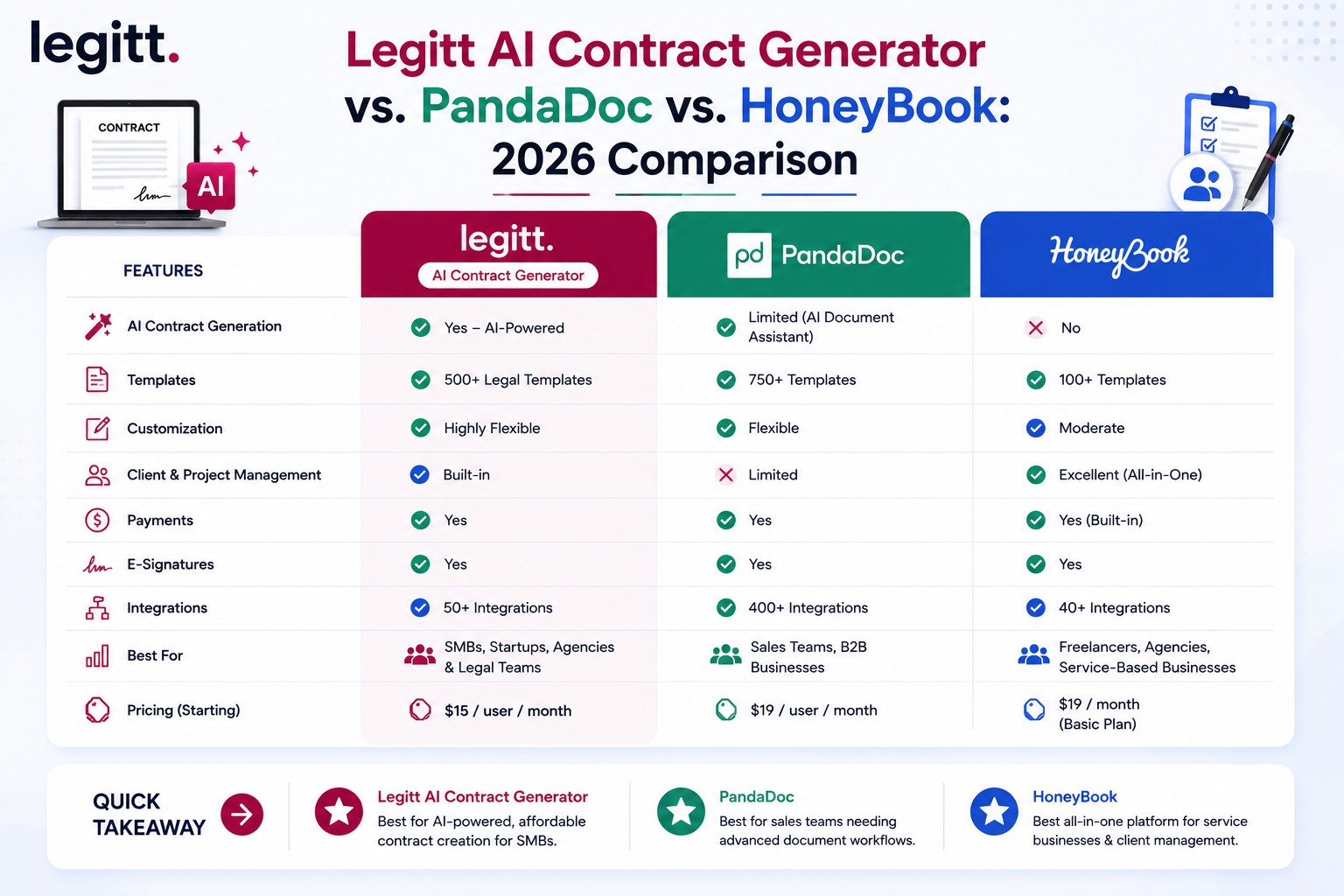
In the 2026 market, HoneyBook, PandaDoc, and Legitt AI sit in the same conversation for one reason only. All three touch contracts. But they come from very different starting points. HoneyBook starts with client flow for small service businesses. PandaDoc starts with document creation and eSignature for revenue teams. Legitt AI starts with contract lifecycle management, legal operations, and AI-driven contract intelligence.
The usual comparison article gets stuck on template counts, how quickly a signature is collected, or whether the editor feels modern. Those details matter, but they don’t answer the most expensive questions. Can the system review third-party paper intelligently? Can it help legal and procurement spot risk deviations early? Can it support jurisdiction-aware compliance instead of just generating another static document?
A strong answer changes more than document handling. It affects approval speed, risk control, renewal capture, and the amount of legal work your team can absorb without adding headcount.
Beyond the Digital Filing Cabinet
A familiar pattern shows up in growing companies.
The sales leader wants contracts out faster because delayed paper slows revenue. The in-house lawyer wants fewer routine reviews because too much time disappears into repetitive redlines. The procurement manager wants one place to see renewal dates, obligations, and vendor terms before auto-renewals slip through. Everyone is talking about the same contract process, but each team experiences a different bottleneck.
The old setup usually looks “good enough” from the outside. Shared folders. Email approvals. A CRM note here, a billing reminder there. But those tools don’t create a reliable contract system. They create fragments.
What teams are really buying
Most buyers say they want contract automation. In practice, they’re trying to eliminate four operational failures:
- Version confusion: Teams lose time reconciling which draft is final.
- Review overload: Legal gets dragged into low-risk work because business users can’t triage contracts confidently.
- Missed dates: Renewals, notice periods, and obligations sit inside executed agreements instead of live workflows.
- Poor visibility: Leadership can’t search terms across the contract portfolio without manual effort.
That’s why the shift away from “digital filing cabinet” software matters. A repository only stores documents. A CLM system should help teams draft, review, approve, sign, track, and analyze contracts as active business assets.
Practical rule: If your contract tool mainly helps you send documents and collect signatures, you still have a document workflow. You don’t yet have contract operations.
Older contract processes also make AI harder to use well. If contracts remain scattered across inboxes and disconnected tools, even strong AI has no clean workflow to act on. The broader shift from paper archives to intelligent systems is captured in this overview of the evolution of contract management from paper to smart contracts.
HoneyBook, PandaDoc, and Legitt AI matter because each represents a different answer to this problem. One simplifies client administration. One accelerates sales documents. One is built for organizations that need structured contract review, workflow control, and searchable contract intelligence across departments.
The Evolution to Intelligent Contract Management
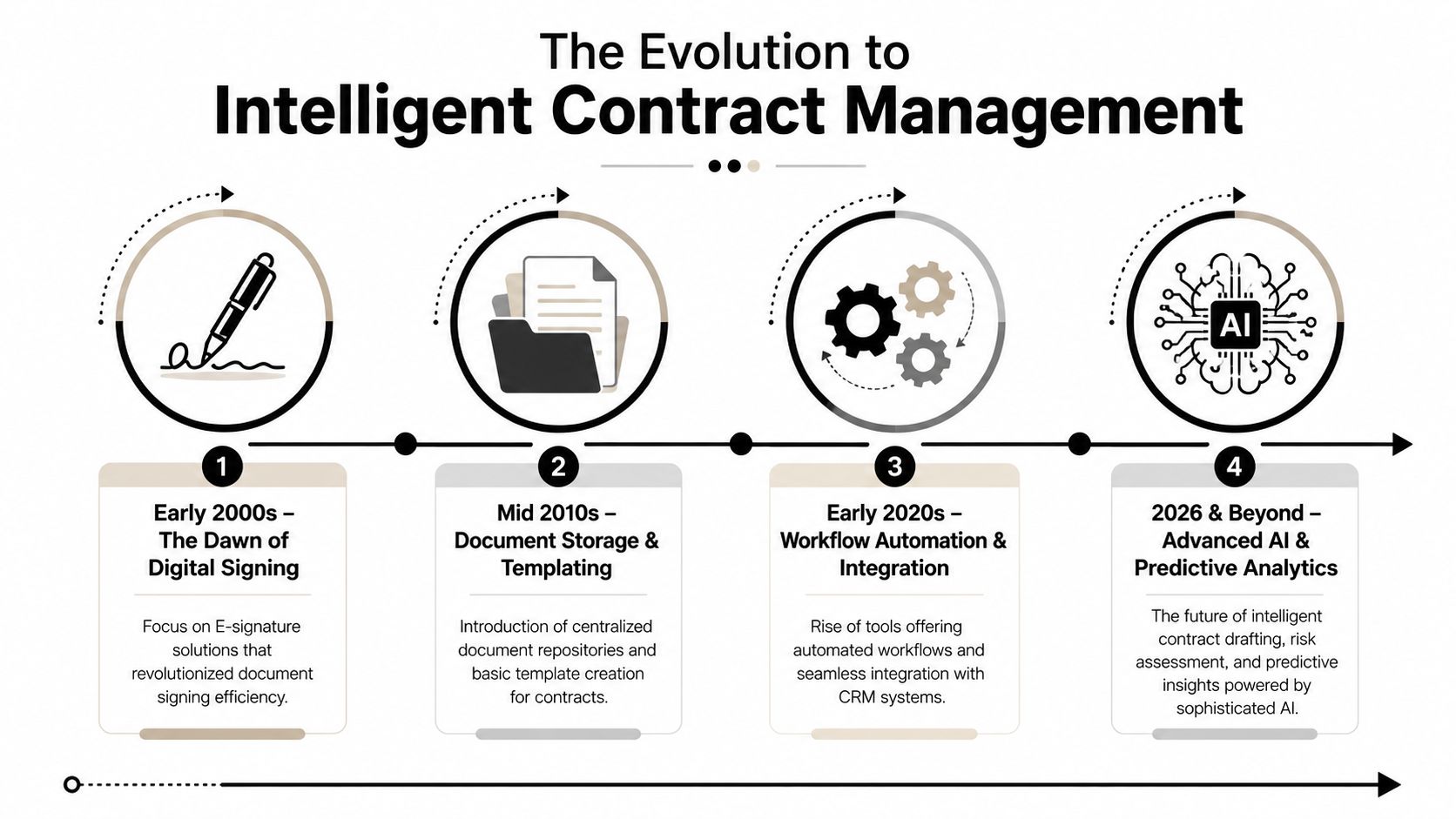
Contract software has moved through distinct phases. First came digital signature tools. Then document storage and templates. After that, workflow automation and integrations. The current benchmark is higher.
Modern buyers don’t just want to create contracts faster. They want the platform to understand what the contract says, route it based on risk, and keep working after signature.
From storage to contract intelligence
Contract Intelligence means turning contracts from static files into structured business data. Instead of opening a PDF and reading line by line, teams can search for liability caps, renewal terms, termination rights, governing law, payment language, and obligations across the portfolio.
That changes how legal and operations work.
A searchable repository helps sales ops identify renewals, procurement identify off-playbook vendor terms, and finance understand commercial commitments. It also changes reporting. A contract system stops being a place where documents go to rest and becomes a place where teams retrieve live information.
From templates to contract automation
Contract Automation goes beyond mail merge and clause libraries. It includes how a contract is generated, reviewed, approved, signed, stored, and monitored.
A practical example makes the distinction clear:
- Basic automation: A rep selects a template, fills in fields, sends for signature.
- Intelligent automation: The system generates a draft, flags clause deviations in incoming third-party paper, routes approvals based on risk, captures metadata, stores the final agreement, and alerts the right team before renewal or obligation deadlines.
That’s why this comparison is relevant now. Proposal software, eSignature tools, and CLM platforms increasingly overlap at the edges, but they still serve different operating models. The broader move toward AI-native workflows is covered in this analysis of AI in contract lifecycle management.
A contract platform earns its place when it reduces decision time, not just document time.
For 2026, that distinction matters more than interface polish. A sales-led tool can be excellent for quote-to-signature workflows and still fall short for legal review. A client-management tool can be ideal for a solo business and still be the wrong fit for procurement-heavy organizations. The right comparison standard is not “which has more features.” It’s “which system matches the complexity of your contract operating model.”
Platform DNA and Primary User Focus
The fastest way to get this decision wrong is to compare these products as if they were built for the same buyer. They weren’t.
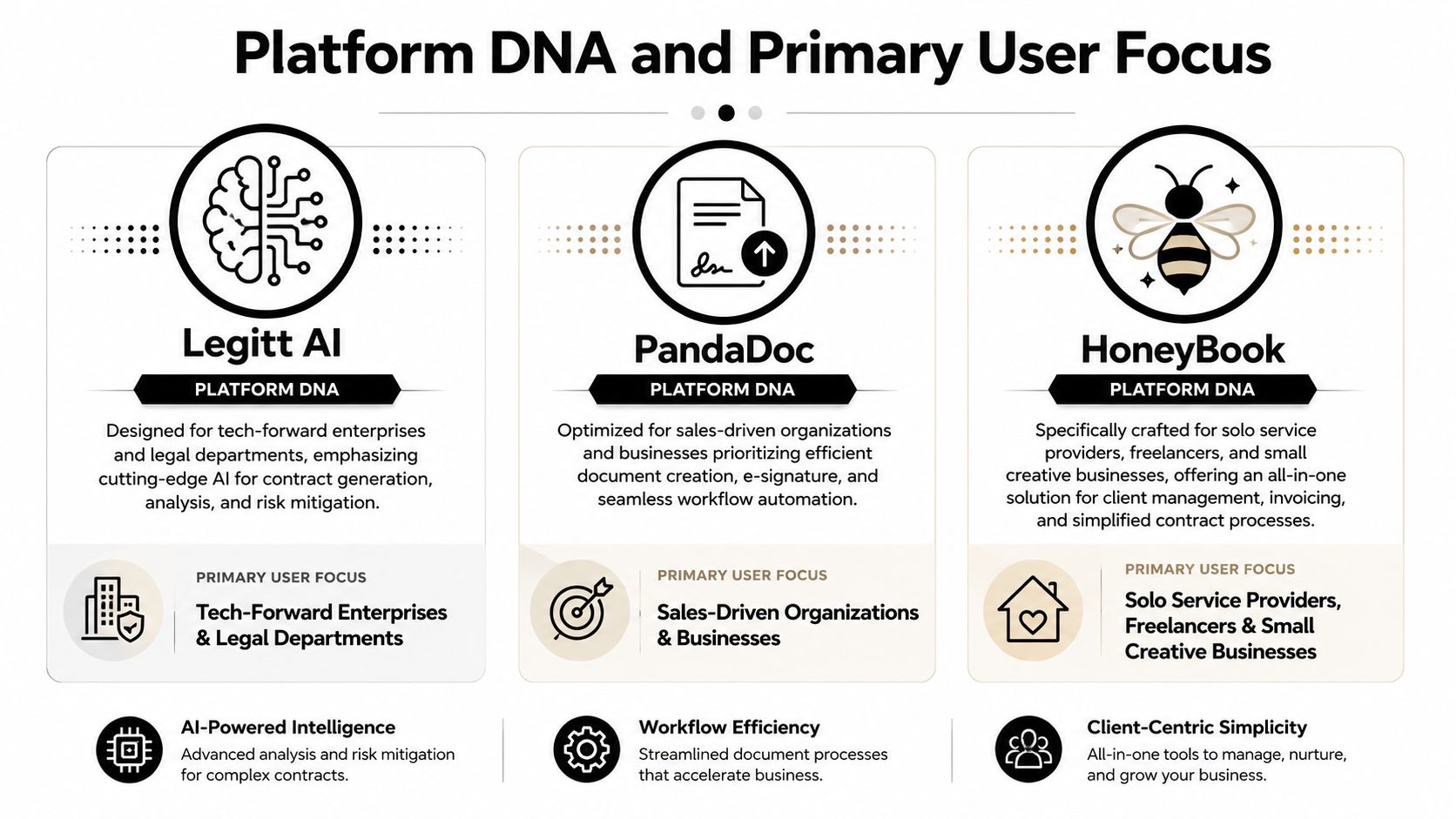
Their differences make more sense when you look at platform DNA. What problem was each tool built to solve first? That original design choice still shapes everything else, including drafting, approvals, analytics, and cost.
| Platform | Core operating model | Primary buyer | Best fit | Main limitation |
|---|---|---|---|---|
| HoneyBook | Client management with proposals, invoices, and simple contracts | Solo businesses and service providers | Managing clients, bookings, billing, and straightforward agreements in one flow | Limited for complex legal review, procurement workflows, and advanced automation |
| PandaDoc | Document workflow and eSignature for revenue teams | Sales leaders, agencies, and operations teams supporting deals | Proposal-to-contract workflows, guided selling, reusable content, and signature collection | Less suited to deep third-party legal review and repository-wide risk analysis |
| Legitt AI | AI-native CLM and contract operations | Legal, procurement, sales ops, and cross-functional teams | Drafting, review, approvals, repository intelligence, renewals, and obligations in one system | Better aligned to organizations with formal contract process needs than very simple solo workflows |
HoneyBook is built for client flow
HoneyBook makes the most sense when the business itself is relatively simple. A photographer, consultant, event professional, or small agency often needs one tool to handle inquiries, proposals, contracts, invoices, and payments. In that environment, simplicity is the product.
That aligns with how HoneyBook is positioned. It is structurally a client management and invoicing platform for small businesses, focused on workflow simplicity rather than the complex, multi-party signing workflows and content library management that PandaDoc provides for agencies and sales teams, as discussed in PandaDoc’s own comparison of HoneyBook alternatives and positioning.
For those users, that’s not a weakness. It’s focus. But the same design becomes a limitation when a company needs legal operations, procurement review, vendor risk analysis, or more advanced approval logic.
PandaDoc is built for revenue execution
PandaDoc’s center of gravity is sales workflow.
Its strongest use case is when a team needs to move from proposal to quote to contract to eSignature with speed and consistency. It’s especially effective where sales reps need guardrails, reusable content, and fewer document errors without routing every routine deal back to legal.
That sales-first orientation explains why PandaDoc’s content library matters. Reps can assemble contracts from pre-approved building blocks, such as liability caps or service levels, to keep routine deals on playbook. It also explains why agencies and revenue teams often prefer it over simpler client-management tools.
Pricing reinforces the same DNA. PandaDoc starts at $19 per user per month for Essentials and $49 per user per month for Business in the comparison cited above, and that per-seat model can become costly as more users need access. The product works best when the commercial gain from faster document throughput outweighs the seat expansion cost.
Legitt AI is built for contract operations
The third model is broader. Some companies don’t just need contracts sent faster. They need contracts interpreted, routed, approved, stored, searched, and monitored as part of legal and operational control.
That’s where AI-native CLM enters the picture. In that environment, contract generation is only one component. The harder problem is managing incoming third-party paper, cross-functional approvals, risk deviation analysis, executed contract visibility, and downstream obligations. Buyers evaluating the category often compare tools across this broader CLM lens, which is reflected in roundups of top CLM platforms for 2026.
The most important product question isn’t “Can it create a contract?” It’s “Who does it help when the other side sends their paper first?”
A practical read on fit
If you’re a founder running a service business, HoneyBook can be enough because your contract process is closely tied to client intake and billing.
If you run a sales organization, PandaDoc often maps more naturally to how deals move.
If your legal, procurement, finance, and sales teams all touch contracts in different ways, a CLM-oriented system is usually the only category that fits the problem without forcing process workarounds.
A Deep Dive on AI Contract Capabilities
“AI-powered” has become the least useful phrase in contract software. Nearly every vendor uses it. The useful question is narrower. What kind of AI is present inside the workflow, and does it reduce legal or operational effort in a way your team can trust?
That’s where the differences become sharp.
AI drafting is not the same as AI review
The first AI layer is drafting. Here, many tools can help users assemble documents faster, especially when templates and clause libraries already exist. That matters, but it’s only half the picture.
The harder half is AI contract review, especially for third-party paper. That work starts when your company doesn’t control the template. Legal and procurement then need help spotting clause deviations, extracting key metadata, and identifying where a counterparty’s terms diverge from policy.
In 2026, purpose-built legal AI tools for contract review achieve over 90% accuracy in clause identification, compared with 69% for general-purpose AI chatbots, and can reduce manual review time by up to 70% for legal teams handling large legacy agreement batches, according to this AI contract review guide. That gap matters because it validates specialized legal AI architecture over generic chatbot use.
Where the products diverge most
The underserved buying question for 2026 isn’t template volume. It’s whether the system can automate third-party risk deviation analysis and support jurisdiction-aware compliance.
Here’s the practical split:
- HoneyBook: AI depth is not the core value proposition. It’s better understood as a business operations tool for small service firms that need lightweight contract handling inside a broader client workflow.
- PandaDoc: Stronger on guided document creation and sales-facing automation than on deep legal review of incoming paper.
- Legitt AI: Better aligned to organizations that need AI contract drafting, clause extraction, risk deviation analysis, repository intelligence, and workflow control in one place.
One reason this distinction gets blurred is that buyers often evaluate AI the same way they evaluate writing assistants. That’s a mistake. Contract AI has to fit legal process, not just generate text. This broader issue is relevant in enterprise software generally, and this piece on designing and building AI solutions is useful because it frames AI value around workflow design rather than model novelty.
Good contract AI doesn’t just write. It classifies, extracts, routes, and warns.
Jurisdiction-aware drafting and repository intelligence
Jurisdiction-aware generation is another dividing line.
A template library helps if your contracts stay close to standard forms. But procurement and legal teams often need documents that reflect state, country, or regulatory context. That’s different from filling placeholders inside a static template. It requires the system to help users produce documents that reflect where and how the agreement will operate.
The same goes for contract intelligence after execution. A useful system should help teams answer questions such as:
- Which agreements renew soon?
- Where do we have unusual liability language?
- Which vendors have non-standard termination rights?
- Which customer contracts contain obligations the business must perform?
That’s where AI becomes operational. It turns executed agreements into a searchable dataset that supports compliance, renewal planning, and legal prioritization.
End-to-End Contract Lifecycle Feature Showdown
Once AI claims are stripped back to real workflow, the next question is straightforward. Can the platform carry a contract from draft through renewal without creating new handoff problems?
That’s where category differences show up in everyday use.
Drafting and document assembly
For front-end document creation, PandaDoc is the most visibly optimized for sales execution. Teams that live in proposals, quotes, and signature-ready customer documents usually find its guided workflows intuitive. The product is designed to reduce document mistakes before the file reaches the buyer.
That focus shows in one hard outcome. PandaDoc delivers a 94% reduction in contract errors through automated validation and compliance checks, according to this analysis of PandaDoc vs Legitt AI. If your biggest pain is quote accuracy and clean sales paperwork, that matters more than broader CLM depth.
HoneyBook also supports document generation, but it’s aimed at simpler service-business workflows. A solo consultant doesn’t usually need advanced clause governance or a large content library. They need a contract attached to a client process that also includes invoicing and scheduling.
Negotiation and collaboration
Negotiation is where many “document tools” start to reveal their limits.
Sales teams often need lightweight commenting and collaboration around a commercial document. PandaDoc handles that use case well enough for many revenue teams. But legal teams usually need more structured redlining, internal review, external negotiation visibility, and a reliable record of how language changed before signature.
For legal operations and procurement, collaboration isn’t just about commenting. It’s about separating internal legal discussion from counterparty discussion, preserving approved fallback language, and routing the right issue to the right reviewer. That requirement tends to push buyers beyond proposal software and toward CLM-oriented systems.
Approval workflows and governance
Approvals are where contract software either creates control or subtly bypasses it.
Simple teams can live with linear approval sequences. More complex organizations usually can’t. They need routing based on contract value, contract type, clause deviation, geography, business unit, or risk level. They also need visibility into where the draft is stuck and why.
A practical distinction:
- HoneyBook: suitable when one person or a very small team controls the client workflow.
- PandaDoc: suitable when approvals mostly support sales process and document consistency.
- CLM-oriented platforms: better when approvals need policy logic, role-based routing, and auditability across departments.
That distinction becomes more important as contract volume increases and legal wants to reserve review time for exceptions rather than routine paper.
Repository, search, and post-signature management
The biggest gap in many deployments appears after signature.
Some tools are excellent up to the point of execution, then become passive storage. That’s fine if the business only cares about sending documents and collecting signatures. It’s a problem if the organization needs a live record of obligations, amendments, notices, and renewals.
A modern contract repository should support:
- Searchability: Find contracts by party, clause, term, date, or obligation.
- Renewal management: Surface notice periods before they expire.
- Obligation tracking: Link signed commitments to follow-up action.
- Amendment visibility: Keep version history and related documents connected.
A true contract lifecycle approach becomes easier to justify as a result. The signed document isn’t the end of the workflow. It’s the start of ongoing commercial and compliance responsibility. Buyers who want a broader framework for these workflows often benefit from a fuller guide to contract lifecycle management.
eSignature, analytics, and enterprise posture
All three platforms participate in digital execution, but they aren’t equally strong in analytics or enterprise governance.
PandaDoc confirms that a document was viewed, which is useful in sales follow-up. But the same cited comparison notes that it does not provide page-by-page engagement data, so users can’t see which specific sections received attention. That limits its usefulness in situations where detailed reader behavior would influence negotiation or stakeholder review.
For regulated organizations, security and compliance posture also matters. The market has moved toward enterprise-grade systems where security is treated as baseline. Some providers, including PandaDoc, explicitly state that customer contract data is not used to train AI models in order to support compliance expectations such as SOC 2, HIPAA, and GDPR, as described in this 2026 market review of contract management software pricing and platform evolution.
A contract platform should shorten the path to signature without weakening policy control after signature.
Analyzing ROI and Total Cost of Ownership
A CLM purchase rarely fails because the software cannot create a document. It fails because the buyer misjudged where the return would come from.
The cleanest way to evaluate ROI is to tie each platform to the business bottleneck it removes.
HoneyBook ROI is administrative simplicity
HoneyBook’s return is easiest to understand.
A solo service business often loses time not in legal review, but in switching between proposal creation, contracts, invoices, scheduling, and payment collection. If one workspace reduces that administrative sprawl, the ROI is immediate and practical. The owner gets time back and presents a more consistent client experience.
That’s valuable, but it’s a different kind of value than enterprise contract management. It doesn’t primarily come from legal risk reduction or portfolio intelligence. It comes from smoother client operations.
PandaDoc ROI is sales efficiency and document control
PandaDoc’s return is strongest when document speed and accuracy affect revenue.
If your team sends a high volume of proposals, order forms, or standard customer contracts, guided selling workflows and validation controls can reduce errors, shorten internal back-and-forth, and keep sales moving. The earlier error-reduction metric supports that case because it points to fewer preventable mistakes in the front end of the deal cycle.
But buyers need to model cost carefully. By 2026, the market ranges from entry-level tools such as PandaDoc starting near $19 per seat per month to enterprise platforms that can reach six-figure costs, according to this review of the 2026 contract management software market. That spread matters because cost isn’t driven only by software sophistication. It’s also driven by user count, implementation complexity, and whether the platform replaces multiple systems or sits beside them.
CLM ROI comes from avoided work and avoided exposure
For legal and procurement, the return profile is broader.
A stronger CLM platform can produce value in at least four ways:
- Less manual review work because routine contracts follow approved paths and incoming paper is triaged faster.
- Lower compliance exposure because obligations, notice dates, and policy deviations are easier to identify.
- Better revenue capture because renewals and commercial milestones aren’t hidden in executed PDFs.
- Fewer tool handoffs because drafting, approval, eSignature, repository, and analytics live in one workflow.
Those gains are harder to summarize in one line item than “documents sent faster,” but they’re often more durable. They change how many contracts the team can manage without adding people.
A useful implementation question is whether the platform improves adjacent systems too. A CLM that connects with CRM, productivity tools, and internal approval workflows tends to produce more measurable operational value than one that remains isolated. Consequently, CLM integration for better ROI becomes important as a planning lens.
What buyers often miss in total cost of ownership
Software price is only one part of TCO. The other costs are process friction, workarounds, and duplication.
Watch for these hidden costs:
- Seat-driven expansion: A low starting price can become expensive if every approver, manager, and operations user needs access.
- System overlap: If you still need separate tools for repository management, vendor tracking, or approval orchestration, the contract tool may be cheaper on paper than in practice.
- Legal fallback cost: If the system can’t help business users self-serve within guardrails, legal remains the bottleneck.
- Post-signature blind spots: Missed renewals and unmanaged obligations don’t show up as software costs, but they’re real costs.
The right ROI question isn’t “Which platform is cheapest?” It’s “Which one removes the most expensive kind of contract friction in our business?”
The Final Verdict A Decision Checklist for Your Business
The right answer depends less on feature breadth than on where contracts create risk or delay inside your business.
If your company mainly needs a clean client workflow for proposals, invoices, and simple agreements, HoneyBook fits. If your company needs sales documents to move faster with fewer errors, PandaDoc is the stronger choice. If your company needs contract drafting, review, approvals, repository intelligence, and risk analysis to work across legal, procurement, sales, and operations, a CLM-oriented platform is the more durable category.
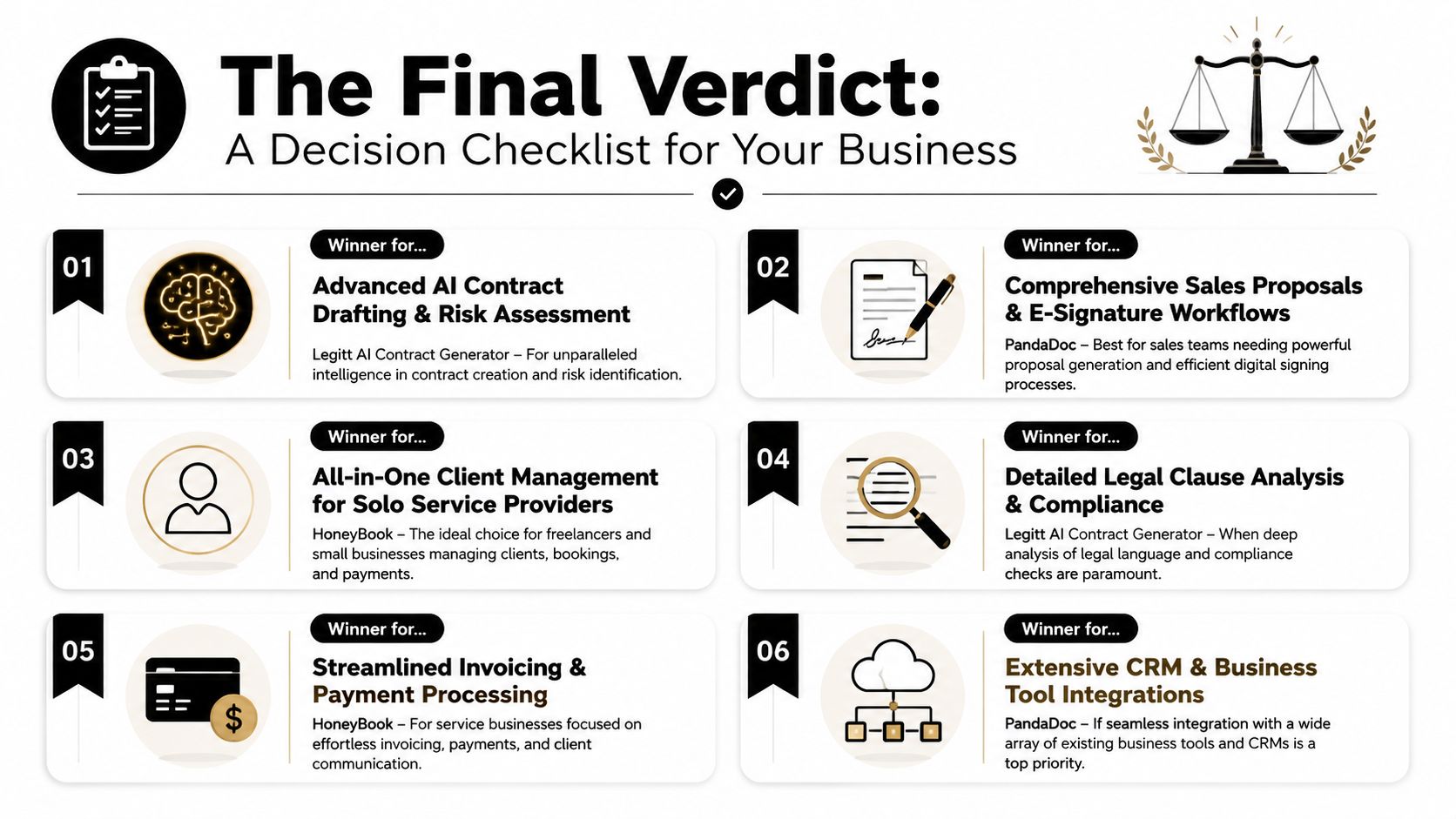
Winner by business context
-
For freelancers and solo service providers: HoneyBook
It aligns contracts with client communication, invoicing, and payment flow. That simplicity is the point. -
For high-velocity sales teams: PandaDoc
It’s strongest where proposal creation, guided selling, document consistency, and eSignature speed directly support revenue execution. -
For legal operations, procurement, and scalable cross-functional workflows: Legitt AI
It fits organizations that need AI-assisted drafting, third-party paper review, approval governance, contract repository intelligence, and post-signature control in one environment.
The key nuance is the one most comparison pages miss. Existing comparisons overwhelmingly focus on template volume, while leaving out automated third-party risk deviation analysis. That’s a major gap because it is at this juncture that legal and procurement teams lose the most time, and where business exposure often starts. The same gap shows up in user feedback, where lack of automated risk scoring is a recurring pain point.
Contract platform decision checklist
| Priority Need | HoneyBook | PandaDoc | Legitt AI |
|---|---|---|---|
| Solo business client workflow | Strong fit | Partial fit | Usually more than needed |
| Sales proposals and guided selling | Limited | Strong fit | Fit if sales needs connect to broader CLM |
| Third-party contract review | Weak fit | Moderate for basic workflows | Strong fit |
| Automated risk deviation analysis | Weak fit | Limited | Strong fit |
| Jurisdiction-aware compliance support | Weak fit | Template-oriented | Strong fit |
| Procurement and vendor contract oversight | Limited | Partial fit | Strong fit |
| Repository intelligence after signature | Basic | Moderate | Strong fit |
| Simple invoicing and client administration | Strong fit | Partial fit | Partial fit |
Fast decision questions
Ask these before you buy:
- Do counterparties send you their paper first? If yes, legal review capability matters more than template design.
- Do multiple departments touch the same contract? If yes, workflow governance matters more than editor convenience.
- Do you need renewals, obligations, and clause data after signature? If yes, repository intelligence matters more than eSignature alone.
- Is compliance different across jurisdictions or business units? If yes, static templates won’t be enough.
- Are you solving for one user’s productivity or the company’s contract system? That answer usually decides the category.
Buy for the contract process you’re growing into, not just the one you can tolerate today.
FAQ
Which platform is best for a small business?
HoneyBook usually fits small service businesses best when the priority is client management, invoicing, and simple contracts in one workflow.
Which platform is better for sales teams?
PandaDoc is the better match for sales-led organizations that need proposal generation, guided selling, document consistency, and eSignature in an integrated quote-to-cash motion.
Which platform is better for legal and procurement teams?
Organizations handling third-party paper, clause analysis, approvals, renewals, and contract intelligence typically need a CLM-oriented platform rather than a document-first tool.
What makes this 2026 comparison different?
Most articles compare templates and signatures. The more important 2026 distinction is whether the platform can support automated third-party risk analysis and jurisdiction-aware compliance, because those capabilities affect legal workload and business exposure more directly.
If your team is moving beyond document sending and needs one system for AI-assisted drafting, review, approvals, eSignature, repository management, renewals, and contract intelligence, it’s worth taking a closer look at Legitt AI.