Most legal teams still compare contract AI the wrong way. They benchmark review accuracy, redline quality, and clause extraction, but the larger business issue is workflow design. That blind spot matters because a 2025 Gartner report cited in this analysis of LawGeex and Kira capabilities found that 78% of in-house legal teams prioritize CLM integration over isolated review features, and that standalone review tools delay signatures by 3 to 5 days on average through workflow fragmentation.
That changes how a serious buyer should evaluate LawGeex, Kira Systems, and an AI-native CLM such as Legitt AI. The key question isn’t which tool spots a clause fastest in a lab setting. It’s which system helps your legal, procurement, sales, and operations teams move from request to signature to post-signature management with the least friction and the clearest control.
For enterprise buyers, this is no longer a niche legal tech decision. It’s an operating model decision.
The Shifting Landscape of AI Contract Management
Contract AI is no longer a review-tool category. It is becoming infrastructure for revenue operations, procurement control, and post-signature governance.
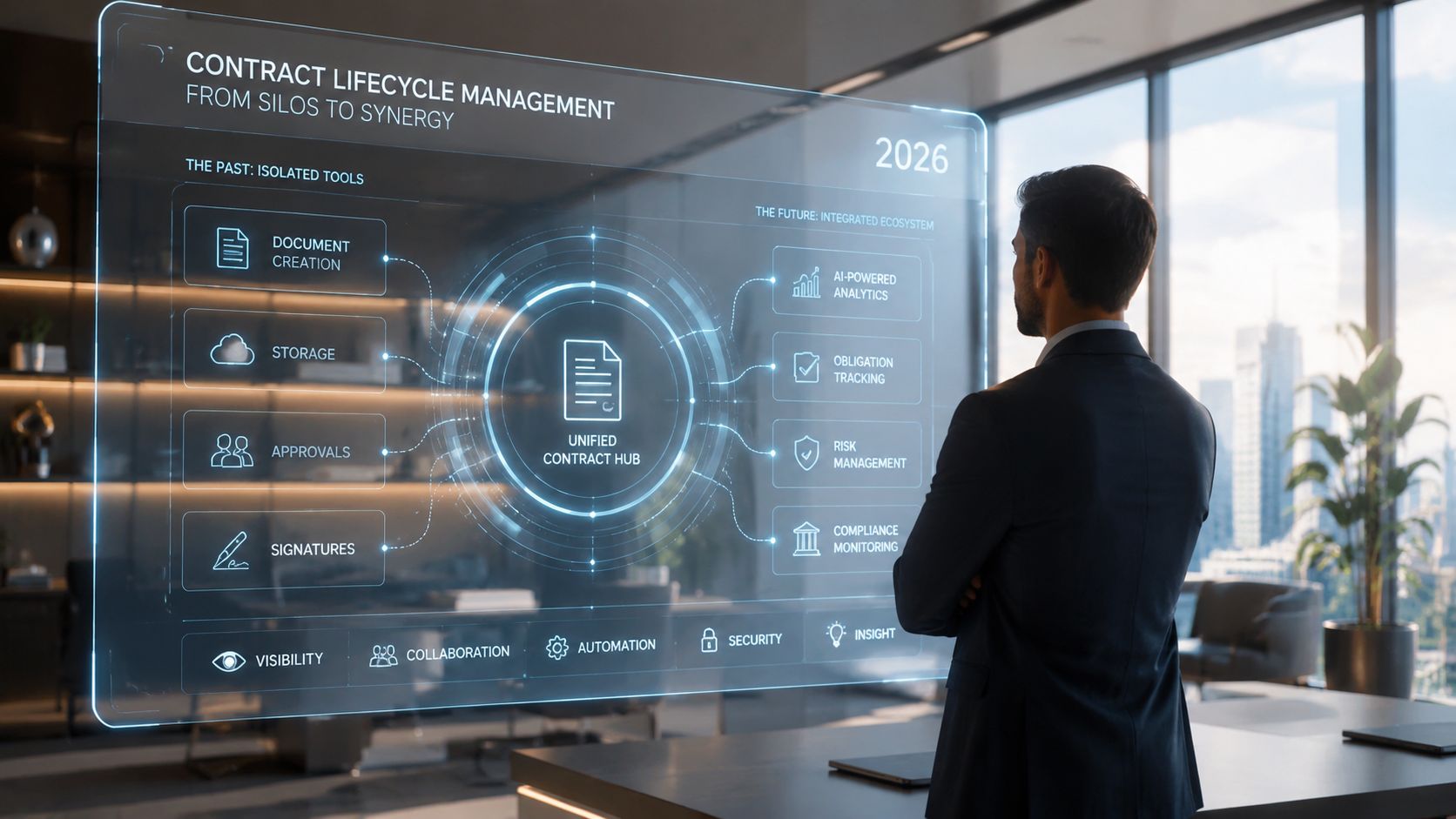
Why review alone is no longer the buying lens
The market has shifted because enterprise contract bottlenecks rarely sit in clause detection alone. They appear in intake, fallback approvals, version control, signature routing, and obligation follow-through. A tool that improves one review step can still leave the business waiting on email chains, shared drives, and disconnected approval rules.
That distinction matters more in 2026 because legal teams are being asked to improve cycle time without weakening control. In that environment, point solutions such as Kira Systems and LawGeex still serve clear purposes, but their ROI depends on whether contract review is the constraint that limits throughput. If delays happen between review and execution, or after signature when renewals and commitments need tracking, a review-first purchase can solve the visible problem while preserving the expensive one.
This broader buying shift mirrors a larger enterprise AI pattern. Teams evaluating legal AI are increasingly treating platform design as a governance question, not just an automation question. The partner analysis AI for enterprise risk 2026 is useful here because it frames AI adoption around policy enforcement, oversight, and operational exposure across functions.
What enterprise buyers should optimize for now
The practical question is no longer which product reviews contracts well. Enterprise buyers need to ask which architecture reduces total contract handling time, lowers control failure risk, and gives business teams a system they will readily use.
| Evaluation lens | Point solution review tools | AI-native CLM platforms |
|---|---|---|
| Primary value | Faster review on a narrow task | Faster contracting across the lifecycle |
| Legal workflow fit | Strong for specialist use cases | Broader cross-functional coordination |
| Business user experience | Often indirect | Usually built for shared workflows |
| Signature readiness | Depends on integrations | Typically native or tightly connected |
| Post-signature control | Limited | Repository, renewals, obligations, reporting |
The table points to the core investment difference. Kira and LawGeex can produce strong returns in due diligence, policy review, and controlled pre-signature use cases. An AI-native CLM such as Legitt AI targets a different outcome. It tries to compress the full path from request to draft to approval to signature to renewal inside one operating system.
That has direct financial implications. Fewer handoffs usually mean less time lost to status chasing, fewer approval mistakes, and better auditability when procurement, sales, finance, and legal need the same contract record. For a buyer with high contract volume, that can matter more than marginal differences in extraction quality.
A useful way to frame the decision is simple. Buy a point solution if your problem is concentrated in document analysis. Buy an AI-native CLM if your problem is contract flow.
Buyers evaluating that second category should also review AI in contract management trends and predictions, which examines how enterprise teams are shifting from task automation to end-to-end contract operations.
Understanding the Three Contenders
The buying decision starts with product architecture, not marketing labels. These three tools address different contract problems, and treating them as direct substitutes usually leads to the wrong shortlist.
Kira Systems came to market as a specialist for large-scale contract analysis. Its historical strength is structured extraction across large document sets, which is why it appears so often in due diligence, remediation, lease review, and repository cleanup projects. For legal teams facing thousands of legacy agreements, that matters because value comes from consistent data capture across volume, not from managing the rest of the contract lifecycle.
LawGeex is built around a narrower operational question. Can standard agreements be checked against company policy before legal spends time on them? That product philosophy makes it a strong fit for first-pass review, intake triage, and playbook enforcement on incoming paper. The business outcome is straightforward. Legal time shifts away from repetitive policy checks and toward exceptions, negotiations, and higher-risk work.
Legitt AI reflects a different thesis. It is an AI-native CLM platform that combines drafting, review, approvals, eSignature, repository management, renewals, and contract intelligence in one system. A buyer evaluating Legitt AI contract reviewer capabilities is not only comparing review quality. They are assessing whether review should remain a standalone step or become part of a managed contract workflow from request through renewal.
That distinction has direct ROI implications.
A point solution can produce a clear return when the bottleneck sits in one stage, such as due diligence extraction or pre-signature policy review. An AI-native CLM targets a broader source of cost. It reduces handoffs between drafting, redlining, approvals, signature, storage, and post-signature tracking. In enterprise teams, those handoffs often create more delay and control failure than clause review itself.
The practical fit is usually clear once you define the operating problem:
- Choose Kira if the business case centers on high-volume extraction, analysis, and document mining.
- Choose LawGeex if legal wants to standardize first-pass review against policy and reduce routine review load.
- Choose an AI-native CLM such as Legitt AI if the goal is faster contract throughput, stronger process control, and one system of record across the full agreement lifecycle.
Kira and LawGeex improve review quality within a defined task. Legitt AI is aimed at improving contract flow across the business. For enterprises buying in 2026, that is the more important shift. The market is moving from AI tools that assist lawyers on discrete review jobs to AI-native platforms that compress the full path from contract request to commercial outcome.
Core AI and Feature Deep Dive
The highest-ROI buyer in this comparison is not choosing the tool with the strongest isolated AI demo. They are choosing the system that removes the most delay, rework, and unmanaged risk from the contract path.
That changes how the feature analysis should be read. Kira and LawGeex are strong at narrowly defined review jobs. Legitt AI is designed to apply AI inside a broader contracting system, which means the same feature can have a different business value depending on whether it sits inside or outside the workflow where contracts are created, negotiated, approved, and tracked.
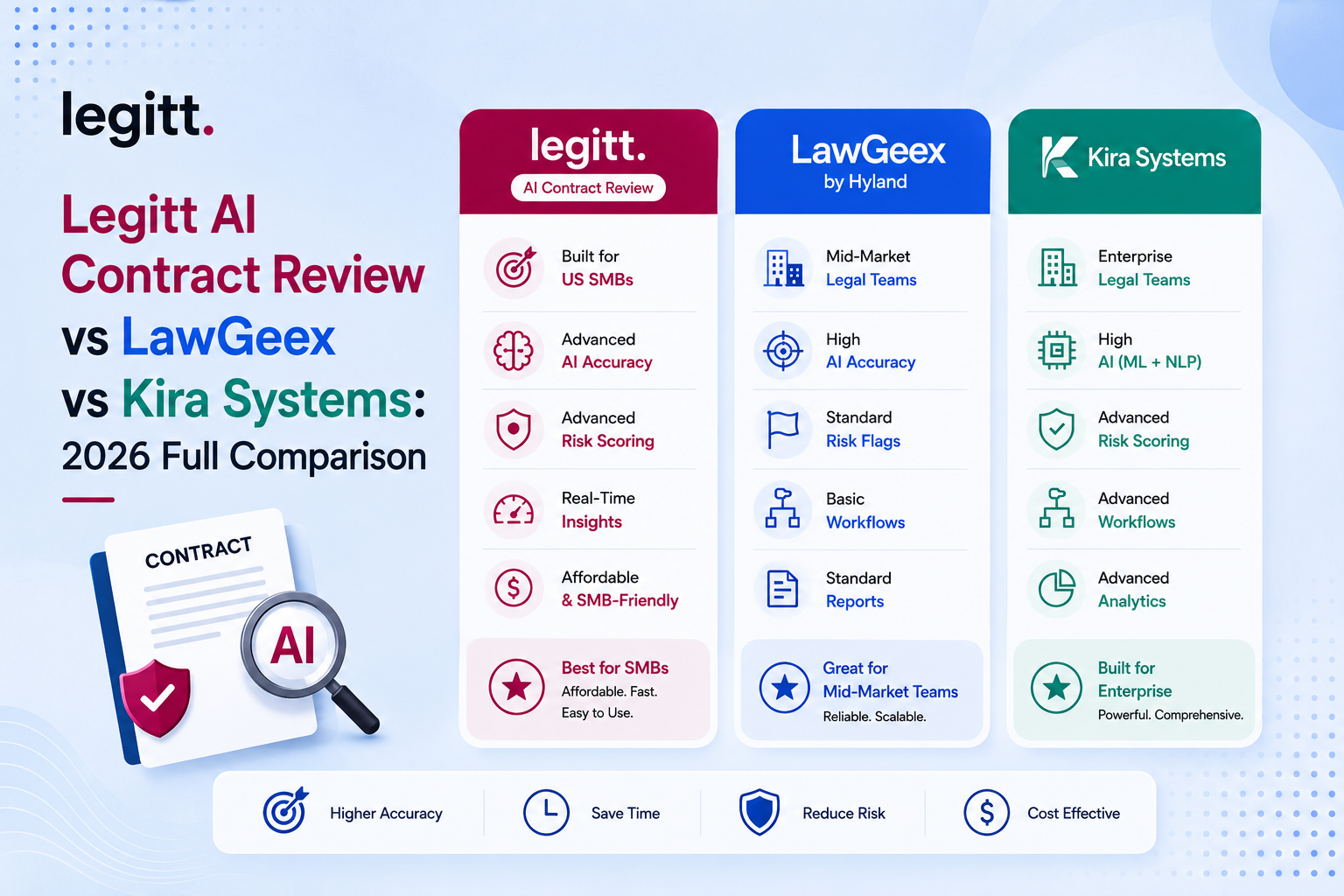
| Capability | Legitt AI | LawGeex | Kira Systems |
|---|---|---|---|
| Product orientation | End-to-end CLM with AI review inside the workflow | First-pass contract policy review | High-volume clause extraction and analysis |
| Best-fit use case | Draft-to-signature process control | Intake triage and policy compliance | Due diligence and repository analysis |
| Review style | Contract review tied to drafting, negotiation, and approvals | Playbook-based checks against legal policies | Structured extraction across large document sets |
| Post-signature support | Repository, renewals, obligations, analytics | Limited relative to CLM scope | Limited relative to CLM scope |
| Buyer type | Cross-functional enterprise teams | Legal teams standardizing frontline review | Law firms and enterprise diligence teams |
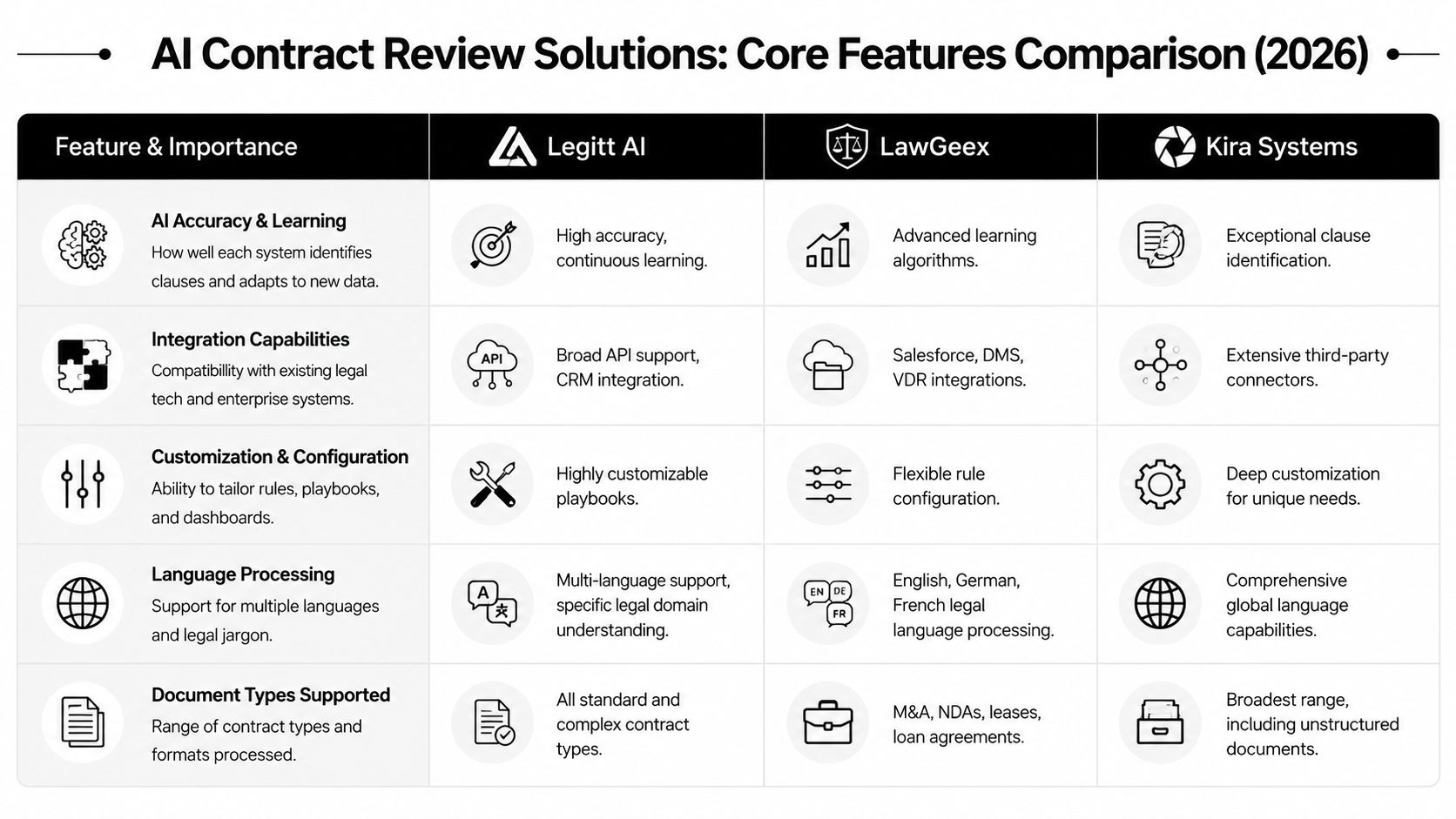
Review accuracy and model specialization
Published evidence favors LawGeex for first-pass policy review. As noted earlier, its benchmarked performance against human lawyers is the clearest public proof point in this group. The practical implication is straightforward. If your legal department needs to screen high volumes of routine agreements against a defined playbook before counsel spends time on them, LawGeex has a credible case.
Kira’s case rests on a different technical strength. As noted earlier, Litera positions Kira around repeatable clause extraction with predictive models, with generative AI used for summaries and related insights. That distinction matters in diligence, remediation, and contract repository analysis because consistency across large document sets often matters more than conversational flexibility. A buyer reviewing thousands of agreements for assignment, indemnity, or change-of-control language needs stable extraction logic, not a polished drafting assistant.
Those two products solve different risk problems. LawGeex reduces policy-review load at the intake stage. Kira reduces missed-data risk in bulk document analysis.
Drafting and redlining in practical workflows
Feature parity on review does not mean parity on execution. Many legal teams lose more time between draft creation, fallback selection, stakeholder review, and approval routing than they lose on the legal analysis itself.
That is where an integrated CLM architecture changes the economics.
In an AI-native platform, drafting, review, negotiation, and approvals happen in the same operating environment. Clause libraries, templates, review comments, approval history, and final metadata stay connected to the same record. In a point solution, review may still be strong, but the team often has to pass documents between systems, re-key information, and reconstruct decision history later. Those handoffs slow cycle time and weaken auditability.
A serious buyer should test the workflow mechanics, not just the model output:
- Draft initiation: Can business users generate approved first drafts through controlled templates and intake forms?
- Redline management: Can internal reviewers and counterparties negotiate in a trackable process with version control?
- Playbook application: Does the system flag deviations against fallback positions in context, rather than as detached issue lists?
- Approval logic: Can legal, sales, procurement, finance, and security review inside one governed workflow?
For buyers assessing how review fits into day-to-day contract operations, Legitt AI contract reviewer features inside drafting and negotiation workflows shows the relevant design choice. The AI reviewer is not positioned as a standalone checkpoint. It sits inside the same process used to create, revise, and move agreements toward signature.
Extraction versus compliance checking
The most common buying error in this category is selecting the right AI capability for the wrong operating problem.
Kira is better aligned to questions such as:
- Portfolio analysis: Which contracts contain a specific clause or obligation?
- Due diligence: Which agreements allocate a defined category of risk in a particular way?
- Repapering projects: Which contracts require remediation after a legal or policy change?
LawGeex is better aligned to questions such as:
- Vendor intake: Does this paper comply with internal contracting rules?
- Sales review: Which provisions fall outside approved policy before a lawyer starts negotiation?
- Frontline standardization: Which issues can be resolved automatically or escalated by exception?
Legitt AI fits a different question set again. How fast can the business get from request to approved paper? How consistently can legal apply fallback language without becoming the manual routing layer for every contract? How much data survives the negotiation process and becomes usable after signature? Those are CLM questions, but they start inside drafting and review.
The feature question that actually predicts ROI
Accuracy matters. Workflow fit matters more.
A review engine can score well in a controlled evaluation and still underperform in production if users export files, move between tools, chase approvers in email, and manually update metadata after signature. In that environment, legal gains some analytical speed but the enterprise still carries the cost of fragmented process control.
The better buying principle is simple. Match the product to the dominant source of delay and risk in your contract operation.
If the problem is bulk extraction across large repositories, Kira remains a rational choice. If the problem is standardizing first-pass legal review against policy, LawGeex has a clear role. If the problem is end-to-end deal velocity, governed negotiation, and usable contract data across the lifecycle, an AI-native CLM platform such as Legitt AI is the stronger strategic fit.
Beyond Review The Full Contract Lifecycle
A contract review tool can improve legal analysis. It can’t, by itself, fix a broken contract workflow.
That’s why CLM has become the more important category. The moment a business asks legal to accelerate revenue, improve procurement controls, or reduce post-signature surprises, the conversation stops being about review quality alone and starts being about orchestration.
What full lifecycle coverage actually means
Modern CLM platforms in 2026 need more than storage and workflow. They must support AI-powered metadata extraction, automated document assembly, and self-service contract requests so business users can initiate contracts through structured portals instead of relying entirely on legal, according to this 2026 CLM feature analysis.
That matters for sales and procurement because legal bottlenecks often start before review. If the first draft arrives late, approvals are improvised, and metadata is manually entered, the process is already behind schedule before any lawyer opens the document.
A full-lifecycle platform should cover at least these operational stages:
- Request intake: Business teams initiate contracts through guided forms.
- Draft generation: Approved templates and clause logic create a usable first draft.
- Negotiation: Redlines, comments, and fallback positions stay in one workflow.
- Approvals: Stakeholders review based on rules, not ad hoc email chains.
- Execution: eSignature is routed from the same system.
- Post-signature management: Renewals, obligations, and reporting continue after the deal closes.
Why the repository is strategic, not administrative
A centralized, searchable repository is now essential. In 2026, modern CLM requires advanced filters and natural language search so teams can find a specific clause or detail in seconds rather than hours, turning contract management from reactive scrambling into a more proactive process, as explained in this CLM repository analysis.
That’s more than convenience. Repository quality determines whether leadership can answer basic business questions without launching a manual project. Which customer contracts renew this quarter? Which vendor agreements include unusual termination rights? Which obligations sit with procurement rather than legal? A point solution usually won’t answer those questions well because it wasn’t built as the source of truth.
Operational takeaway: If you can’t search, report, and track obligations from one repository, you don’t have contract intelligence. You have contract files.
A useful reference for teams evaluating end-to-end process design is this complete guide to contract lifecycle management, especially if your buying committee includes legal, procurement, and revenue operations rather than legal alone.
Where integrated CLM changes business outcomes
An integrated platform changes outcomes in three ways.
First, it reduces handoff risk. Legal doesn’t have to reconstruct context from email threads or hunt for the latest draft. Sales doesn’t have to ask where a contract sits. Procurement doesn’t have to rebuild approval histories for audit or supplier disputes.
Second, it improves deal velocity. Drafting, review, approval, eSignature, and repository updates happen in one chain of custody. That shortens the distance between “contract requested” and “contract executed.”
Third, it creates post-signature accountability. Renewals, obligations, amendments, and deviations remain visible after execution instead of disappearing into shared drives.
This is the main reason AI-native CLM platforms are changing buying criteria. The value isn’t just better legal review. It’s better commercial execution.
Integration Security and Scalability
Enterprise buyers often spend too much time debating AI output and too little time testing whether the software can survive inside the existing stack. That’s where many purchases disappoint.
A contract platform only creates value when it connects to how work already moves across CRM, procurement, identity, productivity, and storage systems.
Integration questions that separate pilots from platforms
The practical checklist starts with systems of engagement and systems of record. Ask whether the product can sit naturally between CRM, document tools, communication channels, and storage without creating duplicate work.
Use these questions in vendor review:
- CRM alignment: Can the platform connect to tools such as Salesforce, HubSpot, or Microsoft Dynamics so deal data doesn’t get retyped?
- Document workflow: Does it support drafting and negotiation inside the tools your teams already use, such as Microsoft Word and Microsoft 365?
- Collaboration handoffs: Can stakeholders approve or comment through systems they already monitor, including Slack or Microsoft Teams?
- API maturity: Is there a usable API strategy for custom workflows, reporting, and downstream archive requirements?
The enterprise payoff is straightforward. Integration quality determines whether contract automation becomes a daily habit or an extra administrative layer.
Security and governance are buying criteria, not legal footnotes
Security review shouldn’t be an afterthought, especially where AI is involved. Buyers should verify whether a vendor supports controls such as SSO, MFA, RBAC, encryption, auditability, and recognized compliance frameworks. For teams navigating regulatory expectations around AI itself, Doczen’s EU AI Act insights are useful background because they help connect product evaluation to governance obligations.
Workflow automation also raises a control question. In 2026, AI-powered contract workflow automation reduces risk through mechanics such as approvals that route contracts based on predefined rules like value thresholds or contract type, and clause reviews that identify non-standard language using AI playbooks, according to this analysis of contract workflow automation. In practice, that means the platform isn’t only accelerating work. It’s enforcing policy at the point of execution.
For buyers comparing a point solution against a broader platform, the distinction sharpens. A standalone reviewer may improve issue spotting. A CLM with embedded controls can also govern who approves, who signs, and what happens next.
Scalability means process consistency
Scalability isn’t just user count. It’s the ability to expand from one team to many teams without rewriting the process every quarter.
Look for signals such as:
- Role-based administration: Can legal, procurement, sales, and operations have different permissions and views?
- Template governance: Can the organization maintain approved language and structured playbooks centrally?
- Multi-entity support: Can the platform support different business units, geographies, and approval paths?
- Auditability: Can administrators reconstruct decisions, version history, and approval chains?
For security-conscious buyers evaluating AI-native CLM, this guide to ensuring data security and privacy with AI contract management is worth reviewing alongside the vendor’s own trust materials.
A platform scales when it standardizes decisions without flattening legitimate differences between teams. That’s the threshold enterprise software has to meet.
Your Decision Framework Choosing the Right Tool
The right choice depends less on abstract feature strength and more on where your contract process breaks today. A law firm running diligence, an in-house legal team standardizing vendor paper, and a revenue team trying to close faster don’t need the same product.
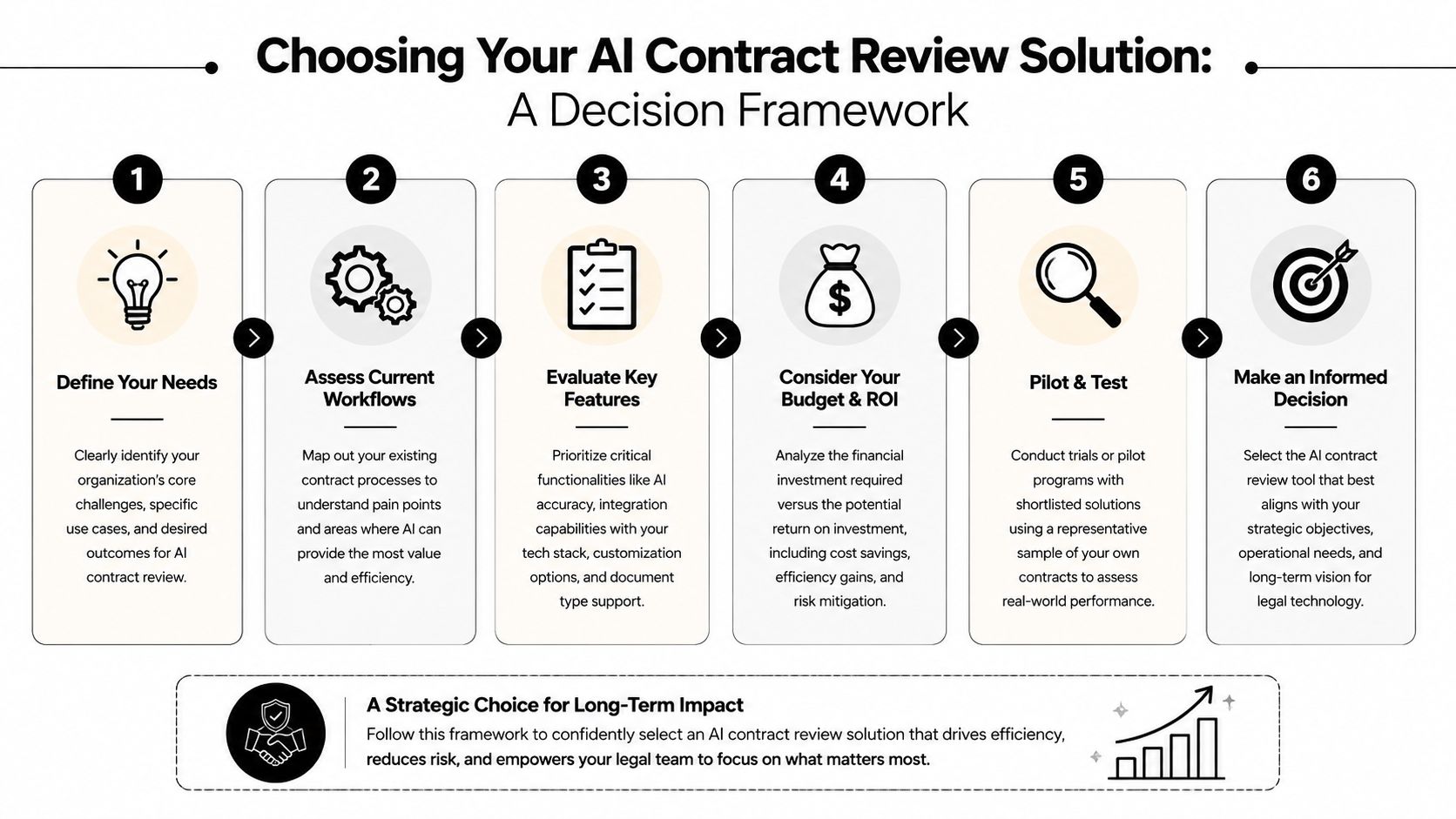
Match the software to the business problem
Start with the contract jobs your team performs most often.
| If your main priority is… | Best fit | Why |
|---|---|---|
| Large-scale due diligence and extraction | Kira Systems | Purpose-built for high-volume clause extraction and analysis |
| First-pass legal policy compliance | LawGeex | Built to compare contracts against configured legal rules before negotiation |
| End-to-end commercial contracting | Legitt AI | CLM-oriented workflow from drafting through eSignature and post-signature control |
That matrix sounds obvious, but many teams still buy based on the most persuasive demo rather than the most persistent operational pain.
Three common buying scenarios
Scenario one. A law firm or corporate development team handles large deal rooms and needs to analyze hundreds of contracts quickly. Kira is usually the logical choice because extraction quality and portfolio analysis matter more than workflow orchestration.
Scenario two. An in-house legal team receives a constant flow of third-party paper and wants a first-pass gate before attorneys step in. LawGeex makes sense here because its product philosophy is built around policy-based review of incoming contracts.
Scenario three. A scaling business needs one system for drafting, redlining, approvals, eSignatures, repository management, renewals, and contract analytics. In this scenario, an AI-native CLM becomes a stronger fit than either specialist review tool.
Pick the software that removes your most expensive delay, not the software with the broadest promise.
The jurisdiction question many buyer guides miss
Cross-border contracting complicates the decision. Many reviews focus on US and UK workflows, but that can produce a false sense of confidence for global businesses. A 2024 MIT study cited in this 2026 legal AI market analysis found that 65% of general-purpose legal AI models misflag non-compete clauses in multi-jurisdiction contracts, while purpose-built platforms with deep legal training achieve 92% accuracy. The same analysis notes that 44% of global deals now involve non-US counterparties.
That has a practical implication. If your contracts regularly involve Brazil, India, Nigeria, or other non-US jurisdictions, ask vendors how they handle jurisdiction-aware drafting and review. Don’t accept a polished demo on domestic paper as proof of international reliability.
Teams that want a broader market view can review top AI-powered CLM platforms in 2025, but the key is to translate category knowledge into your own process map.
A buyer’s short list test
Before signing anything, validate these points with your own contracts:
- Use real paper. Test your standard templates and your messiest third-party agreements.
- Include business users. Legal alone won’t expose approval bottlenecks or repository issues.
- Track time to outcome. Measure how quickly a contract moves from request to executable form.
- Check post-signature visibility. Make sure the platform doesn’t stop being useful the moment the document is signed.
That last step often decides the winner.
Frequently Asked Questions
Is a CLM platform always better than a contract review tool
No. A review tool can be the right answer when the problem is narrow and well-defined. If your organization mainly needs first-pass policy review or high-volume extraction, LawGeex or Kira may fit better than a broader CLM. A CLM becomes more compelling when delays happen across drafting, approvals, execution, and post-signature tracking rather than in review alone.
How should buyers think about ROI
Start with avoided friction, not abstract AI value. Measure where contracts stall, who re-enters data, how often legal handles repetitive first drafts, how many approvals happen outside a system, and how difficult it is to find executed terms later. If the software only speeds up review but leaves intake, approvals, signature, and renewals fragmented, the ROI case will usually be narrower.
Can general-purpose AI replace these platforms for contract review
For professional legal workflows, that’s a risky assumption. In 2026, purpose-built legal AI tools such as Kira and LawGeex achieve over 90% accuracy in clause identification, while general-purpose AI chatbots average 69% accuracy on the same task, creating a 21% performance gap, according to this analysis of AI contract review tools. The same analysis argues that specialized models trained on legal contracts are essential for dependable risk flagging, obligation extraction, and automated redlining.
What’s the biggest buying mistake in this category
Treating contract review as the whole contract process. Many teams buy software to solve what looks like a legal review problem, only to discover that the actual delays sit in intake, approvals, version control, signatures, and post-signature tracking.
What should a pilot include
Use your own templates, third-party paper, realistic approval paths, and a representative mix of contract types. Include legal, sales, procurement, and operations in the test. A pilot should answer whether the product improves contracting in the actual workflow, not just whether the AI produces impressive output on sample text.
If your organization is evaluating how to move from isolated review to end-to-end contract operations, Legitt AI is one option to examine for AI-native CLM, including drafting, negotiation, eSignature, repository management, renewals, and contract intelligence in a single workspace.