The clause looks balanced at first glance. Both sides nod, the redlines shrink, and procurement wants the paper out the door. Then someone asks who controls the defense on a third-party claim, whether late notice kills the claim, or whether the cap applies, and the whole “mutual” story turns out to be more theater than risk allocation.
That's the core problem with a mutual indemnification clause. The label can sound fair while the mechanics shift exposure to one side, especially in contract stacks built around AI contract review, CLM software, and fast approval workflows where teams rely on templates instead of reading the procedure language line by line. In commercial work, the question isn't whether the clause is mutual in name. It's whether it is functionally reciprocal in the scenarios that create claims.
Why Mutual Indemnification Trips Up Even Experienced Teams
I've watched plenty of MSAs reach the last redline with everyone thinking indemnity was settled. Then one side notices that its indemnity covers only breach, while the other side's version also covers third-party claims, defense costs, settlement control, and uncapped IP exposure. That's the moment the room realizes the word mutual hasn't done much work.
The market itself explains why this keeps happening. A 2026 study of master services agreements found mutual indemnification in 38% of agreements, 26% with one-way vendor indemnification, 8% with one-way client indemnification, and 27% with no indemnification clause at all, which is a good reminder that practice is fragmented, not standardized 2026 State of Contracts Report. In negotiated vendor agreements, one benchmark reports 72% include customer indemnification obligations, with third-party IP infringement (52%) and customers' content, data, and materials (42%) the most common covered claims mutual indemnification clause benchmark.
What usually breaks first
The problem rarely starts with the headline promise to indemnify. It starts with the procedural plumbing, who tenders the claim, who appoints counsel, who settles, and whether the indemnitor's obligation begins on notice or only after a judgment.
Practical rule: if the clause doesn't clearly state who controls the defense and when that control starts, the parties are negotiating risk in the dark.
That's why contract teams using contract intelligence and contract analytics need to treat indemnity as a workflow issue, not just a legal clause. A clause library can catch the word “mutual,” but it won't tell you whether the clause is symmetric in operation. For a broader primer on the base concept, see Legitt AI's indemnity clause overview.
The practical takeaway is simple. A balanced clause is not the one that sounds even. It's the one that matches the parties' actual risk profile, claim procedure, and cap structure, so legal, procurement, and finance can all live with the outcome.
What a Mutual Indemnification Clause Does
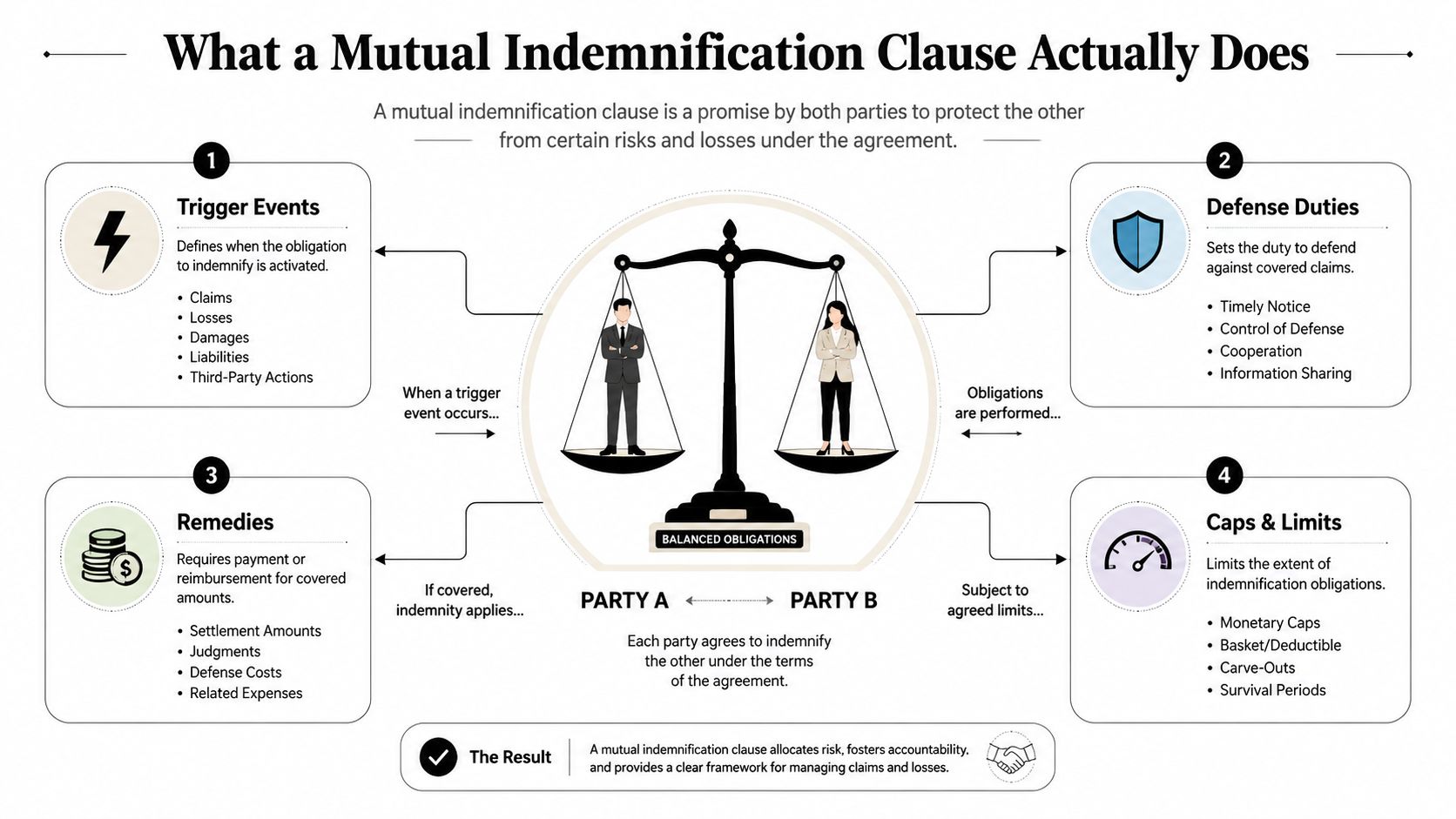
A mutual indemnification clause is reciprocal. Each party agrees to indemnify, defend, and hold the other harmless for losses tied to specified triggers, and the drafting should spell out the exact scope, including claims, damages, losses, expenses, and legal fees plain-language clause guidance. The key question is not whether the clause says “mutual.” It is whether it is functionally reciprocal once the triggers, defense duties, and caps are tested against an actual dispute.
The clause sits inside a wider risk stack. It interacts with warranties, insurance requirements, and the limitation of liability section, so the contract is never just allocating indemnity in isolation. A clause can look balanced on the page and still push most of the exposure to one side once those other provisions start working together.
The four building blocks that matter
- Trigger events. These are the events that activate the obligation, such as breach, violation of law, negligence, omission, or a third-party claim. If the trigger is vague, the clause becomes hard to administer in a real dispute, and the parties end up debating the claim before they ever reach the remedy.
- Covered losses. This is the basket of recoverable items, often claims, damages, expenses, and legal fees. The more precisely this is defined, the less room there is for a post-loss argument about what belongs inside or outside the clause.
- Defense duty. Some clauses require an actual defense, while others only require reimbursement after costs are incurred. That difference matters in litigation, especially when counsel selection, litigation strategy, and settlement timing are on the line.
- Procedural remedies. Notice, consent, and settlement control decide how the claim moves. Those mechanics often matter more than the promise to pay, because they decide who steers the defense and who can settle over objection.
A reciprocal insurance policy is the closest practical comparison. The coverage grant, exclusions, claim handling, and limits all need to line up, or the promise loses most of its value in the first dispute. The same alignment problem shows up in liability coverage for leased property, where the contract language and the insurance program have to point in the same direction.
Some institutional templates go further and add defense, protection, release, and hold-harmless language, plus survival after the agreement ends, which shows that indemnity can be drafted to operate independently of statutory compensation limits Sonoma County mutual indemnification language. For a drafting workflow view, Legitt AI's guide to creating an indemnity agreement shows how teams can move from concept to clause library without losing the procedural details. The underlying mechanics are the same ones discussed in Legitt AI's indemnity clause overview.
Comparing Common Variations and Carve-Outs
Mutual indemnity is not one fixed clause. It shows up in several commercial forms, and choosing the wrong one usually means the parties start fighting about business terms after the paper is signed. The right shape depends on deal economics, bargaining position, and how much each side can control the risk it is being asked to carry.
The four versions I see most often
| Variation | Trigger Scope | Typical Carve-Outs | Best Fit |
|---|---|---|---|
| Broad mutual form | Broad set of third-party claims and breach-related losses | Gross negligence, willful misconduct, liability cap carve-outs | Mature vendor and customer relationships with similar bargaining power |
| Limited mutual form | Closed list of named triggers only | Anything outside the enumerated triggers | Narrow services, short-term transactions, lower-risk deals |
| Carved-down mutual form | Reciprocal, but each side excludes high-risk categories | IP infringement, data misuse, confidentiality breaches, special statutory claims | Deals where one risk category is clearly owned by one party |
| Survival-driven mutual form | Obligation survives expiration or termination | Time-bound survival limits, claim timing rules | Long-tail services, SaaS, and projects with post-close exposure |
The broad version reads cleanly in a redline and feels symmetrical. In practice, it often overpromises if the surrounding cap and defense language are thin. A limited version is easier to price and insure, but it can leave obvious gaps if the deal depends on one side's content, data, or compliance inputs.
A carve-out is not just a limitation. It is a statement about which side owns the risk.
When each shape works
Broad mutuality makes sense when both parties can point to distinct operational risks. That is why commercial benchmarks show reciprocal indemnity is common in negotiated master services agreements and channel arrangements. The more each side contributes something that can create third-party exposure, the more the clause feels commercially justified.
A carved-down version often wins when one category, like IP infringement, is too important to leave inside a generic basket. That is also where teams should compare indemnity against adjacent concepts like guarantee language. For a clean distinction between the two, this indemnity versus guarantee guide helps separate true risk transfer from a promise of performance.
Survival language deserves special attention. A clause that ends when the agreement ends may look tidy, but it can undercut the whole point if claims arise later. For contracts managed through repository management and obligations tracking, the right survival period matters as much as the trigger itself because claims often surface after the performance period is over.
Annotated Sample Clauses You Can Adapt
The easiest way to see how these clauses work is to look at how the verbs and qualifiers move risk. “Indemnify” covers reimbursement. “Defend” shifts litigation handling. “Hold harmless” adds protection language. “Settle only with consent” controls exit decisions. In a real negotiation, those words are never decorative.
Balanced SaaS style clause
Each party shall indemnify, defend, and hold harmless the other party from and against third-party claims arising out of that party's breach of this agreement, violation of law, or negligence, including reasonable attorneys' fees and settlement amounts, provided the indemnified party gives prompt notice and reasonable cooperation.
This version is balanced enough for many SaaS deals because it tracks each side's own misconduct. The phrase third-party claims keeps the obligation from sprawling into every business complaint, and the express reference to fees makes defense costs recoverable instead of assumed.
Vendor-friendly narrower version
Each party shall indemnify the other only for third-party claims caused by its own gross negligence, willful misconduct, or material breach, and only to the extent the claim is not caused by the indemnified party's own acts or omissions.
This version narrows the trigger and helps the vendor limit exposure to serious misconduct rather than routine performance issues. It's the sort of language a procurement team may resist, but it's often the right compromise when the vendor is already carrying heavy insurance and operational responsibility.
Customer-protective version
Each party shall indemnify, defend, and hold harmless the other party, its affiliates, officers, directors, employees, and agents from any third-party claim arising from the indemnifying party's services, products, content, data, materials, or breach of this agreement. The indemnifying party shall control the defense, provided any settlement requires the indemnified party's consent, not to be unreasonably withheld.
That sentence is doing a lot of work. It expands the protected group, makes defense mandatory, and gives the indemnified party settlement veto rights without making the veto absolute. The notice language matters too, because “prompt notice” is vague while a defined process is easier to administer in eSignature and approval workflows that move quickly across teams.
What to push back on
- “As reasonably determined by the indemnifying party.” That phrase usually gives too much control to one side.
- Silent defense duty. If the clause doesn't say who pays and who directs counsel, expect a fight later.
- Undefined notice standard. Late notice should tie to prejudice, not automatic forfeiture.
The strongest clause is the one where the procedural verbs are as clear as the payment verbs.
For teams comparing redlines against a standard playbook, Legitt AI's indemnity agreement workflow is relevant because it maps clause language to structured review. In practice, that's exactly how legal ops reduces rework and keeps contract automation from missing the clauses that move money.
The Hidden Asymmetry Problem in Mutual Clauses
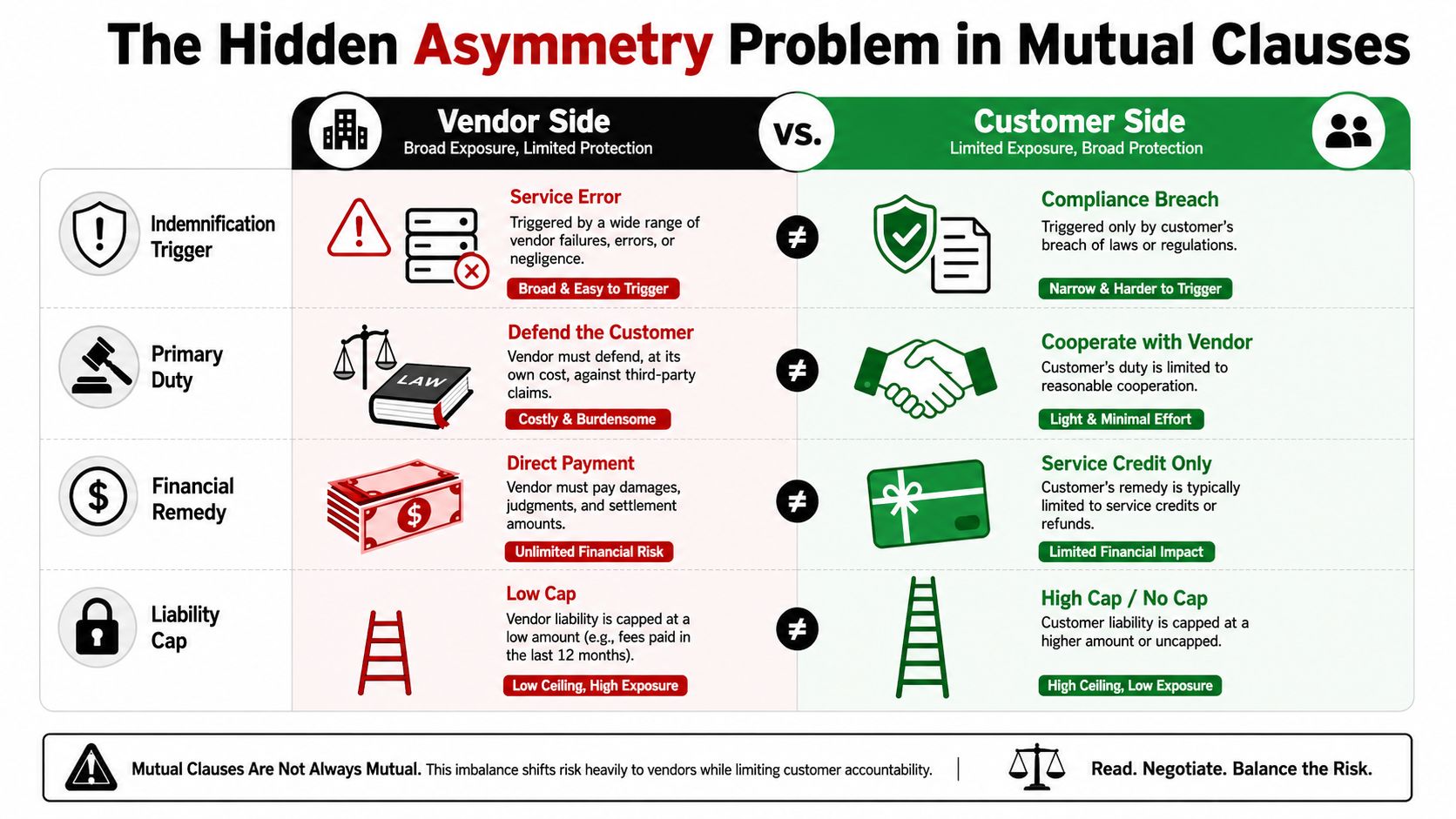
A clause can look mutual and still be economically one-sided. That happens when the vendor's trigger is narrow and procedural, while the customer's trigger reaches broader claims, broader damages, and a tougher settlement posture. The label stays the same, but the exposure doesn't.
Independent guidance says symmetry should extend to triggering events, loss definitions, notice rules, settlement control, and caps or baskets, otherwise reciprocity is only nominal procedural and symmetry guidance. That's the exact point most redlines miss. Teams compare the opening verb, then stop before the structure that determines who carries the risk.
Where the imbalance usually hides
The first pressure point is the trigger. If one side indemnifies for breach, but the other side indemnifies for breach plus content, data, or compliance issues, the clause is already tilted.
The second pressure point is third-party claim procedure. Who controls the defense, who chooses counsel, whether the indemnified party can settle, and whether tender starts the defense obligation all matter more than commonly admitted. If late notice automatically voids the claim, the indemnified party can lose coverage for a technicality even when the underlying loss was valid.
The third pressure point is the cap. A mutual clause with one uncapped side and one capped side is not really symmetric. The fourth is remedy type, because a duty to defend can create immediate cash burn while reimbursement-only language defers the cost but doesn't reduce it.
What to redline first
- Trigger parity. Match the risk categories on both sides, or narrow both sides equally.
- Defense mechanics. State whether defense begins on tender, and whether settlement needs written consent.
- Notice standard. Tie late notice to actual prejudice, not automatic denial.
- Cap treatment. Say clearly whether indemnity sits inside or outside the liability cap.
A clause that misses those mechanics can produce very different outcomes depending on governing law and how the surrounding liability section is written jurisdiction-specific drafting guidance. That's why contract review teams should treat indemnity as a structured extraction problem, not a word search. AI review tools can flag the clause, but a human still has to decide whether the allocation is commercially real.
Negotiation Strategies by Team and Role
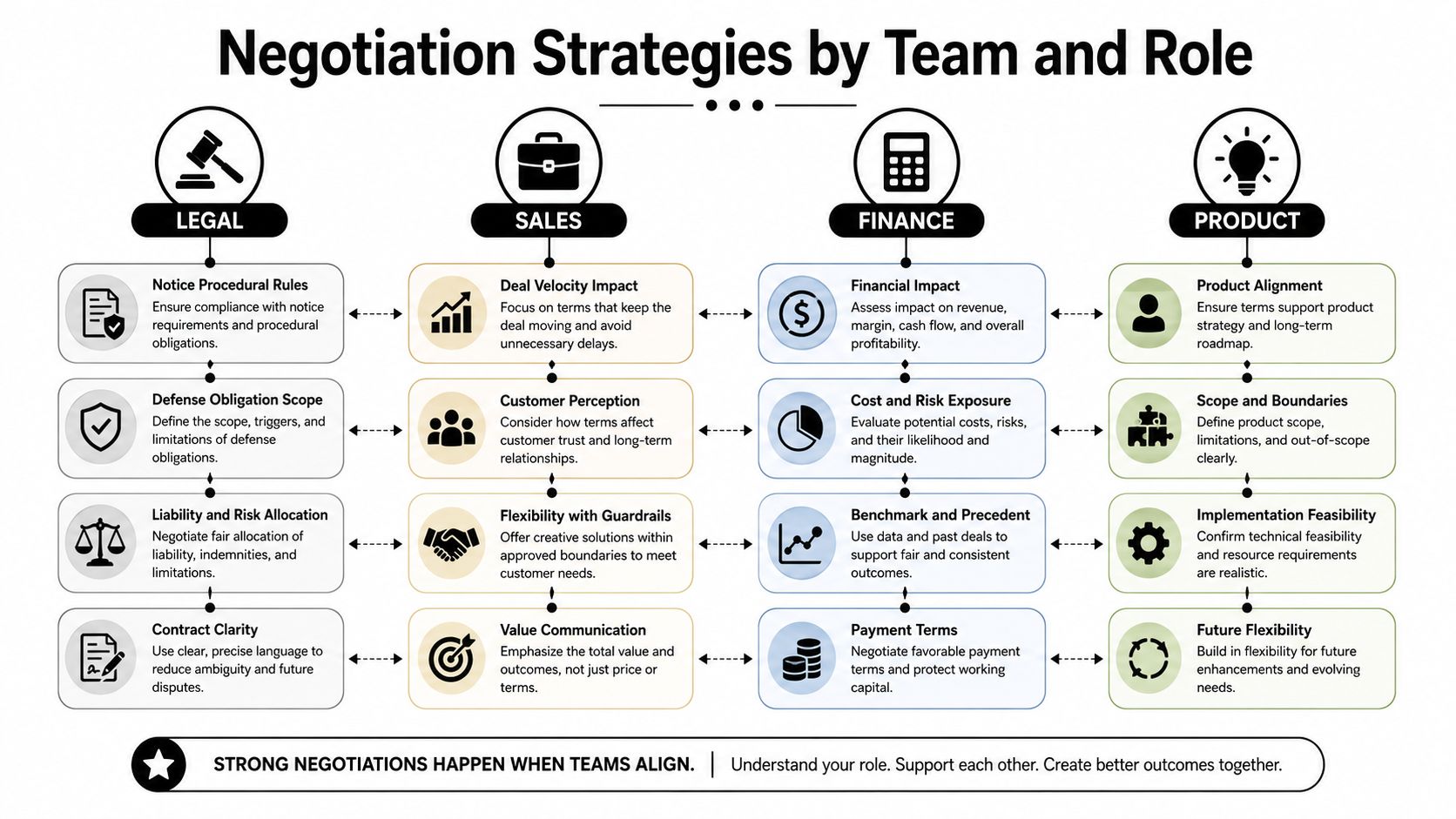
Legal usually owns the clause, but other teams determine whether it survives the deal desk. The fastest way to lose a good position is to let every function negotiate a different risk philosophy without saying so out loud.
Legal
Focus on procedure first. Ask for a defense duty that starts on tender, a notice standard tied to actual prejudice, and settlement consent that can't be withheld unreasonably. If the other side pushes back, trade wording precision for a narrower trigger rather than surrendering defense control.
Sales
Treat indemnity as a close-risk issue. If the customer wants broad language, ask what claim scenario they are worried about and whether the concern can be handled through warranty wording or a targeted carve-out instead. If you need a practical framework for handling that pushback in the room, this guide on handling sales objections is a useful companion because the same logic applies when the objection is legal rather than commercial.
Procurement
Tie scope to what the counterparty can insure and operationally control. Ask for certificates, additional insured status where appropriate, and a clause that doesn't expand beyond the vendor's service footprint. Procurement teams do best when they anchor the clause to supplier risk posture rather than abstract fairness language.
Finance
Look at exposure, not just wording. A defense obligation with no clear cap can create reserve pressure, and a broad indemnity can distort pricing if it's not reflected in the commercial model. Finance should ask whether the liability treatment is inside the cap, outside it, or carved out in a special bucket.
For a broader redline workflow, Legitt AI's contract negotiation guide is relevant because the clause often moves only when approval routing and fallback positions are documented before the call starts.
Red Flags and Interaction With Caps and Insurance
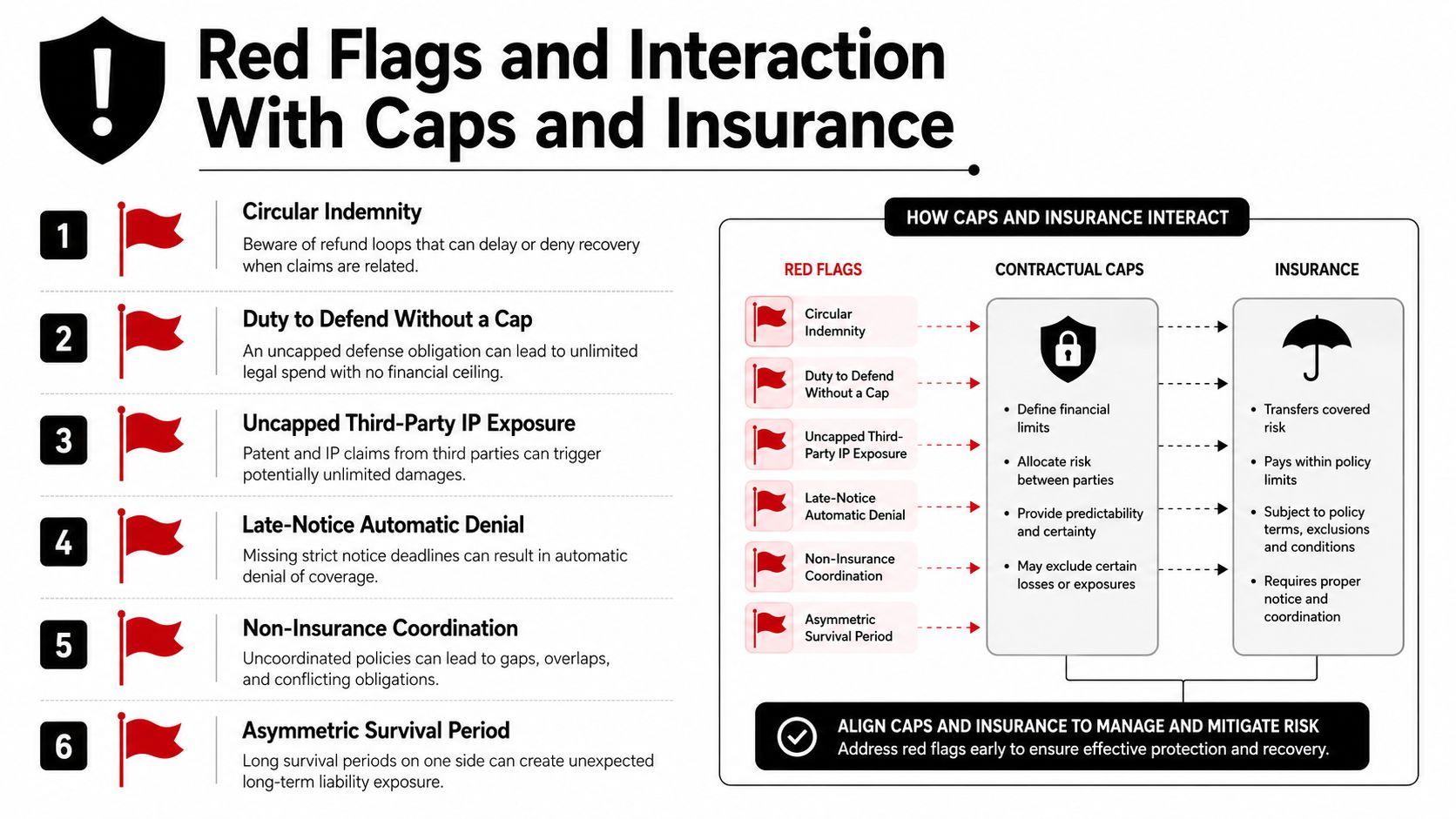
The biggest traps are usually readable on the page, if you know where to look. They become dangerous when the clause is combined with a liability cap that was drafted for something else.
The six red flags
- Circular indemnity. If each party indemnifies the other for the same loss without a clear hierarchy, you can create a refund loop that solves nothing.
- Duty to defend without a cap. Defense costs can run independently of settlement value, so uncapped defense language can exceed the business value of the contract.
- Uncapped third-party IP exposure. IP claims often get special treatment, and if they sit outside the cap by accident, the vendor may be carrying open-ended exposure.
- Late-notice automatic denial. A hard forfeiture rule can wipe out a valid claim even where the delay caused no real harm.
- Non-insurance coordination. If the clause ignores insurance wording, the contract and the policy can point in opposite directions.
- Asymmetric survival period. If one side's obligation survives longer than the other's, the “mutual” label stops meaning much after termination.
Practical rule: if the clause doesn't say whether indemnity is inside or outside the liability cap, assume someone will argue about it later.
Recent drafting guidance continues to warn against circular indemnity obligations and stresses that governing law can change the result, especially when the limitation-of-liability language is drafted loosely jurisdiction-specific drafting guidance. That's why teams should cross-check the clause against limitation of liability treatment before they treat it as final.
Insurance has to match the clause
If the contract calls for defense, the insurance program has to be able to support it. That's where professional indemnity insurance becomes part of the negotiation, not an afterthought, because policy structure can either reinforce the clause or expose a gap between promised and collectible risk transfer.
Some institutional templates also show indemnity operating alongside release, hold-harmless, and survival language, which is a reminder that this clause doesn't live alone Sonoma County mutual indemnification language. If the insurance certificate and the contract don't match, the paper may look clean while the underlying coverage is mismatched.
Practical Checklist and Negotiation Playbook
Use this as a screen-shot checklist before the next redline goes out.
Drafting essentials
- State the triggers clearly. Tie indemnity to defined events, not vague notions of responsibility.
- Name the defense rule. Say who controls counsel, when the obligation starts, and whether reimbursement is enough.
- Define the losses. Include claims, damages, expenses, and fees only where that is intended.
- Spell out settlement control. Consent should be required, and if possible, it should not be withheld unreasonably.
- Say where the cap sits. Put indemnity inside the cap, outside the cap, or carve out specific claims with precision.
Negotiation moves
- Ask for symmetry in the same sentence. If one side has broader triggers, narrow the other side or explain why the mismatch is intentional.
- Trade breadth for process. A narrower trigger is often more valuable than loose wording with bad procedure.
- Push late notice toward prejudice. Automatic forfeiture is usually too harsh for a commercial deal.
- Tie insurance to the paper. If a claim is meant to be insured, the policy language should support it.
Post-signature hygiene
- Load the clause into the repository. Make sure the clause is searchable in the CLM system.
- Track notice windows. Don't rely on memory when a claim surfaces months later.
- Review renewals and amendments. The risk stack changes when the services change.
- Compare the executed version to the standard form. AI contract review and clause comparison can flag deviations from the approved library before the issue becomes a claim.
Short FAQ
Does a mutual indemnification clause survive termination?
It can, if the agreement says so. Survival language matters because claims often arise after the commercial relationship ends.
Is the duty to defend automatic?
Only if the clause says it is. Some clauses create a true defense obligation, while others only require reimbursement after costs are incurred.
Should indemnity sit inside the liability cap?
There's no universal answer. The point is to state it expressly, because silence invites a fight.
What's the fastest way to review it at scale?
Use CLM and AI review to find the clause, compare it against the standard language, and surface any deviation in triggers, defense, notice, or cap treatment.
If your team is trying to standardize this across a contract portfolio, Legitt AI gives you a practical way to draft, review, compare, and store indemnity language in one workflow, with AI contract review, clause comparison, approval routing, eSignature, and repository search tied together. Visit Legitt AI to see how that works in a live contract process.