
You’re about to send a deck to a potential distributor, share margin assumptions with a manufacturing partner, or open your product roadmap to a contractor who needs context to do the work. The business conversation is real. The opportunity matters. The hesitation is also real.
Most founders reach for a generic NDA at that point. That’s understandable, but in 2026, that move often creates false comfort. A weak NDA doesn’t just fail in court. It fails in operations first. People don’t know what information is covered, teams share too much, counterparties use the data more broadly than expected, and nobody tracks what happens after signature.
A practical NDA agreement for small business use has to do two jobs at once. It has to protect sensitive information, and it has to let the deal move forward without turning every exchange into a legal bottleneck. That means tighter definitions, cleaner purpose limits, clearer exclusions, and better internal handling once the document is signed.
The newer risk is that information no longer moves only through email attachments and boardroom conversations. It moves through collaboration tools, vendor portals, personal devices, and AI-enabled workflows. If your NDA still reads like a static template from years ago, it probably misses how your business shares information now.
If you need a quick baseline on the fundamentals, this overview of what a non-disclosure agreement is is useful. But the harder question for founders is not whether to use an NDA. It’s how to use one well.
Why Your Small Business Needs a Modern NDA in 2026
A modern NDA is still doing what NDAs have always done. It protects sensitive business information during high-trust exchanges such as due diligence, partnerships, hiring, and vendor relationships. Business-law guidance still points to financial records, customer lists, supplier contracts, business processes, trade secrets, and proprietary methods as the types of information small businesses most often need to protect, as explained in Hubbs Law Group’s discussion of why businesses use NDAs in transaction settings.
What’s changed is the operating environment.
A founder might share pricing logic with a reseller, product specifications with a contract manufacturer, and customer workflow details with a software implementation partner before the larger commercial agreement is even ready. Information gets exchanged earlier. More people touch it. More systems store it. That makes precision more important than length.
The old template problem
The longest NDA in the room is rarely the safest one. Broad language like “all information disclosed by either party is confidential forever” looks protective, but it often creates confusion.
Your sales lead won’t know what can be sent. The counterparty’s team won’t know what they can use to evaluate the deal. If a dispute happens later, you’re left arguing over a document that never clearly defined the rules.
A strong NDA should protect business value without trying to control everything the other side may ever learn.
That’s why a modern NDA works as a business tool, not just a legal form. It tells the recipient what the information is, why they’re receiving it, what they can do with it, what’s outside the NDA, and what happens if they misuse it.
What founders usually need the NDA to do
For small businesses, the practical goals are usually straightforward:
- Protect core know-how: Keep pricing models, customer insights, product details, and operational methods from being reused outside the deal.
- Enable diligence: Let a potential buyer, investor, partner, or vendor review enough information to make a decision.
- Set internal expectations: Give your own team a rulebook for what can be shared and under what conditions.
- Strengthen your position if something goes wrong: Preserve a clear basis for demanding return, deletion, or legal remedies.
A 2026-ready NDA should also reflect how modern businesses operate. That includes remote access, shared workspaces, AI tools, and contract systems that can track obligations after the document is signed.
Essential Clauses Every Small Business NDA Must Include
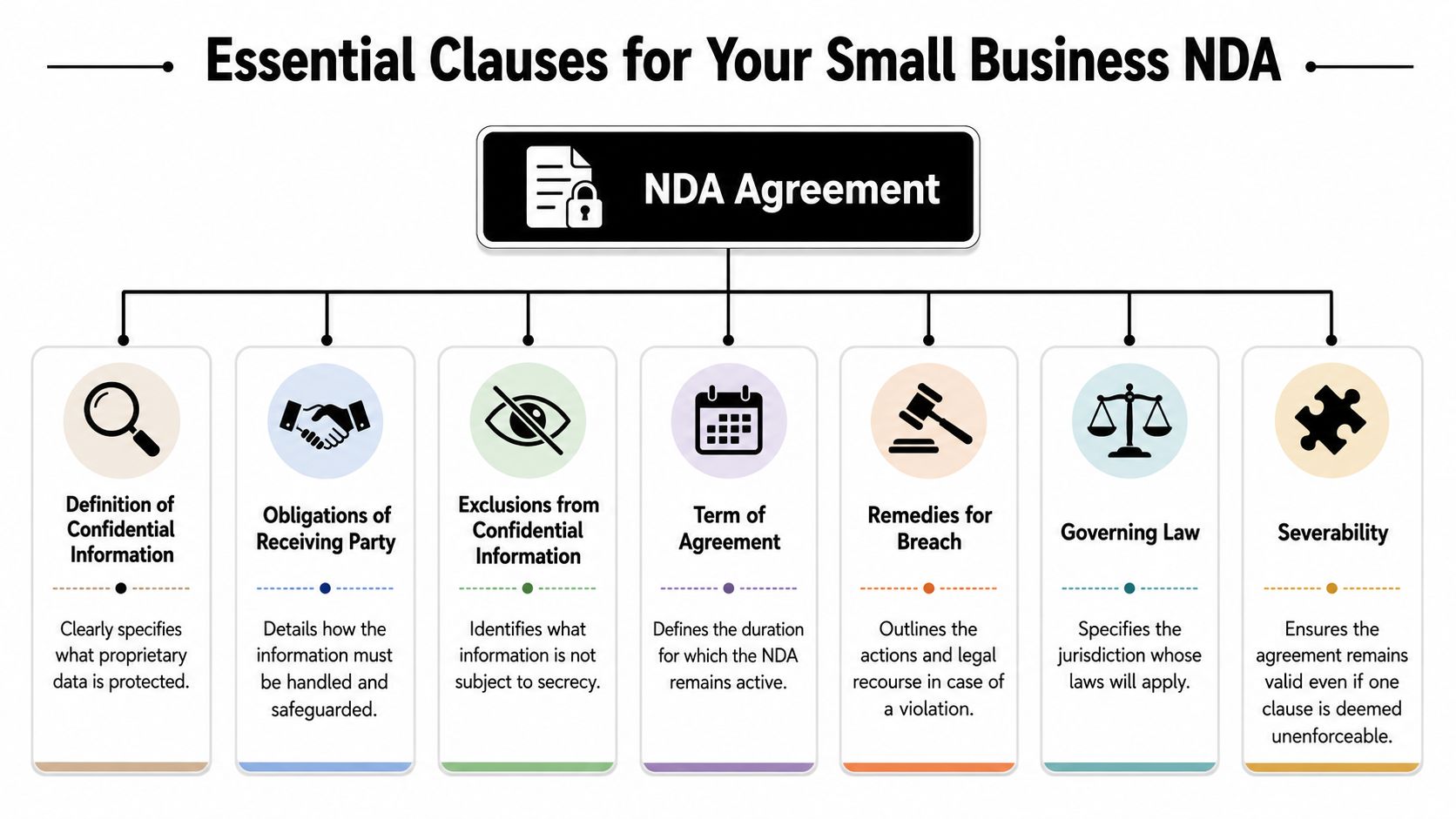
The strongest small-business NDAs are not broad. They are specific. Practical guidance commonly treats a good NDA as one built around a narrow definition of confidential information, a clear purpose limit, written exclusions, and a defined confidentiality period. That same guidance commonly places confidentiality windows at 1–5 years, with some transaction NDAs using 2–5 years, while some templates allow indefinite protection for trade secrets, as summarized in LuminPDF’s guide to small business NDA drafting.
Here is the required structure in visual form.
Define confidential information precisely
This is the clause that carries most of the weight.
Don’t define confidential information as “any and all non-public information.” That sounds all-encompassing, but it’s too abstract for day-to-day use. Define it by category and business function. If you’re discussing a supply arrangement, list the categories relevant to that deal, such as pricing, forecasts, quality standards, manufacturing methods, and customer requirements.
The legal function is obvious. It tells a court what is covered. The business function matters just as much. It tells employees and counterparties what to treat carefully.
A useful drafting prompt is this: if your account manager had to explain the NDA to a new project lead in one minute, would they know what counts as confidential information?
State the permitted purpose
Every NDA should answer one practical question. Why is the other side receiving this information?
If the answer is “to evaluate a distribution relationship,” write that. If the answer is “to assess a possible acquisition” or “to implement a software service,” write that instead. This limits misuse without blocking legitimate work.
Purpose language should also define what the recipient may do internally. Can they share the information with employees? Advisors? Affiliates? Contractors? Usually yes, but only on a need-to-know basis and only to support the stated purpose.
For clause drafting patterns, this resource on confidentiality clauses in contracts is a practical reference.
Include exclusions in writing
A workable NDA doesn’t try to claim information that was never yours to protect. Standard exclusions matter because they keep the agreement commercially reasonable.
Typical exclusions include information that is:
- Publicly known: Already available without breach of the NDA.
- Previously known: In the recipient’s possession before disclosure.
- Independently developed: Created without using the disclosing party’s information.
Without these exclusions, you create friction in negotiations and weaken your position if enforcement becomes necessary.
Practical rule: If a clause would make a reasonable counterparty ask, “Are you trying to own everything we know?”, rewrite it.
Set a defensible confidentiality period
Duration should match the information and the deal.
A short operational discussion may justify a shorter confidentiality period. A strategic transaction may justify a longer one. Trade secrets are different from routine commercial information, which is why some NDA forms treat them separately.
Founders often overreach. “Perpetual” sounds safe. It often isn’t for ordinary business information. A defined and reasonable term is usually easier to defend.
Spell out obligations and remedies
The NDA should tell the receiving party what they must do, not just what they must not do.
That usually includes basic handling obligations such as using the information only for the stated purpose, limiting access internally, and returning or destroying materials when the relationship ends or on request.
Then address breach consequences. You don’t need drama. You need clarity. If misuse occurs, the agreement should support remedies such as injunctions or damages where appropriate.
Cover the legal mechanics
These clauses don’t get much attention until a dispute happens:
| Clause | Why it matters in practice |
|---|---|
| Party identification | Prevents confusion over who is actually bound |
| Governing law | Reduces fights over which jurisdiction’s rules apply |
| Jurisdiction or venue | Helps avoid delay when enforcement is needed |
| Severability | Preserves the rest of the agreement if one part fails |
These are not decorative boilerplate terms. They determine how usable the NDA is under pressure.
Critical Mistakes to Avoid When Drafting Your NDA
Most weak NDAs fail because the drafter tried to make them too strong. That sounds backward, but it’s common. The instinct is to cover everything, restrict everything, and leave no gaps. In practice, that often creates ambiguity, overbreadth, and enforcement risk.
Contract guidance for small businesses consistently warns that the most important drafting point is to define confidential information by function, with the business purpose, covered categories, and permitted uses clearly stated. It also stresses that party identification, purpose, scope, duration, exclusions, and breach consequences should be explicit, and that vague terms can undermine validity, as outlined in DocuSign’s guidance on what to include in an NDA.
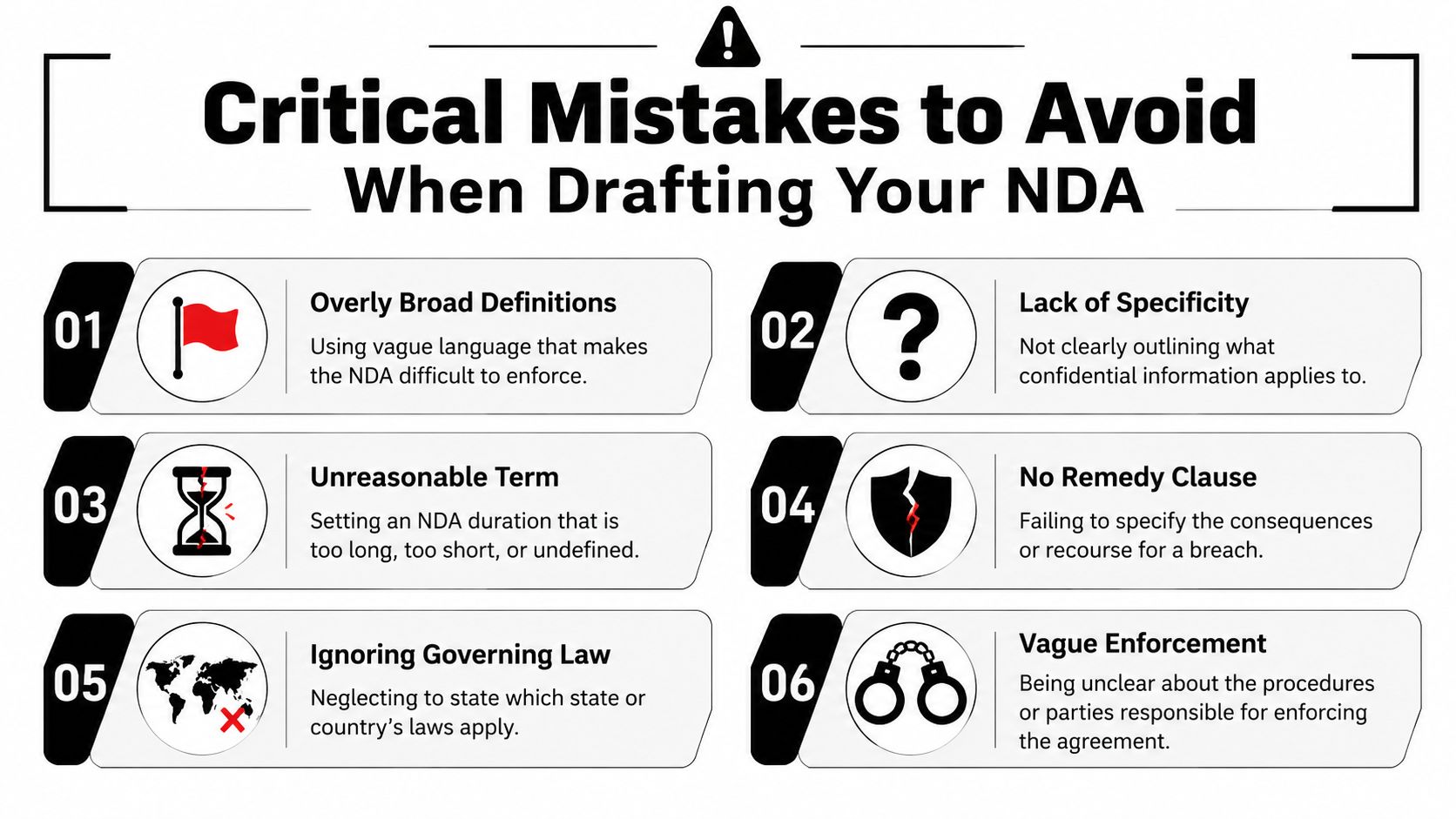
Here’s a quick visual checklist of what to watch for.
Red flags that show up in bad NDAs
Below is the pattern I see most often when founders reuse a free template without adapting it.
| Red flag | Why it causes trouble | Better approach |
|---|---|---|
| “All information is confidential” | Too vague to apply operationally | Name categories tied to the deal |
| No stated purpose | Recipient can argue broad internal use | Limit use to evaluation, analysis, or implementation |
| No exclusions | Claims information you may not be entitled to control | Carve out public, prior known, and independently developed information |
| Undefined term | Creates uncertainty and negotiation friction | Set a clear confidentiality period |
| No governing law | Slows response when a dispute starts | State the jurisdiction clearly |
| No remedy clause | Weakens your response posture | Specify available remedies |
The false comfort of broad language
A clause can feel strong and still be weak.
If your NDA says the recipient may not use “any information relating in any way to the business,” your team may assume the document covers everything from customer strategy to informal comments in a meeting. That assumption creates sloppy disclosure habits. People stop labeling what matters because they believe the agreement already does the work.
It doesn’t.
A better NDA reduces guesswork. It gives your commercial team something they can apply in live negotiations, procurement reviews, and onboarding discussions.
For a useful drafting checklist, see these three things to keep in mind while creating an NDA.
What to fix before you sign
When I review small-business NDAs, I usually tell founders to pause on these questions:
- Is the covered information tied to the actual deal? If not, narrow it.
- Would an operations manager understand what they can share? If not, rewrite it in plain language.
- Does the agreement tell the recipient what they may do with the data? If not, add a use restriction.
- Would you know where to enforce it? If not, complete the governing-law and venue terms.
If an NDA creates more interpretive questions than operational answers, it needs revision before signature.
The 2026 NDA Update AI Data Use and Remote Work Risks
The most important NDA update for 2026 is not stylistic. It’s operational. Older NDA forms were drafted for a world where misuse meant unauthorized disclosure to a competitor or publication to the market. That still matters, but now there’s another issue. A recipient may ingest your information into internal AI systems, prompt tools, knowledge bases, or model-training workflows that were never contemplated when the template was written.
Recent 2026 guidance increasingly flags no-AI-training and data-use restrictions as a separate drafting issue because older NDA checklists focus on disclosure, use, duration, and return or destruction obligations without specifically addressing AI training, as discussed in Pactly’s article on common NDA clauses to include.

Add explicit AI use restrictions
If the receiving party gets your confidential information, the NDA should say whether they may:
- Use it to train models: If the answer is no, say so directly.
- Input it into third-party AI tools: If prohibited, state that.
- Use it for internal automation beyond the deal purpose: Define limits.
- Retain derived outputs: Address whether summaries, embeddings, or analyses remain restricted.
Generic “do not disclose” language may not squarely address machine processing, model improvement, or secondary internal uses.
A founder doesn’t need a dense technical annex to handle this. They need a sentence that closes the gap. If your confidential product specifications end up improving someone else’s internal AI workflow, the damage isn’t limited to disclosure. It can become embedded in systems and processes that are harder to unwind.
For broader thinking on this issue, Legitt AI’s article on safeguarding proprietary data with AI strategies is a useful operational read.
Remote work changed confidentiality handling
The second 2026 issue is less flashy and just as important. Confidential information is often handled by distributed teams across laptops, chat tools, home networks, and shared cloud folders. Your NDA should reflect that reality by requiring reasonable safeguards around access, storage, copying, and onward sharing.
You don’t need the NDA to become a full security policy. But you do want obligations that match the way work happens now. That may include limiting access to personnel with a need to know, requiring secure storage, and controlling use through approved systems rather than personal accounts or ad hoc collaboration channels.
If your business handles regulated or sensitive data in cloud systems, it also helps to align confidentiality obligations with broader frameworks for PIPEDA and HIPAA cloud compliance. That’s especially relevant when vendors, consultants, or implementation partners touch customer or health-related information as part of the engagement.
A 2026 NDA should assume information may be copied, synced, summarized, and processed across multiple tools unless the contract says otherwise.
Beyond the Signature Managing and Enforcing Your NDAs
An NDA that gets signed and then buried in email is only partially useful. The legal drafting may be solid, but the risk remains unmanaged if nobody knows where the agreement lives, when it expires, what it covers, or which business relationship it governs.
That matters because NDAs are usually signed at the front end of relationships where valuable information starts moving quickly. Small businesses use them in due diligence, partnerships, hiring, and vendor arrangements, often to protect financial records, customer lists, supplier contracts, business processes, trade secrets, and proprietary methods, as described earlier in the Hubbs Law Group discussion.
What management looks like in practice
Once an NDA is executed, the business should be able to answer a few basic questions fast:
- Where is the signed copy?
- Which counterparty is covered?
- What information categories were protected?
- When does confidentiality expire?
- Were return or destruction obligations triggered?
If those answers require digging through inboxes or shared drives, you have an execution problem, not just a legal one.
A simple contract lifecycle workflow fixes much of this. Store NDAs in a searchable repository, tag them by relationship type, capture key terms, and set reminders for expiry dates or post-termination obligations.
Contract operations tools are useful.

A CLM platform such as Legitt AI can centralize NDA templates, support drafting and redlining, route approvals, collect eSignatures, store executed versions, and extract key terms for reminders and repository search. For small legal and operations teams, that matters because NDA risk usually comes from inconsistency, not from lack of paperwork.
For the post-execution side of the workflow, this article on post-signing contract management is worth reviewing.
What to do if you suspect a breach
Enforcement starts before litigation.
If you think the other side misused confidential information, take practical steps in order:
- Preserve evidence: Save emails, file logs, messages, meeting notes, and version history.
- Confirm the contract terms: Identify the exact NDA, the covered information, the purpose limit, and the remedy provisions.
- Stop further disclosure: Limit internal spread while you assess the issue.
- Send a focused notice: A cease-and-desist or breach notice should be specific about the conduct and the contractual obligation.
- Escalate quickly if needed: If the information is commercially sensitive, delay can weaken your position.
Why lifecycle discipline matters
Small businesses often assume NDA management is a big-company problem. It isn’t.
The smaller the team, the more likely confidential information moves through informal channels. That makes process discipline more important. A clean repository, approval controls, renewal tracking, and obligation alerts are not administrative extras. They’re the difference between having an NDA and being able to use it.
Frequently Asked Questions About Small Business NDAs
Can I use a free online NDA template
You can start there, but you shouldn’t stop there. A template is only useful if it matches the transaction, identifies the right information categories, limits use properly, and reflects how your business shares data. Generic forms often overreach in some places and miss operational details in others.
What’s the difference between a mutual NDA and a one-way NDA
A one-way NDA works when only one party is disclosing confidential information. A mutual NDA fits situations where both sides are likely to exchange protected information, such as partnership discussions, joint evaluations, or vendor diligence. The right choice depends on the flow of information, not on which side sends the first draft.
How long should the confidentiality period be
It depends on the information and the business purpose. Practical guidance commonly places confidentiality periods at 1–5 years, with some transaction NDAs using 2–5 years, while trade secrets may be treated differently where the template allows ongoing protection. The better question is whether the duration is reasonable for the specific information involved.
What if the other side refuses to sign my NDA
First, ask why. Some counterparties reject NDAs because the draft is too broad, not because they oppose confidentiality. In other cases, they may prefer to address confidentiality in a broader services, partnership, or purchase agreement.
If the refusal is firm, decide based on risk. You can narrow what you share, anonymize sensitive material, delay disclosure until later-stage discussions, or walk away if the information is too valuable to expose without protection.
Should an NDA include return or destruction language
Yes, in most cases. If the relationship ends or the evaluation process stops, you want the agreement to say what happens to documents, copies, and stored materials. That’s even more important when information has been shared across cloud systems and distributed teams.
Is an NDA enough by itself
No. An NDA is part of a confidentiality system. You still need access controls, document handling practices, approval discipline, and a reliable way to track signed agreements. A good document helps. A good workflow protects.
If your team is drafting, reviewing, signing, and tracking NDAs across sales, procurement, partnerships, or hiring, Legitt AI gives you one workspace to manage the full contract lifecycle. You can generate NDAs from templates, route approvals, redline terms, collect eSignatures, and keep every executed agreement in a searchable repository with key-term extraction and obligation tracking.