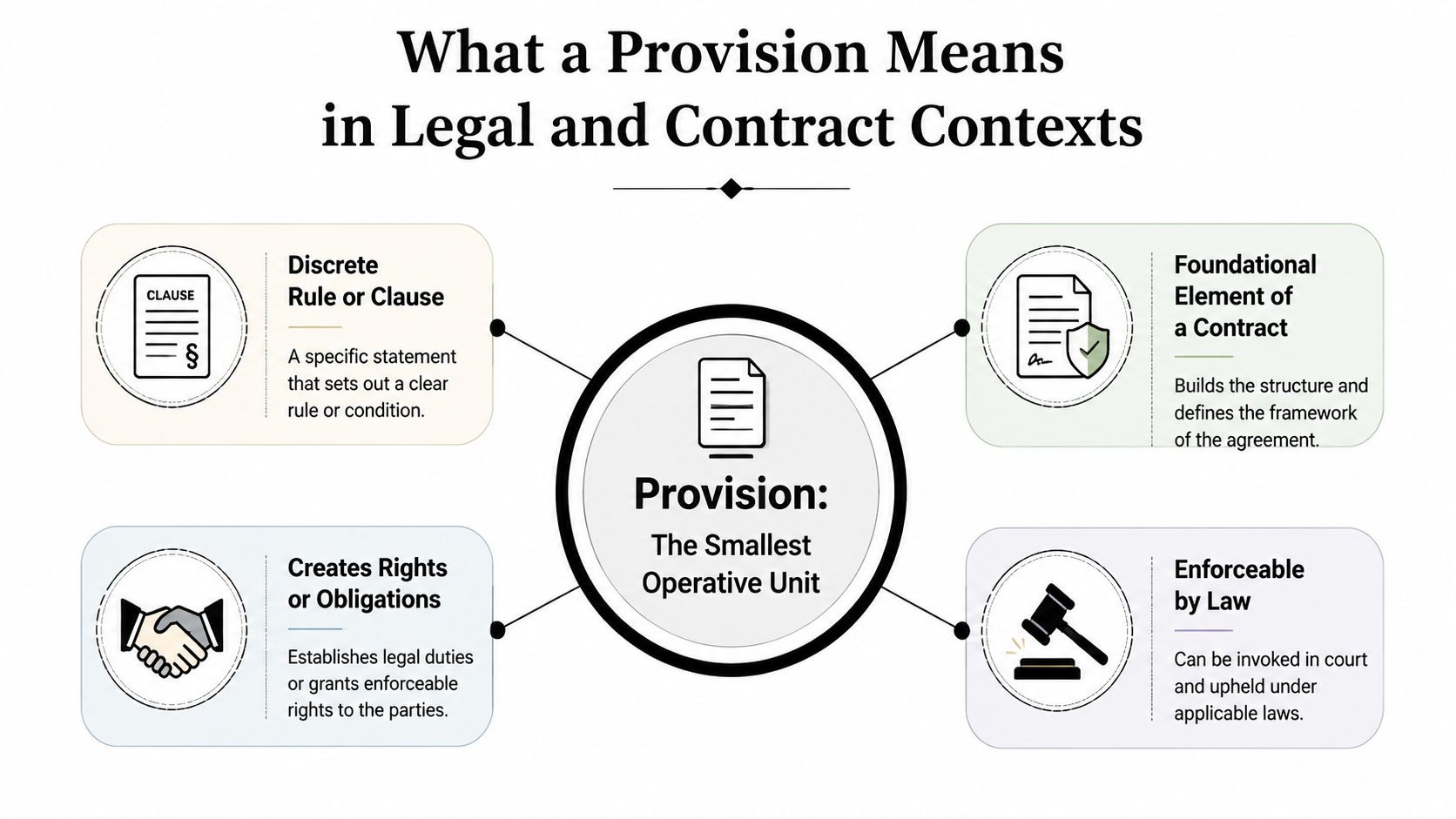
In legal contexts, a provision is a discrete rule, condition, or stipulation inside a contract or statute that tells people what must happen under specified circumstances. It's the smallest operative unit that creates, modifies, or limits rights and duties, which is why contract teams treat it as the building block of an agreement.
A deal can look clean at the document level and still hide risk in one clause. That's the moment when legal, procurement, sales, and operations all need the same clear answer to the provision legal meaning question, because clause-level wording drives review, approval, and post-signature tracking.
What a Provision Means in Legal and Contract Contexts
The confusion usually starts during a contract review. Someone points to a paragraph and asks whether it's “just wording,” while legal is already checking what happens if the trigger ever occurs. That's the right instinct, because a provision isn't the whole agreement, it's the operative rule inside it.
A provision is the clause, condition, or stipulation that tells the parties what to do, when to do it, or what happens if they don't. Legal dictionaries and drafting references describe it as the unit lawyers and courts isolate when they decide rights, duties, exceptions, and remedies, and that's why it matters so much in contract lifecycle management and contract intelligence workflows. Merriam-Webster's legal definition of provision captures that core meaning clearly, and the same basic idea appears in modern drafting references such as Legitt AI's contract terminology guide.
Why the word trips people up
The everyday English meaning can mean supplies or food, which is why business teams sometimes assume “provision” is just a generic term. In legal drafting, that broader sense doesn't help much. Here, the word is narrower and much more operational, it's about a pre-set rule for a specific situation.
Practical rule: If a sentence changes who must act, when payment is due, what exception applies, or what remedy follows, you're looking at a provision.
That distinction also matters because the same word appears in accounting. A financial provision is a liability set aside for an uncertain future expense, which is very different from a contract clause. Teams that manage legal and finance processes in the same workflow need to keep that language clean, or they'll create avoidable confusion during review and reporting.
Why AI contract teams care
AI-powered contract review works best when it extracts the operative meaning of each provision, not just the formatting. A provision can run across several sentences, and one sentence can contain more than one legal rule, so clause extraction has to follow legal effect rather than paragraph breaks. For enterprise contract workflows, that's the difference between a useful summary and a missed obligation.
For a plain-language walkthrough of how this shows up in practice, seek help from Kons Law on a related clause issue can be a useful reference point when your team is reviewing how one provision changes dispute rights.
Common Types of Provisions and Their Business Impact
Commercial contracts usually become readable once you sort provisions by function instead of by label. A procurement lead doesn't need to memorize every clause name. They need to know whether a provision allocates risk, limits exposure, sets an exit path, or protects sensitive information.
Risk, exit, and protection provisions
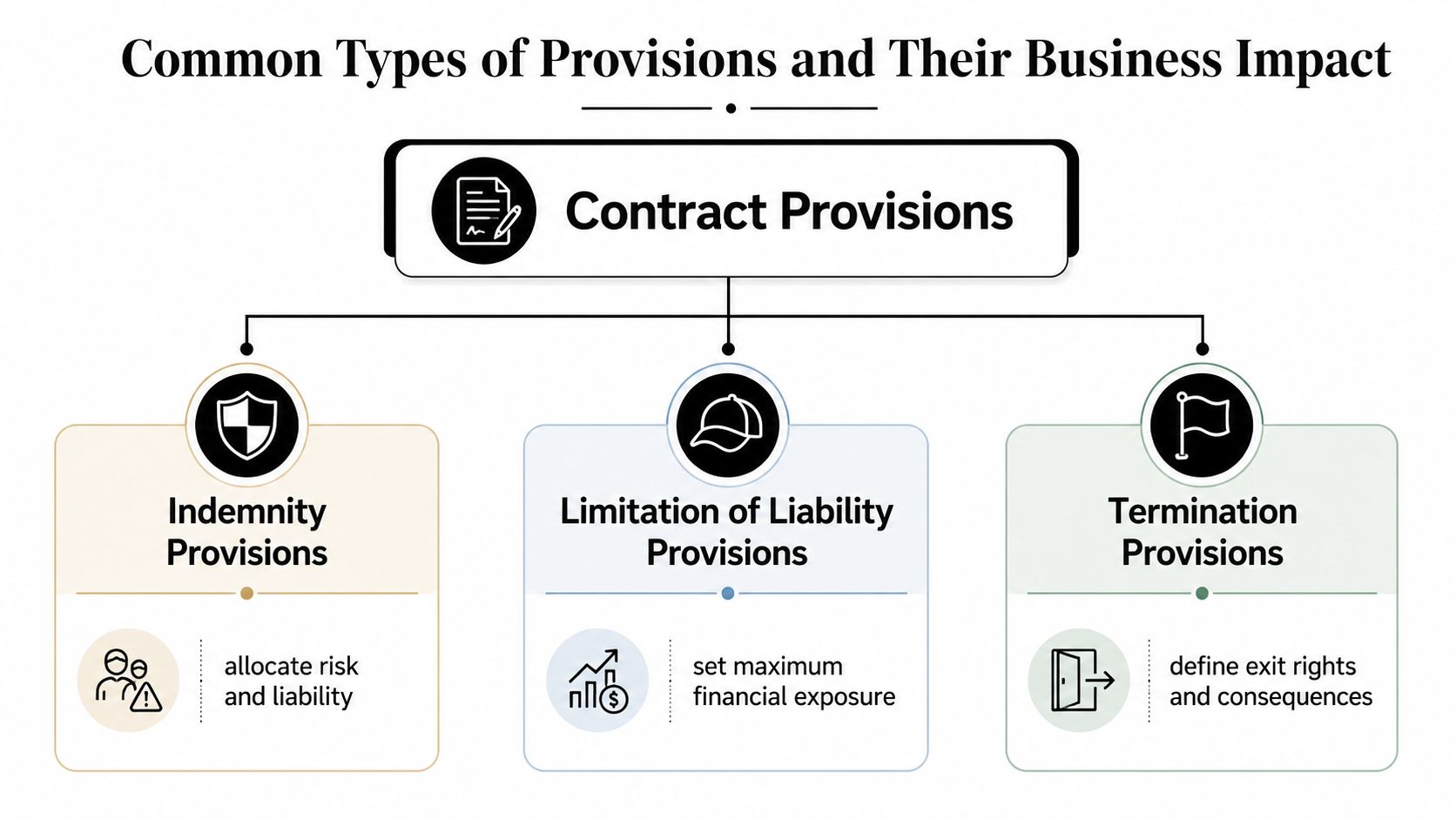
Indemnity provisions shift who pays for certain losses or third-party claims. In a vendor agreement, that can determine whether the supplier absorbs costs tied to infringement, bodily injury, or breach-related claims, or whether the buyer does. The business impact is direct, because legal ends up mapping the clause to risk ownership, insurance review, and escalation paths.
Limitation of liability provisions cap exposure. These clauses matter most in high-value deals where a breach could trigger outsized losses, and they usually become one of the most negotiated provisions in the paper. A clear cap helps finance forecast worst-case exposure and helps legal decide whether the allocation matches the commercial value of the deal.
Termination provisions define how the relationship ends, who can exit, and what happens afterward. In The Law Office of Bryan Fagan termination resource, the broader practical point is easy to see, exit language changes negotiating power, timing, and cleanup obligations.
Operational clauses that affect daily work
Confidentiality provisions protect sensitive information and usually control access, disclosure, and return or destruction of materials. Sales teams see these most often in NDAs and customer paper, while operations teams feel them when access to documents or product data is restricted.
Force majeure provisions address unforeseeable events that stop performance or make it impractical. These clauses became familiar to many business teams because they define whether a party gets extra time, suspension rights, or relief from performance when outside events interfere.
A good CLM team classifies provisions by function first, then by clause name. That makes review faster because the workflow can route indemnity, termination, and liability clauses to different approvers.
For contract clause playbooks, Top contract clauses for business contracts can help teams align review priorities with the clauses that carry the most business risk.
Plain-English Examples and Sample Provision Wording
A lot of contract confusion disappears when legal language is translated into business language. The wording can look formal, but the mechanics are usually simple, a trigger happens, a party must act, and a consequence follows if they don't.
Sample wording with plain-English meaning
| Provision Type | Sample Legal Wording | Plain-English Meaning |
|---|---|---|
| Indemnity | “Supplier shall indemnify, defend, and hold harmless Customer from third-party claims arising out of Supplier's breach.” | If the supplier causes a covered claim, the supplier has to cover the customer's loss and defense costs. |
| Termination for convenience | “Either party may terminate this Agreement on 30 days' written notice.” | Either side can walk away with advance notice, even if nobody breached. |
| Confidentiality | “Receiving Party shall not disclose Confidential Information except as permitted in this Agreement.” | The recipient has to keep protected information private unless the contract allows disclosure. |
| Limitation of liability | “Neither party shall be liable for indirect or consequential damages.” | Some categories of damages are off the table, even if a dispute happens. |
That table format helps non-lawyers see the operative effect immediately. It also helps legal teams standardize their clause library because the sample language can be compared against business intent before the drafting gets too far.
Why the pieces matter
Each provision has a trigger, an obligated party, an action, and a consequence. If the clause says payment is due only after acceptance, that's a very different business process than a general statement about services. If the wording says a party may terminate on notice, that changes renewal planning, customer success work, and revenue forecasting.
Drafting habit: Read every provision as a workflow, not as a paragraph. Ask who acts first, what the condition is, and what happens if the condition isn't met.
For teams trying to make legal language easier for business stakeholders, plain language contract guidance is a good companion to the way this table breaks down sample wording.
How Courts and Jurisdictions Interpret Provisions Differently
The same clause can mean different things depending on the legal system, the drafting context, and the interpretive rules a court applies. That's why cross-border or multi-state contracting can't rely on “close enough” wording.
The contract text is only the starting point
Courts often focus on the written document first, especially when the agreement is integrated and the wording is clear. Ambiguous provisions can invite deeper scrutiny, and when language is unclear, courts may use default interpretive doctrines that shift risk back to the drafter. That's one reason legal teams care so much about definitions, headings, and integration language.
A related issue shows up in US federal law, where a “provision of law” can mean a provision of a federal statute, rule, regulation, or order issued under it. Cornell's legal definition of “provision of law” shows how broad the concept can be in compliance settings, not just in private contracts.
Drafting choices that reduce interpretive risk
Defined terms help. So do explicit headings, clear references, and a solid integration clause that says the written agreement controls. When a modification provision is vague, parties can argue about whether an email, a purchase order, or a side letter changed the deal, and that's where workflow confusion starts.
For trusts and estates teams, a similar drafting issue appears in the guide to trust no contest rules, where small wording choices can change how a clause operates in practice.
The safest contract language is usually the language that leaves less room for a later argument about what the parties meant.
Cross-functional teams should care because interpretation affects implementation. Legal may think a clause is precise, while operations sees a process gap and finance sees a booking issue. AI contract review tools help here by flagging ambiguous provisions before signatures go out, but the underlying drafting still has to be tight.
Drafting and Negotiation Tips for Stronger Provisions
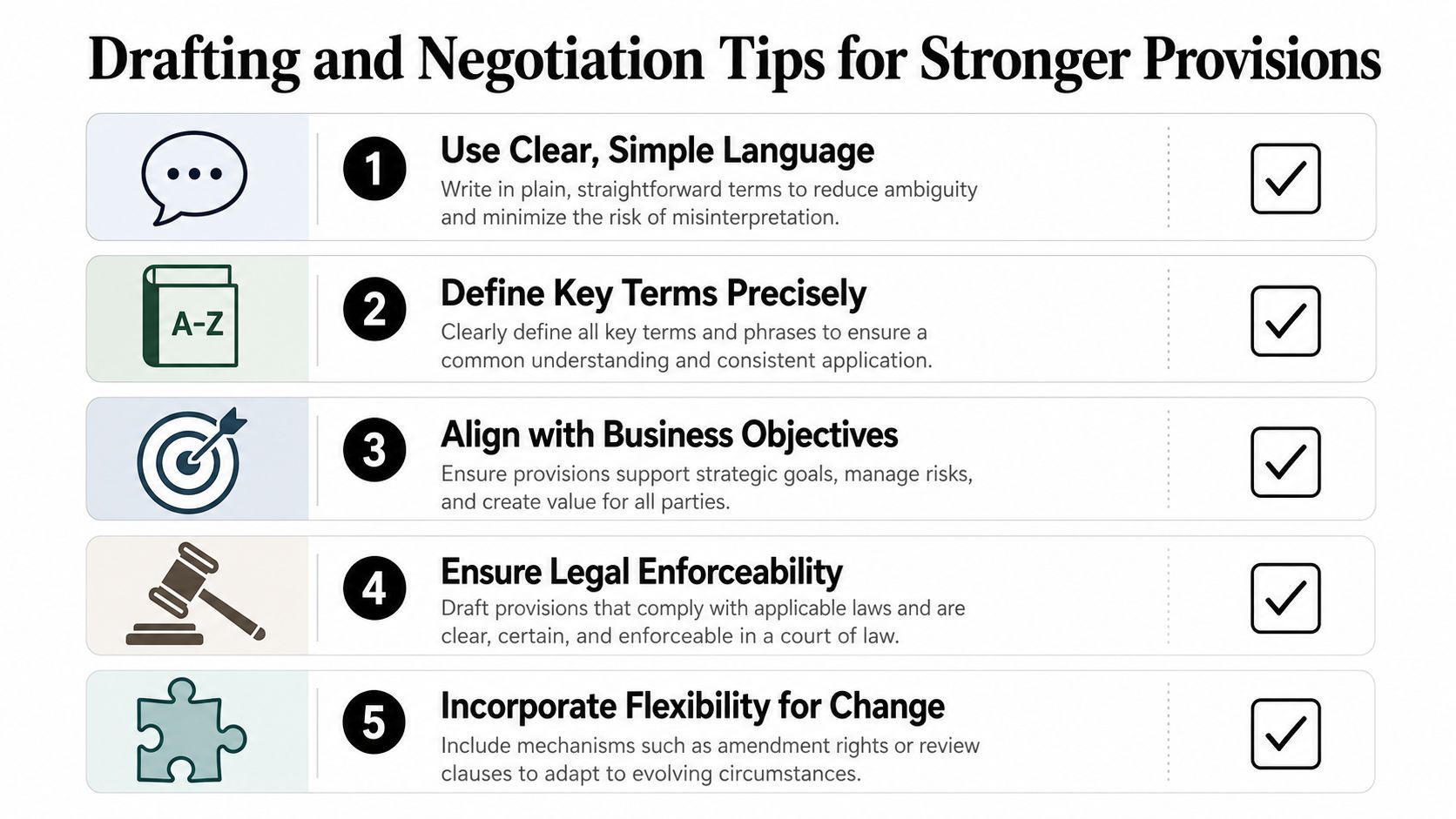
Strong provisions usually come from a simple structure. State the trigger, name the obligated party, describe the action, and spell out the consequence. That structure keeps everyone aligned when the contract is executed and the work starts.
Build the clause around business intent
Start with what the business wants. If the goal is to protect confidential pricing, the provision should describe the information covered, the permitted uses, and the remedy if someone discloses it. If the goal is to cap exposure, the limitation language should match the commercial stakes instead of copying a template without checking the numbers or exclusions.
Defined terms make this easier. A word like “Affiliate,” “Confidential Information,” or “Business Day” should mean one thing everywhere in the agreement, not three slightly different things in three sections.
Negotiate the provisions that move money and risk
The hardest negotiations usually sit in indemnity, liability, and termination. That's where each side is trying to decide who carries the downside if the deal goes wrong. Use fallback language where you can, but don't let a fallback clause create a hidden obligation the business never approved.
A clause library can help here because it gives legal and procurement a controlled starting point. Negotiating contract terms effectively becomes much easier when the team knows which provisions are standard, which are negotiable, and which need escalation.
Negotiation rule: If a clause affects liability, payment, or exit rights, legal should review the final wording before business signs off.
That's also where contract automation helps. Template management reduces inconsistency, while structured approval workflows keep a risky edit from slipping through because someone was working off the wrong version.
Common Provision Pitfalls and How to Avoid Them
The biggest mistake isn't always a bad clause. Sometimes it's a good clause buried in a bad process.
Where teams get tripped up
Vague language creates obligations nobody can enforce cleanly. Inconsistent provisions create internal conflict, especially when one section says one thing and another section says the opposite. Cross-references to outside documents can also cause trouble if those documents aren't properly incorporated, versioned, or available to the reviewer.
Another common failure happens after signature. If legal never tracks the provision obligations, the company can miss notice deadlines, renewal windows, reporting duties, or payment triggers. That's where compliance gaps and revenue leakage show up in real workflows.
Manual management makes the problem worse. Spreadsheets and email threads don't scale well when contracts move across sales, procurement, legal, and operations. Teams end up re-reading the same clauses instead of monitoring what the clauses require.
A clause that isn't tracked after execution is only half-managed.
The legal and accounting meanings of provision can also be mixed up in internal conversations. Legal teams mean a clause. Finance teams may mean a liability reserve. When those conversations overlap, the result is usually slower review and a lot of unnecessary clarification.
How to reduce the risk
Use clearer drafting at the front end. Then pair it with obligation tracking, renewal alerts, and a repository that keeps the executed version easy to find. AI contract management tools can help surface the operational meaning of each provision, but the process has to assign ownership for follow-up. Without that handoff, even a well-drafted clause can go dark after signature.
Managing Provisions with Contract Lifecycle Management Tools
Provisions become much easier to manage when the workflow is built around them. A good CLM process doesn't treat the contract as a static PDF. It treats each operative clause as a trackable business item from draft through signature and beyond.
What the workflow looks like
Drafting starts with a clause library so legal doesn't reinvent the same provisions every time. Review then uses AI-powered extraction to identify deviations, risky language, and missing obligations in third-party paper. From there, approval routing can send a liability clause to legal, a pricing commitment to finance, and a renewal term to operations.
That same logic carries into execution. eSignature closes the loop, but the post-signature repository is where the value shows up. Renewal alerts, obligation tracking, and searchable versions help teams confirm that the business is doing what the provision requires.
For a fuller view of the technology stack, Contract lifecycle management complete guide is a useful reference for how drafting, negotiation, storage, and tracking fit together.
Why this matters for legal and operations
AI contract intelligence can surface clause extraction, risk analysis, and repository-wide insights across a portfolio. In platforms like Legitt AI, that means teams can move from reactive review to structured contract operations, with a single workspace for drafting, negotiation, eSignature, and post-execution management. The practical gain isn't hype, it's fewer manual handoffs, cleaner obligation tracking, and less time spent hunting through folders for the latest version.
Operational payoff: When the system tracks the provision, the team doesn't have to rely on memory, inbox searches, or manual reminders.
That's the standard enterprise contract workflow now. If your organization wants cleaner reviews, stronger compliance, and better visibility into contractual commitments, the next step is to test how provision-level automation fits your own drafting and approval process.
If you're building a contract workflow around clause-level control, Legitt AI gives legal and business teams a way to draft, review, e-sign, and track provisions in one system. Visit Legitt AI to see how AI contract management can support provision extraction, obligation tracking, renewals, and contract intelligence across your agreements.